Vietnam Inorganic Pigments Market Size, Share & Growth Rate
The Vietnam Inorganic Pigments Market was estimated at USD 339 Million in 2025 and is projected to reach USD 478 Million by 2032, growing at a CAGR of 5.0% from 2026 to 2032. This impressive growth trajectory is primarily fueled by a surge in infrastructure development and a booming construction sector, driven by rapid urbanization. Additionally, the increasing demand for durable and vibrant colors in paints and coatings is propelling the market forward, as stakeholders seek high-quality pigments to meet industry needs.
Vietnam Inorganic Pigments Market Year-wise Growth Rate and Key Drivers
This graph highlights how the Vietnam Inorganic Pigments Market has steadily grown over the years, supported by major growth factors.
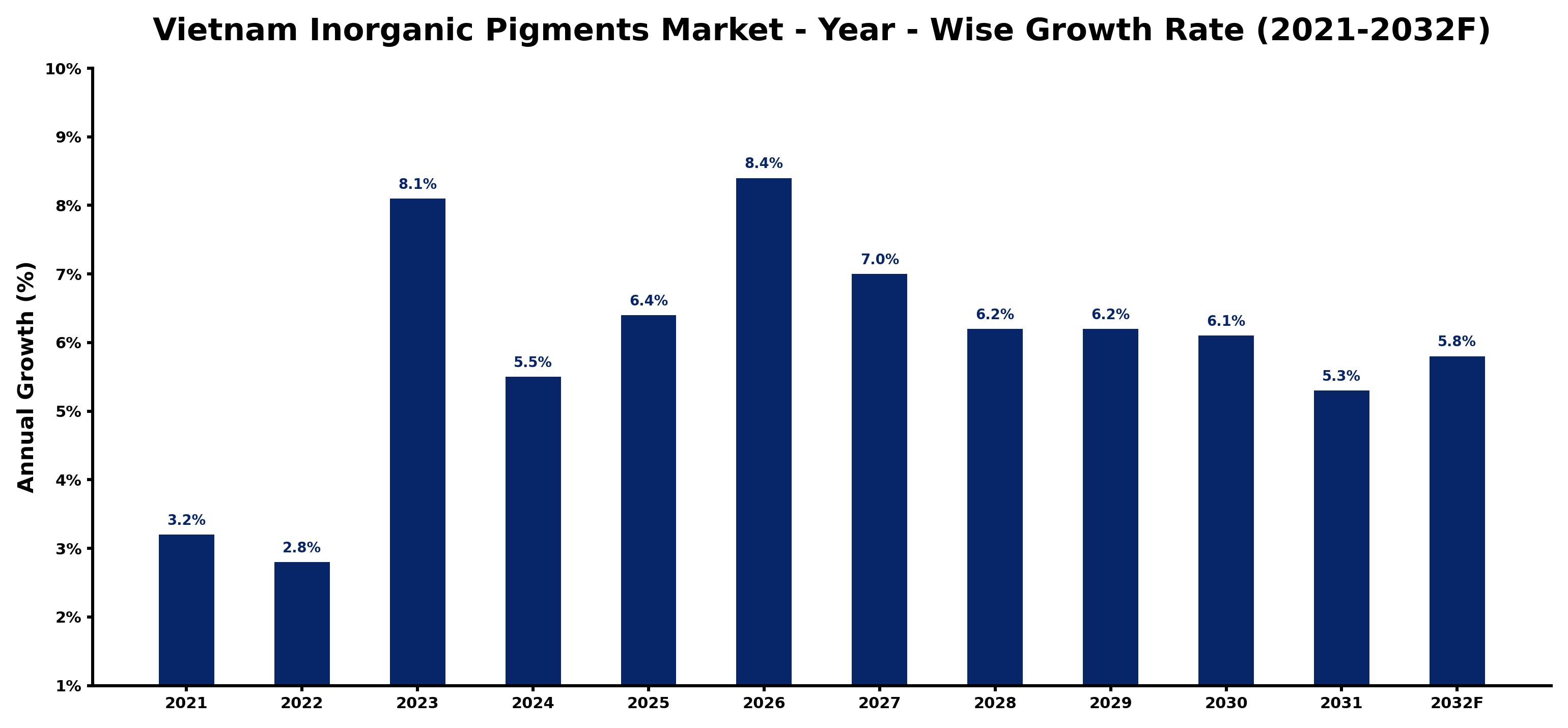
The table below presents the year‑wise growth rates along with the key drivers influencing the market
| Year | Growth Rate | Major Drivers |
| 2021 | 3.2% | Increased construction activities demand pigments |
| 2022 | 2.8% | Automotive sector growth supports demand |
| 2023 | 8.1% | Rising consumer preferences for quality |
| 2024 | 5.5% | Expansion of manufacturing facilities underway |
| 2025 | 6.4% | Sustainable practices drive product innovation |
| 2026 | 8.4% | Technological advancements enhance production efficiency |
| 2027 | 7.0% | Growing export opportunities for pigments |
| 2028 | 6.2% | Rising demand in packaging industry |
| 2029 | 6.2% | Increased investment in infrastructure projects |
| 2030 | 6.1% | Diverse applications broaden market reach |
| 2031 | 5.3% | Emerging markets boost regional sales |
| 2032 | 5.8% | Collaboration with local manufacturers expands |
Note - Market size estimations and growth projections presented in this report are based on 6Wresearch’s advanced forecasting approach, validated with industry datasets as of June 2026.
Vietnam Inorganic Pigments Market Synopsis
The Vietnamese market for inorganic pigments is characterized by a robust demand from the paint and coatings industry, where these pigments are essential for providing color and stability. As the country invests heavily in urban development projects, the need for high-performance pigments that withstand environmental stressors has become paramount.
Moreover, the expanding ceramics and plastics industries in Vietnam are increasingly adopting inorganic pigments, driven by the consumer preference for vibrant, long-lasting colors. This shift reflects a broader trend toward quality and sustainability in manufacturing practices across various sectors.
Vietnam Inorganic Pigments Market Key Takeaways
- The market is experiencing robust growth due to increased urbanization and construction activities.
- Demand is particularly high for durable pigments that offer UV resistance and vibrant colors.
- Technological advancements are shaping the development of more eco-friendly inorganic pigments.
- Regulatory pressures are pushing companies to adopt cleaner production methods.
- The market is adapting post-COVID-19, with innovations in product applications and digital capabilities.
Evaluation of Restraints in Vietnam Inorganic Pigments Market
While the Vietnamese inorganic pigments market shows strong potential, it is hindered by environmental concerns surrounding the production processes and waste management. The production and disposal of inorganic pigments can lead to pollution, prompting stricter regulations from the government. These regulations compel manufacturers to invest in cleaner, sustainable practices, which could impact profit margins. Additionally, competition from alternative pigments and dyes presents ongoing challenges for growth in market share and profitability.
Vietnam Inorganic Pigments Market Trends
Current trends in the Vietnam Inorganic Pigments Market include a growing emphasis on sustainability, with manufacturers exploring bio-based pigments as eco-friendly alternatives. Innovations in nanotechnology are enhancing the performance and color vibrancy of inorganic pigments, appealing to modern consumers. Furthermore, the rise of e-commerce platforms is reshaping distribution channels, making it easier for businesses to reach end-users directly, thereby increasing market accessibility.
Vietnam Inorganic Pigments Market Opportunities
Significant growth opportunities lie in the expanding applications of inorganic pigments beyond traditional sectors. Industries such as automotive, textiles, and electronics are beginning to recognize the benefits of high-performance inorganic pigments. Furthermore, the government's commitment to infrastructure development presents ample opportunities for pigment suppliers to establish partnerships and supply chains that meet the increasing demand from construction projects.
Government Initiatives in the Vietnam Inorganic Pigments Market
The Vietnamese government is actively promoting environmentally sustainable practices through regulatory frameworks and incentive programs aimed at reducing industrial pollution. Public spending is focused on infrastructure development, which indirectly benefits the inorganic pigments market by driving demand for construction materials. These initiatives are critical as they push manufacturers to adopt cleaner technologies, thereby enhancing their competitiveness in the global market.
Future Insights of the Vietnam Inorganic Pigments Market
Looking ahead to 2026-2032, the Vietnam Inorganic Pigments Market is anticipated to continue on its upward trajectory, driven by ongoing urbanization and infrastructure projects. The industry will likely witness a shift towards more sustainable practices as companies innovate to meet stricter environmental standards. As end-user industries increasingly prioritize durability and aesthetic appeal, the demand for high-quality, eco-friendly inorganic pigments is expected to surge, positioning Vietnam as a competitive player in the global market.
Vietnam Inorganic Pigments Market Latest Developments (May 2025 - June 2026)
In recent months, the inorganic pigments industry in Vietnam has seen notable developments, including the introduction of new product lines designed to meet evolving environmental regulations. Companies are investing in research and development to enhance pigment performance and reduce environmental impact. Additionally, partnerships with local construction firms are being forged to ensure a consistent supply of high-quality pigments for ongoing infrastructure projects.
Vietnam Inorganic Pigments Market - Key Attractiveness of the Report
- 10 Years of Market Numbers
- Historical Data Starting from 2022 to 2025
- Base Year: 2025
- Forecast Data until 2032
- Key Performance Indicators Impacting the Market
- Major Upcoming Developments and Projects
Key Highlights of the Report:
- Vietnam Inorganic Pigments Market Outlook
- Market Size of Vietnam Inorganic Pigments Market, 2025
- Forecast of Vietnam Inorganic Pigments Market, 2032
- Historical Data and Forecast of Vietnam Inorganic Pigments Revenues & Volume for the Period 2022-2032F
- Vietnam Inorganic Pigments Market Trend Evolution
- Vietnam Inorganic Pigments Market Drivers and Challenges
- Vietnam Inorganic Pigments Price Trends
- Vietnam Inorganic Pigments Porter's Five Forces
- Vietnam Inorganic Pigments Industry Life Cycle
- Historical Data and Forecast of Vietnam Inorganic Pigments Market Revenues & Volume By Type for the Period 2022-2032F
- Historical Data and Forecast of Vietnam Inorganic Pigments Market Revenues & Volume By Titanium Dioxide for the Period 2022-2032F
- Historical Data and Forecast of Vietnam Inorganic Pigments Market Revenues & Volume By Iron Oxide, Cadmium for the Period 2022-2032F
- Historical Data and Forecast of Vietnam Inorganic Pigments Market Revenues & Volume By Carbon Blank for the Period 2022-2032F
- Historical Data and Forecast of Vietnam Inorganic Pigments Market Revenues & Volume By Lead Chromate for the Period 2022-2032F
- Historical Data and Forecast of Vietnam Inorganic Pigments Market Revenues & Volume By Chromium Oxide for the Period 2022-2032F
- Historical Data and Forecast of Vietnam Inorganic Pigments Market Revenues & Volume By Others for the Period 2022-2032F
- Historical Data and Forecast of Vietnam Inorganic Pigments Market Revenues & Volume By Colour for the Period 2022-2032F
- Historical Data and Forecast of Vietnam Inorganic Pigments Market Revenues & Volume By Red for the Period 2022-2032F
- Historical Data and Forecast of Vietnam Inorganic Pigments Market Revenues & Volume By Yellow for the Period 2022-2032F
- Historical Data and Forecast of Vietnam Inorganic Pigments Market Revenues & Volume By Orange for the Period 2022-2032F
- Historical Data and Forecast of Vietnam Inorganic Pigments Market Revenues & Volume By Green for the Period 2022-2032F
- Historical Data and Forecast of Vietnam Inorganic Pigments Market Revenues & Volume By Blue for the Period 2022-2032F
- Historical Data and Forecast of Vietnam Inorganic Pigments Market Revenues & Volume By Black for the Period 2022-2032F
- Historical Data and Forecast of Vietnam Inorganic Pigments Market Revenues & Volume By White for the Period 2022-2032F
- Historical Data and Forecast of Vietnam Inorganic Pigments Market Revenues & Volume By Others for the Period 2022-2032F
- Historical Data and Forecast of Vietnam Inorganic Pigments Market Revenues & Volume By Chemistry for the Period 2022-2032F
- Historical Data and Forecast of Vietnam Inorganic Pigments Market Revenues & Volume By Oxide for the Period 2022-2032F
- Historical Data and Forecast of Vietnam Inorganic Pigments Market Revenues & Volume By Silicate for the Period 2022-2032F
- Historical Data and Forecast of Vietnam Inorganic Pigments Market Revenues & Volume By Carbonate for the Period 2022-2032F
- Historical Data and Forecast of Vietnam Inorganic Pigments Market Revenues & Volume By Sulphate for the Period 2022-2032F
- Historical Data and Forecast of Vietnam Inorganic Pigments Market Revenues & Volume By Sulphide for the Period 2022-2032F
- Historical Data and Forecast of Vietnam Inorganic Pigments Market Revenues & Volume By Others for the Period 2022-2032F
- Historical Data and Forecast of Vietnam Inorganic Pigments Market Revenues & Volume By Grade for the Period 2022-2032F
- Historical Data and Forecast of Vietnam Inorganic Pigments Market Revenues & Volume By Food Grade for the Period 2022-2032F
- Historical Data and Forecast of Vietnam Inorganic Pigments Market Revenues & Volume By Pharmaceutical Grade for the Period 2022-2032F
- Historical Data and Forecast of Vietnam Inorganic Pigments Market Revenues & Volume By Industrial Grade for the Period 2022-2032F
- Historical Data and Forecast of Vietnam Inorganic Pigments Market Revenues & Volume By Others for the Period 2022-2032F
- Historical Data and Forecast of Vietnam Inorganic Pigments Market Revenues & Volume By Form for the Period 2022-2032F
- Historical Data and Forecast of Vietnam Inorganic Pigments Market Revenues & Volume By Powder for the Period 2022-2032F
- Historical Data and Forecast of Vietnam Inorganic Pigments Market Revenues & Volume By Liquid for the Period 2022-2032F
- Historical Data and Forecast of Vietnam Inorganic Pigments Market Revenues & Volume By Application for the Period 2022-2032F
- Historical Data and Forecast of Vietnam Inorganic Pigments Market Revenues & Volume By Plastics for the Period 2022-2032F
- Historical Data and Forecast of Vietnam Inorganic Pigments Market Revenues & Volume By Paints & Coatings for the Period 2022-2032F
- Historical Data and Forecast of Vietnam Inorganic Pigments Market Revenues & Volume By Printing Inks for the Period 2022-2032F
- Historical Data and Forecast of Vietnam Inorganic Pigments Market Revenues & Volume By Glass & Ceramics for the Period 2022-2032F
- Historical Data and Forecast of Vietnam Inorganic Pigments Market Revenues & Volume By Cosmetics for the Period 2022-2032F
- Historical Data and Forecast of Vietnam Inorganic Pigments Market Revenues & Volume By Paper Industry for the Period 2022-2032F
- Historical Data and Forecast of Vietnam Inorganic Pigments Market Revenues & Volume By Food Industry for the Period 2022-2032F
- Historical Data and Forecast of Vietnam Inorganic Pigments Market Revenues & Volume By Others for the Period 2022-2032F
- Vietnam Inorganic Pigments Import Export Trade Statistics
- Market Opportunity Assessment By Type
- Market Opportunity Assessment By Colour
- Market Opportunity Assessment By Chemistry
- Market Opportunity Assessment By Grade
- Market Opportunity Assessment By Form
- Market Opportunity Assessment By Application
- Vietnam Inorganic Pigments Top Companies Market Share
- Vietnam Inorganic Pigments Competitive Benchmarking By Technical and Operational Parameters
- Vietnam Inorganic Pigments Company Profiles
- Vietnam Inorganic Pigments Key Strategic Recommendations






































