Vietnam Insecticide Market Size, Share & Growth Rate
The Vietnam Insecticide Market was estimated at USD 404 Million in 2025 and is projected to reach USD 569 Million by 2032, growing at a CAGR of 5.0% from 2026 to 2032. This steady growth trajectory is primarily driven by the increasing demand for effective pest control solutions in the agriculture sector, crucial for ensuring food security in the country. Furthermore, the transition towards modern farming techniques and sustainable agricultural practices is contributing to a heightened focus on innovative insecticide products.
Vietnam Insecticide Market Year-wise Growth Rate and Key Drivers
This graph highlights how the Vietnam Insecticide Market has steadily grown over the years, supported by major growth factors.
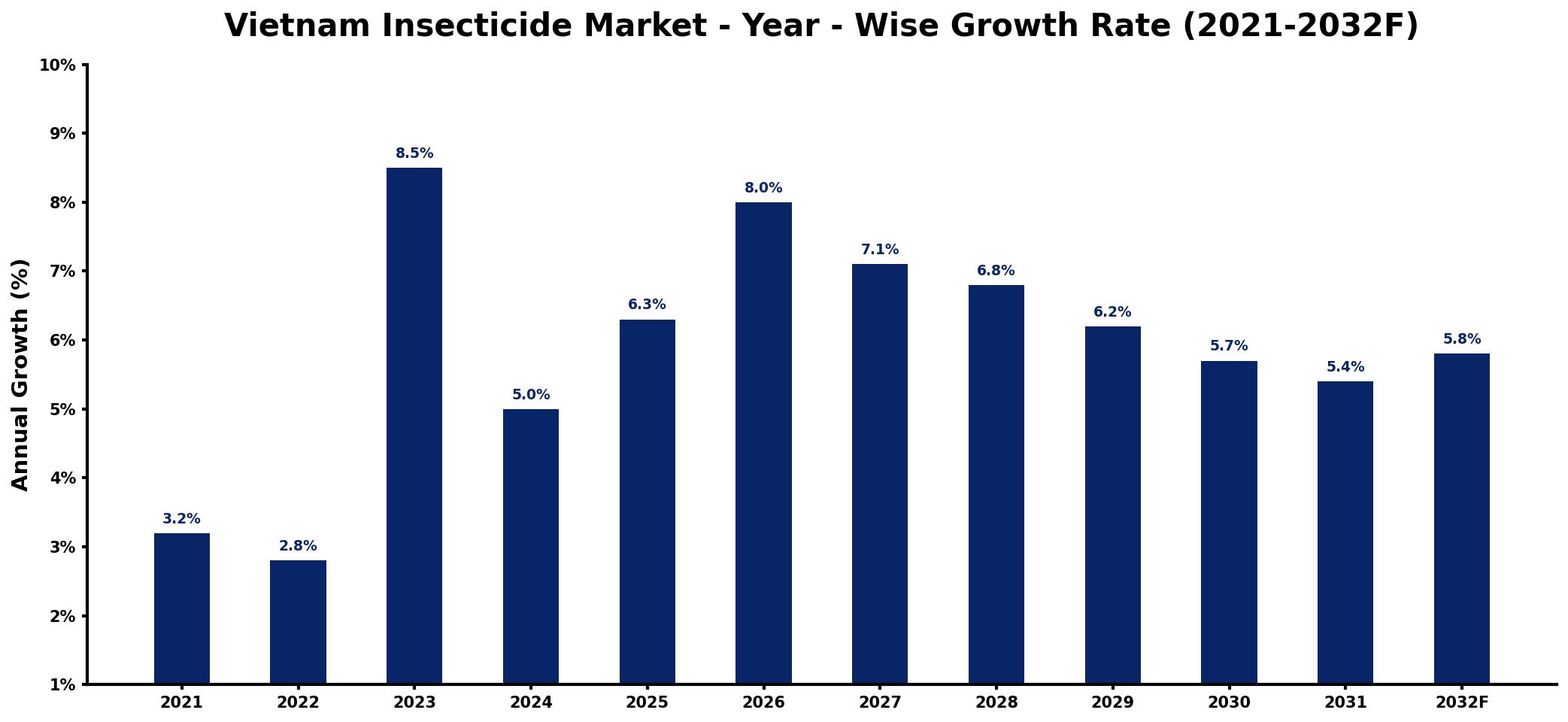
The table below presents the year‑wise growth rates along with the key drivers influencing the market
| Year | Growth Rate | Major Drivers |
| 2021 | 3.2% | Rising agricultural productivity initiatives |
| 2022 | 2.8% | Increased pest control awareness programs |
| 2023 | 8.5% | Growing demand for organic farming |
| 2024 | 5.0% | Expansion of export markets |
| 2025 | 6.3% | Investments in agricultural technology |
| 2026 | 8.0% | Enhanced distribution network efficiency |
| 2027 | 7.1% | Improved regulatory frameworks promoting safety |
| 2028 | 6.8% | rising export shipment volumes |
| 2029 | 6.2% | Surge in urban gardening practices |
| 2030 | 5.7% | Innovations in application techniques |
| 2031 | 5.4% | Strengthening farmer cooperative networks |
| 2032 | 5.8% | Focus on sustainable farming practices |
Note: Market size estimations and growth projections presented in this report are based on 6Wresearch's proprietary forecasting methodology, utilizing the latest available industry data, government publications, and primary research inputs.
Vietnam Insecticide Market Synopsis
Vietnam's insecticide market is witnessing a transformative phase as farmers increasingly recognize the need for integrated pest management to safeguard their crops. The rising prevalence of pests and diseases, combined with the adoption of genetically modified organisms (GMOs), has intensified the demand for effective insecticides that can ensure robust crop yields.
At the same time, the market is evolving to embrace environmentally responsible solutions, spurred by government regulations aimed at promoting sustainable agricultural practices. This shift highlights a commitment not only to crop protection but also to minimizing the ecological footprint of farming activities.
Vietnam Insecticide Market Key Takeaways
- The market is poised for significant growth due to increasing agricultural productivity needs.
- Sustainable and environmentally friendly insecticide products are becoming a priority for consumers and producers.
- Government initiatives are actively promoting responsible pesticide use among farmers.
- Research and development investments are aimed at developing innovative and safer insecticide formulations.
- Pesticide resistance remains a challenge, necessitating the continuous evolution of pest control products.
Evaluation of Restraints in Vietnam Insecticide Market
Despite its promising growth, the Vietnam insecticide market faces notable constraints. The rising issue of pesticide resistance poses a significant challenge to effective pest control. As certain pests adapt to commonly used insecticides, farmers often find themselves reliant on outdated solutions, which can lead to diminished effectiveness. Additionally, stringent environmental regulations are increasingly limiting the availability of traditional chemical solutions. This creates a pressing need for innovative, sustainable alternatives that can navigate both regulatory landscapes and consumer demands.
Vietnam Insecticide Market Trends
A key trend in the Vietnam insecticide market is the growing shift towards biopesticides and organic solutions, driven by consumer demand for safer, non-toxic products. This trend is enhancing the research focus on natural ingredients that can effectively manage pest populations without harming beneficial insects or the environment. Moreover, digital agriculture is emerging as a game-changer, allowing for precision farming techniques that optimize the use of insecticides, thereby improving overall efficiency and sustainability in crop production.
Vietnam Insecticide Market Opportunities
Significant opportunities for growth within the Vietnam insecticide market lie in the development of novel pest control technologies and partnerships with agricultural stakeholders. Collaborations between research institutions and private companies can lead to breakthroughs in bio-based insecticides. Furthermore, the rising global emphasis on food security and sustainable farming presents a ripe environment for innovative insecticide products that align with these values, opening doors for new market entrants.
Government Initiatives in the Vietnam Insecticide Market
The Vietnamese government has implemented several initiatives to promote sustainable agricultural practices, including support for integrated pest management (IPM) strategies. By providing training and resources for farmers, authorities are encouraging the adoption of safer pesticide use, while also offering incentives for the development of eco-friendly products. These initiatives reflect a broader commitment to enhancing agricultural productivity while safeguarding environmental health.
Future Insights of the Vietnam Insecticide Market
Looking ahead to 2026-2032, the Vietnam insecticide market is expected to evolve significantly, driven by ongoing agricultural modernization and the increasing adoption of precision farming techniques. With a robust focus on sustainability and innovation, the market is likely to see a surge in the development and acceptance of biopesticides. This shift will not only address current pest resistance challenges but also align with global trends favoring environmentally responsible agricultural practices.
Vietnam Insecticide Market Latest Developments (2025 - 2026)
Recent developments within the Vietnam insecticide market include advancements in formulations aimed at enhancing efficacy while reducing environmental impact. Companies are increasingly prioritizing R&D to create integrated pest management solutions that leverage modern technology. Furthermore, collaborative efforts between government agencies and agricultural organizations are leading to educational programs designed to inform farmers about sustainable practices and effective pest management strategies.
Vietnam Insecticide Market - Key Attractiveness of the Report
- 10 Years of Market Numbers
- Historical Data Starting from 2022 to 2025
- Base Year: 2025
- Forecast Data until 2032
- Key Performance Indicators Impacting the Market
- Major Upcoming Developments and Projects
Key Highlights of the Report:
- Vietnam Insecticide Market Outlook
- Market Size of Vietnam Insecticide Market, 2025
- Forecast of Vietnam Insecticide Market, 2032
- Historical Data and Forecast of Vietnam Insecticide Revenues & Volume for the Period 2022-2032F
- Vietnam Insecticide Market Trend Evolution
- Vietnam Insecticide Market Drivers and Challenges
- Vietnam Insecticide Price Trends
- Vietnam Insecticide Porter's Five Forces
- Vietnam Insecticide Industry Life Cycle
- Historical Data and Forecast of Vietnam Insecticide Market Revenues & Volume By Type for the Period 2022-2032F
- Historical Data and Forecast of Vietnam Insecticide Market Revenues & Volume By Pyrethroids for the Period 2022-2032F
- Historical Data and Forecast of Vietnam Insecticide Market Revenues & Volume By Organophosphorus for the Period 2022-2032F
- Historical Data and Forecast of Vietnam Insecticide Market Revenues & Volume By Carbamates for the Period 2022-2032F
- Historical Data and Forecast of Vietnam Insecticide Market Revenues & Volume By Organochlorine for the Period 2022-2032F
- Historical Data and Forecast of Vietnam Insecticide Market Revenues & Volume By Botanicals for the Period 2022-2032F
- Historical Data and Forecast of Vietnam Insecticide Market Revenues & Volume By Other Types for the Period 2022-2032F
- Historical Data and Forecast of Vietnam Insecticide Market Revenues & Volume By Crop Type for the Period 2022-2032F
- Historical Data and Forecast of Vietnam Insecticide Market Revenues & Volume By Cereals & Grains for the Period 2022-2032F
- Historical Data and Forecast of Vietnam Insecticide Market Revenues & Volume By Oilseeds & Pulses for the Period 2022-2032F
- Historical Data and Forecast of Vietnam Insecticide Market Revenues & Volume By Fruits & Vegetables for the Period 2022-2032F
- Historical Data and Forecast of Vietnam Insecticide Market Revenues & Volume By Other Crop Types for the Period 2022-2032F
- Historical Data and Forecast of Vietnam Insecticide Market Revenues & Volume By Formulation for the Period 2022-2032F
- Historical Data and Forecast of Vietnam Insecticide Market Revenues & Volume By Wettable Powder for the Period 2022-2032F
- Historical Data and Forecast of Vietnam Insecticide Market Revenues & Volume By Emulsifiable Concentrate for the Period 2022-2032F
- Historical Data and Forecast of Vietnam Insecticide Market Revenues & Volume By Suspension Concentrate for the Period 2022-2032F
- Historical Data and Forecast of Vietnam Insecticide Market Revenues & Volume By Oil Emulsion In Water for the Period 2022-2032F
- Historical Data and Forecast of Vietnam Insecticide Market Revenues & Volume By Microencapsulated Suspension for the Period 2022-2032F
- Historical Data and Forecast of Vietnam Insecticide Market Revenues & Volume By Granules for the Period 2022-2032F
- Historical Data and Forecast of Vietnam Insecticide Market Revenues & Volume By Other Formulations for the Period 2022-2032F
- Historical Data and Forecast of Vietnam Insecticide Market Revenues & Volume By Form for the Period 2022-2032F
- Historical Data and Forecast of Vietnam Insecticide Market Revenues & Volume By Sprays for the Period 2022-2032F
- Historical Data and Forecast of Vietnam Insecticide Market Revenues & Volume By Baits for the Period 2022-2032F
- Historical Data and Forecast of Vietnam Insecticide Market Revenues & Volume By Strips for the Period 2022-2032F
- Vietnam Insecticide Import Export Trade Statistics
- Market Opportunity Assessment By Type
- Market Opportunity Assessment By Crop Type
- Market Opportunity Assessment By Formulation
- Market Opportunity Assessment By Form
- Vietnam Insecticide Top Companies Market Share
- Vietnam Insecticide Competitive Benchmarking By Technical and Operational Parameters
- Vietnam Insecticide Company Profiles
- Vietnam Insecticide Key Strategic Recommendations






































