Vietnam Internal Combustion Engines Market Summary
The vietnam internal combustion engines market was estimated at USD 423 Million in 2025 and is projected to reach USD 597 Million by 2032, growing at a CAGR of 8.4% from 2026 to 2032.
Vietnam Internal Combustion Engines Market Year-wise Growth Rate and Key Drivers
This graph highlights how the Vietnam Internal Combustion Engines Market has steadily grown over the past five years, supported by major growth factors.
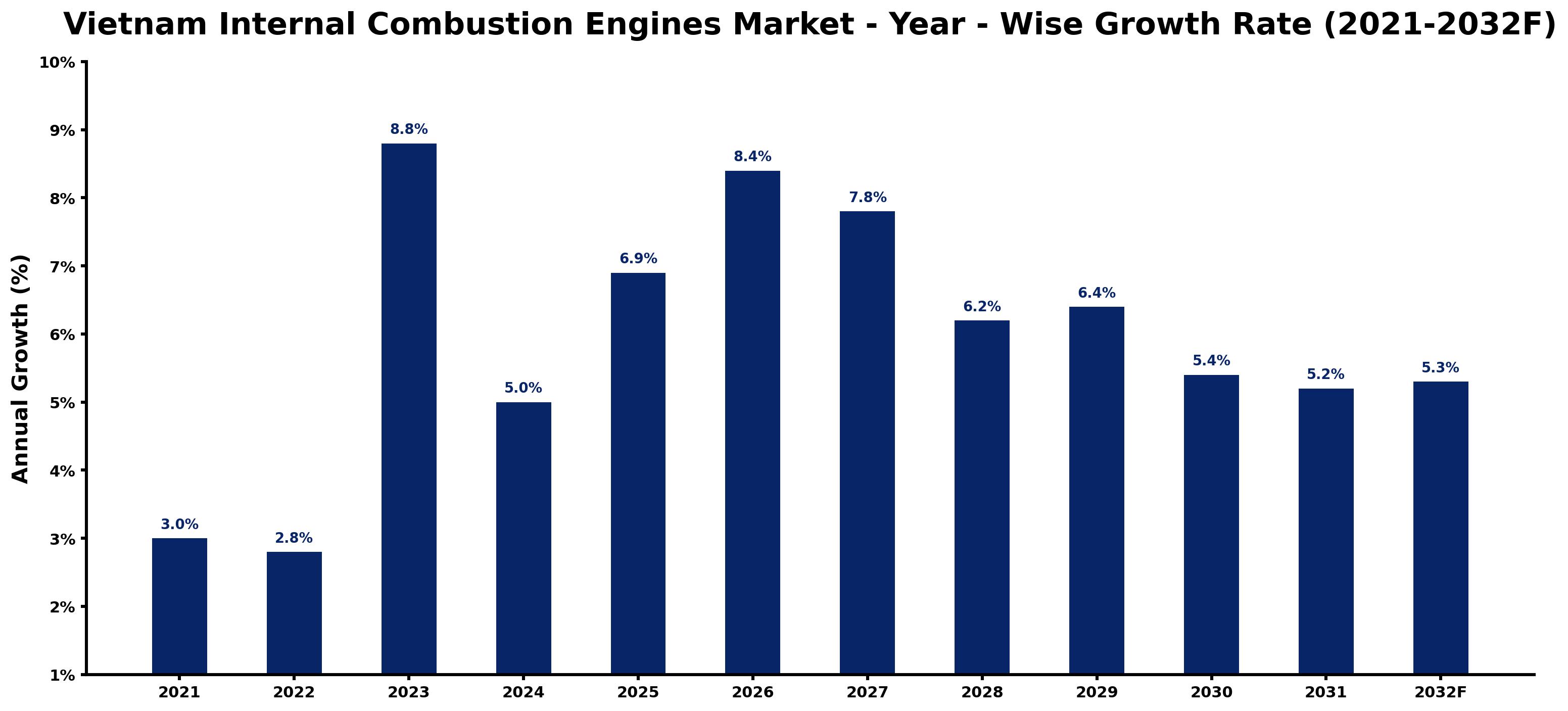
The table below presents the year wise growth rates along with the key drivers influencing the market
| Year | Growth Rate | Major Drivers |
| 2021 | 3.0% | Supply chain disruptions prompted manufacturers to reassess their sourcing strategies and logistics. |
| 2022 | 2.8% | Vietnam's automotive industry witnessed increased local production to meet domestic demand effectively. |
| 2023 | 8.8% | Consumer preferences shifted towards fuel-efficient models, impacting engine design and production. |
| 2024 | 5.0% | Infrastructure improvements enhanced connectivity, boosting transportation and logistics sectors significantly. |
| 2025 | 6.9% | Manufacturing capabilities expanded, leading to reduced reliance on imports for key components. |
| 2026 | 8.4% | Domestic companies began investing heavily in research and development for engine technology improvements. |
| 2027 | 7.8% | Rising urbanization in Vietnam generated higher demand for internal combustion vehicles in cities. |
| 2028 | 6.2% | As electric vehicles gain traction, hybrid engines started capturing a niche market segment. |
| 2029 | 6.4% | Export opportunities emerged as Vietnam positioned itself as a regional manufacturing hub. |
| 2030 | 5.4% | Collaboration with foreign partners introduced advanced technologies into local manufacturing processes. |
| 2031 | 5.2% | Consumer awareness around fuel efficiency influenced purchasing decisions and market dynamics. |
| 2032 | 5.3% | Transition to cleaner fuels prompted innovation in internal combustion engine designs and standards. |
Note - Market size estimations and growth projections presented in this report are based on 6Wresearch's advanced forecasting approach, validated with industry datasets as of June 2026.
Vietnam Internal Combustion Engines Market Synopsis
The Vietnam Internal Combustion Engines Market is projected to reach 8.4% and witness significant growth during the forecast period (2026-2032). The expansion of the industrial sector, coupled with the increasing demand for transportation, underlines the vital role of internal combustion engines across various applications, including automobiles, motorcycles, industrial machinery, and power generation. This market growth is driven by Vietnam's ongoing investments in infrastructure and industrial development, reflecting the engines' essential contribution to the economy.
Vietnam Internal Combustion Engines Market Growth Drivers
Several factors are propelling the expansion of the Vietnam Internal Combustion Engines Market. The increasing urbanization and rising population are significant contributors to the surge in demand for personal and public transportation solutions. As urban areas expand and the middle-class sector grows, there is a pressing need for automobiles and motorcycles powered by internal combustion engines.
- The rapid expansion of cities increases the necessity for reliable transportation, leading to higher vehicle ownership rates.
- As the agricultural and manufacturing industries flourish, there is a growing demand for machinery reliant on internal combustion engines to drive productivity.
- The government's initiatives to enhance infrastructure facilitate industrial growth, subsequently increasing the utilization of internal combustion engines in various sectors.
- Growing consumer preferences for personal vehicles due to rising incomes contribute to the strong market demand.
- The establishment of new industrial zones across the country boosts the demand for industrial machinery powered by internal combustion engines.
Vietnam Internal Combustion Engines Market Challenges and Restraints
While the Vietnam Internal Combustion Engines Market is poised for growth, it faces notable challenges. A key issue is the increasing emphasis on environmental sustainability. The growing public concern regarding air pollution and greenhouse gas emissions has led to a shift towards cleaner energy alternatives.
- Government policies are increasingly advocating for the adoption of electric vehicles and cleaner technologies, presenting a potential threat to traditional internal combustion engines.
- Market competition is intensifying as advancements in electric vehicle technologies enhance their affordability and performance.
- Changing consumer preferences, driven by environmental consciousness, may hinder demand for internal combustion engines over time.
- The impacts of potential regulatory changes aimed at reducing emissions could impose additional costs or operational limitations on internal combustion engine manufacturers.
- Supply chain disruptions resulting from global economic conditions or health crises could impact production and distribution networks.
Vietnam Internal Combustion Engines Market Government Investment and Initiatives
The Vietnamese government has recognized the importance of the internal combustion engines market in fostering economic growth and has initiated several investments and policies to support this sector. These initiatives aim to enhance industrial capabilities while promoting sustainable development.
- The government has allocated funds for infrastructure construction, which directly increases the demand for vehicles and machinery powered by internal combustion engines.
- Investment in research and development is encouraged, focusing on improving the efficiency of internal combustion technologies amid environmental concerns.
- Policy frameworks support the manufacturing sector, aimed at boosting domestic production of internal combustion engines and related components.
- Government incentives for businesses investing in cleaner technologies help transition the industry towards more sustainable practices while still recognizing the role of internal combustion engines.
- Strategic partnerships with foreign entities are being pursued to enhance technology transfer and improve local manufacturing capabilities.
Vietnam Internal Combustion Engines Market Latest Developments (May 2025 - June 2026)
Recent developments in the Vietnam Internal Combustion Engines Market have been shaped by evolving consumer preferences and the onset of technological advancements. The period from May 2025 to June 2026 has seen notable shifts as industries adapt to post-pandemic realities.
- There has been an increased focus on developing more fuel-efficient internal combustion engines as manufacturers respond to consumer demand for cost-effective and environmentally friendly options.
- The pandemic has influenced production patterns, leading companies to reassess supply chains and enhance the resilience of operations.
- Investment in digital technologies is on the rise, prompting manufacturers to adopt smart technologies in engine design and production processes.
- Market players are increasingly exploring hybrid models that combine internal combustion engines with electric capabilities to align with global trends.
- The regulatory landscape is becoming more complex, with the government implementing stricter emissions standards that impact engine design and manufacturing processes.
Vietnam Internal Combustion Engines Market - Key Attractiveness of the Report
- 10 Years of Market Numbers
- Historical Data Starting from 2022 to 2025
- Base Year: 2025
- Forecast Data until 2032
- Key Performance Indicators Impacting the Market
- Major Upcoming Developments and Projects
Key Highlights of the Report:
- Vietnam Internal Combustion Engines Market Outlook
- Market Size of Vietnam Internal Combustion Engines Market, 2025
- Forecast of Vietnam Internal Combustion Engines Market, 2032
- Historical Data and Forecast of Vietnam Internal Combustion Engines Revenues & Volume for the Period 2022-2032F
- Vietnam Internal Combustion Engines Market Trend Evolution
- Vietnam Internal Combustion Engines Market Drivers and Challenges
- Vietnam Internal Combustion Engines Price Trends
- Vietnam Internal Combustion Engines Porter's Five Forces
- Vietnam Internal Combustion Engines Industry Life Cycle
- Historical Data and Forecast of Vietnam Internal Combustion Engines Market Revenues & Volume By Fuel for the Period 2022-2032F
- Historical Data and Forecast of Vietnam Internal Combustion Engines Market Revenues & Volume By Petroleum for the Period 2022-2032F
- Historical Data and Forecast of Vietnam Internal Combustion Engines Market Revenues & Volume By Natural Gas for the Period 2022-2032F
- Historical Data and Forecast of Vietnam Internal Combustion Engines Market Revenues & Volume By End-Users for the Period 2022-2032F
- Historical Data and Forecast of Vietnam Internal Combustion Engines Market Revenues & Volume By Automotive for the Period 2022-2032F
- Historical Data and Forecast of Vietnam Internal Combustion Engines Market Revenues & Volume By Aircraft for the Period 2022-2032F
- Historical Data and Forecast of Vietnam Internal Combustion Engines Market Revenues & Volume By Marine for the Period 2022-2032F
- Vietnam Internal Combustion Engines Import Export Trade Statistics
- Market Opportunity Assessment By Fuel
- Market Opportunity Assessment By End-Users
- Vietnam Internal Combustion Engines Top Companies Market Share
- Vietnam Internal Combustion Engines Competitive Benchmarking By Technical and Operational Parameters
- Vietnam Internal Combustion Engines Company Profiles
- Vietnam Internal Combustion Engines Key Strategic Recommendations






































