Vietnam IoT(Internet of Things) in Oil and Gas Market Size, Share & Growth Rate
The Vietnam IoT(Internet of Things) in Oil and Gas Market was estimated at USD 334 Million in 2025 and is projected to reach USD 474 Million by 2032, growing at a CAGR of 5.1% from 2026 to 2032. This growth trajectory is propelled by the increasing complexity of oil and gas operations, necessitating advanced monitoring and data analytics solutions. Additionally, the rising emphasis on safety and environmental standards amplifies the demand for IoT technologies, as companies seek innovative means to optimize their operations and mitigate risks.
Vietnam IoT(Internet of Things) in Oil and Gas Market Year-wise Growth Rate and Key Drivers
This graph highlights how the Vietnam IoT(Internet of Things) in Oil and Gas Market has steadily grown over the years, supported by major growth factors.
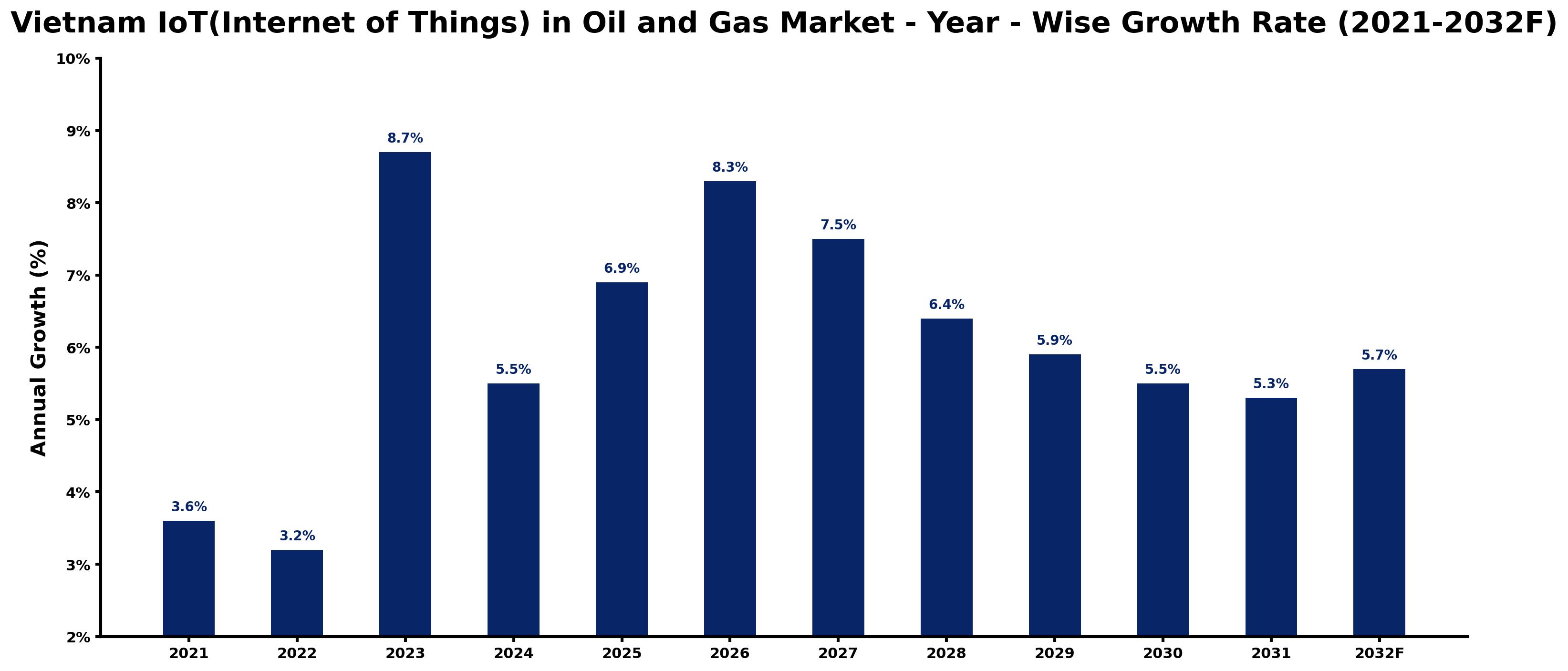
The table below presents the year‑wise growth rates along with the key drivers influencing the market
| Year | Growth Rate | Major Drivers |
| 2021 | 3.6% | Government infrastructure modernization initiatives |
| 2022 | 3.2% | Increasing industrial infrastructure investments |
| 2023 | 8.7% | Growing renewable energy integration projects |
| 2024 | 5.5% | Expansion of commercial construction activities |
| 2025 | 6.9% | Increasing smart city development projects |
| 2026 | 8.3% | Increasing industrial automation investments |
| 2027 | 7.5% | Government infrastructure modernization initiatives |
| 2028 | 6.4% | Rising electricity demand across industries |
| 2029 | 5.9% | Rising electricity demand across industries |
| 2030 | 5.5% | Increasing industrial infrastructure investments |
| 2031 | 5.3% | Growing renewable energy integration projects |
| 2032 | 5.7% | Rapid growth in telecom and data center sectors |
Note - Market size estimations and growth projections presented in this report are based on 6Wresearch’s advanced forecasting approach, validated with industry datasets as of June 2026.
Vietnam IoT(Internet of Things) in Oil and Gas Market Synopsis
The IoT landscape in Vietnam's oil and gas sector is evolving rapidly, characterized by a growing adoption of technologies that enhance operational efficiencies. Real-time monitoring and predictive maintenance capabilities are transforming traditional workflows, enabling companies to make informed decisions that significantly reduce operational downtime and enhance productivity.
As Vietnam continues to explore deeper offshore fields and invest in infrastructure, the integration of IoT solutions is becoming increasingly crucial. This technology not only streamlines operations but also plays a pivotal role in ensuring safety and environmental compliance, a top priority for stakeholders in the industry.
Vietnam IoT(Internet of Things) in Oil and Gas Market Key Takeaways
- The market is driven by the need for operational efficiency, cost reduction, and enhanced safety measures.
- Real-time data analytics and remote monitoring capabilities are transforming traditional operational practices.
- The ongoing digital transformation in response to the COVID-19 pandemic has accelerated IoT adoption.
- Government initiatives aimed at modernization and sustainability further bolster market growth.
- While challenges exist, the long-term outlook remains promising with significant opportunities for innovation.
Evaluation of Restraints in Vietnam IoT(Internet of Things) in Oil and Gas Market
Despite the apparent benefits of IoT technologies in the oil and gas sector, several constraints hinder widespread implementation in Vietnam. Chief among these is the substantial upfront investment necessary to establish a comprehensive IoT infrastructure. The geographical diversity and remoteness of oil and gas operations complicate this further, as companies must invest in extensive sensor networks and robust communication systems. This high initial cost poses a challenge for many operators, requiring a meticulous evaluation of the long-term return on investment to justify the expenditures.
Vietnam IoT(Internet of Things) in Oil and Gas Market Trends
Emerging trends within the Vietnam IoT in oil and gas sector reflect a significant shift towards data-driven decision-making processes. Companies are increasingly leveraging AI and machine learning alongside IoT to enhance predictive maintenance, reducing downtime and operational costs. Furthermore, the rise of digital twin technologies is enabling operators to create virtual replicas of their physical assets, facilitating enhanced monitoring and analysis of operations. Additionally, the industry is witnessing a growing focus on sustainability, with IoT applications increasingly aligning with environmental goals.
Vietnam IoT(Internet of Things) in Oil and Gas Market Opportunities
Opportunities in the Vietnam IoT in oil and gas market are abundant, particularly in the realm of remote monitoring and automation solutions. As companies aim to enhance safety and operational efficiency, there is a burgeoning demand for innovative IoT applications. Additionally, partnerships with technology providers and stakeholders in the digital transformation space present avenues for collaborative growth. As regulatory frameworks evolve, firms that invest in IoT solutions to meet compliance standards will find themselves well-positioned in a rapidly changing environment.
Government Initiatives in the Vietnam IoT(Internet of Things) in Oil and Gas Market
The Vietnamese government is actively promoting the adoption of advanced technologies within the oil and gas sector as part of its broader strategy to modernize the economy. Initiatives include funding for research and development in IoT applications, as well as policies aimed at enhancing safety standards and environmental sustainability. Through strategic investments and public-private partnerships, the government is creating an ecosystem conducive to innovation, thereby stimulating growth in the IoT market.
Future Insights of the Vietnam IoT(Internet of Things) in Oil and Gas Market
Looking ahead to 2026-2032, the Vietnam IoT in oil and gas market is set to evolve dramatically, driven by advancements in technology and shifts in operational paradigms. As the industry continues to embrace digital transformation, the integration of AI, big data analytics, and machine learning will further enhance decision-making processes. Additionally, the emphasis on sustainable practices will spur innovations that prioritize environmental impact. Ultimately, this sector will likely witness a surge in investments as companies strive to adopt cutting-edge solutions to remain competitive.
Vietnam IoT(Internet of Things) in Oil and Gas Market Latest Developments (May 2025 - June 2026)
Recent developments in Vietnam's IoT in oil and gas sector reveal a marked commitment to technological advancement. Industry stakeholders are increasingly prioritizing the implementation of sophisticated monitoring systems that leverage real-time data analytics. Furthermore, companies are exploring partnerships to enhance their IoT capabilities, focusing on integrating IoT devices with existing infrastructure to streamline operations. These movements indicate a significant shift towards smarter, more efficient operational practices.
Vietnam IoT(Internet of Things) in Oil and Gas Market - Key Attractiveness of the Report
- 10 Years of Market Numbers
- Historical Data Starting from 2022 to 2025
- Base Year: 2025
- Forecast Data until 2032
- Key Performance Indicators Impacting the Market
- Major Upcoming Developments and Projects
Key Highlights of the Report:
- Vietnam IoT(Internet of Things) in Oil and Gas Market Outlook
- Market Size of Vietnam IoT(Internet of Things) in Oil and Gas Market, 2025
- Forecast of Vietnam IoT(Internet of Things) in Oil and Gas Market, 2032
- Historical Data and Forecast of Vietnam IoT(Internet of Things) in Oil and Gas Revenues & Volume for the Period 2022-2032F
- Vietnam IoT(Internet of Things) in Oil and Gas Market Trend Evolution
- Vietnam IoT(Internet of Things) in Oil and Gas Market Drivers and Challenges
- Vietnam IoT(Internet of Things) in Oil and Gas Price Trends
- Vietnam IoT(Internet of Things) in Oil and Gas Porter's Five Forces
- Vietnam IoT(Internet of Things) in Oil and Gas Industry Life Cycle
- Historical Data and Forecast of Vietnam IoT(Internet of Things) in Oil and Gas Market Revenues & Volume By Solution for the Period 2022-2032F
- Historical Data and Forecast of Vietnam IoT(Internet of Things) in Oil and Gas Market Revenues & Volume By Sensing for the Period 2022-2032F
- Historical Data and Forecast of Vietnam IoT(Internet of Things) in Oil and Gas Market Revenues & Volume By Communication for the Period 2022-2032F
- Historical Data and Forecast of Vietnam IoT(Internet of Things) in Oil and Gas Market Revenues & Volume By Cloud and Edge Computing for the Period 2022-2032F
- Historical Data and Forecast of Vietnam IoT(Internet of Things) in Oil and Gas Market Revenues & Volume By Data Management for the Period 2022-2032F
- Historical Data and Forecast of Vietnam IoT(Internet of Things) in Oil and Gas Market Revenues & Volume By Application for the Period 2022-2032F
- Historical Data and Forecast of Vietnam IoT(Internet of Things) in Oil and Gas Market Revenues & Volume By Fleet and Asset Management for the Period 2022-2032F
- Historical Data and Forecast of Vietnam IoT(Internet of Things) in Oil and Gas Market Revenues & Volume By Preventive Maintenance for the Period 2022-2032F
- Historical Data and Forecast of Vietnam IoT(Internet of Things) in Oil and Gas Market Revenues & Volume By Security Management for the Period 2022-2032F
- Historical Data and Forecast of Vietnam IoT(Internet of Things) in Oil and Gas Market Revenues & Volume By Pipeline Monitoring for the Period 2022-2032F
- Historical Data and Forecast of Vietnam IoT(Internet of Things) in Oil and Gas Market Revenues & Volume By Others for the Period 2022-2032F
- Historical Data and Forecast of Vietnam IoT(Internet of Things) in Oil and Gas Market Revenues & Volume By Industry Stream for the Period 2022-2032F
- Historical Data and Forecast of Vietnam IoT(Internet of Things) in Oil and Gas Market Revenues & Volume By Upstream for the Period 2022-2032F
- Historical Data and Forecast of Vietnam IoT(Internet of Things) in Oil and Gas Market Revenues & Volume By Midstream for the Period 2022-2032F
- Historical Data and Forecast of Vietnam IoT(Internet of Things) in Oil and Gas Market Revenues & Volume By Downstream for the Period 2022-2032F
- Vietnam IoT(Internet of Things) in Oil and Gas Import Export Trade Statistics
- Market Opportunity Assessment By Solution
- Market Opportunity Assessment By Application
- Market Opportunity Assessment By Industry Stream
- Vietnam IoT(Internet of Things) in Oil and Gas Top Companies Market Share
- Vietnam IoT(Internet of Things) in Oil and Gas Competitive Benchmarking By Technical and Operational Parameters
- Vietnam IoT(Internet of Things) in Oil and Gas Company Profiles
- Vietnam IoT(Internet of Things) in Oil and Gas Key Strategic Recommendations






































