Vietnam IT Operations Analytics Market Size & Growth Rate (2026-2032)
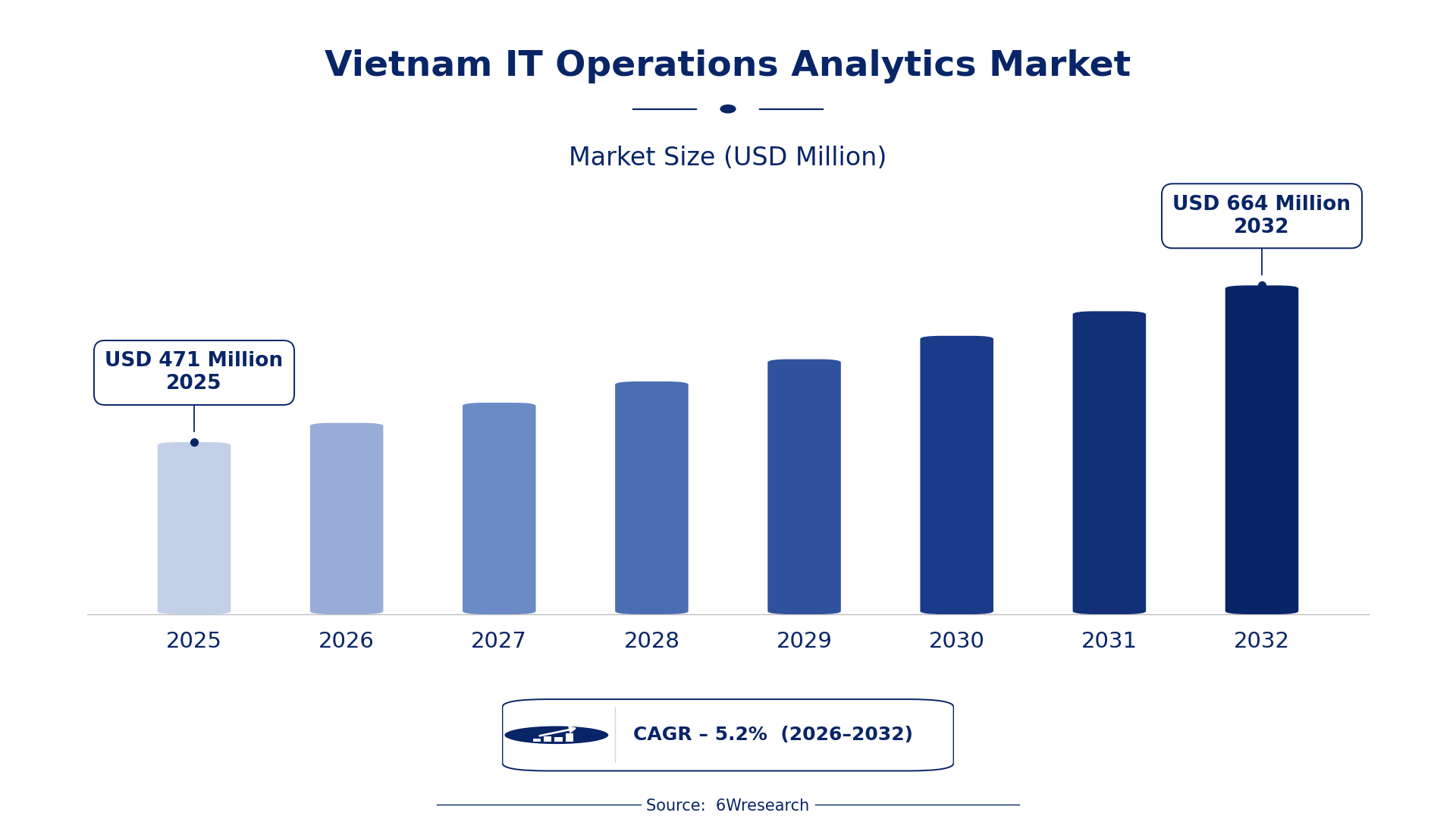
The Vietnam IT Operations Analytics Market was estimated at USD 471 Million in 2025 and is projected to reach USD 664 Million by 2032, growing at a CAGR of 5.2% from 2026 to 2032.
Vietnam IT Operations Analytics Market Synopsis
The most powerful force currently shaping the Vietnam IT Operations Analytics Market is the escalating complexity of IT environments. As organizations expand their digital infrastructure, the need for effective analytics solutions becomes paramount, driving investments in tools that enhance system performance and reliability.
With digitalization becoming a priority across sectors, companies are increasingly turning to predictive and prescriptive analytics. This shift not only helps in detecting anomalies but also enables proactive management of IT operations, ensuring that businesses can maintain continuity in an increasingly competitive landscape.
Vietnam IT Operations Analytics Market Year-wise Growth Rate and Key Drivers
This graph illustrates the annual growth rates of the Vietnam IT Operations Analytics Market from 2021 to 2032, highlighting a steady upward trajectory and projected expansion over the forecast period.
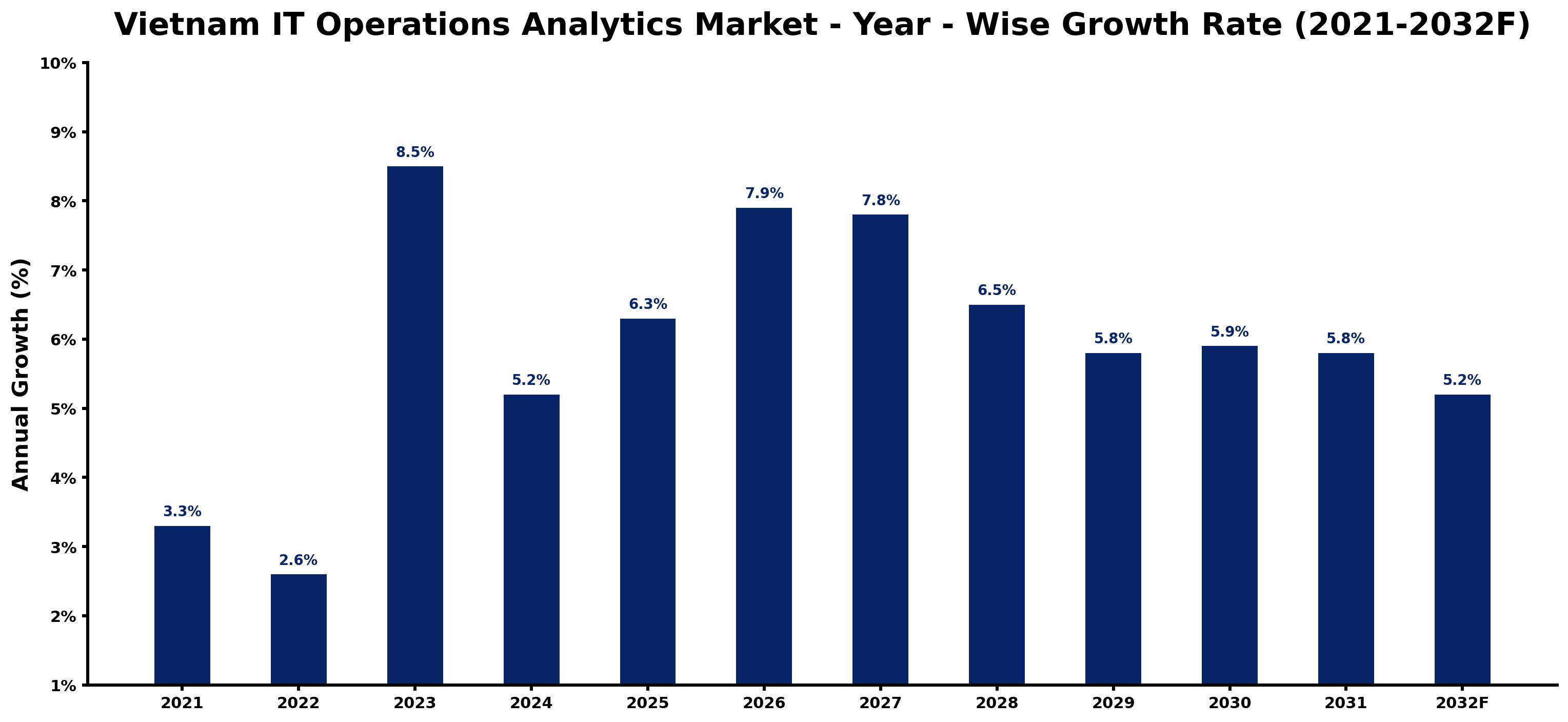
The table below presents the year‑wise growth rates along with the key drivers influencing the market
| Year | Growth Rate | Major Drivers |
| 2021 | 3.3% | Vietnam government's push for smart manufacturing initiatives. |
| 2022 | 2.6% | Growing adoption of Industry 4.0 technologies in production. |
| 2023 | 8.5% | Increased foreign investments in technology startups ecosystem. |
| 2024 | 5.2% | Surge in e-commerce driving operational analytics needs. |
| 2025 | 6.3% | Emergence of data centers catering to national security needs. |
| 2026 | 7.9% | Local firms increasing data-driven decision-making capabilities. |
| 2027 | 7.8% | Government policies promoting digital economy advancements. |
| 2028 | 6.5% | Rise in cybersecurity concerns boosting analytics demand. |
| 2029 | 5.8% | Manufacturing sector focusing on predictive maintenance technologies. |
| 2030 | 5.9% | Higher emphasis on supply chain optimization solutions. |
| 2031 | 5.8% | Growing workforce skilled in data science disciplines. |
| 2032 | 5.2% | Shift towards sustainable practices requiring operational insights. |
Note: Market size estimations and growth projections presented in this report are based on 6Wresearch's proprietary forecasting methodology, utilizing the latest available industry data, government publications, and primary research inputs.
Vietnam IT Operations Analytics Market Key Takeaways
Below are some of the specific key takeaways from the market, including:
- The market is set for significant growth, driven by the need for reliable IT infrastructure.
- Predictive analytics is gaining traction as organizations aim for proactive IT management.
- Cloud technology adoption is a major contributor to the rising demand for analytics tools.
- Companies face challenges related to data management and cybersecurity.
- The COVID-19 pandemic has accelerated the need for advanced IT operations analytics solutions.
Evaluation of Restraints in Vietnam IT Operations Analytics Market
Despite its growth potential, the Vietnam IT Operations Analytics Market faces several restraints. The rapid escalation of IT infrastructure and data volumes poses a significant challenge for organizations attempting to manage and analyze vast datasets effectively. This overwhelming amount of data can hinder timely decision-making and operational efficiency. Additionally, the increasing threat of cybersecurity issues necessitates a strong focus on securing analytics tools, which can complicate implementation. The shortage of skilled IT professionals further exacerbates these challenges, making it essential for companies to invest in training and robust solutions that address real-time analytics needs.
Vietnam IT Operations Analytics Market Trends
Several trends are emerging in the Vietnam IT Operations Analytics Market. First, there is a noticeable shift towards automation within IT operations, allowing for quicker responses to incidents and more efficient resource management. Secondly, organizations are increasingly adopting AI-driven analytics to enhance the accuracy of predictive insights, enabling them to anticipate issues before they arise. Lastly, an emphasis on data privacy and compliance is shaping the design and implementation of analytics solutions, as businesses seek to align with regulatory requirements.
Vietnam IT Operations Analytics Market Opportunities
The market is ripe with opportunities, particularly in sectors that are undergoing digital transformation. Enterprises looking to enhance their operational efficiency can benefit from tailored analytics solutions that meet their specific needs. Additionally, the rise of cloud technologies presents a unique avenue for growth, as companies increasingly migrate their operations to the cloud and require advanced analytics to optimize these environments. There's also potential for partnerships between technology vendors and local businesses, which can drive innovation and customization in analytics offerings.
Government Initiatives in the Vietnam IT Operations Analytics Market
Government policy is playing an influential role in shaping the Vietnam IT Operations Analytics Market. The Vietnamese government recognizes the importance of digitalization and is actively promoting initiatives to bolster IT infrastructure and analytics capabilities. This regulatory support is critical for creating a conducive environment for growth and investment in the analytics sector.
- A national digital infrastructure upgrade programme now in its rollout phase aims to enhance connectivity across various sectors, facilitating better data management and analytics.
- Currently, the government is implementing a regulatory framework focusing on data privacy and cybersecurity to ensure safe usage of analytics tools.
- A planned public-private initiative expected to expand the use of advanced analytics in public sector operations is set to launch by mid-2026.
- A recently completed initiative aimed at improving IT training programs for professionals is expected to address the skills gap in the market.
- An ongoing collaboration between government agencies and tech firms is fostering innovation in analytics solutions tailored for local businesses.
Future Insights of the Vietnam IT Operations Analytics Market
Looking ahead to 2026-2032, the Vietnam IT Operations Analytics Market is likely to see a strong emphasis on integration and interoperability. As businesses increasingly rely on multi-cloud environments, the demand for analytics tools that can operate across various platforms will rise. on top of that, the focus on sustainability will drive companies to seek analytics solutions that not only enhance performance but also support energy efficiency and resource optimization. This evolving market will require adaptability from vendors as they respond to changing business needs and technological advancements.
Vietnam IT Operations Analytics Market Latest Developments
The past year has been marked by notable developments in the Vietnam IT Operations Analytics Market, reflecting the rapid evolution of technologies and the increasing demand for effective solutions. Companies are actively pursuing innovations to stay competitive and meet the growing needs of their clients.
- A technology vendor launched a new analytics platform in early 2025, designed specifically for SMEs, enabling easier access to advanced analytics capabilities.
- Ongoing partnerships between local businesses and international tech firms are leading to customized analytics solutions, enhancing operational efficiency.
- A major initiative that began in Q2 2025 is focused on developing AI-driven analytics tools aimed at predictive maintenance for manufacturing sectors.
- Upcoming in early 2026, a series of workshops and training sessions will be held to educate IT professionals on the latest analytics trends and tools.
- A recent collaboration between educational institutions and tech companies aims to improve the skill sets of IT graduates, ensuring a steady flow of talent into the market.
Vietnam IT Operations Analytics Market - Key Attractiveness of the Report
- 10 Years of Market Numbers
- Historical Data Starting from 2022 to 2025
- Base Year: 2025
- Forecast Data until 2032
- Key Performance Indicators Impacting the Market
- Major Upcoming Developments and Projects
Key Highlights of the Report:
- Vietnam IT Operations Analytics Market Outlook
- Market Size of Vietnam IT Operations Analytics Market, 2025
- Forecast of Vietnam IT Operations Analytics Market, 2032
- Historical Data and Forecast of Vietnam IT Operations Analytics Revenues & Volume for the Period 2022-2032F
- Vietnam IT Operations Analytics Market Trend Evolution
- Vietnam IT Operations Analytics Market Drivers and Challenges
- Vietnam IT Operations Analytics Price Trends
- Vietnam IT Operations Analytics Porter's Five Forces
- Vietnam IT Operations Analytics Industry Life Cycle
- Historical Data and Forecast of Vietnam IT Operations Analytics Market Revenues & Volume By Component for the Period 2022-2032F
- Historical Data and Forecast of Vietnam IT Operations Analytics Market Revenues & Volume By Solutions for the Period 2022-2032F
- Historical Data and Forecast of Vietnam IT Operations Analytics Market Revenues & Volume By Services for the Period 2022-2032F
- Historical Data and Forecast of Vietnam IT Operations Analytics Market Revenues & Volume By Service for the Period 2022-2032F
- Historical Data and Forecast of Vietnam IT Operations Analytics Market Revenues & Volume By Professional Services for the Period 2022-2032F
- Historical Data and Forecast of Vietnam IT Operations Analytics Market Revenues & Volume By Managed Services for the Period 2022-2032F
- Historical Data and Forecast of Vietnam IT Operations Analytics Market Revenues & Volume By Solution for the Period 2022-2032F
- Historical Data and Forecast of Vietnam IT Operations Analytics Market Revenues & Volume By Log Management for the Period 2022-2032F
- Historical Data and Forecast of Vietnam IT Operations Analytics Market Revenues & Volume By Application Performance Management (APM) for the Period 2022-2032F
- Historical Data and Forecast of Vietnam IT Operations Analytics Market Revenues & Volume By Network and Security Management for the Period 2022-2032F
- Historical Data and Forecast of Vietnam IT Operations Analytics Market Revenues & Volume By Root Cause Analysis for the Period 2022-2032F
- Historical Data and Forecast of Vietnam IT Operations Analytics Market Revenues & Volume By Anomaly Detection for the Period 2022-2032F
- Historical Data and Forecast of Vietnam IT Operations Analytics Market Revenues & Volume By Others for the Period 2022-2032F
- Historical Data and Forecast of Vietnam IT Operations Analytics Market Revenues & Volume By Deployment Mode for the Period 2022-2032F
- Historical Data and Forecast of Vietnam IT Operations Analytics Market Revenues & Volume By Cloud for the Period 2022-2032F
- Historical Data and Forecast of Vietnam IT Operations Analytics Market Revenues & Volume By On-premises for the Period 2022-2032F
- Historical Data and Forecast of Vietnam IT Operations Analytics Market Revenues & Volume By End User for the Period 2022-2032F
- Historical Data and Forecast of Vietnam IT Operations Analytics Market Revenues & Volume By BFSI for the Period 2022-2032F
- Historical Data and Forecast of Vietnam IT Operations Analytics Market Revenues & Volume By Retail and Consumer Goods for the Period 2022-2032F
- Historical Data and Forecast of Vietnam IT Operations Analytics Market Revenues & Volume By Telecom for the Period 2022-2032F
- Historical Data and Forecast of Vietnam IT Operations Analytics Market Revenues & Volume By Manufacturing for the Period 2022-2032F
- Historical Data and Forecast of Vietnam IT Operations Analytics Market Revenues & Volume By Energy and Utilities for the Period 2022-2032F
- Historical Data and Forecast of Vietnam IT Operations Analytics Market Revenues & Volume By Healthcare and Life Sciences for the Period 2022-2032F
- Historical Data and Forecast of Vietnam IT Operations Analytics Market Revenues & Volume By Government and Defense for the Period 2022-2032F
- Historical Data and Forecast of Vietnam IT Operations Analytics Market Revenues & Volume By Transportation and Logistics for the Period 2022-2032F
- Historical Data and Forecast of Vietnam IT Operations Analytics Market Revenues & Volume By Organization Size for the Period 2022-2032F
- Historical Data and Forecast of Vietnam IT Operations Analytics Market Revenues & Volume By SMEs for the Period 2022-2032F
- Historical Data and Forecast of Vietnam IT Operations Analytics Market Revenues & Volume By Large Enterprises for the Period 2022-2032F
- Vietnam IT Operations Analytics Import Export Trade Statistics
- Market Opportunity Assessment By Component
- Market Opportunity Assessment By Service
- Market Opportunity Assessment By Solution
- Market Opportunity Assessment By Deployment Mode
- Market Opportunity Assessment By End User
- Market Opportunity Assessment By Organization Size
- Vietnam IT Operations Analytics Top Companies Market Share
- Vietnam IT Operations Analytics Competitive Benchmarking By Technical and Operational Parameters
- Vietnam IT Operations Analytics Company Profiles
- Vietnam IT Operations Analytics Key Strategic Recommendations






































