Vietnam Ladders Market Size, Share & Growth Rate
The Vietnam Ladders Market was estimated at USD 1397 Million in 2025 and is projected to reach USD 1985 Million by 2032, growing at a CAGR of 5.1% from 2026 to 2032. This robust growth trajectory is largely fueled by the burgeoning construction sector, which has increasingly embraced ladders as essential equipment for safety and efficiency. Moreover, rising safety standards across various industries are compelling businesses to invest in certified ladder solutions, further enhancing market expansion.
Vietnam Ladders Market Year-wise Growth Rate and Key Drivers
This graph highlights how the Vietnam Ladders Market has steadily grown over the years, supported by major growth factors.
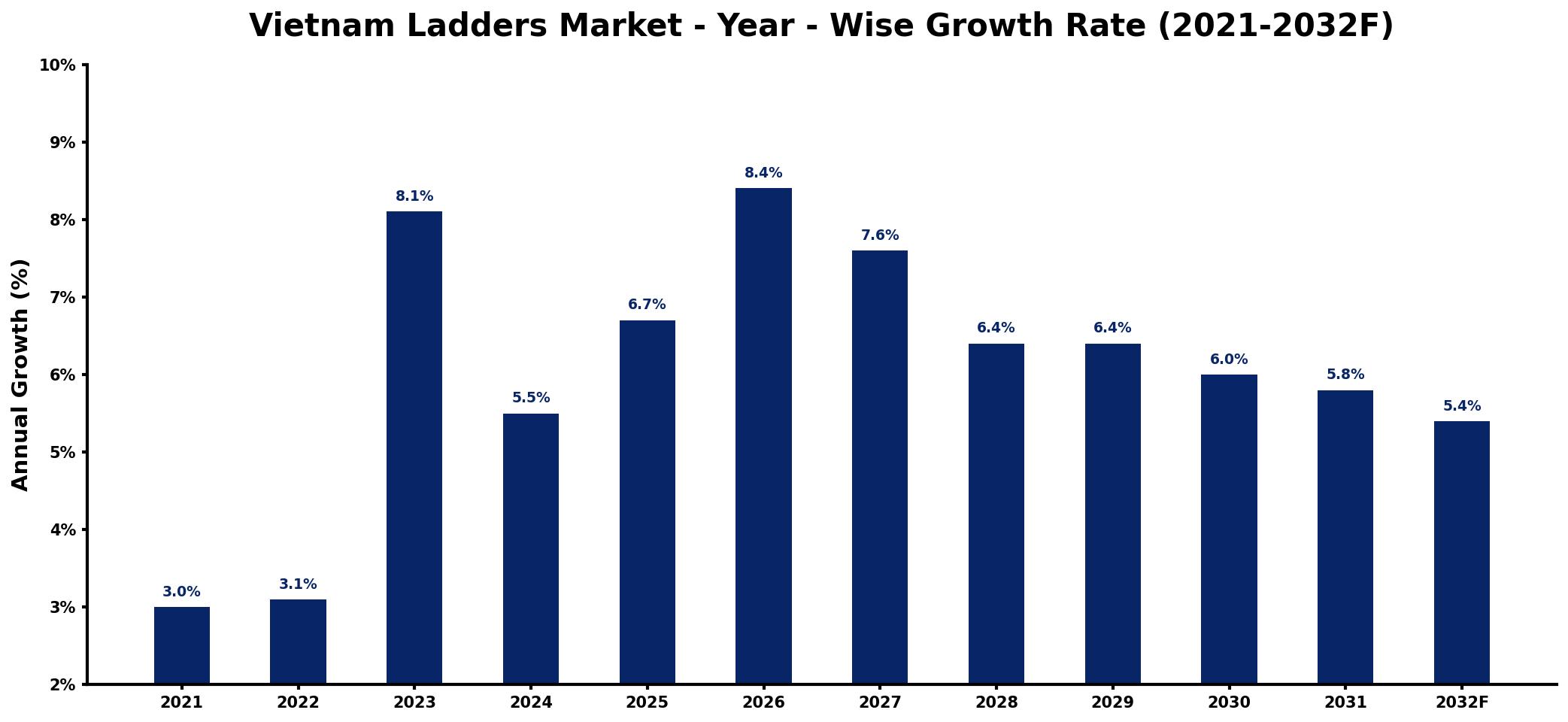
The table below presents the year‑wise growth rates along with the key drivers influencing the market
| Year | Growth Rate | Major Drivers |
| 2021 | 3.0% | Growing construction sector investments |
| 2022 | 3.1% | Increasing demand for home renovations |
| 2023 | 8.1% | Surge in urban infrastructure projects |
| 2024 | 5.5% | Expansion of retail distribution channels |
| 2025 | 6.7% | growing downstream application demand |
| 2026 | 8.4% | Boost in commercial building activities |
| 2027 | 7.6% | Growth in safety regulation enforcement |
| 2028 | 6.4% | Increase in residential construction permits |
| 2029 | 6.4% | Demand for innovative design solutions |
| 2030 | 6.0% | Strengthening of e-commerce platforms |
| 2031 | 5.8% | Investment in green building initiatives |
| 2032 | 5.4% | Focus on durable construction materials |
Note: Market size estimations and growth projections presented in this report are based on 6Wresearch's proprietary forecasting methodology, utilizing the latest available industry data, government publications, and primary research inputs.
Vietnam Ladders Market Synopsis
The Vietnam ladders market is thriving, thanks to an ongoing construction boom and heightened safety consciousness. The necessity for reliable access tools spans multiple sectors, including residential, commercial, and industrial projects, making ladders indispensable in daily operations.
Local manufacturers and international players are actively competing to meet the diverse needs of consumers. This vibrant landscape is characterized by a wide array of ladder types, including extension, step, and platform ladders, all designed to accommodate the varying demands of construction and maintenance tasks.
Vietnam Ladders Market Key Takeaways
- The market is primarily driven by construction activities and stringent safety regulations.
- Expansion in industrial sectors significantly boosts ladder demand for maintenance and access tasks.
- Local and international players are increasingly innovating to meet evolving consumer preferences.
- The market has shown resilience post-COVID-19, recovering as home improvement projects gained traction.
- Investment in high-quality and certified ladders is becoming a priority among businesses to ensure safety.
Evaluation of Restraints in Vietnam Ladders Market
Despite promising growth, the Vietnam ladders market faces several notable restraints. Intense competition among manufacturers can lead to price wars that may compromise product quality. Additionally, the stringent safety and quality regulations necessitate continuous innovation in ladder design and materials. Companies need to balance affordability with compliance to meet diverse customer needs while avoiding potential liabilities.
Vietnam Ladders Market Trends
A few current trends are emerging in the Vietnam ladders market. The shift towards lightweight, portable, and durable materials is gaining traction, making it easier for users to transport and utilize ladders. Smart technology integrations, such as safety sensors and user feedback mechanisms, are also beginning to influence new product designs. Furthermore, the increasing popularity of DIY home improvement projects among consumers is fostering demand for various ladder types.
Vietnam Ladders Market Opportunities
The evolving landscape of urbanization and infrastructure development in Vietnam presents lucrative growth opportunities for the ladders market. As cities expand, the demand for reliable access equipment is projected to rise. Additionally, the focus on enhancing workplace safety presents an avenue for manufacturers to innovate and supply advanced ladder solutions. Investments in sustainable materials and designs could also capture a growing consumer base focused on environmental responsibility.
Government Initiatives in the Vietnam Ladders Market
The Vietnamese government has taken steps to bolster the construction sector, aiming to enhance safety standards and infrastructure development. Policies promoting public spending on construction projects create a favorable environment for ladder manufacturers. Furthermore, safety regulations that demand high-quality ladder solutions align with the government's commitment to improving workplace safety across various industries.
Future Insights of the Vietnam Ladders Market
Looking ahead to 2026-2032, the Vietnam ladders market is poised for substantial growth, propelled by ongoing urbanization and construction activities. Innovations in ladder design, focusing on safety and ease of use, will likely capture consumer interest and drive sales. As the awareness surrounding workplace safety continues to grow, businesses will increasingly prioritize high-quality ladders, further solidifying the market's trajectory.
Vietnam Ladders Market Latest Developments (2025 - 2026)
Recent developments in the Vietnam ladders market indicate a strong shift towards eco-friendly materials and practices. Manufacturers are exploring sustainable sourcing and production techniques to appeal to an environmentally conscious consumer base. Additionally, there has been a surge in digital marketing initiatives aimed at educating customers on the importance of ladder safety and proper usage, reflecting the industry's commitment to enhancing safety standards.
Vietnam Ladders Market - Key Attractiveness of the Report
- 10 Years of Market Numbers
- Historical Data Starting from 2022 to 2025
- Base Year: 2025
- Forecast Data until 2032
- Key Performance Indicators Impacting the Market
- Major Upcoming Developments and Projects
Key Highlights of the Report:
- Vietnam Ladders Market Outlook
- Market Size of Vietnam Ladders Market, 2025
- Forecast of Vietnam Ladders Market, 2032
- Historical Data and Forecast of Vietnam Ladders Revenues & Volume for the Period 2022-2032F
- Vietnam Ladders Market Trend Evolution
- Vietnam Ladders Market Drivers and Challenges
- Vietnam Ladders Price Trends
- Vietnam Ladders Porter's Five Forces
- Vietnam Ladders Industry Life Cycle
- Historical Data and Forecast of Vietnam Ladders Market Revenues & Volume By Application for the Period 2022-2032F
- Historical Data and Forecast of Vietnam Ladders Market Revenues & Volume By Industrial for the Period 2022-2032F
- Historical Data and Forecast of Vietnam Ladders Market Revenues & Volume By Domestic for the Period 2022-2032F
- Historical Data and Forecast of Vietnam Ladders Market Revenues & Volume By Commercial for the Period 2022-2032F
- Vietnam Ladders Import Export Trade Statistics
- Market Opportunity Assessment By Application
- Vietnam Ladders Top Companies Market Share
- Vietnam Ladders Competitive Benchmarking By Technical and Operational Parameters
- Vietnam Ladders Company Profiles
- Vietnam Ladders Key Strategic Recommendations






































