Vietnam Lavender oil Market Size, Share & Growth Rate
The Vietnam Lavender oil Market was estimated at USD 1447 Million in 2025 and is projected to reach USD 2058 Million by 2032, growing at a CAGR of 5.2% from 2026 to 2032. This growth trajectory is primarily driven by the surging demand for aromatherapy and natural personal care products that emphasize wellness and stress relief. As consumer preferences shift towards organic and natural ingredients, the lavender oil market is poised to flourish, supported by favorable cultivation conditions and increasing local production.
Vietnam Lavender oil Market Year-wise Growth Rate and Key Drivers
This graph highlights how the Vietnam Lavender oil Market has steadily grown over the years, supported by major growth factors.
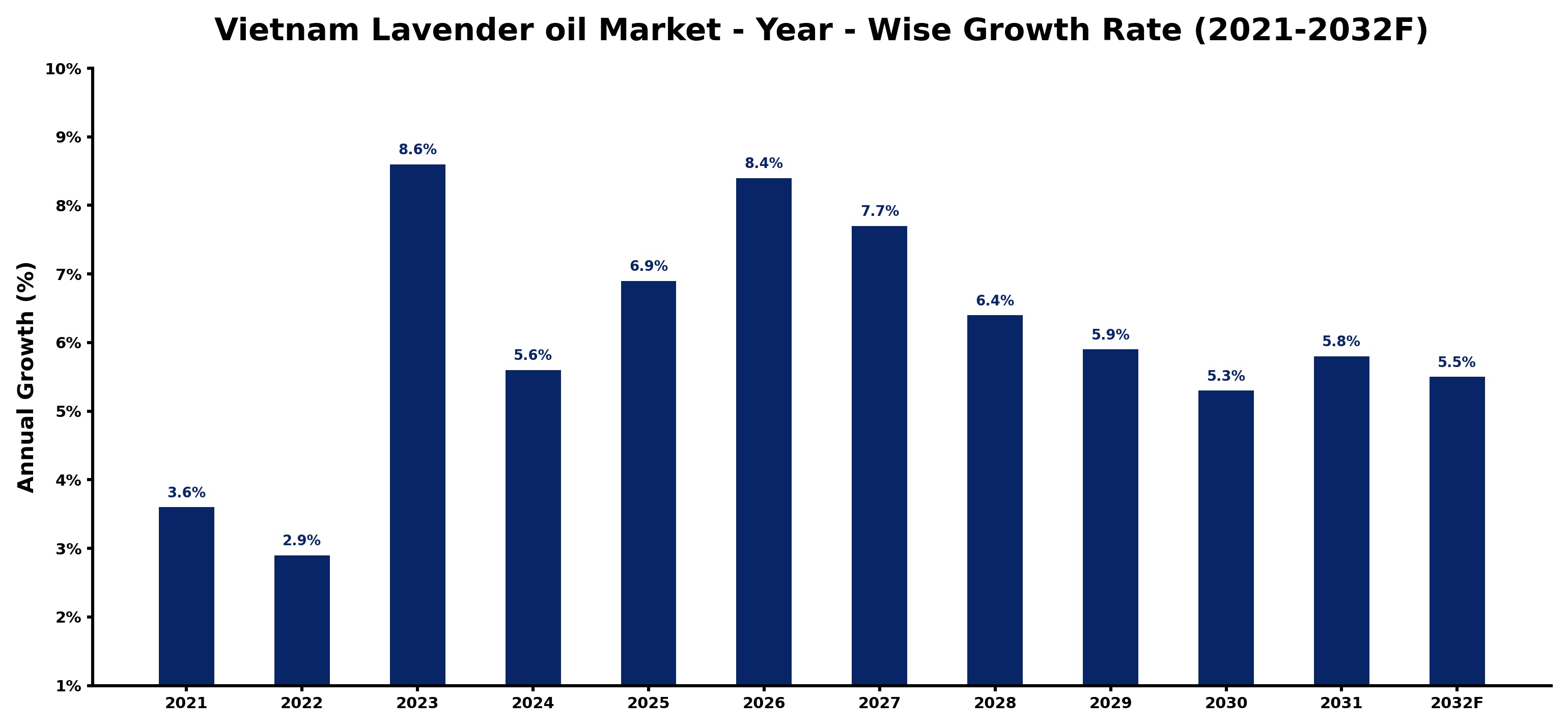
The table below presents the year‑wise growth rates along with the key drivers influencing the market
| Year | Growth Rate | Major Drivers |
| 2021 | 3.6% | Growing renewable energy integration projects |
| 2022 | 2.9% | Increasing industrial infrastructure investments |
| 2023 | 8.6% | Increasing industrial infrastructure investments |
| 2024 | 5.6% | Expansion of transportation and logistics networks |
| 2025 | 6.9% | Government infrastructure modernization initiatives |
| 2026 | 8.4% | Increasing industrial infrastructure investments |
| 2027 | 7.7% | Growing urbanization and commercial development |
| 2028 | 6.4% | Rising electricity demand across industries |
| 2029 | 5.9% | Increasing industrial infrastructure investments |
| 2030 | 5.3% | Growing renewable energy integration projects |
| 2031 | 5.8% | Increasing smart city development projects |
| 2032 | 5.5% | Increasing smart city development projects |
Note - Market size estimations and growth projections presented in this report are based on 6Wresearch's advanced forecasting approach, validated with industry datasets as of June 2026.
Vietnam Lavender oil Market Synopsis
The Vietnam Lavender oil Market has experienced a notable shift in momentum, driven by heightened consumer awareness of the mental and emotional benefits associated with lavender oil. With an increasing inclination towards self-care practices, the market is seeing a rise in lavender-infused products ranging from home fragrances to wellness therapies.
Looking ahead, the market is set to maintain its positive trajectory as more consumers embrace natural solutions for relaxation and holistic well-being. However, the ongoing challenges of quality control and cultivation practices will need to be addressed to sustain this growth effectively.
Vietnam Lavender oil Market Key Takeaways
- The market is benefiting from increased consumer interest in wellness-oriented products.
- High-quality domestic production is becoming crucial for market competitiveness.
- Organic and natural formulations are gaining popularity in personal care and aromatherapy.
- Government initiatives aimed at supporting herbal cultivation are fostering industry growth.
- Current trends indicate a shift towards online distribution channels for reaching consumers.
Evaluation of Restraints in Vietnam Lavender oil Market
Despite the promising growth prospects, the Vietnam Lavender oil Market is held back by several significant restraints. Primarily, the adaptability of lavender plants to the local climate poses a challenge; the specific soil and climatic conditions optimal for lavender cultivation are not consistently found throughout Vietnam. This limitation results in potential issues such as lower yields and variability in oil quality. Additionally, the market faces obstacles in maintaining quality control and adhering to international standards, which are essential for competing on the global stage. Addressing these issues will be vital for ensuring sustained growth and market positioning.
Vietnam Lavender oil Market Trends
Several trends are currently shaping the Vietnam Lavender oil Market. There is a growing inclination towards sustainable and eco-friendly production practices, driven by environmentally conscious consumers. Moreover, the rise of wellness tourism in Vietnam is increasing the demand for lavender-infused products in spas and resorts. The expansion of e-commerce platforms is also playing a pivotal role in making lavender oil products more accessible to a broader audience, allowing consumers to explore and purchase these natural solutions conveniently.
Vietnam Lavender oil Market Opportunities
Opportunities within the Vietnam Lavender oil Market are significant, particularly in the organic segment. As consumers increasingly seek out natural and holistic products, there is ample scope for brands to innovate with lavender-based formulations in skincare, aromatherapy, and home fragrances. Additionally, expanding export capabilities for high-quality lavender oil presents a viable opportunity for local producers to tap into international markets, leveraging Vietnam's unique growing conditions and rising brand reputation.
Government Initiatives in the Vietnam Lavender oil Market
The Vietnamese government has been actively promoting the cultivation of herbal and aromatic plants, including lavender, as part of its broader agricultural strategy. This includes initiatives aimed at providing support for farmers in the form of subsidies and training programs focused on sustainable cultivation practices. Additionally, policies encouraging the development of essential oil extraction industries are fostering growth and investment in this sector, which is crucial for elevating the quality and competitive positioning of Vietnamese lavender oil in both domestic and international markets.
Future Insights of the Vietnam Lavender oil Market
Looking towards 2026-2032, the Vietnam Lavender oil Market is expected to continue its upward trajectory, driven by ongoing consumer trends toward health, wellness, and natural products. With increasing investment in quality control measures and cultivation practices, local producers are likely to enhance the quality and availability of lavender oil. As wellness becomes a more integral part of daily life for many consumers, lavender oil is poised to become a staple in aromatherapy and natural personal care products, creating a vibrant future for the market.
Vietnam Lavender oil Market Latest Developments (May 2025 - June 2026)
Recent developments in the Vietnam Lavender oil Market indicate a strong focus on enhancing production capabilities. There has been a notable increase in collaborative efforts between local farmers and research institutions aimed at improving lavender cultivation techniques. Additionally, marketing campaigns emphasizing the purity and authenticity of locally produced lavender oil are gaining momentum, helping to bolster consumer trust. As companies adapt to evolving consumer preferences, there is an increasing emphasis on digital marketing strategies to engage with health-conscious audiences more effectively.
Vietnam Lavender oil Market - Key Attractiveness of the Report
- 10 Years of Market Numbers
- Historical Data Starting from 2022 to 2025
- Base Year: 2025
- Forecast Data until 2032
- Key Performance Indicators Impacting the Market
- Major Upcoming Developments and Projects
Key Highlights of the Report:
- Vietnam Lavender oil Market Outlook
- Market Size of Vietnam Lavender oil Market, 2025
- Forecast of Vietnam Lavender oil Market, 2032
- Historical Data and Forecast of Vietnam Lavender oil Revenues & Volume for the Period 2022-2032F
- Vietnam Lavender oil Market Trend Evolution
- Vietnam Lavender oil Market Drivers and Challenges
- Vietnam Lavender oil Price Trends
- Vietnam Lavender oil Porter's Five Forces
- Vietnam Lavender oil Industry Life Cycle
- Historical Data and Forecast of Vietnam Lavender oil Market Revenues & Volume By Application for the Period 2022-2032F
- Historical Data and Forecast of Vietnam Lavender oil Market Revenues & Volume By Food and Beverage for the Period 2022-2032F
- Historical Data and Forecast of Vietnam Lavender oil Market Revenues & Volume By Cosmetic for the Period 2022-2032F
- Historical Data and Forecast of Vietnam Lavender oil Market Revenues & Volume By Pharmaceutical for the Period 2022-2032F
- Historical Data and Forecast of Vietnam Lavender oil Market Revenues & Volume By Distribution Channel for the Period 2022-2032F
- Historical Data and Forecast of Vietnam Lavender oil Market Revenues & Volume By Pharmacy and Drug Stores for the Period 2022-2032F
- Historical Data and Forecast of Vietnam Lavender oil Market Revenues & Volume By Health and Beauty Stores for the Period 2022-2032F
- Historical Data and Forecast of Vietnam Lavender oil Market Revenues & Volume By Online Retailing for the Period 2022-2032F
- Historical Data and Forecast of Vietnam Lavender oil Market Revenues & Volume By Others for the Period 2022-2032F
- Vietnam Lavender oil Import Export Trade Statistics
- Market Opportunity Assessment By Application
- Market Opportunity Assessment By Distribution Channel
- Vietnam Lavender oil Top Companies Market Share
- Vietnam Lavender oil Competitive Benchmarking By Technical and Operational Parameters
- Vietnam Lavender oil Company Profiles
- Vietnam Lavender oil Key Strategic Recommendations






































