Vietnam Leather Belts Market Summary
The vietnam leather belts market was estimated at USD 291 Million in 2025 and is projected to reach USD 410 Million by 2032, growing at a CAGR of 8.4% from 2026 to 2032.
Vietnam Leather Belts Market Year-wise Growth Rate and Key Drivers
This graph highlights how the Vietnam Leather Belts Market has steadily grown over the past five years, supported by major growth factors.
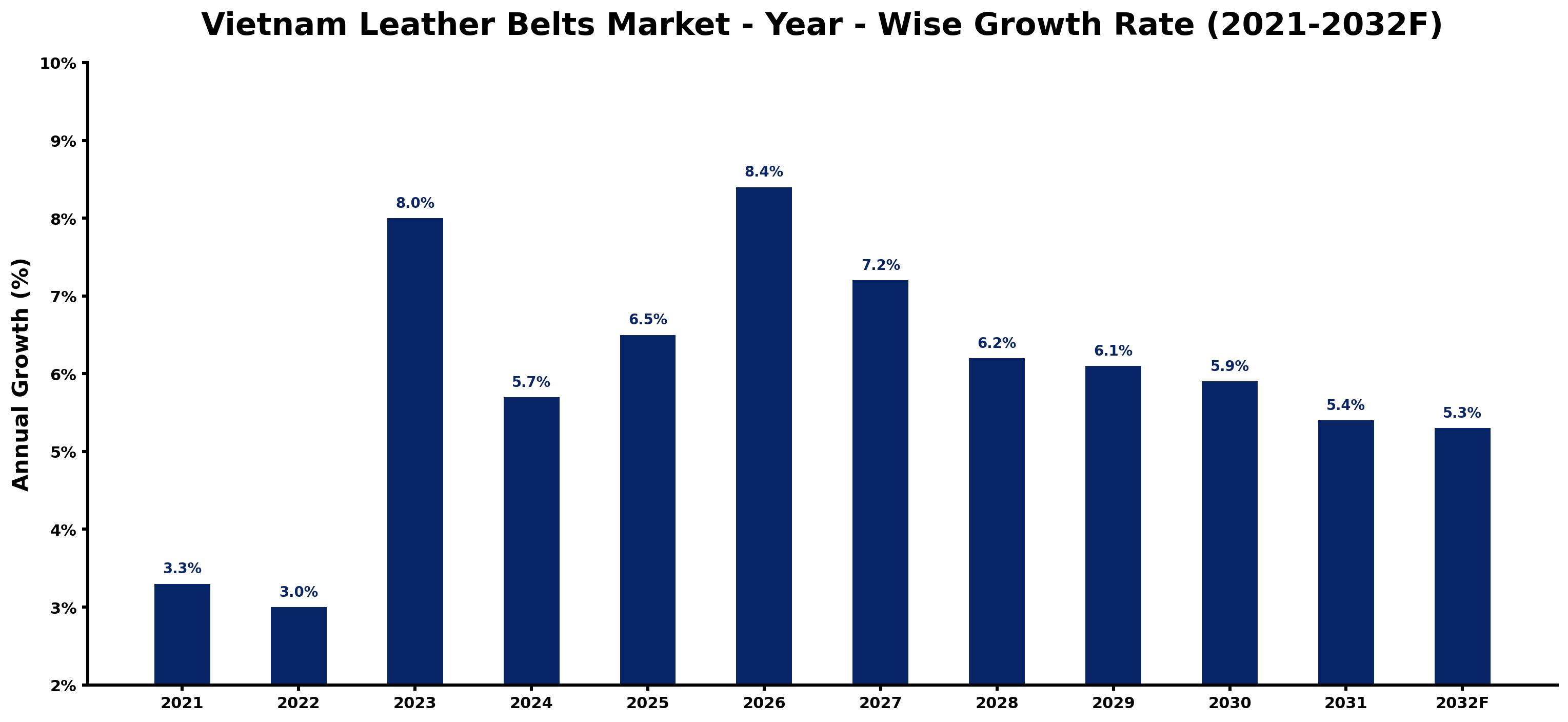
The table below presents the year wise growth rates along with the key drivers influencing the market
| Year | Growth Rate | Major Drivers |
| 2021 | 3.3% | Post-lockdown retail projects began revitalizing the leather accessories market landscape. |
| 2022 | 3.0% | Increased domestic production capacity aligned with rising fashion trends and consumer expectations. |
| 2023 | 8.0% | E-commerce platforms expanded their footwear and accessories categories, boosting online sales significantly. |
| 2024 | 5.7% | Local craftsmanship received recognition, enhancing brand loyalty among quality-conscious consumers. |
| 2025 | 6.5% | Rising disposable incomes among the middle class shifted preferences towards premium leather goods. |
| 2026 | 8.4% | Vietnam's textile industry modernization has entered a pivotal phase with technology adoption. |
| 2027 | 7.2% | Sustainable materials gained traction as environmentally conscious consumers demanded greener options. |
| 2028 | 6.2% | Collaborations between local artisans and global brands stimulated unique product offerings. |
| 2029 | 6.1% | Tourism resurgence brought international brands, raising competition in the leather market segment. |
| 2030 | 5.9% | Urbanization trends continued, shifting consumer focus towards fashion-centric lifestyle products. |
| 2031 | 5.4% | Investment in logistics and distribution networks improved accessibility for rural markets. |
| 2032 | 5.3% | Youth culture's influence on fashion trends propelled innovative and stylish belt collections. |
Note - Market size estimations and growth projections presented in this report are based on 6Wresearch's advanced forecasting approach, validated with industry datasets as of June 2026.
Vietnam Leather Belts Market Synopsis
The Vietnam Leather Belts Market is projected to reach 8.4% and witness significant growth during the forecast period (2026-2032). This market growth is underpinned by increasing consumer interest in fashion accessories, particularly leather belts, which serve both functional and aesthetic purposes. As the Vietnamese economy continues to develop and disposable incomes rise, the demand for quality leather belts has surged, driven largely by dynamic fashion trends and the influence of social media on purchasing behaviors.
Vietnam Leather Belts Market Growth Drivers
The expansion of the Vietnam leather belts market can be attributed to several compelling factors impacting consumer behavior and market dynamics:
- The rising influence of fashion trends has played a pivotal role, with consumers increasingly seeking stylish leather belts to enhance their outfits. This trend is particularly evident among younger demographics, eager to adopt contemporary styles.
- Access to modern retail channels, including shopping malls and online platforms, has enhanced the visibility of leather belts, making them more accessible to consumers across diverse regions.
- Growing disposable incomes have empowered consumers to invest in high-quality leather products, fueling demand for durable and premium leather belts that offer value for money.
- The shift towards genuine leather products, as opposed to synthetics, has solidified the market's appeal, with consumers expressing a preference for products that reflect quality and craftsmanship.
- Social media marketing has emerged as a strong driver, with brands leveraging platforms to showcase their products and influence consumer preferences, dramatically increasing market engagement.
Vietnam Leather Belts Market Challenges and Restraints
Despite the optimistic growth trajectory, the Vietnam leather belts market is confronted with several challenges that could hinder its expansion:
- Intense competition from synthetic and imitation leather belts poses a significant threat, with these alternatives often available at lower price points, appealing to cost-conscious consumers.
- Volatility in raw material prices, particularly for leather, can create fluctuations in production costs, impacting the pricing strategies of manufacturers and potentially narrowing profit margins.
- Consumer awareness regarding sustainability and ethical production processes is rising, leading to increased scrutiny of leather sourcing and manufacturing practices.
- Market saturation in urban areas may limit growth potential as consumer bases become more established and competition intensifies.
- Economic uncertainties, influenced by global market conditions, could impact consumer spending behaviors, ultimately affecting the demand for luxury items like leather belts.
Vietnam Leather Belts Market COVID-19 Impact
The COVID-19 pandemic, which began affecting Vietnam's economy in 2025, had mixed repercussions on the leather belts market. Initial lockdowns and restrictions severely impacted retail operations, leading to reduced foot traffic in stores and supply chain disruptions. However, as economic activities gradually resumed, the market showed signs of recovery. Consumers, adapting to the 'new normal', began seeking fashion accessories that complemented their evolving personal styles. Furthermore, the surge in e-commerce during this period allowed manufacturers and retailers to pivot towards online sales, enabling them to reach a broader audience and mitigate some of the pandemic's adverse effects.
Vietnam Leather Belts Market Government Investment and Initiatives
The Vietnamese government has initiated various policies aimed at boosting the domestic leather goods sector, including leather belts. These initiatives include promoting sustainable practices within the industry, encouraging investments in modern manufacturing technologies, and providing incentives for companies to adopt environmentally friendly processes. Moreover, the government is focused on enhancing export capabilities through trade agreements, which are intended to provide local manufacturers with better access to international markets. By fostering a conducive business environment, these strategies aim to bolster the growth of the Vietnam leather belts market while ensuring the sector's long-term sustainability.
Vietnam Leather Belts Market Latest Developments (May 2025 - June 2026)
Recent developments in the Vietnam leather belts market from May 2025 to June 2026 highlight a paradigm shift towards digitalization and online retailing. Numerous brands have enhanced their online presence in response to changing consumer habits, utilizing social media platforms for marketing and direct sales. Additionally, there has been an uptick in collaborations between fashion influencers and brands, focusing on sophisticated advertising strategies to attract the tech-savvy youth demographic. The trend of customizing leather belts has also emerged, allowing consumers to express their individuality, thereby driving demand for bespoke products.
Vietnam Leather Belts Market - Key Attractiveness of the Report
- 10 Years of Market Numbers
- Historical Data Starting from 2022 to 2025
- Base Year: 2025
- Forecast Data until 2032
- Key Performance Indicators Impacting the Market
- Major Upcoming Developments and Projects
Key Highlights of the Report:
- Vietnam Leather Belts Market Outlook
- Market Size of Vietnam Leather Belts Market, 2025
- Forecast of Vietnam Leather Belts Market, 2032
- Historical Data and Forecast of Vietnam Leather Belts Revenues & Volume for the Period 2022-2032F
- Vietnam Leather Belts Market Trend Evolution
- Vietnam Leather Belts Market Drivers and Challenges
- Vietnam Leather Belts Price Trends
- Vietnam Leather Belts Porter's Five Forces
- Vietnam Leather Belts Industry Life Cycle
- Historical Data and Forecast of Vietnam Leather Belts Market Revenues & Volume By Type for the Period 2022-2032F
- Historical Data and Forecast of Vietnam Leather Belts Market Revenues & Volume By Man for the Period 2022-2032F
- Historical Data and Forecast of Vietnam Leather Belts Market Revenues & Volume By Woman for the Period 2022-2032F
- Historical Data and Forecast of Vietnam Leather Belts Market Revenues & Volume By Application for the Period 2022-2032F
- Historical Data and Forecast of Vietnam Leather Belts Market Revenues & Volume By Business for the Period 2022-2032F
- Historical Data and Forecast of Vietnam Leather Belts Market Revenues & Volume By Leisure for the Period 2022-2032F
- Historical Data and Forecast of Vietnam Leather Belts Market Revenues & Volume By Other for the Period 2022-2032F
- Vietnam Leather Belts Import Export Trade Statistics
- Market Opportunity Assessment By Type
- Market Opportunity Assessment By Application
- Vietnam Leather Belts Top Companies Market Share
- Vietnam Leather Belts Competitive Benchmarking By Technical and Operational Parameters
- Vietnam Leather Belts Company Profiles
- Vietnam Leather Belts Key Strategic Recommendations






































