Vietnam Letterpress Printing Machinery Market Size, Share & Growth Rate
The Vietnam Letterpress Printing Machinery Market was estimated at USD 1207 Million in 2025 and is projected to reach USD 1719 Million by 2032, growing at a CAGR of 5.2% from 2026 to 2032. This growth trajectory is primarily fueled by the expanding printing and packaging sectors, which increasingly require high-quality machinery for diverse applications. As businesses prioritize quality in branding and packaging, the demand for letterpress printing machinery continues to gain momentum across various industries.
Vietnam Letterpress Printing Machinery Market Year-wise Growth Rate and Key Drivers
This graph highlights how the Vietnam Letterpress Printing Machinery Market has steadily grown over the years, supported by major growth factors.
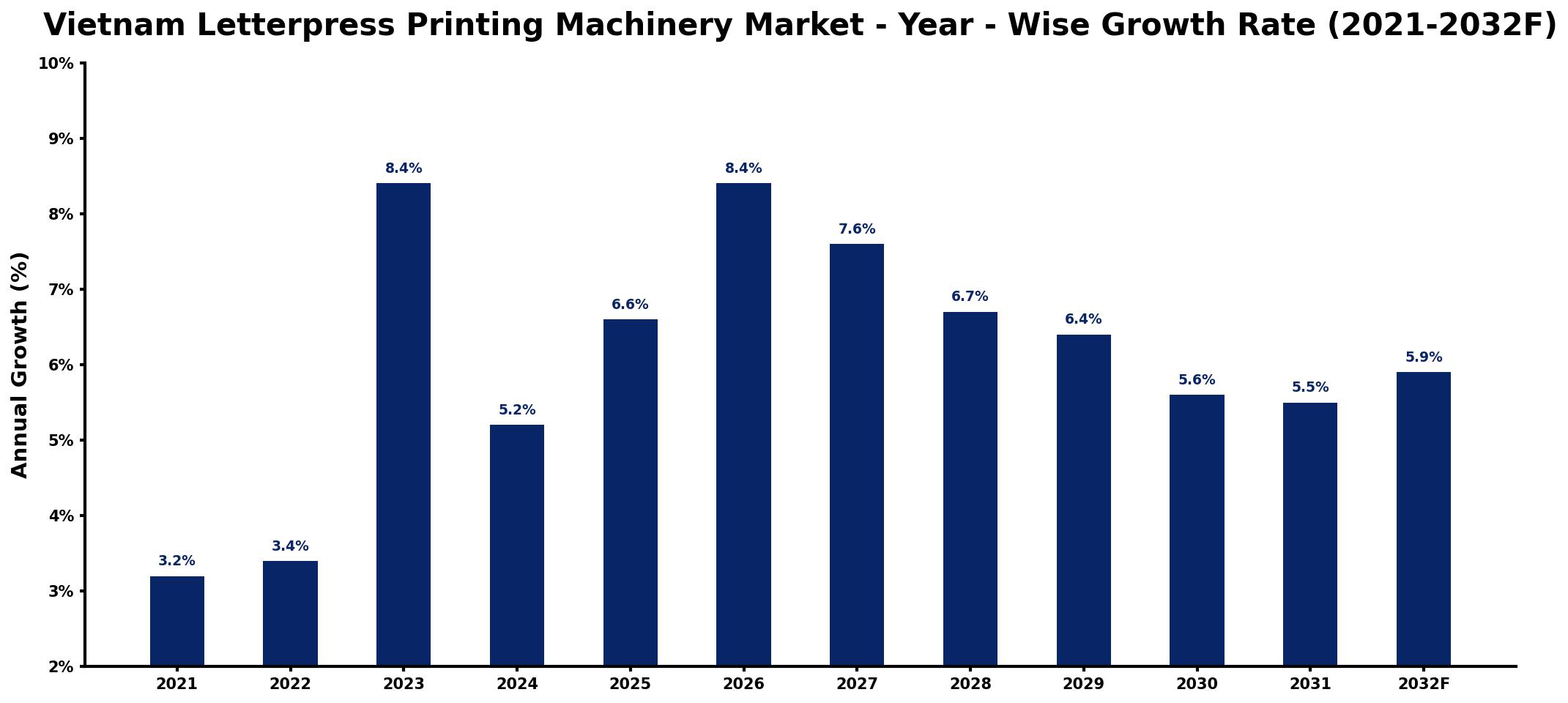
The table below presents the year‑wise growth rates along with the key drivers influencing the market
| Year | Growth Rate | Major Drivers |
| 2021 | 3.2% | Increased demand from packaging sector |
| 2022 | 3.4% | Rising interest in artisanal crafts |
| 2023 | 8.4% | Growth in e-commerce packaging solutions |
| 2024 | 5.2% | rising demand from electronics |
| 2025 | 6.6% | Emergence of sustainable materials trend |
| 2026 | 8.4% | Technological advancements in design tools |
| 2027 | 7.6% | Surge in customized product offerings |
| 2028 | 6.7% | increased domestic production output |
| 2029 | 6.4% | Growing awareness of local brands |
| 2030 | 5.6% | Increase in export opportunities |
| 2031 | 5.5% | Rising consumer preference for uniqueness |
| 2032 | 5.9% | Continued investment in creative industries |
Note: Market size estimations and growth projections presented in this report are based on 6Wresearch's proprietary forecasting methodology, utilizing the latest available industry data, government publications, and primary research inputs.
Vietnam Letterpress Printing Machinery Market Synopsis
In recent years, the Vietnam letterpress printing machinery market has experienced steady growth, driven by an upsurge in demand for traditional printing methods. While the market has thrived amid increasing consumer interest in quality printed materials, it faces pivotal challenges from rising digital alternatives. Looking ahead, adapting to technological shifts while maintaining product relevance will be crucial for sustaining this growth.
The competitive landscape features a blend of local and international manufacturers, all vying for market share. This rivalry fosters innovation, pushing players to enhance their product offerings. As letterpress printing remains a popular choice for packaging and specialty printing, the market is well-positioned, albeit with hurdles that necessitate strategic agility from manufacturers.
Vietnam Letterpress Printing Machinery Market Key Takeaways
- Vietnam's expanding printing and packaging industries are the primary drivers of letterpress machinery demand.
- Growing consumer preference for high-quality printed materials is reinforcing the market's positive growth outlook.
- Competition from digital printing technologies poses ongoing challenges, prompting manufacturers to innovate continuously.
- The market is witnessing an increasing emphasis on eco-friendly printing solutions amid growing environmental concerns.
- Adapting to technological advancements is essential for sustaining growth in the letterpress printing segment.
Evaluation of Restraints in Vietnam Letterpress Printing Machinery Market
The Vietnam letterpress printing machinery market is navigating several significant constraints. Foremost among these is the declining preference for traditional printing methods in favor of digital solutions, as companies strive for efficiency and cost-effectiveness. Environmental considerations have become increasingly influential, with the need for more sustainable printing practices complicating manufacturing processes. Furthermore, the lingering effects of supply chain disruptions caused by the COVID-19 pandemic have created challenges in sourcing raw materials, subsequently impacting production costs and schedules. This confluence of factors underscores the necessity for manufacturers to pivot towards innovation and adaptability.
Vietnam Letterpress Printing Machinery Market Trends
Several trends are currently shaping the Vietnam letterpress printing machinery market. First, the integration of digital elements into traditional letterpress techniques is gaining traction, allowing for enhanced capabilities and efficiencies. Additionally, there's a notable shift towards environmentally sustainable practices, with manufacturers increasingly focusing on eco-friendly inks and materials. Customization and personalization are also trending, as businesses look to stand out in a crowded marketplace through unique branding and packaging solutions. These trends collectively signify an evolving landscape, demanding innovation and adaptability from industry players.
Vietnam Letterpress Printing Machinery Market Opportunities
The letterpress printing machinery market in Vietnam presents genuine opportunities for growth and investment. As traditional printing methods find new applications in niche markets such as artisanal packaging, there is potential for manufacturers to develop specialized machines catering to these segments. Furthermore, the increasing trend of e-commerce in Vietnam underscores the necessity for high-quality packaging solutions, creating demand for advanced printing technologies. Companies that focus on sustainability and adaptability will be well-positioned to capture emerging opportunities in this evolving market.
Government Initiatives in the Vietnam Letterpress Printing Machinery Market
The Vietnamese government is increasingly aware of the importance of the printing and packaging industry in driving economic growth. Various initiatives aim to boost technological advancements within the sector, with incentives for businesses adopting environmentally sustainable practices. Public spending on infrastructure, including logistics and transportation, is expected to enhance distribution channels for printing machinery, facilitating market accessibility. Additionally, support for research and development in manufacturing technologies will further contribute to advancing the capabilities of local manufacturers.
Future Insights of the Vietnam Letterpress Printing Machinery Market
Looking towards 2026-2032, the Vietnam letterpress printing machinery market is likely to continue its upward trajectory, albeit with challenges. Companies that successfully navigate the landscape of digital competition and commit to innovative solutions are expected to thrive. The market's future hinges on the ability of manufacturers to integrate new technologies and eco-friendly practices while addressing the growing demand for customization. As the printing landscape evolves, a strategic focus on emerging opportunities will be essential for sustained growth.
Vietnam Letterpress Printing Machinery Market Latest Developments (2025 - 2026)
In the recent months, the Vietnam letterpress printing machinery market has seen notable shifts as industry players adapt to changing market dynamics. Many manufacturers are exploring strategic partnerships to enhance their technology offerings and improve production efficiencies. Additionally, there has been a marked increase in initiatives aimed at developing eco-friendly printing solutions. This evolving landscape reflects a proactive approach towards adapting to both consumer preferences and regulatory pressures, positioning the industry for future resilience.
Vietnam Letterpress Printing Machinery Market - Key Attractiveness of the Report
- 10 Years of Market Numbers
- Historical Data Starting from 2022 to 2025
- Base Year: 2025
- Forecast Data until 2032
- Key Performance Indicators Impacting the Market
- Major Upcoming Developments and Projects
Key Highlights of the Report:
- Vietnam Letterpress Printing Machinery Market Outlook
- Market Size of Vietnam Letterpress Printing Machinery Market, 2025
- Forecast of Vietnam Letterpress Printing Machinery Market, 2032
- Historical Data and Forecast of Vietnam Letterpress Printing Machinery Revenues & Volume for the Period 2022-2032F
- Vietnam Letterpress Printing Machinery Market Trend Evolution
- Vietnam Letterpress Printing Machinery Market Drivers and Challenges
- Vietnam Letterpress Printing Machinery Price Trends
- Vietnam Letterpress Printing Machinery Porter's Five Forces
- Vietnam Letterpress Printing Machinery Industry Life Cycle
- Historical Data and Forecast of Vietnam Letterpress Printing Machinery Market Revenues & Volume By Type for the Period 2022-2032F
- Historical Data and Forecast of Vietnam Letterpress Printing Machinery Market Revenues & Volume By Rotary Letterpress Machine for the Period 2022-2032F
- Historical Data and Forecast of Vietnam Letterpress Printing Machinery Market Revenues & Volume By Other for the Period 2022-2032F
- Historical Data and Forecast of Vietnam Letterpress Printing Machinery Market Revenues & Volume By Application for the Period 2022-2032F
- Historical Data and Forecast of Vietnam Letterpress Printing Machinery Market Revenues & Volume By Securities for the Period 2022-2032F
- Historical Data and Forecast of Vietnam Letterpress Printing Machinery Market Revenues & Volume By Invitation Card for the Period 2022-2032F
- Historical Data and Forecast of Vietnam Letterpress Printing Machinery Market Revenues & Volume By Other for the Period 2022-2032F
- Vietnam Letterpress Printing Machinery Import Export Trade Statistics
- Market Opportunity Assessment By Type
- Market Opportunity Assessment By Application
- Vietnam Letterpress Printing Machinery Top Companies Market Share
- Vietnam Letterpress Printing Machinery Competitive Benchmarking By Technical and Operational Parameters
- Vietnam Letterpress Printing Machinery Company Profiles
- Vietnam Letterpress Printing Machinery Key Strategic Recommendations






































