Vietnam Logistics Automation Market Size & Growth Rate (2026-2032)
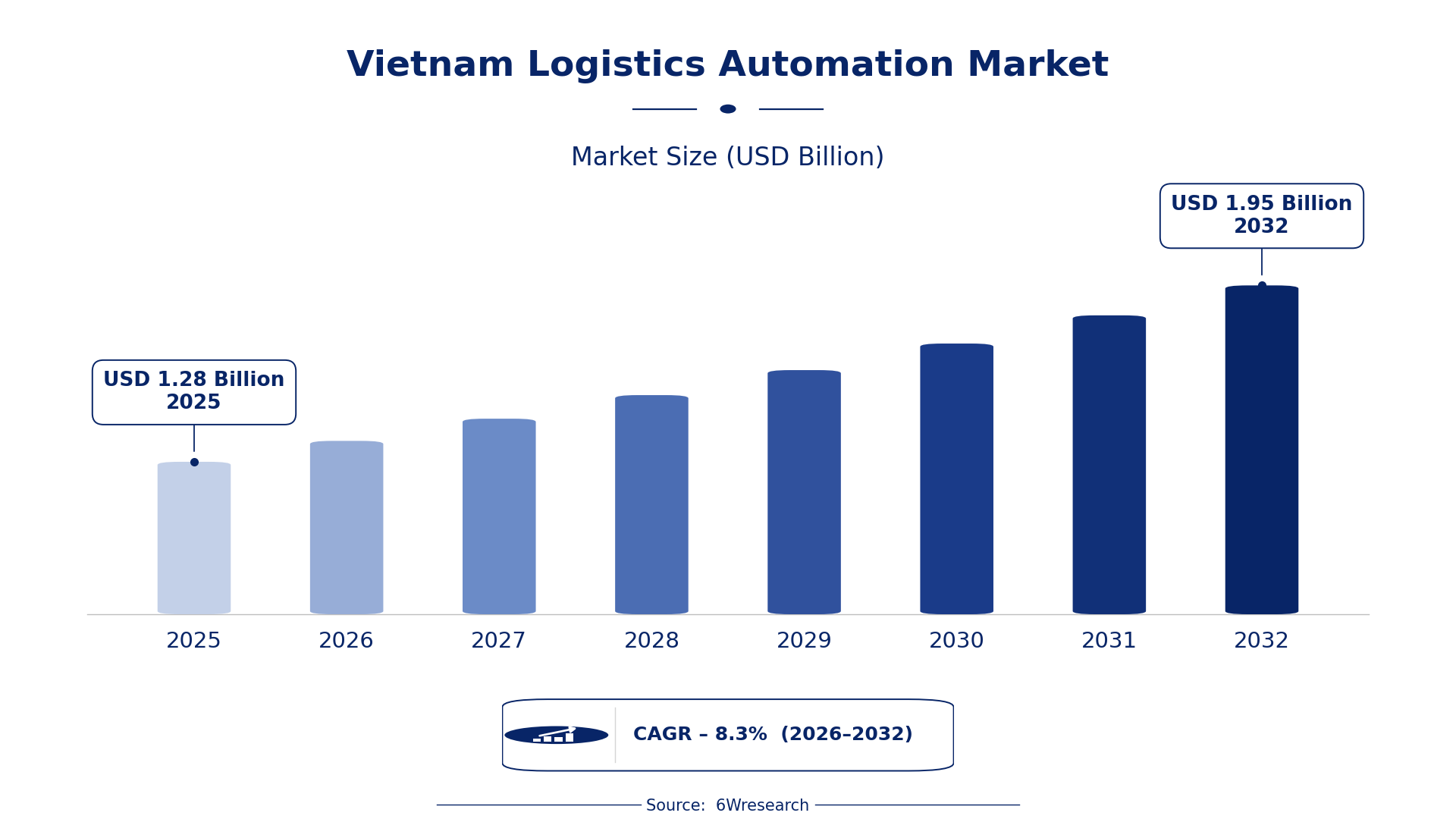
The Vietnam Logistics Automation Market was estimated at USD 1285 Million in 2025 and is projected to reach USD 1954 Million by 2032, growing at a CAGR of 8.3% from 2026 to 2032.
Vietnam Logistics Automation Market Synopsis
Vietnam’s logistics sector is seeing a surge in automation adoption, driven by the rapid expansion of the e-commerce industry. As companies strive to meet consumer expectations for swift delivery, automation technologies such as robotic process automation and autonomous vehicles are becoming essential tools in this competitive environment.
The market is not just about efficiency; it’s also about accuracy. Enhanced inventory management and order fulfillment systems are crucial in ensuring that logistics providers can deliver on their promises. As Vietnam positions itself as a regional trade hub, the investment in logistics automation is expected to accelerate further.
Vietnam Logistics Automation Market Year-wise Growth Rate and Key Drivers
This graph illustrates the annual growth rates of the Vietnam Logistics Automation Market from 2021 to 2032, highlighting a steady upward trajectory and projected expansion over the forecast period.
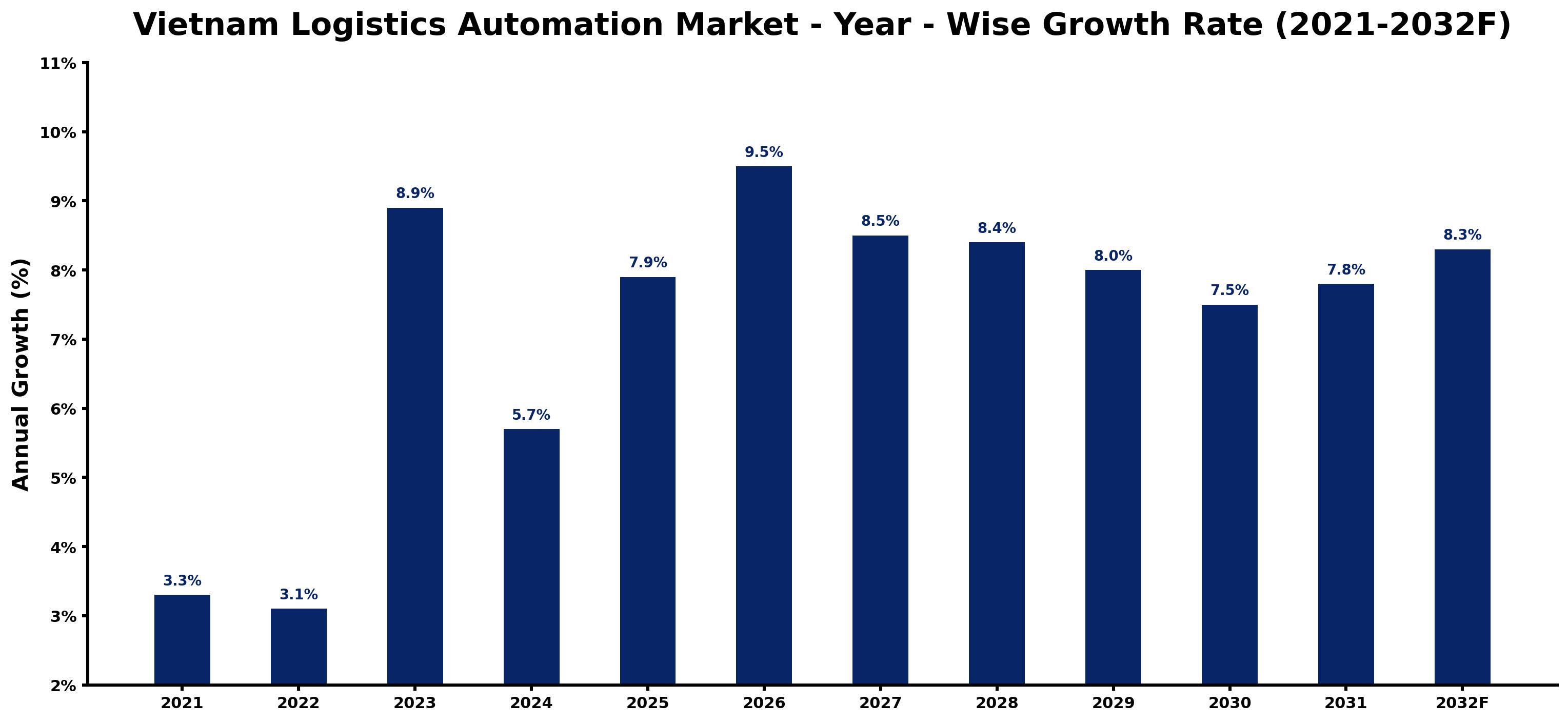
The table below presents the year‑wise growth rates along with the key drivers influencing the market
| Year | Growth Rate | Major Drivers |
| 2021 | 3.3% | Vietnam adopted Industry 4.0 policies for automation. |
| 2022 | 3.1% | Increased e-commerce demand drives logistics automation solutions. |
| 2023 | 8.9% | Launch of Smart Logistics centers in Ho Chi Minh. |
| 2024 | 5.7% | Government initiatives support green logistics technology adoption. |
| 2025 | 7.9% | Rising workforce urbanization boosts demand for logistics automation. |
| 2026 | 9.5% | Investment in AI technologies improves warehouse efficiency. |
| 2027 | 8.5% | Growing regional trade partnerships enhance logistics automation needs. |
| 2028 | 8.4% | Vietnam's industrial parks adopt advanced logistics automation systems. |
| 2029 | 8.0% | Rising last-mile delivery demands prompt automation solutions. |
| 2030 | 7.5% | Regulatory support for digital logistics platform integration. |
| 2031 | 7.8% | Emerging startups innovating in logistics automation services. |
| 2032 | 8.3% | Increased foreign investment in Vietnamese logistics sector growth. |
Note: Market size estimations and growth projections presented in this report are based on 6Wresearch's proprietary forecasting methodology, utilizing the latest available industry data, government publications, and primary research inputs.
Vietnam Logistics Automation Market Key Takeaways
Below are some of the specific key takeaways from the market, including:
- The rapid growth of e-commerce is a key driver of logistics automation in Vietnam.
- Government initiatives are enhancing infrastructure to support automation technologies.
- Challenges such as high implementation costs and a skills gap in the workforce persist.
- The market is witnessing increased investments from logistics providers to stay competitive.
- COVID-19 has accelerated the adoption of automation solutions across the logistics sector.
Evaluation of Restraints in Vietnam Logistics Automation Market
Despite the promising growth trajectory of the Vietnam Logistics Automation Market, several restraints hinder its advancement. One major limitation is the substantial upfront investment required for automation technologies, which can deter smaller logistics companies from adopting these solutions. Additionally, the shortage of skilled labor to operate and maintain automated systems presents a significant challenge. Companies often struggle to find technicians who possess the necessary expertise, making the transition to automation more complicated. on top of that, the lack of standardization across different automation technologies can lead to interoperability issues, complicating system integration. These factors collectively slow the pace at which logistics companies can fully embrace automation.
Vietnam Logistics Automation Market Trends
Several key trends are shaping the Vietnam Logistics Automation Market. First, the integration of artificial intelligence and machine learning into logistics processes is gaining traction, enhancing decision-making capabilities. Companies are using predictive analytics to optimize inventory and improve supply chain visibility. Secondly, there’s a growing focus on last-mile delivery solutions, with automation technologies being utilized to ensure timely delivery in urban areas. Lastly, sustainability is becoming a priority, as logistics providers seek eco-friendly automation solutions to reduce their carbon footprint.
Vietnam Logistics Automation Market Opportunities
Investment opportunities abound in the Vietnam Logistics Automation Market. Companies can capitalize on the increasing demand for advanced warehouse management systems that incorporate automation features. There’s also a significant opportunity in developing tailored solutions for last-mile delivery challenges, particularly in densely populated cities. Additionally, as the government continues to enhance infrastructure, logistics firms can explore partnerships to innovate in transportation and warehousing, leveraging automation to improve efficiency.
Government Initiatives in the Vietnam Logistics Automation Market
The Vietnamese government is actively promoting logistics automation through various initiatives aimed at modernizing the industry. By enhancing trade infrastructure and reducing bottlenecks, these policies are designed to make Vietnam a more attractive hub for international logistics. Support for technological advancements in logistics is also a priority, reflecting a strategic focus on improving efficiency and competitiveness in the sector.
- A recently completed national initiative focused on upgrading transportation networks to facilitate smoother logistics operations.
- Current efforts include the implementation of a regulatory framework that encourages investments in automation technologies.
- Upcoming plans involve public-private partnerships aimed at expanding digital infrastructure within the logistics sector by 2028.
- The government is also working on developing training programs to address the skills gap in automation technologies.
- A new policy introduced in 2026 mandates the adoption of automated systems in state-owned logistics enterprises.
Future Insights of the Vietnam Logistics Automation Market
Looking ahead to 2026-2032, the Vietnam Logistics Automation Market is set for substantial growth. As e-commerce continues to flourish, logistics firms will increasingly rely on automation to keep pace with demand. The government’s commitment to infrastructure improvement and technological adoption will further bolster this growth. As challenges are addressed, particularly regarding workforce skills and system interoperability, the market's potential will be fully realized.
Vietnam Logistics Automation Market Latest Developments
In the past year, the Vietnam Logistics Automation Market has seen various developments aimed at enhancing operational efficiency. Companies are rapidly integrating automation technologies to streamline logistics processes, especially in response to changing consumer expectations. Investment in new technologies and strategic partnerships has become common as businesses work to stay competitive in a fast-evolving environment.
- A leading regional operator launched a new automated warehouse management system in late 2025, improving inventory accuracy.
- In early 2026, a major technology vendor began implementing AI-driven predictive analytics tools to optimize logistics operations.
- An ongoing initiative focuses on automating last-mile delivery solutions in urban areas, enhancing delivery speed and reliability.
- Planned for Q3 2026, a collaborative project between logistics firms aims to develop standard protocols for automated systems.
Vietnam Logistics Automation Market - Key Attractiveness of the Report
- 10 Years of Market Numbers
- Historical Data Starting from 2022 to 2025
- Base Year: 2025
- Forecast Data until 2032
- Key Performance Indicators Impacting the Market
- Major Upcoming Developments and Projects
Key Highlights of the Report:
- Vietnam Logistics Automation Market Outlook
- Market Size of Vietnam Logistics Automation Market, 2025
- Forecast of Vietnam Logistics Automation Market, 2032
- Historical Data and Forecast of Vietnam Logistics Automation Revenues & Volume for the Period 2022-2032F
- Vietnam Logistics Automation Market Trend Evolution
- Vietnam Logistics Automation Market Drivers and Challenges
- Vietnam Logistics Automation Price Trends
- Vietnam Logistics Automation Porter's Five Forces
- Vietnam Logistics Automation Industry Life Cycle
- Historical Data and Forecast of Vietnam Logistics Automation Market Revenues & Volume By Function for the Period 2022-2032F
- Historical Data and Forecast of Vietnam Logistics Automation Market Revenues & Volume By Inventory and Storage Management for the Period 2022-2032F
- Historical Data and Forecast of Vietnam Logistics Automation Market Revenues & Volume By Transportation logistics for the Period 2022-2032F
- Historical Data and Forecast of Vietnam Logistics Automation Market Revenues & Volume By Vertical for the Period 2022-2032F
- Historical Data and Forecast of Vietnam Logistics Automation Market Revenues & Volume By Retail & eCommerce for the Period 2022-2032F
- Historical Data and Forecast of Vietnam Logistics Automation Market Revenues & Volume By Manufacturing for the Period 2022-2032F
- Historical Data and Forecast of Vietnam Logistics Automation Market Revenues & Volume By Healthcare & Pharmaceuticals for the Period 2022-2032F
- Historical Data and Forecast of Vietnam Logistics Automation Market Revenues & Volume By Food & Beverages for the Period 2022-2032F
- Historical Data and Forecast of Vietnam Logistics Automation Market Revenues & Volume By Automotive for the Period 2022-2032F
- Historical Data and Forecast of Vietnam Logistics Automation Market Revenues & Volume By Aerospace and Defense for the Period 2022-2032F
- Historical Data and Forecast of Vietnam Logistics Automation Market Revenues & Volume By Chemicals for the Period 2022-2032F
- Historical Data and Forecast of Vietnam Logistics Automation Market Revenues & Volume By Other Verticals (paper and printing, and textiles and clothing) for the Period 2022-2032F
- Historical Data and Forecast of Vietnam Logistics Automation Market Revenues & Volume By Organization Size for the Period 2022-2032F
- Historical Data and Forecast of Vietnam Logistics Automation Market Revenues & Volume By SMES for the Period 2022-2032F
- Historical Data and Forecast of Vietnam Logistics Automation Market Revenues & Volume By Large Enterprises for the Period 2022-2032F
- Historical Data and Forecast of Vietnam Logistics Automation Market Revenues & Volume By Logistics Type for the Period 2022-2032F
- Historical Data and Forecast of Vietnam Logistics Automation Market Revenues & Volume By Sales Logistics for the Period 2022-2032F
- Historical Data and Forecast of Vietnam Logistics Automation Market Revenues & Volume By Production Logistics for the Period 2022-2032F
- Historical Data and Forecast of Vietnam Logistics Automation Market Revenues & Volume By Recovery Logistics for the Period 2022-2032F
- Historical Data and Forecast of Vietnam Logistics Automation Market Revenues & Volume By Procurement Logistics for the Period 2022-2032F
- Historical Data and Forecast of Vietnam Logistics Automation Market Revenues & Volume By Software Application for the Period 2022-2032F
- Historical Data and Forecast of Vietnam Logistics Automation Market Revenues & Volume By Inventory Management for the Period 2022-2032F
- Historical Data and Forecast of Vietnam Logistics Automation Market Revenues & Volume By Order Management for the Period 2022-2032F
- Historical Data and Forecast of Vietnam Logistics Automation Market Revenues & Volume By Yard Management for the Period 2022-2032F
- Historical Data and Forecast of Vietnam Logistics Automation Market Revenues & Volume By Shipping Management for the Period 2022-2032F
- Historical Data and Forecast of Vietnam Logistics Automation Market Revenues & Volume By Labor Management for the Period 2022-2032F
- Historical Data and Forecast of Vietnam Logistics Automation Market Revenues & Volume By Vendor Management for the Period 2022-2032F
- Historical Data and Forecast of Vietnam Logistics Automation Market Revenues & Volume By Customer Support for the Period 2022-2032F
- Vietnam Logistics Automation Import Export Trade Statistics
- Market Opportunity Assessment By Function
- Market Opportunity Assessment By Vertical
- Market Opportunity Assessment By Organization Size
- Market Opportunity Assessment By Logistics Type
- Market Opportunity Assessment By Software Application
- Vietnam Logistics Automation Top Companies Market Share
- Vietnam Logistics Automation Competitive Benchmarking By Technical and Operational Parameters
- Vietnam Logistics Automation Company Profiles
- Vietnam Logistics Automation Key Strategic Recommendations






































