Vietnam Machining Centers Market Size, Share & Growth Rate
The Vietnam Machining Centers Market was estimated at USD 247 Million in 2025 and is projected to reach USD 349 Million by 2032, growing at a CAGR of 5.1% from 2026 to 2032. This growth trajectory is underpinned by Vietnam's increasing prominence as a manufacturing hub in Southeast Asia, bolstered by foreign investments and an ongoing push towards automation. Additionally, the surging demand for precision machining in key sectors such as automotive, aerospace, and electronics is significantly driving the market.
Vietnam Machining Centers Market Year-wise Growth Rate and Key Drivers
This graph highlights how the Vietnam Machining Centers Market has steadily grown over the years, supported by major growth factors.
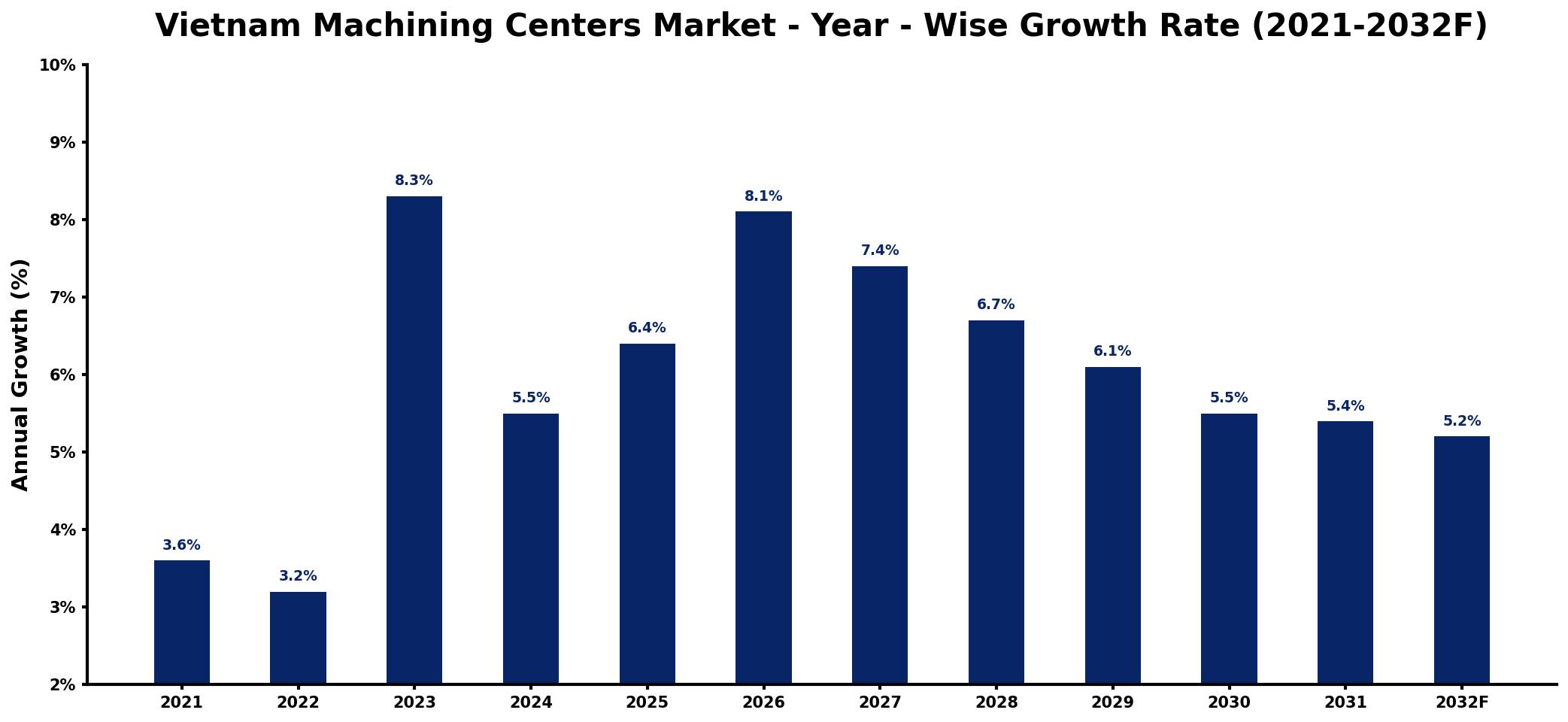
The table below presents the year‑wise growth rates along with the key drivers influencing the market
| Year | Growth Rate | Major Drivers |
| 2021 | 3.6% | Rising demand from automotive sector |
| 2022 | 3.2% | Increased investments in manufacturing |
| 2023 | 8.3% | Growing automation in production lines |
| 2024 | 5.5% | Expansion of electronics industry needs |
| 2025 | 6.4% | Surge in renewable energy projects |
| 2026 | 8.1% | Emergence of smart technology applications |
| 2027 | 7.4% | Boost in aerospace components production |
| 2028 | 6.7% | Growth in medical device manufacturing |
| 2029 | 6.1% | Heightened focus on precision engineering |
| 2030 | 5.5% | Increased exports of industrial goods |
| 2031 | 5.4% | improved processing technologies adoption |
| 2032 | 5.2% | growing emerging market penetration |
Note: Market size estimations and growth projections presented in this report are based on 6Wresearch's proprietary forecasting methodology, utilizing the latest available industry data, government publications, and primary research inputs.
Vietnam Machining Centers Market Synopsis
The Vietnam machining centers market has recently witnessed a significant surge in activity, largely fueled by the expansion of the local manufacturing landscape. Industries across various sectors are increasingly adopting advanced machining technologies to enhance efficiency and meet the demand for high-quality products.
Looking ahead, the market is poised for continued growth as companies further invest in state-of-the-art machining capabilities. This shift is not only in response to domestic needs but also to compete effectively on the international stage, reflecting the countrys commitment to positioning itself as a leader in precision engineering.
Vietnam Machining Centers Market Key Takeaways
- The market is significantly driven by the growth of precision engineering across various sectors.
- Technological advancements are becoming essential for manufacturers to maintain competitiveness.
- Increased automation is reshaping production processes in the machining industry.
- Investment in workforce skills is crucial to maximize the potential of advanced machining technologies.
- There is a growing emphasis on customized solutions to meet the specific needs of local industries.
Evaluation of Restraints in Vietnam Machining Centers Market
Despite the positive outlook, the Vietnam machining centers market encounters several restraints that could temper its growth. One notable concern is the escalating need for continuous technological innovation, which poses both financial and operational challenges for manufacturers. Investing in the latest machining technologies is essential, yet it can burden companies, especially smaller players who may lack the necessary capital. Additionally, the global competition necessitates that domestic products not only satisfy local demand but also adhere to international quality standards. Moreover, the volatile global economic landscape introduces uncertainty, impacting investment decisions and market stability.
Vietnam Machining Centers Market Trends
A significant trend shaping the Vietnam machining centers market is the rise of Industry 4.0, where automation and data exchange in manufacturing technologies are becoming increasingly prevalent. This trend emphasizes the integration of smart technologies into machining processes, enhancing precision, reducing waste, and improving overall production efficiency. Furthermore, there is a heightened focus on sustainability, with companies seeking to minimize their environmental footprint by optimizing resource usage and reducing emissions in machining operations.
Vietnam Machining Centers Market Opportunities
The landscape is rich with growth and investment opportunities, particularly in sectors such as aerospace and automotive, where precision machining is crucial. Expanding the skilled workforce is a pivotal opportunity; companies that invest in training and development will be better positioned to leverage advanced technologies. Additionally, as global firms increasingly look to Vietnam for manufacturing, local companies have the chance to engage in partnerships that can enhance capabilities and market reach. The ongoing governmental support for industrial development further sets the stage for burgeoning opportunities in the machining centers market.
Government Initiatives in the Vietnam Machining Centers Market
The Vietnamese government has undertaken several initiatives aimed at bolstering the manufacturing sector, which directly influences the machining centers market. Policies encouraging foreign direct investment (FDI) are designed to attract global players and enhance local production capabilities. Additionally, public spending in infrastructure development and technological advancement initiatives aims to strengthen the industrial base. Programs promoting workforce training in modern manufacturing techniques further enhance the competitive landscape, fostering a skilled labor pool ready to meet the demands of advanced machining technologies.
Future Insights of the Vietnam Machining Centers Market
From 2026 to 2032, the Vietnam machining centers market is expected to evolve significantly, driven by a combination of technological advancements and strategic investments in manufacturing. As industries increasingly embrace automation, there will be a growing reliance on sophisticated machining solutions capable of delivering high precision and efficiency. The competitive landscape will necessitate continuous innovation, with companies striving to differentiate themselves through cutting-edge technologies and tailored solutions. Furthermore, as Vietnam solidifies its position as a manufacturing hub, the demand for high-quality machining services will only intensify, establishing a robust market for years to come.
Vietnam Machining Centers Market Latest Developments (2025 - 2026)
The Vietnam machining centers market has seen a surge in interest, with increased activity in automation investments and partnerships aimed at enhancing local manufacturing capabilities. Companies are prioritizing the adoption of smart technologies, with several initiatives underway to integrate digital solutions into traditional machining processes. This shift not only enhances operational efficiency but also positions Vietnam favorably in the global manufacturing supply chain. As industries adapt to post-pandemic realities, the focus on high-quality, precision machining is stronger than ever.
Vietnam Machining Centers Market - Key Attractiveness of the Report
- 10 Years of Market Numbers
- Historical Data Starting from 2022 to 2025
- Base Year: 2025
- Forecast Data until 2032
- Key Performance Indicators Impacting the Market
- Major Upcoming Developments and Projects
Key Highlights of the Report:
- Vietnam Machining Centers Market Outlook
- Market Size of Vietnam Machining Centers Market, 2025
- Forecast of Vietnam Machining Centers Market, 2032
- Historical Data and Forecast of Vietnam Machining Centers Revenues & Volume for the Period 2022-2032F
- Vietnam Machining Centers Market Trend Evolution
- Vietnam Machining Centers Market Drivers and Challenges
- Vietnam Machining Centers Price Trends
- Vietnam Machining Centers Porter's Five Forces
- Vietnam Machining Centers Industry Life Cycle
- Historical Data and Forecast of Vietnam Machining Centers Market Revenues & Volume By Product for the Period 2022-2032F
- Historical Data and Forecast of Vietnam Machining Centers Market Revenues & Volume By Vertical Machining Center for the Period 2022-2032F
- Historical Data and Forecast of Vietnam Machining Centers Market Revenues & Volume By Horizontal Machining Center for the Period 2022-2032F
- Historical Data and Forecast of Vietnam Machining Centers Market Revenues & Volume By Others for the Period 2022-2032F
- Historical Data and Forecast of Vietnam Machining Centers Market Revenues & Volume By Application for the Period 2022-2032F
- Historical Data and Forecast of Vietnam Machining Centers Market Revenues & Volume By Automotive for the Period 2022-2032F
- Historical Data and Forecast of Vietnam Machining Centers Market Revenues & Volume By General Machinery for the Period 2022-2032F
- Historical Data and Forecast of Vietnam Machining Centers Market Revenues & Volume By Precision Engineering for the Period 2022-2032F
- Historical Data and Forecast of Vietnam Machining Centers Market Revenues & Volume By Transport Machinery for the Period 2022-2032F
- Historical Data and Forecast of Vietnam Machining Centers Market Revenues & Volume By Others for the Period 2022-2032F
- Vietnam Machining Centers Import Export Trade Statistics
- Market Opportunity Assessment By Product
- Market Opportunity Assessment By Application
- Vietnam Machining Centers Top Companies Market Share
- Vietnam Machining Centers Competitive Benchmarking By Technical and Operational Parameters
- Vietnam Machining Centers Company Profiles
- Vietnam Machining Centers Key Strategic Recommendations






































