Vietnam Magnesium Metal Market Size, Share & Growth Rate
The Vietnam Magnesium Metal Market was estimated at USD 489 Million in 2025 and is projected to reach USD 694 Million by 2032, growing at a CAGR of 5.1% from 2026 to 2032. This upward trajectory is primarily driven by the increasing application of magnesium alloys in the automotive and aerospace sectors, where lightweight components are increasingly prioritized to enhance fuel efficiency and reduce emissions. Additionally, the burgeoning electronics industry is contributing to the market's expansion, as magnesium's properties make it ideal for various electronic components.
Vietnam Magnesium Metal Market Year-wise Growth Rate and Key Drivers
This graph highlights how the Vietnam Magnesium Metal Market has steadily grown over the years, supported by major growth factors.
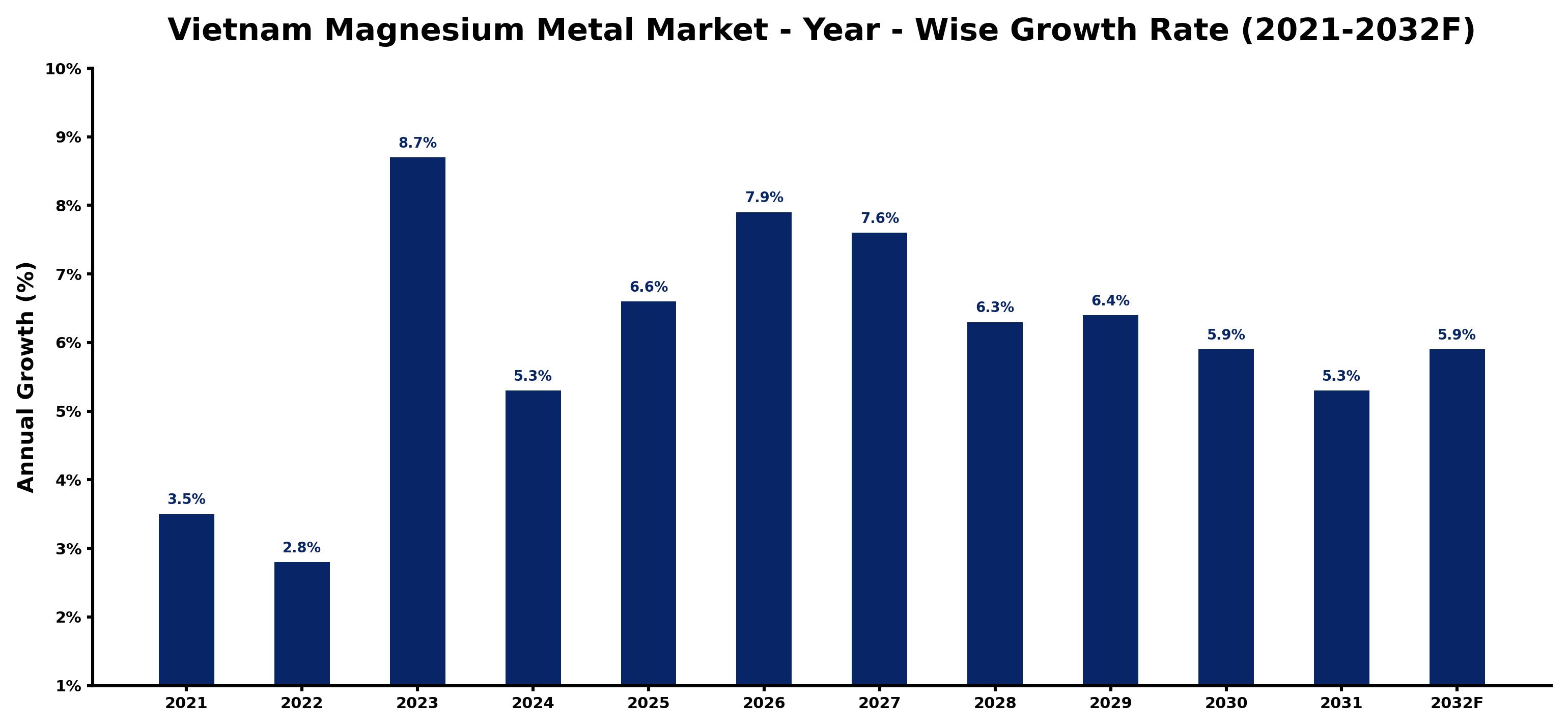
The table below presents the year‑wise growth rates along with the key drivers influencing the market
| Year | Growth Rate | Major Drivers |
| 2021 | 3.5% | Increased automotive production demand |
| 2022 | 2.8% | Construction sector growth accelerated usage |
| 2023 | 8.7% | Aerospace industry expanded magnesium applications |
| 2024 | 5.3% | Electronics manufacturing boosted material needs |
| 2025 | 6.6% | Renewable energy projects increased demand |
| 2026 | 7.9% | Consumer goods innovation drove consumption |
| 2027 | 7.6% | Infrastructure development enhanced market growth |
| 2028 | 6.3% | Healthcare applications expanded magnesium use |
| 2029 | 6.4% | Export opportunities increased market reach |
| 2030 | 5.9% | Sustainable practices drove material adoption |
| 2031 | 5.3% | Technological advancements improved production efficiency |
| 2032 | 5.9% | Collaborations with industries enhanced growth |
Note - Market size estimations and growth projections presented in this report are based on 6Wresearch’s advanced forecasting approach, validated with industry datasets as of June 2026.
Vietnam Magnesium Metal Market Synopsis
Vietnam's strategic geographic location and an abundance of natural resources are positioning the country as a significant player in the magnesium metal landscape. The drive for lightweight materials in manufacturing processes is translating into heightened demand for magnesium, especially in innovative sectors like healthcare and electronics.
However, the market is concurrently grappling with the challenge of limited domestic production capabilities. This dependence on imports places Vietnam in a precarious position regarding pricing stability and supply chain security, necessitating a strategic approach to bolster local production.
Vietnam Magnesium Metal Market Key Takeaways
- The market is set to experience substantial growth driven by the automotive and aerospace industries.
- Technological advancements are facilitating more efficient extraction and production processes.
- Environmental considerations are shaping regulations that impact market dynamics.
- Innovation in magnesium applications is expanding into electronics and healthcare sectors.
- Import dependency poses a significant challenge to pricing stability and supply chain resilience.
Evaluation of Restraints in Vietnam Magnesium Metal Market
Despite its growth potential, the Vietnam Magnesium Metal market is restrained by significant challenges. The reliance on imports for magnesium metal creates vulnerabilities in the supply chain, exposing local industries to external price fluctuations. High energy costs in Vietnam further impact the competitiveness of domestic production, making it difficult for local manufacturers to scale operations effectively. Moreover, environmental regulations surrounding magnesium extraction and processing are tightening, posing additional hurdles for compliance and operational costs.
Vietnam Magnesium Metal Market Trends
Current trends indicate a significant shift towards sustainability, with industries increasingly prioritizing eco-friendly materials. The push for lightweight components in transportation and consumer electronics has elevated the status of magnesium alloys. Additionally, innovations in recycling technologies and production methods are gaining traction, promoting a circular economy approach within the magnesium metal sector.
Vietnam Magnesium Metal Market Opportunities
As Vietnam continues to develop its industrial base, numerous growth opportunities are emerging within the magnesium metal market. Enhancements in local production capabilities can reduce import reliance while fostering job creation. Furthermore, partnerships with global players could spur technological advancements, driving efficiency and sustainability in magnesium extraction and usage. Notably, the health and wellness sector's increasing reliance on lightweight materials for medical devices presents a burgeoning avenue for investment.
Government Initiatives in the Vietnam Magnesium Metal Market
The Vietnamese government has recognized the strategic importance of lightweight materials, including magnesium, for enhancing industrial competitiveness. Various initiatives are being implemented to promote research and development within the magnesium sector. These policies aim to encourage sustainable practices in resource extraction and processing, thereby positioning Vietnam as a responsible player in the global market. Public spending is also being directed toward infrastructure improvements, which are essential for supporting the domestic production of magnesium metal.
Future Insights of the Vietnam Magnesium Metal Market
Looking ahead to 2026-2032, the Vietnam Magnesium Metal market is poised for a robust evolution. The drive towards sustainability will continue to be a pivotal factor influencing production strategies and consumer preferences. As local industries innovate and adapt, the demand for magnesium in new applications will likely rise. Additionally, as global supply chains stabilize post-COVID-19, Vietnam may strengthen its position as a key supplier of magnesium alloys, especially in sectors prioritizing weight reduction and energy efficiency.
Vietnam Magnesium Metal Market Latest Developments (May 2025 - June 2026)
Recent developments in the Vietnam Magnesium Metal market indicate a gradual recovery post-pandemic, with industries beginning to ramp up operations. There have been strides in technological innovations that enhance extraction efficiency and reduce environmental impacts. Additionally, collaborations between local manufacturers and international partners are emerging, aimed at bolstering production capabilities and expanding the application of magnesium alloys across various sectors.
Vietnam Magnesium Metal Market - Key Attractiveness of the Report
- 10 Years of Market Numbers
- Historical Data Starting from 2022 to 2025
- Base Year: 2025
- Forecast Data until 2032
- Key Performance Indicators Impacting the Market
- Major Upcoming Developments and Projects
Key Highlights of the Report:
- Vietnam Magnesium Metal Market Outlook
- Market Size of Vietnam Magnesium Metal Market, 2025
- Forecast of Vietnam Magnesium Metal Market, 2032
- Historical Data and Forecast of Vietnam Magnesium Metal Revenues & Volume for the Period 2022-2032F
- Vietnam Magnesium Metal Market Trend Evolution
- Vietnam Magnesium Metal Market Drivers and Challenges
- Vietnam Magnesium Metal Price Trends
- Vietnam Magnesium Metal Porter's Five Forces
- Vietnam Magnesium Metal Industry Life Cycle
- Historical Data and Forecast of Vietnam Magnesium Metal Market Revenues & Volume By Application for the Period 2022-2032F
- Historical Data and Forecast of Vietnam Magnesium Metal Market Revenues & Volume By Die Casting for the Period 2022-2032F
- Historical Data and Forecast of Vietnam Magnesium Metal Market Revenues & Volume By Aluminum Alloys for the Period 2022-2032F
- Historical Data and Forecast of Vietnam Magnesium Metal Market Revenues & Volume By Titanium Reduction for the Period 2022-2032F
- Historical Data and Forecast of Vietnam Magnesium Metal Market Revenues & Volume By Iron & Steel Making for the Period 2022-2032F
- Historical Data and Forecast of Vietnam Magnesium Metal Market Revenues & Volume By Others for the Period 2022-2032F
- Historical Data and Forecast of Vietnam Magnesium Metal Market Revenues & Volume By End-user Industry for the Period 2022-2032F
- Historical Data and Forecast of Vietnam Magnesium Metal Market Revenues & Volume By Automotive for the Period 2022-2032F
- Historical Data and Forecast of Vietnam Magnesium Metal Market Revenues & Volume By Aerospace for the Period 2022-2032F
- Historical Data and Forecast of Vietnam Magnesium Metal Market Revenues & Volume By Electronics for the Period 2022-2032F
- Historical Data and Forecast of Vietnam Magnesium Metal Market Revenues & Volume By Sports for the Period 2022-2032F
- Historical Data and Forecast of Vietnam Magnesium Metal Market Revenues & Volume By Medical for the Period 2022-2032F
- Historical Data and Forecast of Vietnam Magnesium Metal Market Revenues & Volume By Others for the Period 2022-2032F
- Vietnam Magnesium Metal Import Export Trade Statistics
- Market Opportunity Assessment By Application
- Market Opportunity Assessment By End-user Industry
- Vietnam Magnesium Metal Top Companies Market Share
- Vietnam Magnesium Metal Competitive Benchmarking By Technical and Operational Parameters
- Vietnam Magnesium Metal Company Profiles
- Vietnam Magnesium Metal Key Strategic Recommendations






































