Vietnam Magnesium Sulfate Market Size, Share & Growth Rate
The Vietnam Magnesium Sulfate Market was estimated at USD 464 Million in 2025 and is projected to reach USD 656 Million by 2032, growing at a CAGR of 5.1% from 2026 to 2032. This growth trajectory is predominantly driven by the agricultural sector's increasing adoption of magnesium sulfate fertilizers, which play a vital role in enhancing soil quality and crop yield. Furthermore, the rising demand for pharmaceutical-grade magnesium sulfate within healthcare applications has bolstered market potential, aligning with Vietnam's broader health and wellness trends.
Vietnam Magnesium Sulfate Market Year-wise Growth Rate and Key Drivers
This graph highlights how the Vietnam Magnesium Sulfate Market has steadily grown over the years, supported by major growth factors.
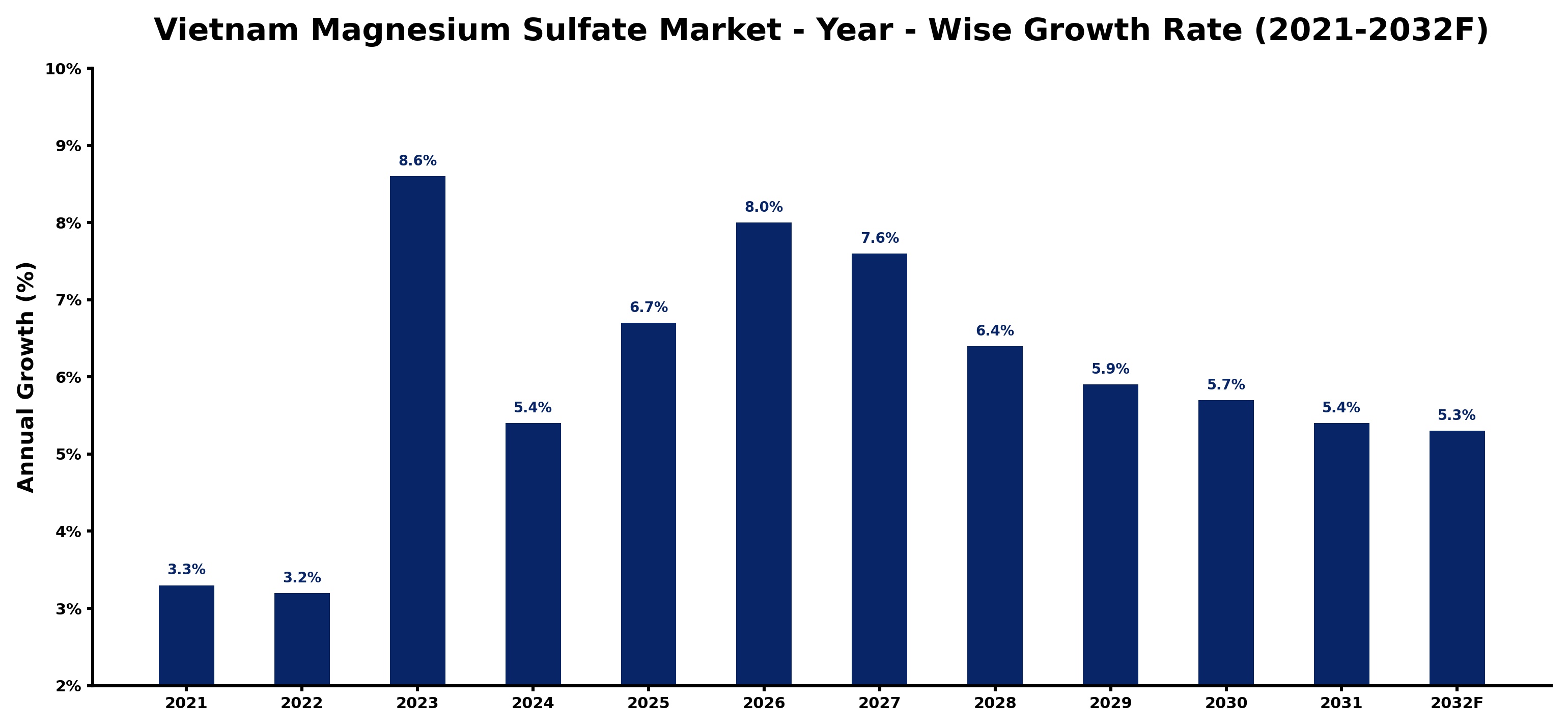
The table below presents the year‑wise growth rates along with the key drivers influencing the market
| Year | Growth Rate | Major Drivers |
| 2021 | 3.3% | Government infrastructure modernization initiatives |
| 2022 | 3.2% | Growing renewable energy integration projects |
| 2023 | 8.6% | Expansion of commercial construction activities |
| 2024 | 5.4% | Increasing industrial automation investments |
| 2025 | 6.7% | Increasing smart city development projects |
| 2026 | 8.0% | Increasing industrial infrastructure investments |
| 2027 | 7.6% | Increasing industrial automation investments |
| 2028 | 6.4% | Increasing industrial infrastructure investments |
| 2029 | 5.9% | Increasing smart city development projects |
| 2030 | 5.7% | Expansion of manufacturing activities |
| 2031 | 5.4% | Growing renewable energy integration projects |
| 2032 | 5.3% | Expansion of transportation and logistics networks |
Note - Market size estimations and growth projections presented in this report are based on 6Wresearch’s advanced forecasting approach, validated with industry datasets as of June 2026.
Vietnam Magnesium Sulfate Market Synopsis
The strongest force shaping the Vietnam Magnesium Sulfate Market is the booming agricultural sector. As more Vietnamese farmers recognize the benefits of magnesium sulfate in improving soil health and crop productivity, the demand for this essential compound continues to expand.
Simultaneously, healthcare applications such as Epsom salt baths and treatments have increased the need for high-quality magnesium sulfate. This dual focus on agriculture and healthcare provides a stable foundation for sustained market growth in the years ahead.
Vietnam Magnesium Sulfate Market Key Takeaways
- The market is poised for growth, driven primarily by agricultural applications and healthcare demand.
- Government initiatives promoting sustainable farming practices are fostering increased adoption of magnesium sulfate.
- Education and outreach efforts are critical for maximizing the benefits of magnesium sulfate among local farmers.
- Price fluctuations and competitiveness remain essential factors influencing market dynamics.
- As the healthcare sector expands, pharmaceutical-grade magnesium sulfate applications are expected to rise significantly.
Evaluation of Restraints in Vietnam Magnesium Sulfate Market
Despite its promising growth trajectory, the Vietnam Magnesium Sulfate Market is not without challenges. Many local farmers may lack a comprehensive understanding of magnesium sulfate's benefits, resulting in underutilization. Therefore, education and outreach are critical to ensure proper application and dosage, which is essential for maximizing the compound's advantages. Additionally, market competitiveness leads to price fluctuations, complicating the landscape for both producers and consumers. Consequently, addressing these limitations is vital for maintaining stability and fostering continued growth in the market.
Vietnam Magnesium Sulfate Market Trends
A notable trend within the Vietnam Magnesium Sulfate Market is the increasing shift towards sustainable agriculture. Farmers are becoming more conscious of their environmental impact and are actively seeking eco-friendly solutions to improve soil health. In tandem with this, technological advancements in production processes are enhancing the quality and availability of magnesium sulfate, further driving its adoption across sectors. Additionally, the expanding healthcare industry is leaning towards natural and organic compounds, paving the way for a broader acceptance of magnesium sulfate in therapeutic applications.
Vietnam Magnesium Sulfate Market Opportunities
Opportunities within the Vietnam Magnesium Sulfate Market are robust, particularly in the realms of sustainable farming and healthcare. By investing in educational programs that highlight the benefits of magnesium sulfate, stakeholders can stimulate demand among farmers and health professionals alike. Moreover, with the increasing integration of magnesium sulfate in innovative agricultural products and medical treatments, companies can explore niche markets that address specific consumer needs, thus positioning themselves as leaders in a growing field.
Government Initiatives in the Vietnam Magnesium Sulfate Market
The Vietnamese government has recognized the importance of sustainable agricultural practices, which has led to various initiatives encouraging the use of environmentally friendly fertilizers like magnesium sulfate. Policies aimed at promoting research and development in agriculture, as well as investment in agricultural technologies, are currently in place. These governmental efforts are essential for facilitating growth in the magnesium sulfate sector and ensuring that farmers have access to the necessary resources and knowledge to optimize crop yields.
Future Insights of the Vietnam Magnesium Sulfate Market
Looking ahead to 2026-2032, the Vietnam Magnesium Sulfate Market is anticipated to undergo significant transformation, fueled by sustained growth in both agricultural and healthcare sectors. The emphasis on sustainable farming practices and organic fertilizers will continue to drive demand for magnesium sulfate, while the expanding healthcare market will open new avenues for pharmaceutical applications. As these trends solidify, the market is expected to evolve with greater focus on quality, innovation, and adaptability, positioning itself as a key player in Vietnam's economic landscape.
Vietnam Magnesium Sulfate Market Latest Developments (May 2025 - June 2026)
In recent months, the Vietnam Magnesium Sulfate Market has witnessed increased collaboration among stakeholders aimed at enhancing product quality and market accessibility. Initiatives focused on educating farmers about the benefits of magnesium sulfate have gained traction, thereby promoting wider acceptance of the compound. Furthermore, ongoing research in the healthcare sector is fostering innovative applications of magnesium sulfate, contributing to its resilience in the post-pandemic recovery phase. As these developments unfold, the market continues to adapt and grow, driven by evolving consumer demands.
Vietnam Magnesium Sulfate Market - Key Attractiveness of the Report
- 10 Years of Market Numbers
- Historical Data Starting from 2022 to 2025
- Base Year: 2025
- Forecast Data until 2032
- Key Performance Indicators Impacting the Market
- Major Upcoming Developments and Projects
Key Highlights of the Report:
- Vietnam Magnesium Sulfate Market Outlook
- Market Size of Vietnam Magnesium Sulfate Market, 2025
- Forecast of Vietnam Magnesium Sulfate Market, 2032
- Historical Data and Forecast of Vietnam Magnesium Sulfate Revenues & Volume for the Period 2022-2032F
- Vietnam Magnesium Sulfate Market Trend Evolution
- Vietnam Magnesium Sulfate Market Drivers and Challenges
- Vietnam Magnesium Sulfate Price Trends
- Vietnam Magnesium Sulfate Porter's Five Forces
- Vietnam Magnesium Sulfate Industry Life Cycle
- Historical Data and Forecast of Vietnam Magnesium Sulfate Market Revenues & Volume By Form for the Period 2022-2032F
- Historical Data and Forecast of Vietnam Magnesium Sulfate Market Revenues & Volume By Crystal for the Period 2022-2032F
- Historical Data and Forecast of Vietnam Magnesium Sulfate Market Revenues & Volume By Powder for the Period 2022-2032F
- Historical Data and Forecast of Vietnam Magnesium Sulfate Market Revenues & Volume By Granules for the Period 2022-2032F
- Historical Data and Forecast of Vietnam Magnesium Sulfate Market Revenues & Volume By Types for the Period 2022-2032F
- Historical Data and Forecast of Vietnam Magnesium Sulfate Market Revenues & Volume By Heptahydrate for the Period 2022-2032F
- Historical Data and Forecast of Vietnam Magnesium Sulfate Market Revenues & Volume By Anhydrous for the Period 2022-2032F
- Historical Data and Forecast of Vietnam Magnesium Sulfate Market Revenues & Volume By Monohydrate for the Period 2022-2032F
- Historical Data and Forecast of Vietnam Magnesium Sulfate Market Revenues & Volume By Others for the Period 2022-2032F
- Historical Data and Forecast of Vietnam Magnesium Sulfate Market Revenues & Volume By Applications for the Period 2022-2032F
- Historical Data and Forecast of Vietnam Magnesium Sulfate Market Revenues & Volume By Fertilizer for the Period 2022-2032F
- Historical Data and Forecast of Vietnam Magnesium Sulfate Market Revenues & Volume By Medical for the Period 2022-2032F
- Historical Data and Forecast of Vietnam Magnesium Sulfate Market Revenues & Volume By Food Additive for the Period 2022-2032F
- Historical Data and Forecast of Vietnam Magnesium Sulfate Market Revenues & Volume By Industrial for the Period 2022-2032F
- Historical Data and Forecast of Vietnam Magnesium Sulfate Market Revenues & Volume By Chemical for the Period 2022-2032F
- Historical Data and Forecast of Vietnam Magnesium Sulfate Market Revenues & Volume By Others for the Period 2022-2032F
- Vietnam Magnesium Sulfate Import Export Trade Statistics
- Market Opportunity Assessment By Form
- Market Opportunity Assessment By Types
- Market Opportunity Assessment By Applications
- Vietnam Magnesium Sulfate Top Companies Market Share
- Vietnam Magnesium Sulfate Competitive Benchmarking By Technical and Operational Parameters
- Vietnam Magnesium Sulfate Company Profiles
- Vietnam Magnesium Sulfate Key Strategic Recommendations






































