Vietnam Malt Extract Market Size, Share & Growth Rate
The Vietnam Malt Extract Market was estimated at USD 469 Million in 2025 and is projected to reach USD 661 Million by 2032, growing at a CAGR of 5.0% from 2026 to 2032. This growth trajectory is bolstered by an expanding food and beverage sector, particularly within brewing and bakery applications, where malt extract plays a pivotal role. The increasing consumer preference for natural sweeteners and functional ingredients further enhances the market's potential, driving innovation and quality across product lines.
Vietnam Malt Extract Market Year-wise Growth Rate and Key Drivers
This graph highlights how the Vietnam Malt Extract Market has steadily grown over the years, supported by major growth factors.
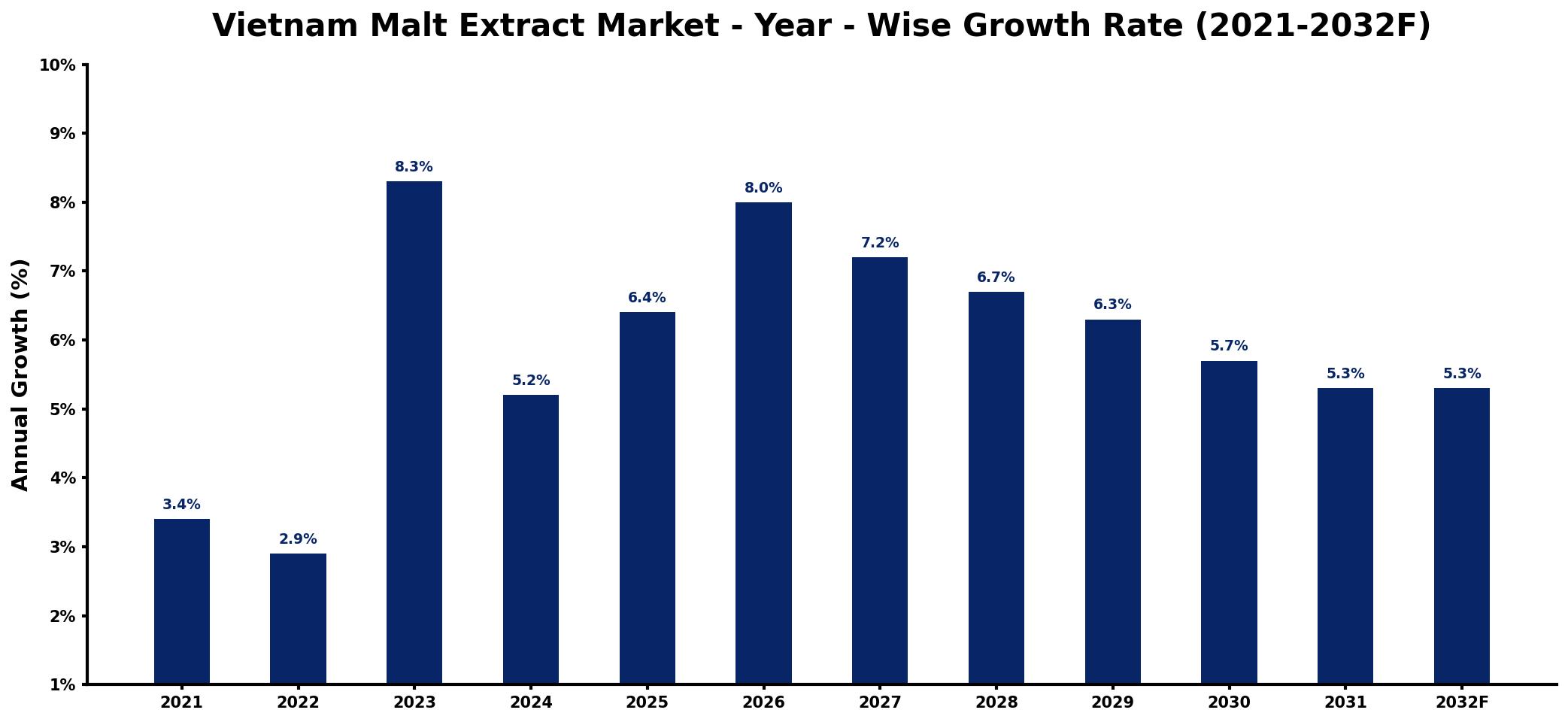
The table below presents the year‑wise growth rates along with the key drivers influencing the market
| Year | Growth Rate | Major Drivers |
| 2021 | 3.4% | Rising consumer health consciousness |
| 2022 | 2.9% | Increasing demand for natural ingredients |
| 2023 | 8.3% | Growth in beverage manufacturing sector |
| 2024 | 5.2% | Expansion of food processing industry |
| 2025 | 6.4% | Surge in organic product popularity |
| 2026 | 8.0% | Investment in local production facilities |
| 2027 | 7.2% | Emergence of new market players |
| 2028 | 6.7% | Growing interest in functional foods |
| 2029 | 6.3% | Strengthening distribution networks nationwide |
| 2030 | 5.7% | Adoption of sustainable sourcing practices |
| 2031 | 5.3% | Boost in export opportunities abroad |
| 2032 | 5.3% | Development of innovative product formulations |
Note: Market size estimations and growth projections presented in this report are based on 6Wresearch's proprietary forecasting methodology, utilizing the latest available industry data, government publications, and primary research inputs.
Vietnam Malt Extract Market Synopsis
Recently, the Vietnam malt extract market has experienced a significant shift, propelled by a rising demand for healthier food alternatives. As consumers become increasingly health-conscious, the use of malt extract in various food products, from beverages to baked goods, continues to gain momentum. Looking ahead, the market is poised to evolve further, fueled by technological advancements and a growing inclination toward premium malt-based products.
Malt extract serves as a cornerstone in many Vietnamese food and beverage applications, providing not only sweetness but also essential nutrients. Its versatility allows manufacturers to explore novel applications, expanding beyond traditional uses and catering to diverse consumer preferences, thus ensuring the sustainability of growth in this competitive market.
Vietnam Malt Extract Market Key Takeaways
- The market is driven by the increasing demand for natural sweeteners in food production.
- Innovative product formulations leveraging malt extract are emerging across various sectors.
- The brewing industry remains a significant contributor to market growth.
- Consumer health trends are shifting focus toward nutrient-rich, natural ingredients.
- Technological advancements are facilitating improved production efficiencies.
Evaluation of Restraints in Vietnam Malt Extract Market
Despite its growth, the Vietnam malt extract market faces certain constraints. The reliance on imported raw materials can lead to supply chain vulnerabilities and pricing pressures. Additionally, traditional preferences for local ingredients pose challenges for market penetration of malt extract. Manufacturers must navigate these hurdles by emphasizing quality and the unique benefits of malt extract to secure consumer buy-in and market share.
Vietnam Malt Extract Market Trends
One of the defining trends shaping the Vietnam malt extract market is the shift towards clean label products. Consumers are increasingly scrutinizing ingredient lists, pushing manufacturers to highlight natural components like malt extract. Furthermore, the rise of craft brewing has spurred demand for specialty malt extracts, allowing for greater customization and unique flavor profiles in beverages. Finally, the health and wellness trend is fostering innovation, with malt extract being incorporated into functional foods aimed at enhancing nutritional value.
Vietnam Malt Extract Market Opportunities
Opportunities for growth within the Vietnam malt extract market lie in expanding product applications, particularly in functional and health-oriented products. The burgeoning interest in craft beverages presents a lucrative avenue for malt extract suppliers to partner with local brewers. Moreover, the development of malt extract for specialized dietary segments, such as gluten-free options, can attract a wider consumer base, driving further market diversification and investment potential.
Government Initiatives in the Vietnam Malt Extract Market
The Vietnamese government has actively supported the food and beverage sector through various initiatives aimed at enhancing product quality and safety standards. These policies encourage the use of local ingredients, which can indirectly benefit the malt extract market by promoting its usage in conjunction with other domestic products. Furthermore, investment in agricultural infrastructure aims to bolster the supply chain, ultimately leading to a more resilient malt extract market.
Future Insights of the Vietnam Malt Extract Market
Looking ahead to 2026-2032, the Vietnam malt extract market is anticipated to thrive, driven by an increasing embrace of healthier consumption patterns and product innovation. As local producers leverage technological advancements and respond to evolving consumer demands, the market's landscape will likely shift towards more premium offerings. Additionally, sustainability initiatives within the food production chain may further reinforce the market's growth, as brands prioritize environmentally-friendly sourcing and production practices.
Vietnam Malt Extract Market Latest Developments (2025 - 2026)
The Vietnam malt extract market has witnessed dynamic developments, with several companies focusing on enhancing their product lines to meet health-conscious consumer preferences. Recent industry movements include partnerships aimed at developing innovative malt-based formulations and investments in production technology to streamline processes. Additionally, a noticeable increase in craft brewing activities across the country is further invigorating demand for malt extract, as brewers seek out unique flavors and high-quality ingredients.
Vietnam Malt Extract Market - Key Attractiveness of the Report
- 10 Years of Market Numbers
- Historical Data Starting from 2022 to 2025
- Base Year: 2025
- Forecast Data until 2032
- Key Performance Indicators Impacting the Market
- Major Upcoming Developments and Projects
Key Highlights of the Report:
- Vietnam Malt Extract Market Outlook
- Market Size of Vietnam Malt Extract Market, 2025
- Forecast of Vietnam Malt Extract Market, 2032
- Historical Data and Forecast of Vietnam Malt Extract Revenues & Volume for the Period 2022-2032F
- Vietnam Malt Extract Market Trend Evolution
- Vietnam Malt Extract Market Drivers and Challenges
- Vietnam Malt Extract Price Trends
- Vietnam Malt Extract Porter's Five Forces
- Vietnam Malt Extract Industry Life Cycle
- Historical Data and Forecast of Vietnam Malt Extract Market Revenues & Volume By Application for the Period 2022-2032F
- Historical Data and Forecast of Vietnam Malt Extract Market Revenues & Volume By Bakery for the Period 2022-2032F
- Historical Data and Forecast of Vietnam Malt Extract Market Revenues & Volume By Confectionary for the Period 2022-2032F
- Historical Data and Forecast of Vietnam Malt Extract Market Revenues & Volume By Beverages for the Period 2022-2032F
- Historical Data and Forecast of Vietnam Malt Extract Market Revenues & Volume By Animal Feed for the Period 2022-2032F
- Historical Data and Forecast of Vietnam Malt Extract Market Revenues & Volume By Pharmaceuticals for the Period 2022-2032F
- Historical Data and Forecast of Vietnam Malt Extract Market Revenues & Volume By Source for the Period 2022-2032F
- Historical Data and Forecast of Vietnam Malt Extract Market Revenues & Volume By Barley for the Period 2022-2032F
- Historical Data and Forecast of Vietnam Malt Extract Market Revenues & Volume By Wheat for the Period 2022-2032F
- Historical Data and Forecast of Vietnam Malt Extract Market Revenues & Volume By Rice for the Period 2022-2032F
- Historical Data and Forecast of Vietnam Malt Extract Market Revenues & Volume By Rye for the Period 2022-2032F
- Historical Data and Forecast of Vietnam Malt Extract Market Revenues & Volume By Product Form for the Period 2022-2032F
- Historical Data and Forecast of Vietnam Malt Extract Market Revenues & Volume By Dry for the Period 2022-2032F
- Historical Data and Forecast of Vietnam Malt Extract Market Revenues & Volume By Liquid for the Period 2022-2032F
- Historical Data and Forecast of Vietnam Malt Extract Market Revenues & Volume By Product Type for the Period 2022-2032F
- Historical Data and Forecast of Vietnam Malt Extract Market Revenues & Volume By Standard for the Period 2022-2032F
- Historical Data and Forecast of Vietnam Malt Extract Market Revenues & Volume By Speciality for the Period 2022-2032F
- Vietnam Malt Extract Import Export Trade Statistics
- Market Opportunity Assessment By Application
- Market Opportunity Assessment By Source
- Market Opportunity Assessment By Product Form
- Market Opportunity Assessment By Product Type
- Vietnam Malt Extract Top Companies Market Share
- Vietnam Malt Extract Competitive Benchmarking By Technical and Operational Parameters
- Vietnam Malt Extract Company Profiles
- Vietnam Malt Extract Key Strategic Recommendations






































