Vietnam Manganese Mining Market Size, Share & Growth Rate
The Vietnam Manganese Mining Market was estimated at USD 601 Million in 2025 and is projected to reach USD 853 Million by 2032, growing at a CAGR of 5.1% from 2026 to 2032. This growth trajectory is propelled by increasing domestic and international demand for manganese, primarily fueled by its application in steel production, battery manufacturing, and emerging green technologies. The ongoing investments in infrastructure and energy sectors in Vietnam further reinforce this upward trend.
Vietnam Manganese Mining Market Year-wise Growth Rate and Key Drivers
This graph highlights how the Vietnam Manganese Mining Market has steadily grown over the years, supported by major growth factors.
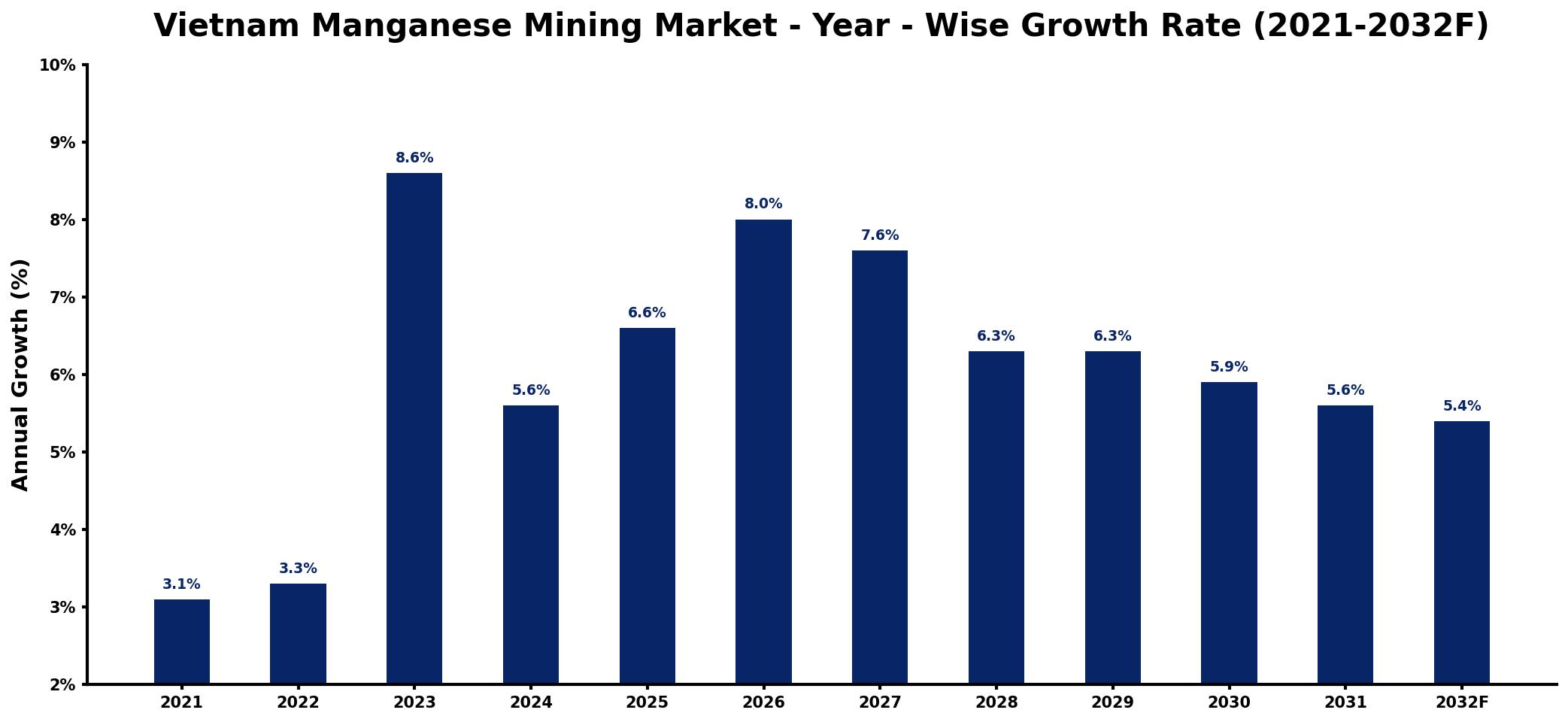
The table below presents the year‑wise growth rates along with the key drivers influencing the market
| Year | Growth Rate | Major Drivers |
| 2021 | 3.1% | Rising demand from steel industry |
| 2022 | 3.3% | Increased investments in infrastructure |
| 2023 | 8.6% | Surge in renewable energy projects |
| 2024 | 5.6% | Growth in electric vehicle production |
| 2025 | 6.6% | Expansion of battery manufacturing capacity |
| 2026 | 8.0% | Boost in global industrial activities |
| 2027 | 7.6% | Higher demand from construction sector |
| 2028 | 6.3% | Increased exports to regional markets |
| 2029 | 6.3% | rising infrastructure development spending |
| 2030 | 5.9% | rising procurement volume requirements |
| 2031 | 5.6% | Rising interest in sustainable materials |
| 2032 | 5.4% | Increased focus on recycling initiatives |
Note: Market size estimations and growth projections presented in this report are based on 6Wresearch's proprietary forecasting methodology, utilizing the latest available industry data, government publications, and primary research inputs.
Vietnam Manganese Mining Market Synopsis
Vietnam is endowed with manganese-rich deposits, which are critical for the burgeoning steel industry. As one of the key components that enhance the strength and durability of steel, manganese is essential for various industrial applications, driving significant investment in mining operations throughout the country.
The market is not only vital for domestic consumption but also plays a crucial role in supplying manganese to global markets. As Vietnamese manufacturers adopt modern, sustainable mining techniques, the ability to efficiently extract manganese ore enhances the country's position in the global mining landscape.
Vietnam Manganese Mining Market Key Takeaways
- The market is driven by strong demand from the steel and renewable energy sectors.
- Technological advancements in mining practices support sustainable operations.
- Vietnam's rich manganese deposits position it as a competitive player in the global market.
- COVID-19 disruptions highlighted the industry's adaptability and resilience.
- International collaborations are enhancing Vietnam's manganese mining capabilities.
Evaluation of Restraints in Vietnam Manganese Mining Market
While the Vietnam manganese mining market presents significant growth opportunities, it faces restraints related to environmental considerations and compliance with sustainable mining practices. Stricter regulations regarding environmental impact require miners to invest in cleaner technologies and operational modifications. Additionally, the volatility of global demand can create uncertainties for local producers, necessitating strategic planning and adaptability to market fluctuations.
Vietnam Manganese Mining Market Trends
Key trends shaping the Vietnam manganese mining market include a shift towards sustainable mining practices and increased investment in technology that enhances ore extraction efficiency. The rising popularity of electric vehicles and energy storage systems is also boosting demand for manganese in battery production. Furthermore, there is a growing emphasis on local sourcing and reduced reliance on imports, fostering a more self-sufficient manganese supply chain.
Vietnam Manganese Mining Market Opportunities
The expanding sectors of construction, automotive, and renewable energy present significant growth opportunities for the Vietnam manganese mining market. Investments in infrastructure development, driven by government initiatives, further amplify the potential for manganese usage. Additionally, the growing emphasis on green technologies offers prospects for manganese as a key component in the energy transition, particularly in battery applications.
Government Initiatives in the Vietnam Manganese Mining Market
The Vietnamese government has introduced several initiatives to promote sustainable mining practices and enhance the efficiency of mineral resource utilization. Policies aimed at attracting foreign investment in the mining sector are being implemented, along with regulations that encourage environmentally responsible operations. Public spending on infrastructure projects creates a favorable backdrop for increased manganese demand and further development of the mining industry.
Future Insights of the Vietnam Manganese Mining Market
Looking ahead to 2026-2032, the Vietnam manganese mining market is set to continue its growth trajectory, driven by the increasing demand for high-quality manganese in various industrial applications. The integration of innovative mining technologies and sustainable practices will likely position Vietnam as a more significant player in the global manganese supply chain. Additionally, the emphasis on green energy solutions will create new avenues for manganese usage, further underpinning the market's expansion.
Vietnam Manganese Mining Market Latest Developments (2025 - 2026)
In the recent months, the Vietnam manganese mining market has seen a notable shift towards adopting advanced technologies that enhance operational efficiency and environmental sustainability. Companies are exploring partnerships to develop innovative mining solutions, focusing on reducing environmental impacts while optimizing production outputs. Furthermore, there has been a concerted effort to secure international supply chains in response to evolving global market demands.
Vietnam Manganese Mining Market - Key Attractiveness of the Report
- 10 Years of Market Numbers
- Historical Data Starting from 2022 to 2025
- Base Year: 2025
- Forecast Data until 2032
- Key Performance Indicators Impacting the Market
- Major Upcoming Developments and Projects
Key Highlights of the Report:
- Vietnam Manganese Mining Market Outlook
- Market Size of Vietnam Manganese Mining Market, 2025
- Forecast of Vietnam Manganese Mining Market, 2032
- Historical Data and Forecast of Vietnam Manganese Mining Revenues & Volume for the Period 2022-2032F
- Vietnam Manganese Mining Market Trend Evolution
- Vietnam Manganese Mining Market Drivers and Challenges
- Vietnam Manganese Mining Price Trends
- Vietnam Manganese Mining Porter's Five Forces
- Vietnam Manganese Mining Industry Life Cycle
- Historical Data and Forecast of Vietnam Manganese Mining Market Revenues & Volume By Application for the Period 2022-2032F
- Historical Data and Forecast of Vietnam Manganese Mining Market Revenues & Volume By Alloys for the Period 2022-2032F
- Historical Data and Forecast of Vietnam Manganese Mining Market Revenues & Volume By Othes for the Period 2022-2032F
- Vietnam Manganese Mining Import Export Trade Statistics
- Market Opportunity Assessment By Application
- Vietnam Manganese Mining Top Companies Market Share
- Vietnam Manganese Mining Competitive Benchmarking By Technical and Operational Parameters
- Vietnam Manganese Mining Company Profiles
- Vietnam Manganese Mining Key Strategic Recommendations






































