Vietnam Manual Pruning Shears Market Size, Share & Growth Rate
The Vietnam Manual Pruning Shears Market was estimated at USD 445 Million in 2025 and is projected to reach USD 627 Million by 2032, growing at a CAGR of 5.0% from 2026 to 2032. This anticipated growth trajectory is largely influenced by the robust agricultural sector that underpins Vietnam's economy. The increasing embrace of modern farming techniques and the rising popularity of gardening and landscaping among homeowners further fuel demand for these essential tools.
Vietnam Manual Pruning Shears Market Year-wise Growth Rate and Key Drivers
This graph highlights how the Vietnam Manual Pruning Shears Market has steadily grown over the years, supported by major growth factors.
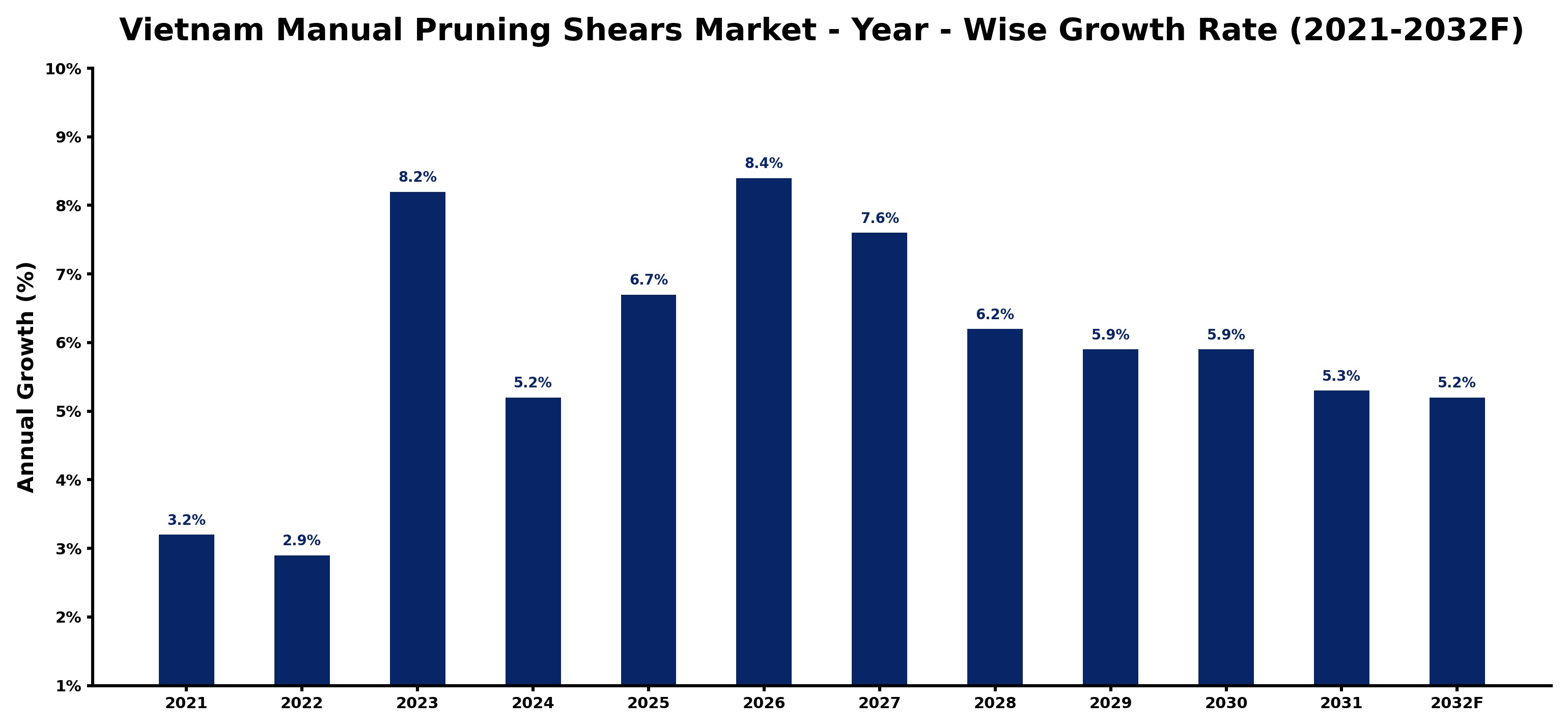
The table below presents the year‑wise growth rates along with the key drivers influencing the market
| Year | Growth Rate | Major Drivers |
| 2021 | 3.2% | Increasing industrial infrastructure investments |
| 2022 | 2.9% | Growing urbanization and commercial development |
| 2023 | 8.2% | Rising electricity demand across industries |
| 2024 | 5.2% | Expansion of transportation and logistics networks |
| 2025 | 6.7% | Expansion of commercial construction activities |
| 2026 | 8.4% | Increasing smart city development projects |
| 2027 | 7.6% | Increasing smart city development projects |
| 2028 | 6.2% | Rapid growth in telecom and data center sectors |
| 2029 | 5.9% | Increasing industrial infrastructure investments |
| 2030 | 5.9% | Expansion of commercial construction activities |
| 2031 | 5.3% | Rising electricity demand across industries |
| 2032 | 5.2% | Increasing industrial infrastructure investments |
Note - Market size estimations and growth projections presented in this report are based on 6Wresearch's advanced forecasting approach, validated with industry datasets as of June 2026.
Vietnam Manual Pruning Shears Market Synopsis
The most significant force currently shaping the Vietnam Manual Pruning Shears market is the agricultural sector's evolution. As farmers strive to enhance productivity through improved maintenance practices, the demand for efficient pruning tools is more pronounced than ever. Coupled with a burgeoning interest in horticulture and landscaping, the market finds itself in a fertile environment for growth.
Moreover, technological advancements in shear design are revolutionizing how these tools are perceived and utilized. Farmers and gardeners alike are increasingly turning to ergonomically designed, durable shears that enhance performance and comfort, thereby contributing to overall market expansion.
Vietnam Manual Pruning Shears Market Key Takeaways
- The market is driven by the evolving agricultural landscape in Vietnam, emphasizing improved crop management.
- Technological innovations in shear design are enhancing product appeal and user experience.
- There is a growing trend among homeowners towards gardening and landscaping, further boosting demand.
- Despite challenges, the market remains resilient with a focus on adapting to modern agricultural practices.
- Government initiatives aimed at supporting the agricultural sector also provide a favorable backdrop for market growth.
Evaluation of Restraints in Vietnam Manual Pruning Shears Market
While the market exhibits promising growth, it also faces notable restraints. Fluctuations in labor availability and associated costs can impact the economic viability of manual pruning practices. Additionally, the rise of automated pruning solutions presents a competitive challenge, with some farmers considering these technologies as more efficient alternatives. These factors could potentially stifle market expansion if not addressed through strategic initiatives and innovation.
Vietnam Manual Pruning Shears Market Trends
Emerging trends within the Vietnam Manual Pruning Shears market include an increasing focus on ergonomic design that not only enhances usability but also minimizes fatigue during prolonged use. The integration of lightweight materials is gaining traction, appealing to both commercial users and hobbyist gardeners. Furthermore, sustainability is becoming a crucial consideration, as manufacturers explore eco-friendly materials and production processes to meet growing consumer demands.
Vietnam Manual Pruning Shears Market Opportunities
The market presents numerous opportunities for growth and investment. As urbanization accelerates, the increasing number of residential gardening and landscaping projects signals a burgeoning consumer base. Additionally, the potential to tap into e-commerce channels can enhance accessibility and reach for manufacturers and distributors. Establishing partnerships with agricultural cooperatives and gardening communities could also provide strategic avenues for market penetration.
Government Initiatives in the Vietnam Manual Pruning Shears Market
The Vietnamese government has initiated several policies aimed at bolstering the agricultural sector, which inherently supports the manual pruning shears market. These initiatives focus on improving agricultural productivity through funding, training programs, and the promotion of modern farming practices. Increased public spending in agriculture further serves to create a conducive environment for the growth of the manual pruning shears market.
Future Insights of the Vietnam Manual Pruning Shears Market
Looking ahead to 2026-2032, the Vietnam Manual Pruning Shears market is set for sustained expansion, driven by an increasingly sophisticated agricultural sector and the growing significance of horticultural practices among urban dwellers. As product innovation continues to evolve, the market will likely see enhanced competition, resulting in improved offerings for consumers. Adapting to the changing landscape will be key for stakeholders aiming to leverage the growth potential of this vital market.
Vietnam Manual Pruning Shears Market Latest Developments (May 2025 - June 2026)
Recent industry developments indicate a shift towards innovation in the manual pruning shears segment, with manufacturers investing in research and development to introduce new ergonomic designs. Additionally, there is an observable rise in the adoption of online sales platforms, facilitating broader market access for consumers. As the industry adjusts post-COVID-19, the focus appears to be on reinforcing supply chains and enhancing distribution capabilities to meet growing demand.
Vietnam Manual Pruning Shears Market - Key Attractiveness of the Report
- 10 Years of Market Numbers
- Historical Data Starting from 2022 to 2025
- Base Year: 2025
- Forecast Data until 2032
- Key Performance Indicators Impacting the Market
- Major Upcoming Developments and Projects
Key Highlights of the Report:
- Vietnam Manual Pruning Shears Market Outlook
- Market Size of Vietnam Manual Pruning Shears Market, 2025
- Forecast of Vietnam Manual Pruning Shears Market, 2032
- Historical Data and Forecast of Vietnam Manual Pruning Shears Revenues & Volume for the Period 2022-2032F
- Vietnam Manual Pruning Shears Market Trend Evolution
- Vietnam Manual Pruning Shears Market Drivers and Challenges
- Vietnam Manual Pruning Shears Price Trends
- Vietnam Manual Pruning Shears Porter's Five Forces
- Vietnam Manual Pruning Shears Industry Life Cycle
- Historical Data and Forecast of Vietnam Manual Pruning Shears Market Revenues & Volume By Type for the Period 2022-2032F
- Historical Data and Forecast of Vietnam Manual Pruning Shears Market Revenues & Volume By Pruning Shears for the Period 2022-2032F
- Historical Data and Forecast of Vietnam Manual Pruning Shears Market Revenues & Volume By Hedge Shears for the Period 2022-2032F
- Historical Data and Forecast of Vietnam Manual Pruning Shears Market Revenues & Volume By Lopping Shears for the Period 2022-2032F
- Historical Data and Forecast of Vietnam Manual Pruning Shears Market Revenues & Volume By Long Reach Pruners for the Period 2022-2032F
- Historical Data and Forecast of Vietnam Manual Pruning Shears Market Revenues & Volume By Application for the Period 2022-2032F
- Historical Data and Forecast of Vietnam Manual Pruning Shears Market Revenues & Volume By Household for the Period 2022-2032F
- Historical Data and Forecast of Vietnam Manual Pruning Shears Market Revenues & Volume By Commercial Use for the Period 2022-2032F
- Vietnam Manual Pruning Shears Import Export Trade Statistics
- Market Opportunity Assessment By Type
- Market Opportunity Assessment By Application
- Vietnam Manual Pruning Shears Top Companies Market Share
- Vietnam Manual Pruning Shears Competitive Benchmarking By Technical and Operational Parameters
- Vietnam Manual Pruning Shears Company Profiles
- Vietnam Manual Pruning Shears Key Strategic Recommendations






































