Vietnam Mass Spectrometry Market Size, Share & Growth Rate
The Vietnam Mass Spectrometry Market was estimated at USD 168 Million in 2025 and is projected to reach USD 236 Million by 2032, growing at a CAGR of 5.0% from 2026 to 2032. This growth trajectory is driven by the expanding applications of mass spectrometry in critical sectors such as pharmaceuticals, environmental testing, and food safety. Increasing regulatory scrutiny for quality and safety standards further fuels the demand for sophisticated analytical instruments in laboratories across Vietnam.
Vietnam Mass Spectrometry Market Year-wise Growth Rate and Key Drivers
This graph highlights how the Vietnam Mass Spectrometry Market has steadily grown over the years, supported by major growth factors.
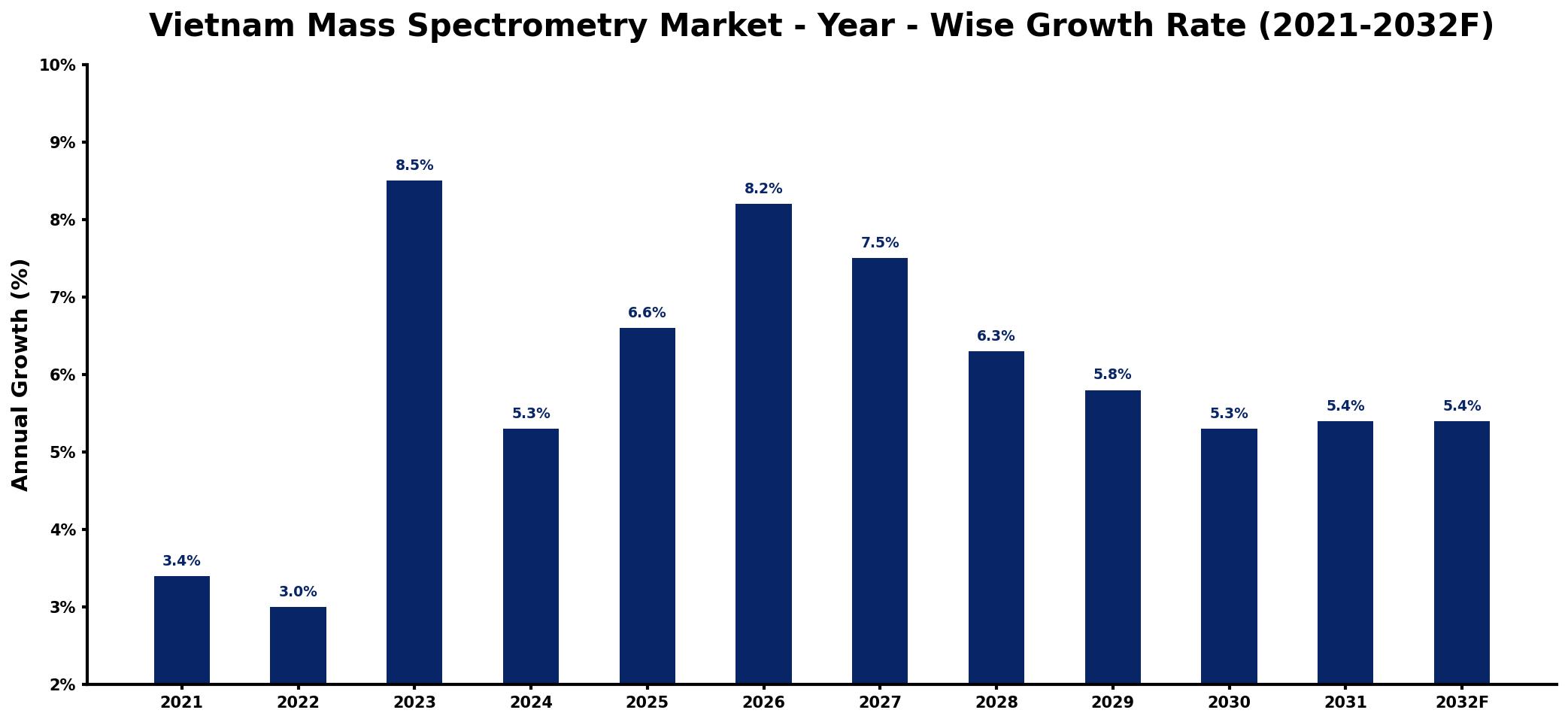
The table below presents the year‑wise growth rates along with the key drivers influencing the market
| Year | Growth Rate | Major Drivers |
| 2021 | 3.4% | rising demand for pharmaceuticals |
| 2022 | 3.0% | increased investment in research |
| 2023 | 8.5% | expansion of food safety regulations |
| 2024 | 5.3% | growing environmental monitoring needs |
| 2025 | 6.6% | surge in clinical diagnostics applications |
| 2026 | 8.2% | enhanced quality control measures |
| 2027 | 7.5% | higher adoption in academia |
| 2028 | 6.3% | growing emerging market penetration |
| 2029 | 5.8% | strengthened regulatory compliance requirements |
| 2030 | 5.3% | growing automotive sector requirements |
| 2031 | 5.4% | growing interest in metabolomics studies |
| 2032 | 5.4% | increased focus on personalized medicine |
Note: Market size estimations and growth projections presented in this report are based on 6Wresearch's proprietary forecasting methodology, utilizing the latest available industry data, government publications, and primary research inputs.
Vietnam Mass Spectrometry Market Synopsis
Recent advancements in mass spectrometry technology have positioned Vietnam as a notable player in the Southeast Asian analytical landscape. Laboratories and research institutions are increasingly adopting mass spectrometry due to its unparalleled accuracy and reliability in compound identification and quantitative analysis.
Pharmaceutical and biotechnology sectors are particularly reliant on this technique for drug development, quality assurance, and regulatory compliance. As investment in research and development grows, the market is expected to further benefit from the innovation and enhancement of mass spectrometry solutions tailored to diverse applications.
Vietnam Mass Spectrometry Market Key Takeaways
- Strong growth is anticipated, with a market value reaching USD 236 Million by 2032.
- Pharmaceuticals and biotechnology are the leading sectors driving demand for mass spectrometry.
- Regulatory changes are increasing the need for advanced analytical solutions in quality control.
- Technical expertise and sample preparation remain key challenges in market adoption.
- The COVID-19 pandemic has highlighted the importance of mass spectrometry in biomedical research.
Evaluation of Restraints in Vietnam Mass Spectrometry Market
Despite its growth potential, the Vietnam mass spectrometry market faces significant challenges that could hinder its expansion. One of the primary restraints is the need for skilled technicians who are proficient in the intricate operation and maintenance of mass spectrometry equipment. In addition, meticulous sample preparation is crucial for obtaining accurate results, often leading to bottlenecks in laboratory workflows. These factors can limit the rate at which laboratories can scale up their operations and fully leverage the capabilities of mass spectrometry technology.
Vietnam Mass Spectrometry Market Trends
The demand for mass spectrometry in Vietnam is shaped by several noteworthy trends. First, the integration of advanced technologies, such as artificial intelligence and machine learning, is enhancing data analysis capabilities, thus improving efficiency. Second, there is a growing focus on environmental sustainability, pushing industries to adopt more rigorous testing for pollutants and contaminants. Lastly, the expansion of pharmaceutical research and development, especially in personalized medicine, is driving innovation in mass spectrometry techniques, leading to the development of specialized instruments that cater to unique research needs.
Vietnam Mass Spectrometry Market Opportunities
There are significant growth opportunities within the Vietnam mass spectrometry market, particularly in the realms of environmental monitoring and food safety analysis. As the public becomes increasingly aware of health and safety concerns, demand for precise analytical tools to detect harmful substances will rise. Moreover, the ongoing expansion of pharmaceutical R&D, bolstered by government incentives and partnerships with international firms, is likely to lead to innovative applications of mass spectrometry. Investment in training programs to enhance operator skills could also open new avenues for market development.
Government Initiatives in the Vietnam Mass Spectrometry Market
The Vietnamese government is actively promoting advancements in scientific research and technological development, which includes support for mass spectrometry initiatives. Public funding for health and environmental safety programs is encouraging laboratories to upgrade their analytical capabilities. Furthermore, collaborations between government entities and private sectors aim to foster innovation and research, creating an environment conducive to the growth of analytical technologies. Policies emphasizing safety standards in food and pharmaceuticals are also catalyzing the adoption of mass spectrometry solutions.
Future Insights of the Vietnam Mass Spectrometry Market
Looking ahead to 2026-2032, the Vietnam mass spectrometry market is poised for transformative growth. As industries continue to embrace advanced analytical techniques, the demand for mass spectrometry is expected to escalate, particularly in the pharmaceutical and environmental sectors. The evolution of regulatory frameworks will further necessitate the use of precise analytical solutions. Additionally, technological advancements will likely bring down operational costs and enhance accessibility for smaller laboratories, thus broadening the market landscape.
Vietnam Mass Spectrometry Market Latest Developments (2025 - 2026)
In recent months, the Vietnam mass spectrometry market has seen significant progress, with several initiatives aimed at enhancing research capabilities. New partnerships between domestic laboratories and international technology providers have emerged, facilitating knowledge transfer and equipment upgrades. Furthermore, a rise in the number of conferences and workshops focused on mass spectrometry applications is creating platforms for industry experts to share insights and advancements, fostering innovation across the sector.
Vietnam Mass Spectrometry Market - Key Attractiveness of the Report
- 10 Years of Market Numbers
- Historical Data Starting from 2022 to 2025
- Base Year: 2025
- Forecast Data until 2032
- Key Performance Indicators Impacting the Market
- Major Upcoming Developments and Projects
Key Highlights of the Report:
- Vietnam Mass Spectrometry Market Outlook
- Market Size of Vietnam Mass Spectrometry Market, 2025
- Forecast of Vietnam Mass Spectrometry Market, 2032
- Historical Data and Forecast of Vietnam Mass Spectrometry Revenues & Volume for the Period 2022-2032F
- Vietnam Mass Spectrometry Market Trend Evolution
- Vietnam Mass Spectrometry Market Drivers and Challenges
- Vietnam Mass Spectrometry Price Trends
- Vietnam Mass Spectrometry Porter's Five Forces
- Vietnam Mass Spectrometry Industry Life Cycle
- Historical Data and Forecast of Vietnam Mass Spectrometry Market Revenues & Volume By Technology for the Period 2022-2032F
- Historical Data and Forecast of Vietnam Mass Spectrometry Market Revenues & Volume By Hybrid Mass Spectrometry for the Period 2022-2032F
- Historical Data and Forecast of Vietnam Mass Spectrometry Market Revenues & Volume By Single Mass Spectrometry for the Period 2022-2032F
- Historical Data and Forecast of Vietnam Mass Spectrometry Market Revenues & Volume By Application for the Period 2022-2032F
- Historical Data and Forecast of Vietnam Mass Spectrometry Market Revenues & Volume By Pharmaceutical for the Period 2022-2032F
- Historical Data and Forecast of Vietnam Mass Spectrometry Market Revenues & Volume By Biotechnology for the Period 2022-2032F
- Historical Data and Forecast of Vietnam Mass Spectrometry Market Revenues & Volume By Security for the Period 2022-2032F
- Historical Data and Forecast of Vietnam Mass Spectrometry Market Revenues & Volume By Industrial chemistry for the Period 2022-2032F
- Historical Data and Forecast of Vietnam Mass Spectrometry Market Revenues & Volume By Environmental testing for the Period 2022-2032F
- Historical Data and Forecast of Vietnam Mass Spectrometry Market Revenues & Volume By Food & beverage testing for the Period 2022-2032F
- Historical Data and Forecast of Vietnam Mass Spectrometry Market Revenues & Volume By Forensic for the Period 2022-2032F
- Historical Data and Forecast of Vietnam Mass Spectrometry Market Revenues & Volume By Clinical for the Period 2022-2032F
- Vietnam Mass Spectrometry Import Export Trade Statistics
- Market Opportunity Assessment By Technology
- Market Opportunity Assessment By Application
- Vietnam Mass Spectrometry Top Companies Market Share
- Vietnam Mass Spectrometry Competitive Benchmarking By Technical and Operational Parameters
- Vietnam Mass Spectrometry Company Profiles
- Vietnam Mass Spectrometry Key Strategic Recommendations






































