Vietnam Mechanical Power Transmission Equipments Market Summary
The vietnam mechanical power transmission equipments market was estimated at USD 381 Million in 2025 and is projected to reach USD 538 Million by 2032, growing at a CAGR of 8.2% from 2026 to 2032.
Vietnam Mechanical Power Transmission Equipments Market Year-wise Growth Rate and Key Drivers
This graph highlights how the Vietnam Mechanical Power Transmission Equipments Market has steadily grown over the past five years, supported by major growth factors.
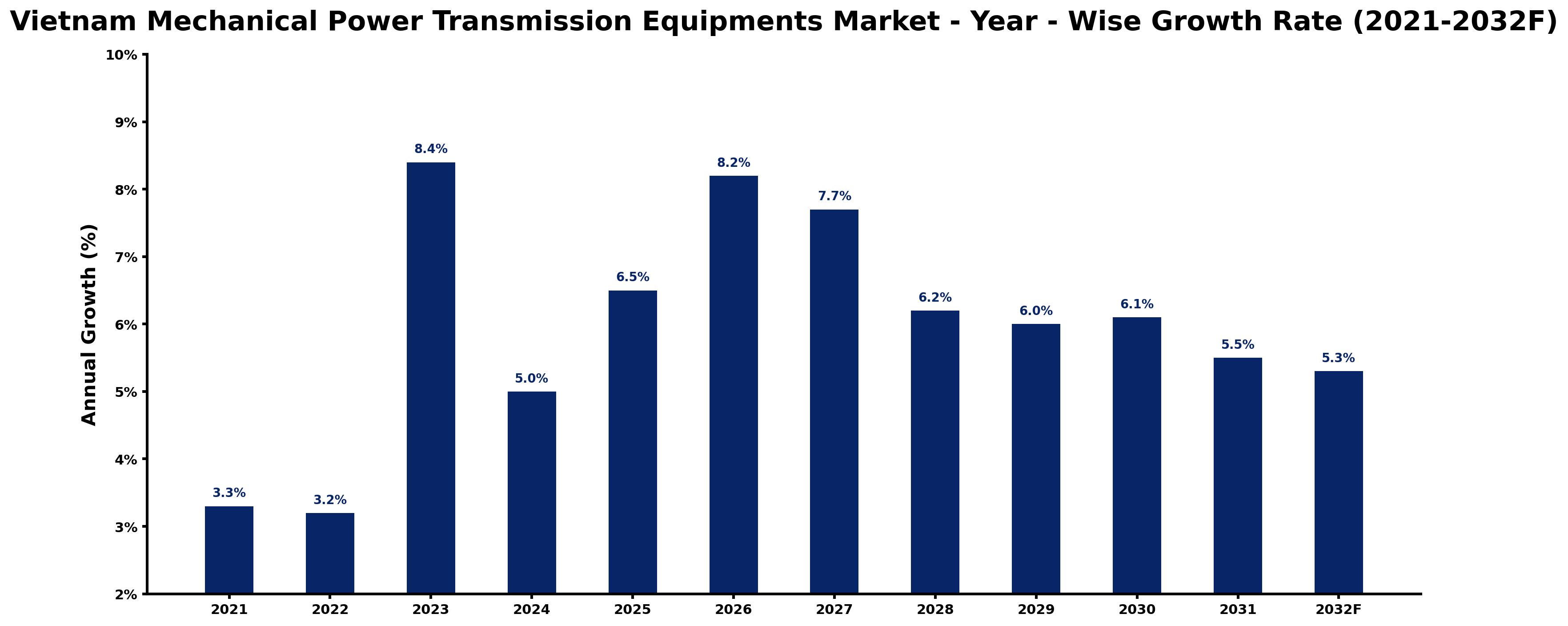
The table below presents the year wise growth rates along with the key drivers influencing the market
| Year | Growth Rate | Major Drivers |
| 2021 | 3.3% | Manufacturing sectors increasingly seek to modernize aging equipment and facilities. |
| 2022 | 3.2% | Vietnam's industrial parks expand, boosting demand for reliable transmission solutions. |
| 2023 | 8.4% | Renewable energy projects gain momentum, requiring advanced power transmission technologies. |
| 2024 | 5.0% | Foreign investments in infrastructure lead to innovative mechanical power solutions. |
| 2025 | 6.5% | Local manufacturers prioritize automation, enhancing efficiency in production lines. |
| 2026 | 8.2% | Adoption of IoT technologies facilitates smart power transmission systems development. |
| 2027 | 7.7% | Rural electrification projects accelerate, expanding access to mechanical power systems. |
| 2028 | 6.2% | Collaborations with global firms spur technology transfers and skill enhancements. |
| 2029 | 6.0% | Urbanization trends drive demand for efficient public transportation power systems. |
| 2030 | 6.1% | Government incentives promote energy efficiency in manufacturing and construction. |
| 2031 | 5.5% | Sustainability targets push for low-carbon mechanical power transmission alternatives. |
| 2032 | 5.3% | Emerging trends in electric mobility shape the future of power transmission needs. |
Note - Market size estimations and growth projections presented in this report are based on 6Wresearch's advanced forecasting approach, validated with industry datasets as of June 2026.
Vietnam Mechanical Power Transmission Equipments Market Synopsis
The Vietnam Mechanical Power Transmission Equipments Market is projected to reach 8.2% and witness significant growth during the forecast period (2026-2032). This market, integral to the broader industrial machinery and equipment sector in Vietnam, encompasses a diverse array of products including gears, bearings, belts, couplings, and chains. The increasing demand for efficient and reliable power transmission systems stems from the burgeoning manufacturing and industrial sectors within the country, particularly in automotive, aerospace, energy, and construction industries.
Vietnam Mechanical Power Transmission Equipments Market Growth Drivers
Driving the expansion of the Vietnam Mechanical Power Transmission Equipments Market are several key factors. First, the rapid industrialization taking place across the nation drastically increases the quantity and quality of machinery required for production processes. As local manufacturing capabilities expand, industries such as automotive and aerospace are demanding advanced and efficient power transmission equipment to enhance productivity.
- The expansion of Vietnam's manufacturing sector requires modernized power transmission solutions, propelling market growth.
- Increased foreign investment in infrastructure and industrial projects is enhancing the demand for mechanical power transmission equipment.
- The growing trend towards automation in factories necessitates advanced, reliable power transmission systems to maintain efficiency.
- The rise in construction activities nationwide further fuels the demand for durable and efficient mechanical power transmission gear.
- Government policies focused on fostering industrial growth and enhancing international trade relations are instrumental in creating a conducive business environment.
Vietnam Mechanical Power Transmission Equipments Market Challenges and Restraints
Despite the promising growth outlook, the Vietnam Mechanical Power Transmission Equipments Market faces several challenges. The presence of low-cost international alternatives puts pressure on domestic manufacturers, creating intense price competition. Furthermore, insufficient standardization and quality assurance in certain local products may deter customers concerned about reliability.
- The influx of imported goods may undermine the competitiveness of local manufacturers, posing a significant market challenge.
- Quality control issues in locally produced equipment can lead to reliability problems and damage customer trust.
- A shortage of skilled technicians and engineers complicates the installation and maintenance of mechanical power transmission systems.
- Rapid technological advancements require constant innovation, which can be challenging for manufacturers to keep pace with.
- The evolving needs of industries demand that manufacturers adapt their products continuously, which may strain resources.
Vietnam Mechanical Power Transmission Equipments Market Government Investment and Initiatives
The Vietnamese government is actively investing in initiatives that bolster the Mechanical Power Transmission Equipments Market. Through various policies aimed at encouraging industrialization, the government is creating an environment conducive to growth. Public spending on infrastructure development, including roads, ports, and manufacturing facilities, has a direct relationship with the demand for power transmission equipment.
- Significant government investment in infrastructure projects promotes an increased need for mechanical power systems.
- Incentives offered to foreign investors stimulate the establishment of new manufacturing facilities, driving demand for power transmission products.
- Government programs aimed at enhancing vocational training can address the skills gap in the mechanical power transmission sector.
- Regulatory frameworks that promote standardization and quality assurance in manufacturing enhance consumer confidence in local products.
- Public-private partnerships in industrial sectors encourage innovation, leading to advancements in power transmission technologies.
Vietnam Mechanical Power Transmission Equipments Market Latest Developments (May 2025 - June 2026)
Recent developments in the Vietnam Mechanical Power Transmission Equipments Market indicate a robust response to the evolving industrial landscape. In the period from May 2025 to June 2026, companies within the sector have begun focusing on sustainable practices and innovations to enhance efficiency. The necessity for resilient supply chains has prompted many manufacturers to reassess their sourcing strategies and invest in automation technologies.
- Industry players are prioritizing the development of energy-efficient power transmission solutions to meet environmental standards.
- Innovations in manufacturing processes have been adopted to reduce production costs and improve product quality.
- Collaboration with international partners has increased, fostering technology transfer and advancement in local capabilities.
- Investment in research and development has risen, emphasizing the creation of smart mechanical systems.
- The market is witnessing a gradual recovery from pandemic-related disruptions, with a renewed focus on expanding operational capacity.
Vietnam Mechanical Power Transmission Equipments Market - Key Attractiveness of the Report
- 10 Years of Market Numbers
- Historical Data Starting from 2022 to 2025
- Base Year: 2025
- Forecast Data until 2032
- Key Performance Indicators Impacting the Market
- Major Upcoming Developments and Projects
Key Highlights of the Report:
- Vietnam Mechanical Power Transmission Equipments Market Outlook
- Market Size of Vietnam Mechanical Power Transmission Equipments Market, 2025
- Forecast of Vietnam Mechanical Power Transmission Equipments Market, 2032
- Historical Data and Forecast of Vietnam Mechanical Power Transmission Equipments Revenues & Volume for the Period 2022-2032F
- Vietnam Mechanical Power Transmission Equipments Market Trend Evolution
- Vietnam Mechanical Power Transmission Equipments Market Drivers and Challenges
- Vietnam Mechanical Power Transmission Equipments Price Trends
- Vietnam Mechanical Power Transmission Equipments Porter's Five Forces
- Vietnam Mechanical Power Transmission Equipments Industry Life Cycle
- Historical Data and Forecast of Vietnam Mechanical Power Transmission Equipments Market Revenues & Volume By Type for the Period 2022-2032F
- Historical Data and Forecast of Vietnam Mechanical Power Transmission Equipments Market Revenues & Volume By Gear Drive for the Period 2022-2032F
- Historical Data and Forecast of Vietnam Mechanical Power Transmission Equipments Market Revenues & Volume By Chain Drive for the Period 2022-2032F
- Historical Data and Forecast of Vietnam Mechanical Power Transmission Equipments Market Revenues & Volume By Hydraulic Transmission for the Period 2022-2032F
- Historical Data and Forecast of Vietnam Mechanical Power Transmission Equipments Market Revenues & Volume By Other for the Period 2022-2032F
- Historical Data and Forecast of Vietnam Mechanical Power Transmission Equipments Market Revenues & Volume By Application for the Period 2022-2032F
- Historical Data and Forecast of Vietnam Mechanical Power Transmission Equipments Market Revenues & Volume By Transportation Industry for the Period 2022-2032F
- Historical Data and Forecast of Vietnam Mechanical Power Transmission Equipments Market Revenues & Volume By Automotive for the Period 2022-2032F
- Historical Data and Forecast of Vietnam Mechanical Power Transmission Equipments Market Revenues & Volume By Aerospace and Defense for the Period 2022-2032F
- Historical Data and Forecast of Vietnam Mechanical Power Transmission Equipments Market Revenues & Volume By Power Industry for the Period 2022-2032F
- Historical Data and Forecast of Vietnam Mechanical Power Transmission Equipments Market Revenues & Volume By Other for the Period 2022-2032F
- Vietnam Mechanical Power Transmission Equipments Import Export Trade Statistics
- Market Opportunity Assessment By Type
- Market Opportunity Assessment By Application
- Vietnam Mechanical Power Transmission Equipments Top Companies Market Share
- Vietnam Mechanical Power Transmission Equipments Competitive Benchmarking By Technical and Operational Parameters
- Vietnam Mechanical Power Transmission Equipments Company Profiles
- Vietnam Mechanical Power Transmission Equipments Key Strategic Recommendations






































