Vietnam Mechanical Seal Market Size, Share & Growth Rate
The Vietnam Mechanical Seal Market was estimated at USD 346 Million in 2025 and is projected to reach USD 489 Million by 2032, growing at a CAGR of 5.1% from 2026 to 2032. This upward trajectory is largely fueled by the robust industrial growth and an increasing emphasis on operational efficiency across various sectors, including oil & gas and pharmaceuticals. Additionally, as environmental regulations tighten, the demand for high-quality mechanical seals that minimize leakage and reduce emissions is expected to further propel market expansion.
Vietnam Mechanical Seal Market Year-wise Growth Rate and Key Drivers
This graph highlights how the Vietnam Mechanical Seal Market has steadily grown over the years, supported by major growth factors.
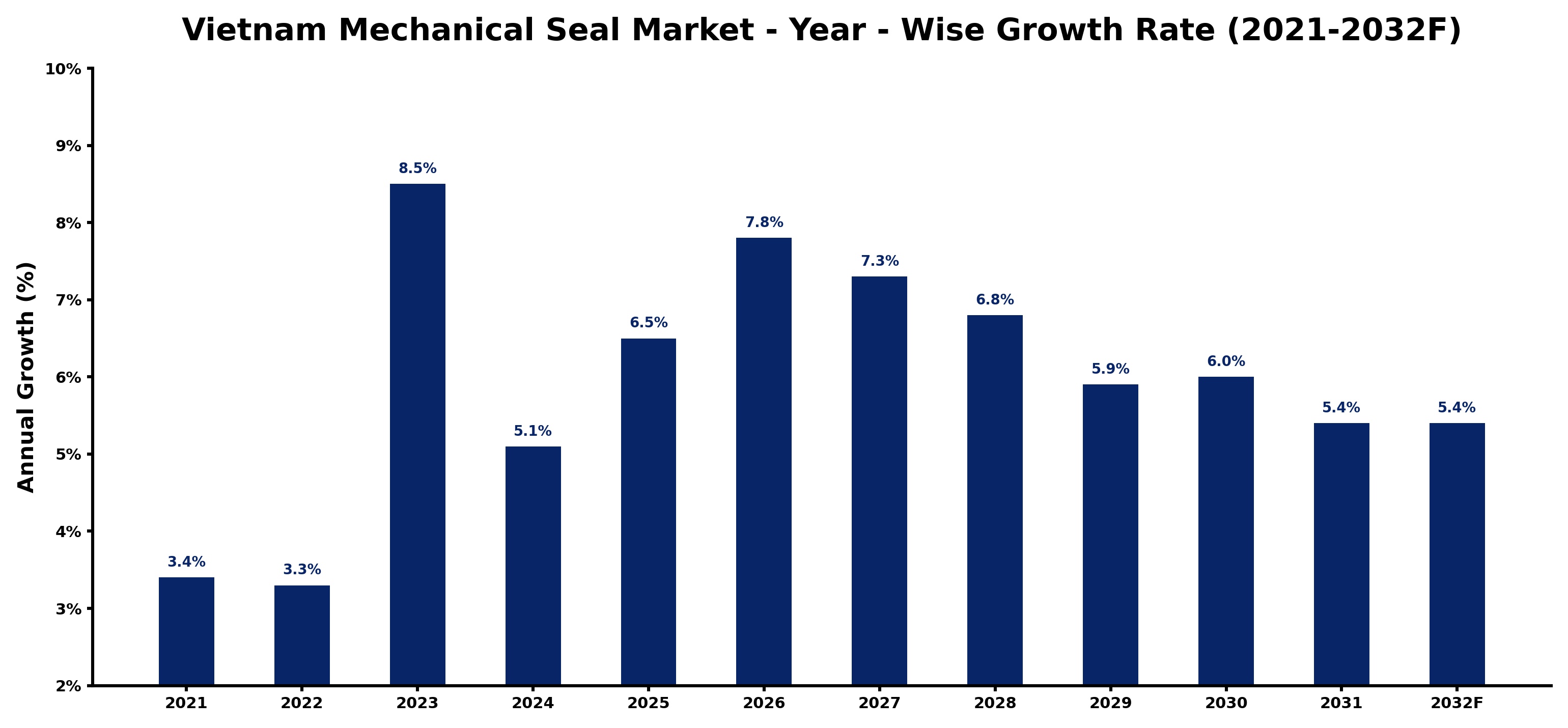
The table below presents the year‑wise growth rates along with the key drivers influencing the market
| Year | Growth Rate | Major Drivers |
| 2021 | 3.4% | Rising electricity demand across industries |
| 2022 | 3.3% | Expansion of commercial construction activities |
| 2023 | 8.5% | Growing urbanization and commercial development |
| 2024 | 5.1% | Expansion of commercial construction activities |
| 2025 | 6.5% | Growing renewable energy integration projects |
| 2026 | 7.8% | Increasing industrial infrastructure investments |
| 2027 | 7.3% | Rapid growth in telecom and data center sectors |
| 2028 | 6.8% | Growing urbanization and commercial development |
| 2029 | 5.9% | Expansion of transportation and logistics networks |
| 2030 | 6.0% | Expansion of manufacturing activities |
| 2031 | 5.4% | Rapid growth in telecom and data center sectors |
| 2032 | 5.4% | Expansion of manufacturing activities |
Note - Market size estimations and growth projections presented in this report are based on 6Wresearch's advanced forecasting approach, validated with industry datasets as of June 2026.
Vietnam Mechanical Seal Market Synopsis
The Vietnam mechanical seal market has gained significant momentum in recent years, bolstered by an expanding industrial landscape and technological advancements. As demand for reliable fluid-handling solutions increases, businesses are increasingly turning to mechanical seals as essential components for preventing leakage and enhancing efficiency.
Looking forward, the market is poised for further growth, driven by investments in infrastructure and heightened awareness of environmental sustainability. The introduction of innovative sealing technologies will likely address the diverse needs of industries, facilitating smoother operations and lower maintenance costs.
Vietnam Mechanical Seal Market Key Takeaways
- Vietnam's industrial growth is a major driver for the mechanical seal market, particularly in oil & gas, chemicals, and pharmaceuticals.
- Heightened awareness of environmental regulations is pushing industries to adopt high-quality sealing solutions.
- The market is witnessing a shift towards advanced mechanical seal technologies, enhancing operational efficiency.
- Competitive pressure from low-cost alternatives necessitates consumer education on the advantages of premium mechanical seals.
- COVID-19 caused temporary disruptions, but recovery is set to fuel demand as industries rebound.
Evaluation of Restraints in Vietnam Mechanical Seal Market
Despite a favorable market outlook, the Vietnam mechanical seal market grapples with certain constraints. The influx of low-cost, inferior-quality mechanical seals poses significant risks to industrial operations, leading to increased breakdowns and maintenance costs. This situation emphasizes the need for raising awareness among users regarding the long-term benefits of investing in high-performance seals. Moreover, the competitive landscape further complicates matters, as both domestic and international players strive to secure market share amidst ongoing price pressures.
Vietnam Mechanical Seal Market Trends
Several trends are emerging in the Vietnam mechanical seal market that are shaping its future direction. The shift towards automation and digital technologies in manufacturing processes is prompting demand for seals that can withstand higher operational pressures and diverse fluid types. Additionally, the ongoing emphasis on sustainability is encouraging the development of eco-friendly materials for seals, further aligning with global environmental objectives. The integration of smart technologies, such as IoT connectivity for predictive maintenance, is also gaining traction in this sector, promising improved efficiency and reduced downtime.
Vietnam Mechanical Seal Market Opportunities
The opportunities for growth in the Vietnam mechanical seal market are substantial. The expanding manufacturing and construction sectors present avenues for new applications and innovations in sealing technology. Furthermore, the push for green initiatives opens doors for manufacturers to create environmentally friendly sealing solutions. Additionally, the government's focus on infrastructure development will likely lead to increased demand for advanced machinery, creating further opportunities for the mechanical seal market.
Government Initiatives in the Vietnam Mechanical Seal Market
The Vietnamese government is actively promoting industrial growth through various initiatives aimed at enhancing manufacturing capabilities and infrastructure development. Public spending on infrastructure projects is likely to bolster demand for machinery that employs advanced mechanical seals. Furthermore, policies encouraging energy efficiency and environmental sustainability provide an additional impetus for industries to invest in high-performance sealing solutions. These efforts are indicative of a broader strategy to position Vietnam as a competitive player in the regional industrial landscape.
Future Insights of the Vietnam Mechanical Seal Market
Between 2026 and 2032, the Vietnam mechanical seal market is expected to navigate a path of sustainable growth. As industrial operations continue to evolve, the demand for advanced sealing solutions tailored to specific applications will become increasingly paramount. The integration of smart technologies into sealing solutions is likely to redefine operational standards, enhancing both performance and longevity. Additionally, the ongoing focus on environmental compliance will further drive innovations in seal design, ensuring they meet the high standards set by both domestic and international regulations.
Vietnam Mechanical Seal Market Latest Developments (May 2025 - June 2026)
The latest developments in the Vietnam mechanical seal market indicate a heightened focus on innovation and sustainability. Companies are increasingly investing in R&D to create advanced mechanical seals that not only meet but exceed current industry standards. Collaborations between domestic and international firms have emerged to leverage expertise in cutting-edge sealing technologies. Additionally, industry players are also shifting towards sustainable materials in their products, aligning with global environmental initiatives and responding to consumer demand for greener solutions.
Vietnam Mechanical Seal Market - Key Attractiveness of the Report
- 10 Years of Market Numbers
- Historical Data Starting from 2022 to 2025
- Base Year: 2025
- Forecast Data until 2032
- Key Performance Indicators Impacting the Market
- Major Upcoming Developments and Projects
Key Highlights of the Report:
- Vietnam Mechanical Seal Market Outlook
- Market Size of Vietnam Mechanical Seal Market, 2025
- Forecast of Vietnam Mechanical Seal Market, 2032
- Historical Data and Forecast of Vietnam Mechanical Seal Revenues & Volume for the Period 2022-2032F
- Vietnam Mechanical Seal Market Trend Evolution
- Vietnam Mechanical Seal Market Drivers and Challenges
- Vietnam Mechanical Seal Price Trends
- Vietnam Mechanical Seal Porter's Five Forces
- Vietnam Mechanical Seal Industry Life Cycle
- Historical Data and Forecast of Vietnam Mechanical Seal Market Revenues & Volume By Type for the Period 2022-2032F
- Historical Data and Forecast of Vietnam Mechanical Seal Market Revenues & Volume By Cartridge Seals for the Period 2022-2032F
- Historical Data and Forecast of Vietnam Mechanical Seal Market Revenues & Volume By Balanced and Unbalanced Seals for the Period 2022-2032F
- Historical Data and Forecast of Vietnam Mechanical Seal Market Revenues & Volume By Pusher and Non-Pusher for the Period 2022-2032F
- Historical Data and Forecast of Vietnam Mechanical Seal Market Revenues & Volume By Conventional Seals for the Period 2022-2032F
- Historical Data and Forecast of Vietnam Mechanical Seal Market Revenues & Volume By Others for the Period 2022-2032F
- Historical Data and Forecast of Vietnam Mechanical Seal Market Revenues & Volume By Industry for the Period 2022-2032F
- Historical Data and Forecast of Vietnam Mechanical Seal Market Revenues & Volume By Metal & Mining for the Period 2022-2032F
- Historical Data and Forecast of Vietnam Mechanical Seal Market Revenues & Volume By Food& Beverage for the Period 2022-2032F
- Historical Data and Forecast of Vietnam Mechanical Seal Market Revenues & Volume By Oil & Gas for the Period 2022-2032F
- Historical Data and Forecast of Vietnam Mechanical Seal Market Revenues & Volume By Energy & Power for the Period 2022-2032F
- Historical Data and Forecast of Vietnam Mechanical Seal Market Revenues & Volume By Aerospace for the Period 2022-2032F
- Historical Data and Forecast of Vietnam Mechanical Seal Market Revenues & Volume By Marine for the Period 2022-2032F
- Historical Data and Forecast of Vietnam Mechanical Seal Market Revenues & Volume By Construction & Manufacturer for the Period 2022-2032F
- Historical Data and Forecast of Vietnam Mechanical Seal Market Revenues & Volume By Others for the Period 2022-2032F
- Vietnam Mechanical Seal Import Export Trade Statistics
- Market Opportunity Assessment By Type
- Market Opportunity Assessment By Industry
- Vietnam Mechanical Seal Top Companies Market Share
- Vietnam Mechanical Seal Competitive Benchmarking By Technical and Operational Parameters
- Vietnam Mechanical Seal Company Profiles
- Vietnam Mechanical Seal Key Strategic Recommendations






































