Vietnam Mechanical Springs Market Size, Share & Growth Rate
The Vietnam Mechanical Springs Market was estimated at USD 311 Million in 2025 and is projected to reach USD 440 Million by 2032, growing at a CAGR of 5.1% from 2026 to 2032. This impressive trajectory is primarily fueled by the rapid expansion of Vietnam's manufacturing sector, particularly in automotive and electronics, where precision and reliability are paramount. As industries increasingly adopt advanced technologies and innovative processes, the demand for high-quality mechanical springs continues to grow, further driving market expansion.
Vietnam Mechanical Springs Market Year-wise Growth Rate and Key Drivers
This graph highlights how the Vietnam Mechanical Springs Market has steadily grown over the years, supported by major growth factors.
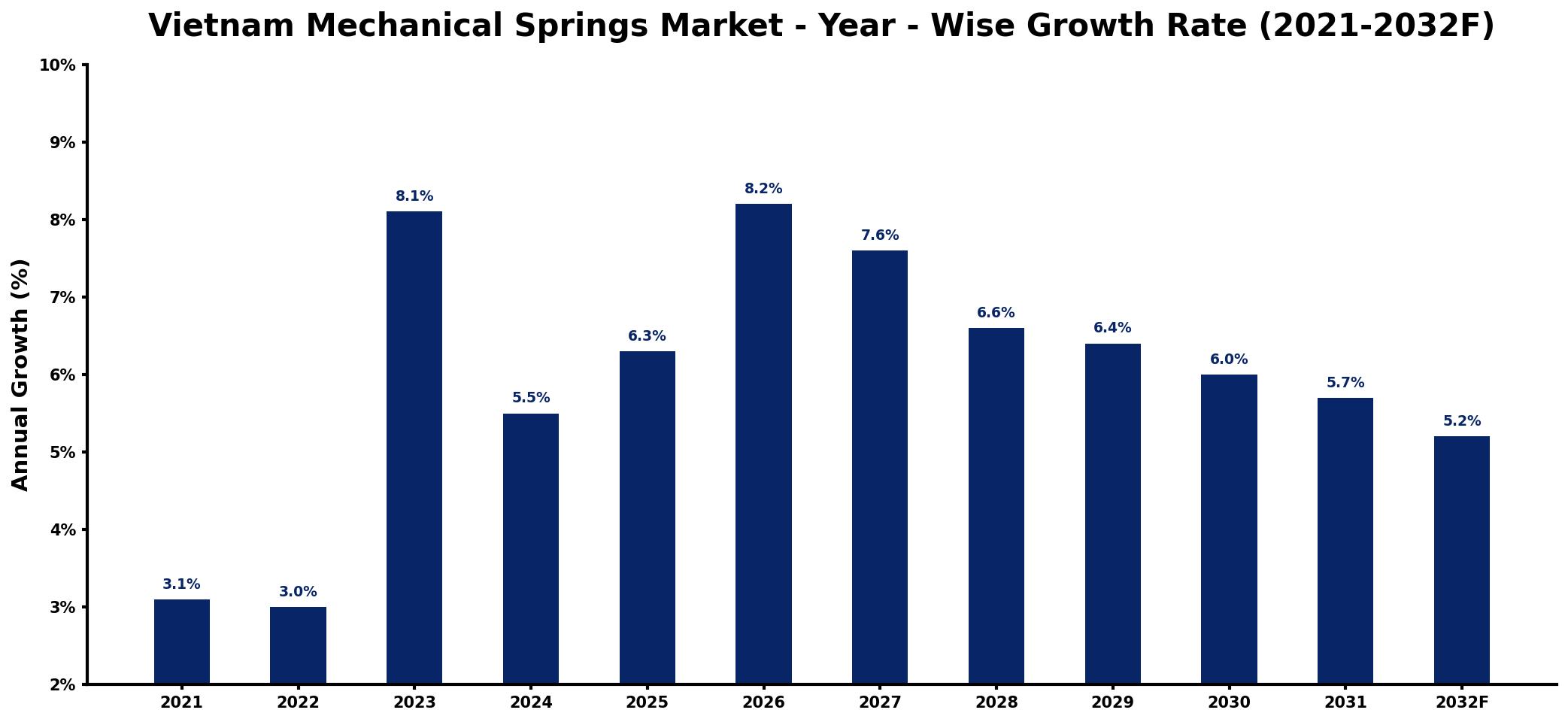
The table below presents the year‑wise growth rates along with the key drivers influencing the market
| Year | Growth Rate | Major Drivers |
| 2021 | 3.1% | Rising automotive production demands components |
| 2022 | 3.0% | Increased investment in manufacturing technologies |
| 2023 | 8.1% | Expansion of renewable energy projects |
| 2024 | 5.5% | Growth in consumer electronics market |
| 2025 | 6.3% | Surge in construction activities nationwide |
| 2026 | 8.2% | Boost in industrial automation initiatives |
| 2027 | 7.6% | Demand from aerospace sector increases |
| 2028 | 6.6% | Emerging electric vehicle market growth |
| 2029 | 6.4% | Technological advancements in machinery applications |
| 2030 | 6.0% | Diversification of manufacturing capabilities expands |
| 2031 | 5.7% | Strengthening of infrastructure development projects |
| 2032 | 5.2% | Rising demand for home appliances |
Note: Market size estimations and growth projections presented in this report are based on 6Wresearch's proprietary forecasting methodology, utilizing the latest available industry data, government publications, and primary research inputs.
Vietnam Mechanical Springs Market Synopsis
The most significant force shaping the Vietnam mechanical springs market right now is the robust growth within the automotive and manufacturing sectors. As these industries thrive, they require increasingly sophisticated spring designs tailored to specific applications, which is fostering innovation among local manufacturers.
Another pivotal aspect influencing the market is the focus on energy efficiency and sustainability. Industries are increasingly seeking specialized springs that enhance energy performance, particularly within the automotive sector. This trend not only underscores the importance of mechanical springs but also highlights the necessity for manufacturers to adapt and innovate continuously.
Vietnam Mechanical Springs Market Key Takeaways
- The Vietnam mechanical springs market is projected to experience significant growth, reaching USD 440 Million by 2032.
- Key drivers include the expansion of the manufacturing sector, particularly in automotive and electronics.
- Technological advancements are facilitating the production of high-quality and durable springs.
- Customization and precision engineering remain critical for market competitiveness.
- The focus on energy-efficient solutions is reshaping product offerings in the automotive sector.
Evaluation of Restraints in Vietnam Mechanical Springs Market
Despite promising growth, the Vietnam mechanical springs market faces certain restraints that hinder its full potential. One significant challenge is the ongoing need for precision and customization in production. As springs are vital components, meeting exact performance specifications is crucial, which complicates manufacturing processes. Furthermore, sourcing high-quality raw materials presents another hurdle, as inconsistencies can impact the reliability and durability of the final products. Balancing these demands is a continuous challenge for manufacturers, requiring them to innovate while maintaining quality standards.
Vietnam Mechanical Springs Market Trends
Current trends in the Vietnam mechanical springs market are heavily influenced by advancements in automation and smart manufacturing techniques. Manufacturers are increasingly leveraging technologies such as computer-aided design (CAD) and additive manufacturing to enhance precision and reduce lead times. Moreover, there's a growing demand for lightweight and compact spring solutions, especially in automotive applications where energy efficiency is critical. The trend towards sustainable manufacturing practices is also gaining momentum, pushing companies to adopt eco-friendly materials and production processes.
Vietnam Mechanical Springs Market Opportunities
As the market continues to evolve, substantial growth opportunities are emerging, particularly in sectors that require tailored solutions. The automotive industry, with its push for electric vehicles (EVs), presents an avenue for innovation, as specialized springs can enhance vehicle performance and energy efficiency. Additionally, the increasing demand for automation across various industries offers opportunities for manufacturers to develop advanced spring technologies that cater to automation needs. The combination of growing domestic demand and the potential for export to neighboring regions also enhances the overall market outlook.
Government Initiatives in the Vietnam Mechanical Springs Market
The Vietnamese government is keen on promoting industrial growth through various initiatives aimed at attracting foreign investment and supporting local manufacturers. Policies encouraging technological innovation and R&D in manufacturing sectors directly benefit the mechanical springs market. Additionally, initiatives to streamline regulations and enhance infrastructure are creating a more conducive environment for businesses. Investments in education and workforce training programs are also being prioritized to ensure that the labor force is equipped with the necessary skills to meet industry demands.
Future Insights of the Vietnam Mechanical Springs Market
Looking ahead to 2026-2032, the Vietnam mechanical springs market is poised for continued expansion, largely driven by ongoing advancements in manufacturing technologies and a strong emphasis on customization. As domestic and international demand for high-quality springs rises, manufacturers that can adeptly balance innovation with quality will lead the market. The integration of smart technologies into production processes will likely redefine operational efficiency, setting a new standard for the industry. Additionally, as environmental considerations take center stage, there will be an increasing demand for sustainable practices, positioning the market to adapt and thrive in a changing global landscape.
Vietnam Mechanical Springs Market Latest Developments (2025 - 2026)
Recent developments in the Vietnam mechanical springs market highlight a continued trend toward technological integration and efficiency improvements. Manufacturers are increasingly adopting smart technologies that enhance precision in spring production, enabling them to meet the evolving demands of various sectors. Furthermore, partnerships and collaborations between local firms and international entities are fostering innovation, particularly in the automotive sector, as stakeholders seek to develop next-generation spring solutions that prioritize energy efficiency and performance. Overall, the market's trajectory remains positive as companies adapt to the changing landscape.
Vietnam Mechanical Springs Market - Key Attractiveness of the Report
- 10 Years of Market Numbers
- Historical Data Starting from 2022 to 2025
- Base Year: 2025
- Forecast Data until 2032
- Key Performance Indicators Impacting the Market
- Major Upcoming Developments and Projects
Key Highlights of the Report:
- Vietnam Mechanical Springs Market Outlook
- Market Size of Vietnam Mechanical Springs Market, 2025
- Forecast of Vietnam Mechanical Springs Market, 2032
- Historical Data and Forecast of Vietnam Mechanical Springs Revenues & Volume for the Period 2022-2032F
- Vietnam Mechanical Springs Market Trend Evolution
- Vietnam Mechanical Springs Market Drivers and Challenges
- Vietnam Mechanical Springs Price Trends
- Vietnam Mechanical Springs Porter's Five Forces
- Vietnam Mechanical Springs Industry Life Cycle
- Historical Data and Forecast of Vietnam Mechanical Springs Market Revenues & Volume By Shape for the Period 2022-2032F
- Historical Data and Forecast of Vietnam Mechanical Springs Market Revenues & Volume By Helical Springs or Coil Springs for the Period 2022-2032F
- Historical Data and Forecast of Vietnam Mechanical Springs Market Revenues & Volume By Conical and Volute Springs for the Period 2022-2032F
- Historical Data and Forecast of Vietnam Mechanical Springs Market Revenues & Volume By Laminated or Leaf Springs for the Period 2022-2032F
- Historical Data and Forecast of Vietnam Mechanical Springs Market Revenues & Volume By Disc or Belleville Springs for the Period 2022-2032F
- Historical Data and Forecast of Vietnam Mechanical Springs Market Revenues & Volume By Material for the Period 2022-2032F
- Historical Data and Forecast of Vietnam Mechanical Springs Market Revenues & Volume By Alloy Steel for the Period 2022-2032F
- Historical Data and Forecast of Vietnam Mechanical Springs Market Revenues & Volume By Beryllium Copper for the Period 2022-2032F
- Historical Data and Forecast of Vietnam Mechanical Springs Market Revenues & Volume By Brass for the Period 2022-2032F
- Historical Data and Forecast of Vietnam Mechanical Springs Market Revenues & Volume By Bronze for the Period 2022-2032F
- Historical Data and Forecast of Vietnam Mechanical Springs Market Revenues & Volume By Carbon Steel for the Period 2022-2032F
- Historical Data and Forecast of Vietnam Mechanical Springs Market Revenues & Volume By Chrome Silicone for the Period 2022-2032F
- Historical Data and Forecast of Vietnam Mechanical Springs Market Revenues & Volume By Copper for the Period 2022-2032F
- Historical Data and Forecast of Vietnam Mechanical Springs Market Revenues & Volume By Application for the Period 2022-2032F
- Historical Data and Forecast of Vietnam Mechanical Springs Market Revenues & Volume By Dock Levels for the Period 2022-2032F
- Historical Data and Forecast of Vietnam Mechanical Springs Market Revenues & Volume By Farming Equipment for the Period 2022-2032F
- Historical Data and Forecast of Vietnam Mechanical Springs Market Revenues & Volume By Furniture for the Period 2022-2032F
- Historical Data and Forecast of Vietnam Mechanical Springs Market Revenues & Volume By Power & Energy for the Period 2022-2032F
- Historical Data and Forecast of Vietnam Mechanical Springs Market Revenues & Volume By Transportation for the Period 2022-2032F
- Historical Data and Forecast of Vietnam Mechanical Springs Market Revenues & Volume By Agriculture for the Period 2022-2032F
- Historical Data and Forecast of Vietnam Mechanical Springs Market Revenues & Volume By Electrical & Electronics for the Period 2022-2032F
- Historical Data and Forecast of Vietnam Mechanical Springs Market Revenues & Volume By Others for the Period 2022-2032F
- Vietnam Mechanical Springs Import Export Trade Statistics
- Market Opportunity Assessment By Shape
- Market Opportunity Assessment By Material
- Market Opportunity Assessment By Application
- Vietnam Mechanical Springs Top Companies Market Share
- Vietnam Mechanical Springs Competitive Benchmarking By Technical and Operational Parameters
- Vietnam Mechanical Springs Company Profiles
- Vietnam Mechanical Springs Key Strategic Recommendations






































