Vietnam Microtomes Market Size, Share & Growth Rate
The Vietnam Microtomes Market was estimated at USD 286 Million in 2025 and is projected to reach USD 402 Million by 2032, growing at a CAGR of 5.0% from 2026 to 2032. This growth trajectory is primarily driven by the increasing demand for advanced diagnostic tools and the expansion of healthcare facilities, which are actively investing in histopathology services. Additionally, the rising prevalence of diseases that require meticulous tissue analysis is further stimulating the market.
Vietnam Microtomes Market Year-wise Growth Rate and Key Drivers
This graph highlights how the Vietnam Microtomes Market has steadily grown over the years, supported by major growth factors.
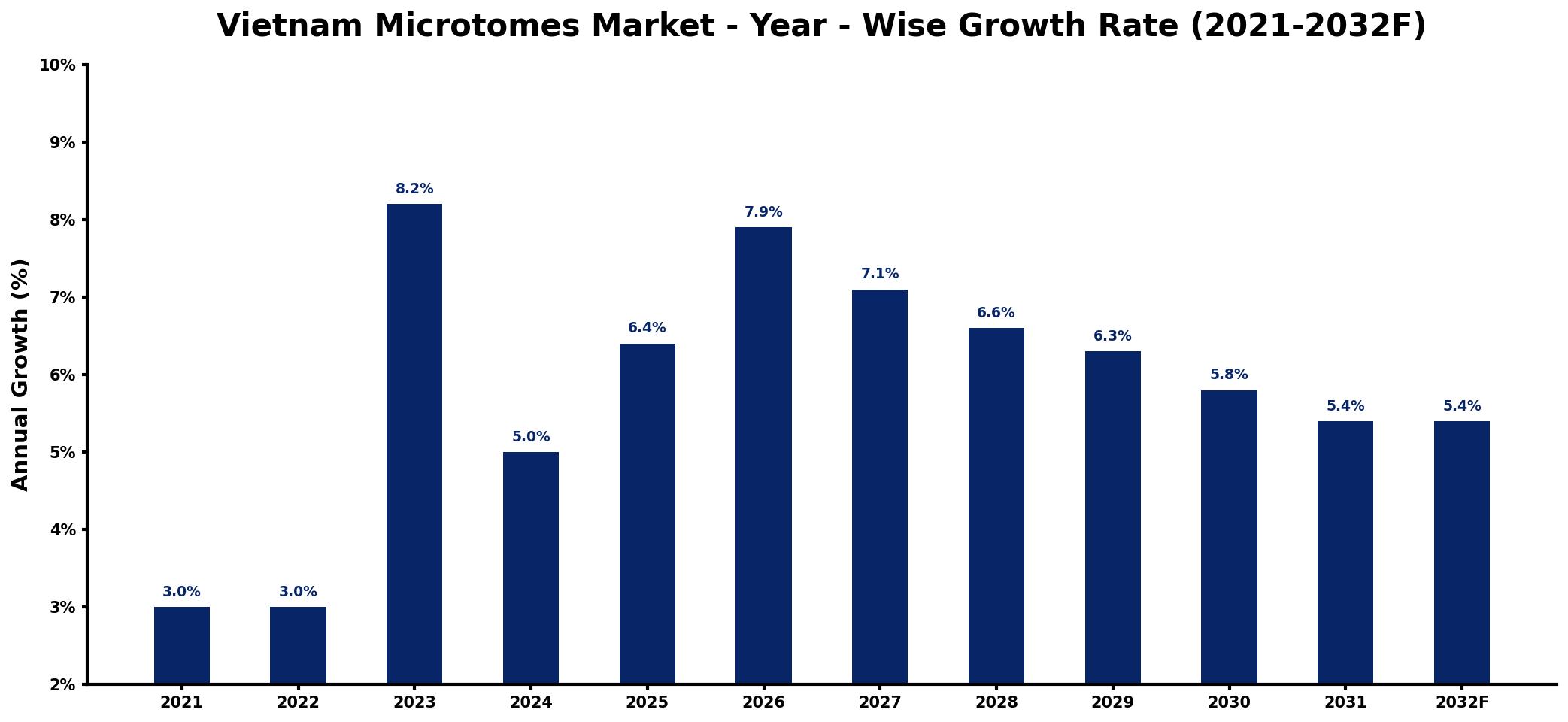
The table below presents the year‑wise growth rates along with the key drivers influencing the market
| Year | Growth Rate | Major Drivers |
| 2021 | 3.0% | Rising healthcare sector investments |
| 2022 | 3.0% | Increased laboratory automation adoption |
| 2023 | 8.2% | Growing demand for diagnostic tools |
| 2024 | 5.0% | Expansion of research facilities worldwide |
| 2025 | 6.4% | Surge in biotechnology advancements |
| 2026 | 7.9% | Enhanced focus on precision medicine |
| 2027 | 7.1% | Increasing educational institution funding |
| 2028 | 6.6% | Higher incidence of chronic diseases |
| 2029 | 6.3% | Strengthening public health initiatives |
| 2030 | 5.8% | Emerging markets healthcare expansion |
| 2031 | 5.4% | Robust growth in life sciences |
| 2032 | 5.4% | Technological innovations in healthcare |
Note: Market size estimations and growth projections presented in this report are based on 6Wresearch's proprietary forecasting methodology, utilizing the latest available industry data, government publications, and primary research inputs.
Vietnam Microtomes Market Synopsis
The most significant force shaping the Vietnam microtomes market is the rapid expansion of the healthcare and research sectors. With more laboratories emerging, the demand for high-precision equipment to prepare tissue samples for diagnosis and research is surging. This trend underscores the vital role microtomes play in the workflow of histology and pathology labs across the country.
Moreover, as Vietnam's healthcare system continues to evolve, there is an increasing focus on enhancing diagnostic capabilities. The emphasis on early disease detection and accurate pathology results is prompting laboratories to upgrade their equipment, thus driving the demand for sophisticated microtomes designed for precision and efficiency.
Vietnam Microtomes Market Key Takeaways
- The market is experiencing robust growth fueled by advancements in healthcare technology.
- Increased research activities in the biomedical field are driving demand for microtomes.
- Challenges such as limited budgets and regulatory hurdles are affecting market dynamics.
- The rise in disease prevalence necessitates improved diagnostic tools, benefiting the microtomes market.
- As COVID-19 impacts diminish, normal research activities are expected to resume, stabilizing the market.
Evaluation of Restraints in Vietnam Microtomes Market
Despite the promising growth outlook, the Vietnam microtomes market faces several substantial restraints. Limited funding allocated to healthcare and research significantly constrains the procurement of advanced microtomes. This budgetary limitation hinders technological advancements and the ability to maintain state-of-the-art laboratory standards. Furthermore, a lack of skilled personnel capable of operating these precision instruments restricts their adoption in laboratories. The complex regulatory landscape also poses a challenge, as navigating compliance can be both time-consuming and costly, impacting market growth.
Vietnam Microtomes Market Trends
A number of trends are shaping the Vietnam microtomes market, particularly the shift towards automation and digital integration in laboratory processes. As laboratories strive for greater efficiency, there is a growing interest in automated microtomes that enhance throughput while ensuring precision. Additionally, the increasing integration of artificial intelligence in histological analysis presents opportunities for innovative microtome designs that can provide more accurate and quicker results.
Vietnam Microtomes Market Opportunities
Genuine growth opportunities in the Vietnam microtomes market lie in the development of affordable yet advanced microtomes that cater to the needs of smaller laboratories. Investment in training programs for technicians can also enhance market potential by addressing skill shortages. As research institutions seek to diversify their investigations, there is an opportunity for manufacturers to introduce specialized microtomes tailored for specific research applications, thus expanding their market footprint.
Government Initiatives in the Vietnam Microtomes Market
The Vietnamese government has been increasing its focus on improving healthcare infrastructure, which includes investing in diagnostic and laboratory services. Initiatives aimed at boosting public health funding are encouraging the establishment of more advanced medical facilities. Furthermore, government programs that promote research and development in the biomedical field are likely to foster an environment conducive to the growth of the microtomes market.
Future Insights of the Vietnam Microtomes Market
Looking ahead to 2026-2032, the Vietnam microtomes market is positioned for significant advancements. As healthcare infrastructure continues to improve, and as the focus on disease prevention and early diagnosis intensifies, the demand for microtomes is expected to rise. Additionally, the integration of more sophisticated technologies and the entry of new players into the market will likely stimulate competition, driving innovations that enhance the functionality and affordability of microtomes.
Vietnam Microtomes Market Latest Developments (2025 - 2026)
Recent developments in the Vietnam microtomes market indicate a trend toward greater automation and digital solutions. Several manufacturers are reportedly introducing enhanced models designed for efficiency and accuracy, which are gaining traction among laboratories. Moreover, ongoing discussions within the healthcare community highlight the importance of training programs aimed at upskilling technicians to effectively utilize these advanced tools, further bolstering market growth.
Vietnam Microtomes Market - Key Attractiveness of the Report
- 10 Years of Market Numbers
- Historical Data Starting from 2022 to 2025
- Base Year: 2025
- Forecast Data until 2032
- Key Performance Indicators Impacting the Market
- Major Upcoming Developments and Projects
Key Highlights of the Report:
- Vietnam Microtomes Market Outlook
- Market Size of Vietnam Microtomes Market, 2025
- Forecast of Vietnam Microtomes Market, 2032
- Historical Data and Forecast of Vietnam Microtomes Revenues & Volume for the Period 2022-2032F
- Vietnam Microtomes Market Trend Evolution
- Vietnam Microtomes Market Drivers and Challenges
- Vietnam Microtomes Price Trends
- Vietnam Microtomes Porter's Five Forces
- Vietnam Microtomes Industry Life Cycle
- Historical Data and Forecast of Vietnam Microtomes Market Revenues & Volume By Product for the Period 2022-2032F
- Historical Data and Forecast of Vietnam Microtomes Market Revenues & Volume By Microtome Devices for the Period 2022-2032F
- Historical Data and Forecast of Vietnam Microtomes Market Revenues & Volume By Accessories for the Period 2022-2032F
- Historical Data and Forecast of Vietnam Microtomes Market Revenues & Volume By Technology for the Period 2022-2032F
- Historical Data and Forecast of Vietnam Microtomes Market Revenues & Volume By Fully Automated for the Period 2022-2032F
- Historical Data and Forecast of Vietnam Microtomes Market Revenues & Volume By Semi-Automated for the Period 2022-2032F
- Historical Data and Forecast of Vietnam Microtomes Market Revenues & Volume By Manual for the Period 2022-2032F
- Vietnam Microtomes Import Export Trade Statistics
- Market Opportunity Assessment By Product
- Market Opportunity Assessment By Technology
- Vietnam Microtomes Top Companies Market Share
- Vietnam Microtomes Competitive Benchmarking By Technical and Operational Parameters
- Vietnam Microtomes Company Profiles
- Vietnam Microtomes Key Strategic Recommendations






































