Vietnam Multifunctional Composite Materials Market Summary
The vietnam multifunctional composite materials market was estimated at USD 466 Million in 2025 and is projected to reach USD 659 Million by 2032, growing at a CAGR of 7.7% from 2026 to 2032.
Vietnam Multifunctional Composite Materials Market Year-wise Growth Rate and Key Drivers
This graph highlights how the Vietnam Multifunctional Composite Materials Market has steadily grown over the past five years, supported by major growth factors.
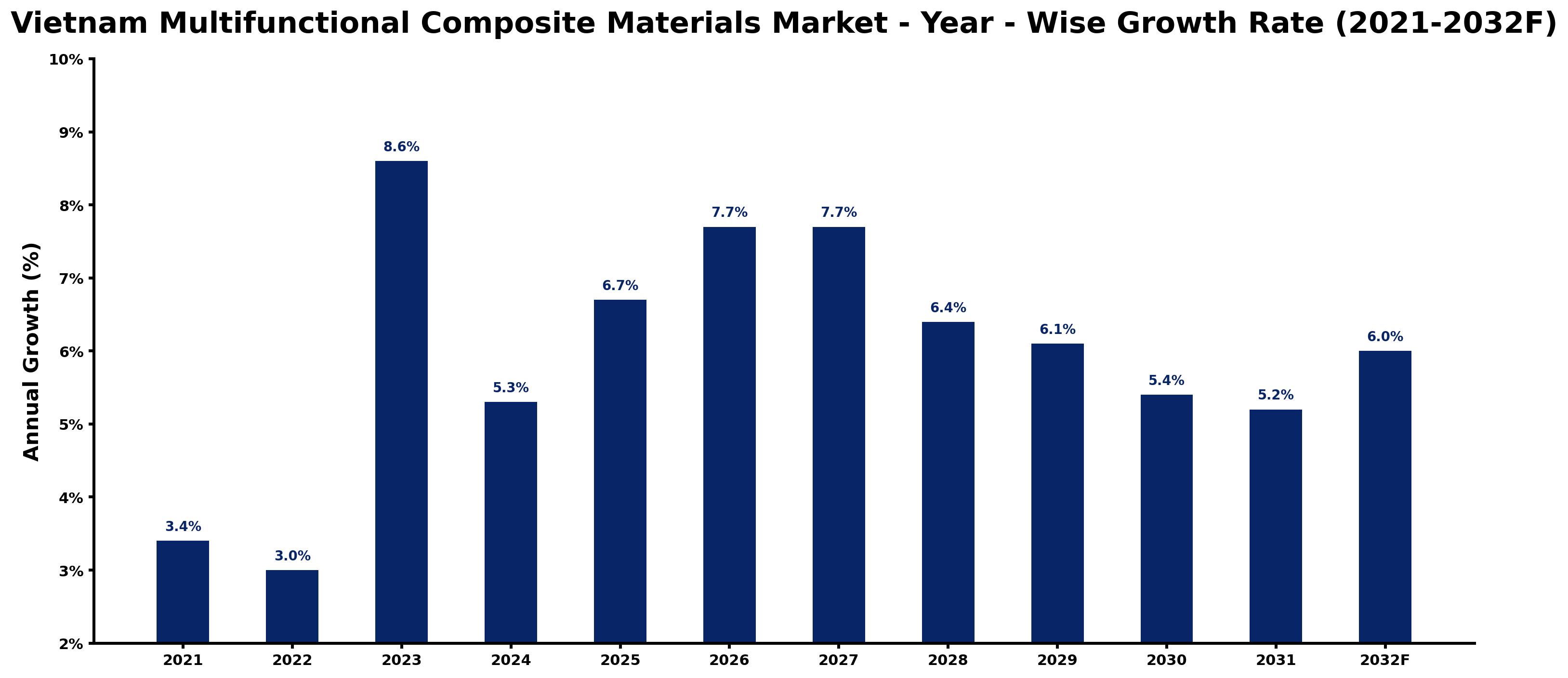
The table below presents the year wise growth rates along with the key drivers influencing the market
| Year | Growth Rate | Major Drivers |
| 2021 | 3.4% | Manufacturers began exploring lightweight materials due to evolving automotive design requirements. |
| 2022 | 3.0% | Local businesses invested heavily in research to enhance composite material properties. |
| 2023 | 8.6% | Infrastructure projects accelerated demand for durable building materials in urban areas. |
| 2024 | 5.3% | Rural electrification efforts necessitated the use of innovative composite solutions. |
| 2025 | 6.7% | Competition among suppliers led to significant product diversification and customization options. |
| 2026 | 7.7% | Technological collaborations flourished, creating synergies in material development and application. |
| 2027 | 7.7% | Sustainability concerns promoted eco-friendly composites, aligning with global consumer preferences. |
| 2028 | 6.4% | Increased investment in the automotive sector spurred demand for advanced composite materials. |
| 2029 | 6.1% | The emergence of smart materials integrated with IoT technology transformed manufacturing landscapes. |
| 2030 | 5.4% | Expansion of Vietnam's textile industry injected fresh opportunities for multifunctional composites. |
| 2031 | 5.2% | Enhanced manufacturing capabilities positioned Vietnam as a regional hub for material supply. |
| 2032 | 6.0% | Emerging startups focused on niche applications, fueling innovation within the composite sector. |
Note - Market size estimations and growth projections presented in this report are based on 6Wresearch's advanced forecasting approach, validated with industry datasets as of June 2026.
Vietnam Multifunctional Composite Materials Market Synopsis
The Vietnam Multifunctional Composite Materials Market is projected to reach 7.7% and witness significant growth during the forecast period (2026-2032). This market encompasses a range of composite materials designed to fulfill multiple functional requirements across various industries including aerospace, automotive, construction, and marine. The properties of these materials—ranging from strength and durability to lightweight and corrosion resistance—make them increasingly essential in applications demanding high performance and efficiency.
Vietnam Multifunctional Composite Materials Market Growth Drivers
The demand for multifunctional composite materials in Vietnam is propelled by several key factors:
- The aviation and automotive sectors are rapidly expanding, necessitating materials that enhance performance while reducing weight. This is particularly important in efforts to improve fuel efficiency and lower emissions.
- Advancements in material science are continually introducing new multifunctional composites with enhanced properties, thereby broadening their application spectrum and appealing to various industries.
- Sustainability is becoming a focal point for many industries, and multifunctional composite materials often provide solutions that minimize energy consumption and material waste during production and usage.
- Government incentives aimed at promoting greener technologies are encouraging businesses to invest in advanced materials, driving market growth for multifunctional composites.
- The increasing complexity of modern manufacturing processes demands higher performance materials that combine multiple functions, making multifunctional composites a desirable choice.
Vietnam Multifunctional Composite Materials Market Challenges and Restraints
While the Vietnam multifunctional composite materials market presents numerous opportunities, several challenges exist:
- The high cost associated with the production of advanced multifunctional composites can deter smaller companies from adopting these materials.
- There is a significant skills gap, as working with these sophisticated materials requires specialized knowledge in design and manufacturing processes.
- Compliance with stringent industry standards and regulations can be challenging, especially in safety-critical applications where failure could have dire consequences.
- The market is sensitive to fluctuations in raw material prices, which can impact the cost-effectiveness of multifunctional composites.
- Post-COVID-19 market recovery may lead to uncertainty and hesitance in investment decisions among companies, affecting overall market dynamics.
Vietnam Multifunctional Composite Materials Market Government Investment and Initiatives
The government of Vietnam is actively investing in initiatives aimed at fostering growth within the multifaceted composite materials sector. Key government measures include:
- Increased funding for research and development in advanced materials, encouraging local universities and institutions to collaborate with industries.
- Establishing regulatory frameworks that promote innovation while ensuring safety and compliance with international standards.
- Providing incentives for companies that adopt eco-friendly technologies, particularly those using multifunctional composites to reduce environmental footprints.
- Initiatives to enhance skilled labor through educational programs focused on composite material technology, ensuring a workforce equipped to handle advanced manufacturing challenges.
- Public-private partnerships aimed at developing local production facilities to reduce dependency on imported materials and stimulate domestic economic growth.
Vietnam Multifunctional Composite Materials Market Latest Developments (May 2025 - June 2026)
Recent developments within the Vietnam multifunctional composite materials market from May 2025 to June 2026 reflect a dynamic environment influenced by global trends and innovations:
- There has been a marked increase in industrial collaborations focused on the research and application of advanced multifunctional composites, bridging gaps between academia and practical implementations.
- Innovations in production technology, including automated processes, have been introduced to enhance efficiency and reduce costs associated with multifunctional composite materials.
- Industry leaders are prioritizing sustainability; new products are increasingly being designed with recycled materials and lower environmental impact throughout their lifecycle.
- The Vietnam government has launched several initiatives aimed at stimulating investment in green technologies, thereby encouraging the adoption of multifunctional composites within the construction sector.
- Post-pandemic recovery strategies have prompted a renewed interest in lightweight materials, particularly in the automotive industry, to achieve better fuel efficiency and lower emissions.
Vietnam Multifunctional Composite Materials Market - Key Attractiveness of the Report
- 10 Years of Market Numbers
- Historical Data Starting from 2022 to 2025
- Base Year: 2025
- Forecast Data until 2032
- Key Performance Indicators Impacting the Market
- Major Upcoming Developments and Projects
Key Highlights of the Report:
- Vietnam Multifunctional Composite Materials Market Outlook
- Market Size of Vietnam Multifunctional Composite Materials Market, 2025
- Forecast of Vietnam Multifunctional Composite Materials Market, 2032
- Historical Data and Forecast of Vietnam Multifunctional Composite Materials Revenues & Volume for the Period 2022-2032F
- Vietnam Multifunctional Composite Materials Market Trend Evolution
- Vietnam Multifunctional Composite Materials Market Drivers and Challenges
- Vietnam Multifunctional Composite Materials Price Trends
- Vietnam Multifunctional Composite Materials Porter's Five Forces
- Vietnam Multifunctional Composite Materials Industry Life Cycle
- Historical Data and Forecast of Vietnam Multifunctional Composite Materials Market Revenues & Volume By Product Type for the Period 2022-2032F
- Historical Data and Forecast of Vietnam Multifunctional Composite Materials Market Revenues & Volume By Carbon Fiber for the Period 2022-2032F
- Historical Data and Forecast of Vietnam Multifunctional Composite Materials Market Revenues & Volume By Fabrics/Reinforcements for the Period 2022-2032F
- Historical Data and Forecast of Vietnam Multifunctional Composite Materials Market Revenues & Volume By Prepregs/Resins for the Period 2022-2032F
- Historical Data and Forecast of Vietnam Multifunctional Composite Materials Market Revenues & Volume By Adhesives for the Period 2022-2032F
- Historical Data and Forecast of Vietnam Multifunctional Composite Materials Market Revenues & Volume By Honeycomb for the Period 2022-2032F
- Historical Data and Forecast of Vietnam Multifunctional Composite Materials Market Revenues & Volume By Other for the Period 2022-2032F
- Historical Data and Forecast of Vietnam Multifunctional Composite Materials Market Revenues & Volume By Applications for the Period 2022-2032F
- Historical Data and Forecast of Vietnam Multifunctional Composite Materials Market Revenues & Volume By Aerospace Industry for the Period 2022-2032F
- Historical Data and Forecast of Vietnam Multifunctional Composite Materials Market Revenues & Volume By Medical Industry for the Period 2022-2032F
- Historical Data and Forecast of Vietnam Multifunctional Composite Materials Market Revenues & Volume By Machinery Industry for the Period 2022-2032F
- Historical Data and Forecast of Vietnam Multifunctional Composite Materials Market Revenues & Volume By Achitechture Industry for the Period 2022-2032F
- Historical Data and Forecast of Vietnam Multifunctional Composite Materials Market Revenues & Volume By Other for the Period 2022-2032F
- Vietnam Multifunctional Composite Materials Import Export Trade Statistics
- Market Opportunity Assessment By Product Type
- Market Opportunity Assessment By Applications
- Vietnam Multifunctional Composite Materials Top Companies Market Share
- Vietnam Multifunctional Composite Materials Competitive Benchmarking By Technical and Operational Parameters
- Vietnam Multifunctional Composite Materials Company Profiles
- Vietnam Multifunctional Composite Materials Key Strategic Recommendations






































