Vietnam Music Toys Market Size, Share & Growth Rate
The Vietnam Music Toys Market was estimated at USD 324 Million in 2025 and is projected to reach USD 458 Million by 2032, growing at a CAGR of 5.1% from 2026 to 2032. This growth trajectory is largely fueled by an expanding middle class that places increasing value on educational tools for children. As disposable incomes rise, parents are becoming more inclined to invest in developmental toys that promote creativity and cognitive skills through music.
Vietnam Music Toys Market Year-wise Growth Rate and Key Drivers
This graph highlights how the Vietnam Music Toys Market has steadily grown over the years, supported by major growth factors.
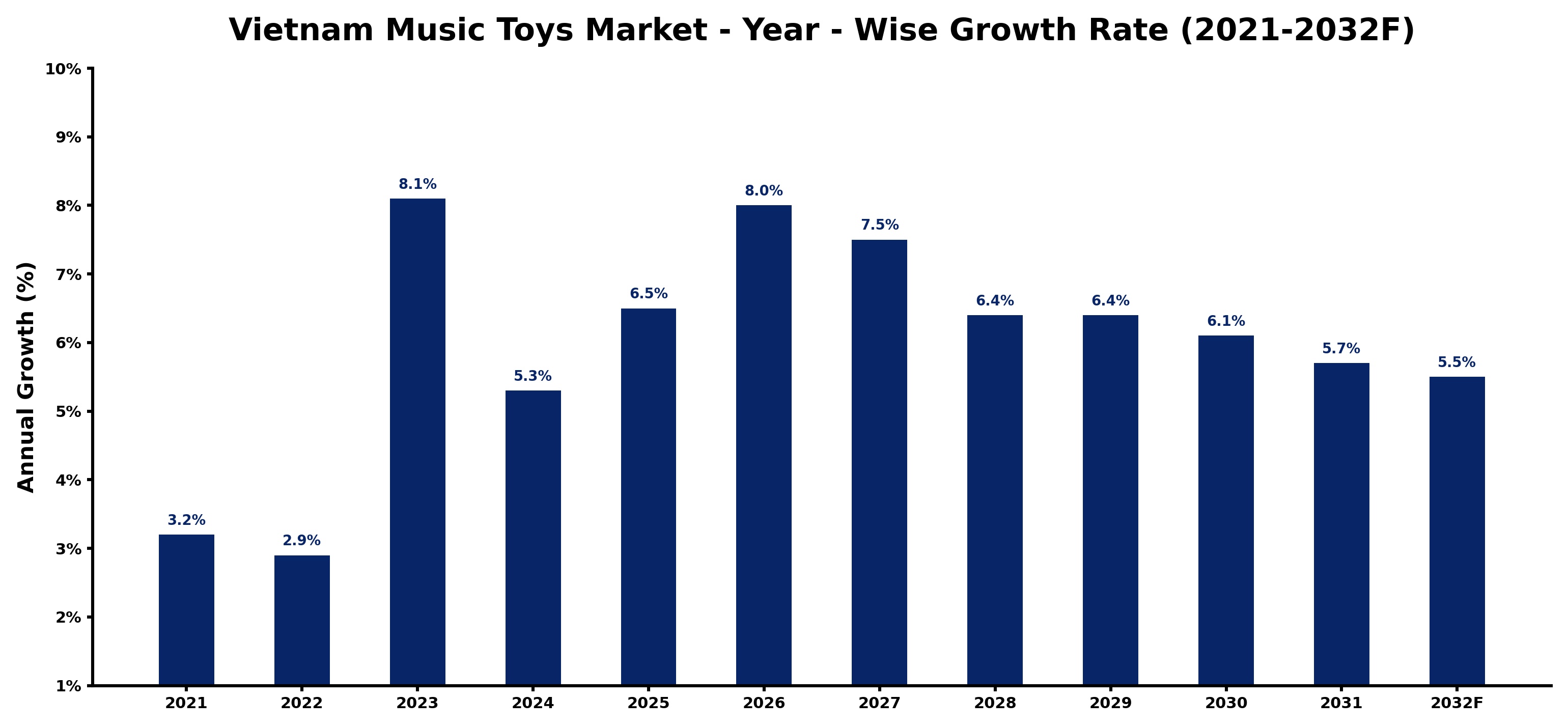
The table below presents the year‑wise growth rates along with the key drivers influencing the market
| Year | Growth Rate | Major Drivers |
| 2021 | 3.2% | Increasing smart city development projects |
| 2022 | 2.9% | Expansion of transportation and logistics networks |
| 2023 | 8.1% | Growing urbanization and commercial development |
| 2024 | 5.3% | Increasing smart city development projects |
| 2025 | 6.5% | Rapid growth in telecom and data center sectors |
| 2026 | 8.0% | Expansion of commercial construction activities |
| 2027 | 7.5% | Rising electricity demand across industries |
| 2028 | 6.4% | Expansion of commercial construction activities |
| 2029 | 6.4% | Increasing adoption of advanced technologies |
| 2030 | 6.1% | Expansion of commercial construction activities |
| 2031 | 5.7% | Increasing adoption of advanced technologies |
| 2032 | 5.5% | Increasing smart city development projects |
Note - Market size estimations and growth projections presented in this report are based on 6Wresearch's advanced forecasting approach, validated with industry datasets as of June 2026.
Vietnam Music Toys Market Synopsis
The Vietnam music toys market is experiencing a renaissance as awareness of early childhood development takes center stage in parenting. Parents and caregivers alike are gravitating towards music toys that stimulate creativity and enhance sensory perception, leading to a noticeable surge in demand. This growing focus on education has made music toys not just a form of entertainment, but also essential tools for learning.
As urbanization continues to reshape Vietnamese lifestyles, the need for engaging and educational toys has never been greater. The expansion of retail avenues, including e-commerce platforms, has made music toys more accessible than ever, allowing a wider demographic to partake in this enriching experience.
Vietnam Music Toys Market Key Takeaways
- The market is experiencing steady growth due to rising awareness of early childhood development.
- Urbanization and busy lifestyles are driving the demand for interactive and educational toys.
- Accessibility through various retail channels, including online marketplaces, is enhancing market reach.
- Music toys are increasingly viewed as essential learning tools rather than mere playthings.
- The impact of COVID-19 highlighted the importance of engaging toys for home-bound children.
Evaluation of Restraints in Vietnam Music Toys Market
Despite the promising growth trajectory, the Vietnam music toys market faces certain restraints that could impede its potential. A significant concern is the fierce competition from digital devices and electronic gadgets that captivate children's attention, diverting interest away from traditional toys. Additionally, factors such as fluctuating supply chain dynamics can impact the availability and pricing of music toys, creating uncertainty in the market landscape. In a rapidly evolving digital age, maintaining engagement in a tactile and educational medium requires ongoing innovation to capture children's imaginations.
Vietnam Music Toys Market Trends
One of the prevailing trends within the Vietnam music toys market is the increasing incorporation of technology into traditional music toys. Hybrid toys that blend physical interaction with digital experiences are capturing the interest of both parents and children. Furthermore, there is a shift towards eco-friendly materials as consumers become more environmentally conscious. The focus on sustainable products is influencing purchasing decisions and shaping market offerings.
Vietnam Music Toys Market Opportunities
The Vietnam music toys market is rife with growth opportunities, particularly through the expansion of product lines that cater to diverse age groups and learning stages. Collaborations with educational institutions to create tailored music toys can foster deeper engagement and enhance learning outcomes. Additionally, exploring partnerships with local artisans to develop culturally relevant music toys could appeal to consumers looking for unique, meaningful products. With the right strategies, there exists a significant potential for brands to capitalize on the growing interest in educational and creative play.
Government Initiatives in the Vietnam Music Toys Market
The Vietnamese government has shown a commitment to improving early childhood education, which indirectly benefits the music toys market. Initiatives aimed at promoting educational equity and enhancing access to quality learning resources are critical in shaping market dynamics. Public programs that encourage parental involvement in childhood education underscore the importance of developmentally appropriate toys, including music toys. These efforts align with broader educational goals, creating a supportive environment for market growth.
Future Insights of the Vietnam Music Toys Market
Looking ahead to 2026-2032, the Vietnam music toys market is poised for continuous expansion, propelled by evolving consumer preferences that increasingly favor educational play. The integration of innovative designs and smart technologies will likely enhance the appeal of music toys, making them indispensable in every child's developmental journey. As parents remain dedicated to providing quality educational experiences for their children, the market will adapt to these demands, creating rich opportunities for investment and innovation.
Vietnam Music Toys Market Latest Developments (May 2025 - June 2026)
Recent industry developments indicate a surge in the introduction of interactive music toys that incorporate elements of gamification to enhance engagement. Manufacturers are increasingly focusing on sustainability by utilizing eco-friendly materials in production processes. Additionally, local toy fairs and exhibitions have showcased a growing variety of music toys that highlight cultural themes, reflecting a desire for deeper connections through play.
Vietnam Music Toys Market - Key Attractiveness of the Report
- 10 Years of Market Numbers
- Historical Data Starting from 2022 to 2025
- Base Year: 2025
- Forecast Data until 2032
- Key Performance Indicators Impacting the Market
- Major Upcoming Developments and Projects
Key Highlights of the Report:
- Vietnam Music Toys Market Outlook
- Market Size of Vietnam Music Toys Market, 2025
- Forecast of Vietnam Music Toys Market, 2032
- Historical Data and Forecast of Vietnam Music Toys Revenues & Volume for the Period 2022-2032F
- Vietnam Music Toys Market Trend Evolution
- Vietnam Music Toys Market Drivers and Challenges
- Vietnam Music Toys Price Trends
- Vietnam Music Toys Porter's Five Forces
- Vietnam Music Toys Industry Life Cycle
- Historical Data and Forecast of Vietnam Music Toys Market Revenues & Volume By Type for the Period 2022-2032F
- Historical Data and Forecast of Vietnam Music Toys Market Revenues & Volume By Drums & Percussion for the Period 2022-2032F
- Historical Data and Forecast of Vietnam Music Toys Market Revenues & Volume By Guitars & Strings for the Period 2022-2032F
- Historical Data and Forecast of Vietnam Music Toys Market Revenues & Volume By Pianos & Keyboards for the Period 2022-2032F
- Historical Data and Forecast of Vietnam Music Toys Market Revenues & Volume By Wind & Brass for the Period 2022-2032F
- Historical Data and Forecast of Vietnam Music Toys Market Revenues & Volume By Others for the Period 2022-2032F
- Historical Data and Forecast of Vietnam Music Toys Market Revenues & Volume By Age for the Period 2022-2032F
- Historical Data and Forecast of Vietnam Music Toys Market Revenues & Volume By Below 1 Year for the Period 2022-2032F
- Historical Data and Forecast of Vietnam Music Toys Market Revenues & Volume By 1??3 Years for the Period 2022-2032F
- Historical Data and Forecast of Vietnam Music Toys Market Revenues & Volume By 3??5 Year for the Period 2022-2032F
- Historical Data and Forecast of Vietnam Music Toys Market Revenues & Volume By 5??7 Years for the Period 2022-2032F
- Historical Data and Forecast of Vietnam Music Toys Market Revenues & Volume By 7??9 Years for the Period 2022-2032F
- Historical Data and Forecast of Vietnam Music Toys Market Revenues & Volume By Above 9 Years for the Period 2022-2032F
- Historical Data and Forecast of Vietnam Music Toys Market Revenues & Volume By Distribution Channel for the Period 2022-2032F
- Historical Data and Forecast of Vietnam Music Toys Market Revenues & Volume By Online Channel for the Period 2022-2032F
- Historical Data and Forecast of Vietnam Music Toys Market Revenues & Volume By Offline Channel for the Period 2022-2032F
- Vietnam Music Toys Import Export Trade Statistics
- Market Opportunity Assessment By Type
- Market Opportunity Assessment By Age
- Market Opportunity Assessment By Distribution Channel
- Vietnam Music Toys Top Companies Market Share
- Vietnam Music Toys Competitive Benchmarking By Technical and Operational Parameters
- Vietnam Music Toys Company Profiles
- Vietnam Music Toys Key Strategic Recommendations






































