Vietnam Narrow Woven Fabrics Market Summary
The vietnam narrow woven fabrics market was estimated at USD 629 Million in 2025 and is projected to reach USD 895 Million by 2032, growing at a CAGR of 8.4% from 2026 to 2032.
Vietnam Narrow Woven Fabrics Market Year-wise Growth Rate and Key Drivers
This graph highlights how the Vietnam Narrow Woven Fabrics Market has steadily grown over the past five years, supported by major growth factors.
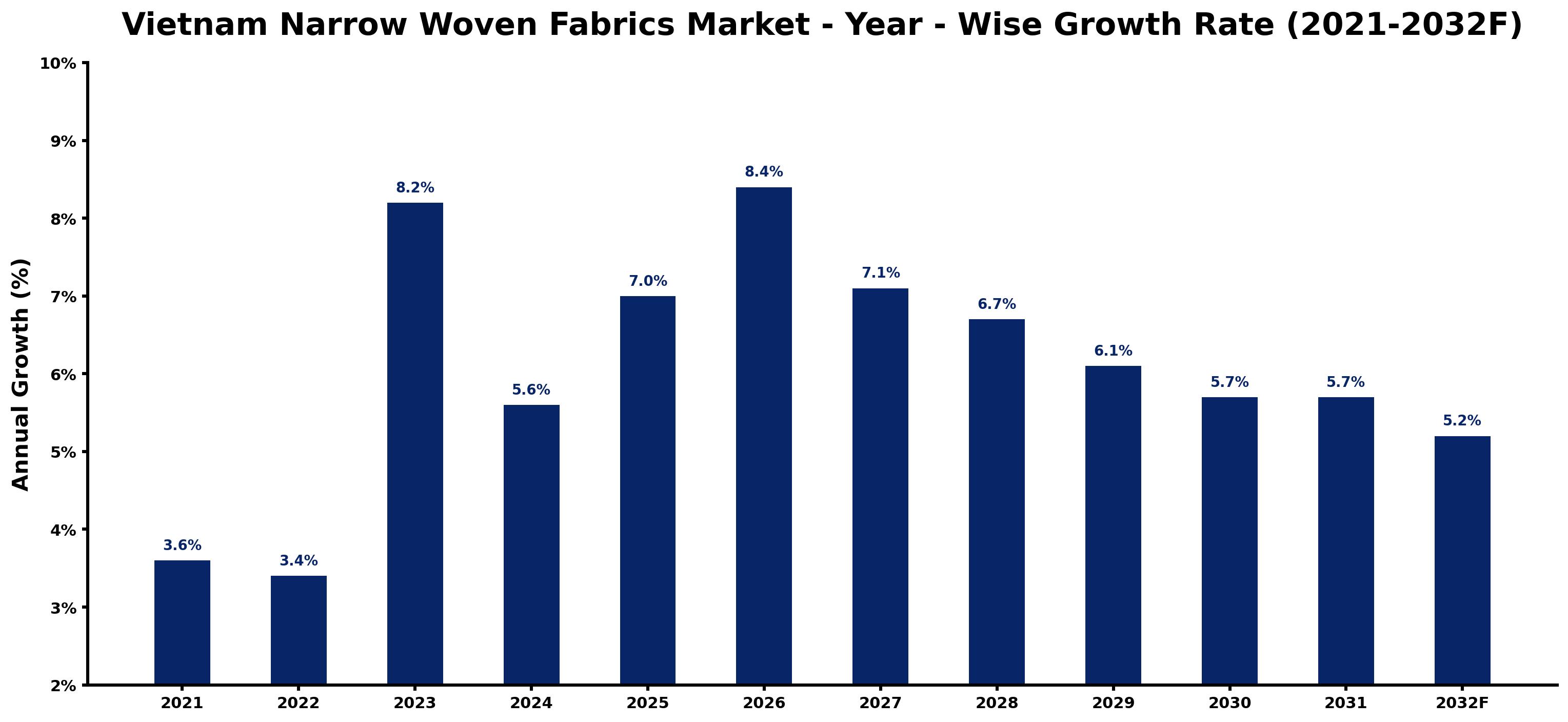
The table below presents the year wise growth rates along with the key drivers influencing the market
| Year | Growth Rate | Major Drivers |
| 2021 | 3.6% | Manufacturers are increasingly sourcing raw materials locally to reduce logistics costs. |
| 2022 | 3.4% | Vietnam's textile industry sees a boost from expanding international trade agreements with key partners. |
| 2023 | 8.2% | Rural areas invest in power grid improvements, enhancing production capabilities for textiles. |
| 2024 | 5.6% | Technological upgrades in weaving processes result in higher efficiency and product quality. |
| 2025 | 7.0% | Growing awareness of sustainable practices encourages innovations in eco-friendly fabric production. |
| 2026 | 8.4% | Consumer preferences shift toward customizable textile products, prompting market diversification efforts. |
| 2027 | 7.1% | E-commerce platforms capture a larger share of the fabrics market, expanding reach significantly. |
| 2028 | 6.7% | Increased collaboration between fabric producers and fashion designers stimulates product development. |
| 2029 | 6.1% | Vietnam's reputation for quality textiles strengthens, attracting more foreign investments into manufacturing. |
| 2030 | 5.7% | Emerging trends in smart textiles encourage research and development in functional fabrics. |
| 2031 | 5.7% | The workforce adapts to automation technologies, enhancing productivity across manufacturing sectors. |
| 2032 | 5.2% | Market leaders focus on branding strategies, appealing to both local and global consumers. |
Note - Market size estimations and growth projections presented in this report are based on 6Wresearch's advanced forecasting approach, validated with industry datasets as of June 2026.
Vietnam Narrow Woven Fabrics Market Synopsis
The Vietnam Narrow Woven Fabrics Market is projected to reach 8.4% and witness significant growth during the forecast period (2026-2032). This sector encompasses a variety of woven products crucial for numerous applications across different industries, including textiles, apparel, automotive, home furnishings, and packaging. The increasing demand for narrow woven fabrics is closely tied to the expansion of the country's textile and garment industry, where such fabrics are vital for trims, labels, belts, and straps. The automotive and construction sectors are also significant contributors, utilizing narrow woven fabrics for safety features such as seat belts and webbings. As Vietnam continues to attract foreign investments aimed at enhancing its manufacturing capabilities, the demand for narrow woven fabrics is expected to remain robust, driven by both domestic manufacturers and international firms.
Vietnam Narrow Woven Fabrics Market Growth Drivers
The growth of the Vietnam Narrow Woven Fabrics Market can be attributed to several key drivers:
- The booming textile and garment industry has positioned Vietnam as a global hub for textile production. This sector's growth has spurred a heightened demand for narrow woven fabrics which are utilized in various garment applications.
- As international brands continue to source from Vietnam, there is a growing need for an extensive range of narrow woven fabrics offering various textures, patterns, and colors to meet fashion trends.
- The automotive industry's expansion in Vietnam fosters demand for narrow woven fabrics used in safety belts and seatbelt systems, further propelling the market's growth.
- Investment in manufacturing infrastructure and technology aids in improving production efficiency, contributing positively to the availability of high-quality narrow woven fabrics.
- Consumer demand for functional and fashionable garments promotes the diverse use of narrow woven fabrics, creating opportunities for innovation and product development in the market.
Vietnam Narrow Woven Fabrics Market Challenges and Restraints
Despite its robust growth trajectory, the Vietnam Narrow Woven Fabrics Market encounters several challenges:
- Increased competition from neighboring countries also enhancing their textile production capabilities presents a competitive threat to Vietnam's market share.
- Fluctuations in raw material prices, particularly for synthetic fibers and yarns essential for narrow woven fabrics, can significantly impact production costs and profit margins.
- The disruptions caused by the COVID-19 pandemic revealed vulnerabilities in the supply chain, emphasizing the need for comprehensive risk management strategies.
- Manufacturers face increasing pressure to adopt sustainable practices in production, which may necessitate significant investment and compliance with evolving regulations.
- Small and medium-sized enterprises, in particular, may find it challenging to implement advanced technologies and sustainable practices due to limited resources.
Vietnam Narrow Woven Fabrics Market Government Investment and Initiatives
The Vietnamese government is actively promoting the development of the textile and garment sector, which directly influences the narrow woven fabrics market. Various initiatives aimed at enhancing labor skills through training programs and increasing technological innovation are in place. The government is also focusing on attracting foreign direct investment (FDI) in manufacturing, offering incentives to companies investing in sustainable practices and advanced manufacturing technologies. Additionally, public spending on infrastructure improvements, such as transportation and logistics, is expected to facilitate smoother supply chain operations for fabric producers. Various trade agreements and policy frameworks encourage the export of textile products, further solidifying Vietnam's position as a significant player in the narrow woven fabrics market.
Vietnam Narrow Woven Fabrics Market Latest Developments (May 2025 - June 2026)
In the period from May 2025 to June 2026, the Vietnam Narrow Woven Fabrics Market witnessed several notable developments. Manufacturers began to adapt to post-pandemic market conditions, focusing on enhancing online sales channels to ensure product availability. The demand for personal protective equipment (PPE) and medical textiles surged, creating new opportunities within the industry. Innovations in product designs and materials have become a focus, with companies exploring eco-friendly fabrics in response to rising consumer awareness about sustainability. Government support for technology adoption in textiles has encouraged manufacturers to modernize production processes, thereby increasing efficiency. Additionally, the recovery of global trade has spurred renewed interest in Vietnam as a sourcing destination for narrow woven fabrics.
Vietnam Narrow Woven Fabrics Market - Key Attractiveness of the Report
- 10 Years of Market Numbers
- Historical Data Starting from 2022 to 2025
- Base Year: 2025
- Forecast Data until 2032
- Key Performance Indicators Impacting the Market
- Major Upcoming Developments and Projects
Key Highlights of the Report:
- Vietnam Narrow Woven Fabrics Market Outlook
- Market Size of Vietnam Narrow Woven Fabrics Market, 2025
- Forecast of Vietnam Narrow Woven Fabrics Market, 2032
- Historical Data and Forecast of Vietnam Narrow Woven Fabrics Revenues & Volume for the Period 2022-2032F
- Vietnam Narrow Woven Fabrics Market Trend Evolution
- Vietnam Narrow Woven Fabrics Market Drivers and Challenges
- Vietnam Narrow Woven Fabrics Price Trends
- Vietnam Narrow Woven Fabrics Porter's Five Forces
- Vietnam Narrow Woven Fabrics Industry Life Cycle
- Historical Data and Forecast of Vietnam Narrow Woven Fabrics Market Revenues & Volume By Type for the Period 2022-2032F
- Historical Data and Forecast of Vietnam Narrow Woven Fabrics Market Revenues & Volume By Polyester for the Period 2022-2032F
- Historical Data and Forecast of Vietnam Narrow Woven Fabrics Market Revenues & Volume By Nylon for the Period 2022-2032F
- Historical Data and Forecast of Vietnam Narrow Woven Fabrics Market Revenues & Volume By PP for the Period 2022-2032F
- Historical Data and Forecast of Vietnam Narrow Woven Fabrics Market Revenues & Volume By Applications for the Period 2022-2032F
- Historical Data and Forecast of Vietnam Narrow Woven Fabrics Market Revenues & Volume By Garments for the Period 2022-2032F
- Historical Data and Forecast of Vietnam Narrow Woven Fabrics Market Revenues & Volume By Home Furnishing for the Period 2022-2032F
- Historical Data and Forecast of Vietnam Narrow Woven Fabrics Market Revenues & Volume By Other for the Period 2022-2032F
- Vietnam Narrow Woven Fabrics Import Export Trade Statistics
- Market Opportunity Assessment By Type
- Market Opportunity Assessment By Applications
- Vietnam Narrow Woven Fabrics Top Companies Market Share
- Vietnam Narrow Woven Fabrics Competitive Benchmarking By Technical and Operational Parameters
- Vietnam Narrow Woven Fabrics Company Profiles
- Vietnam Narrow Woven Fabrics Key Strategic Recommendations






































