Vietnam Network Slicing Market Size, Share & Growth Rate
The Vietnam Network Slicing Market was estimated at USD 1103 Million in 2025 and is projected to reach USD 1569 Million by 2032, growing at a CAGR of 5.2% from 2026 to 2032. This robust growth trajectory is primarily driven by the accelerated rollout of 5G networks in Vietnam, which demand advanced solutions like network slicing to optimize resource allocation. As industries increasingly adopt IoT and require specific network configurations, the necessity for tailored connectivity solutions becomes ever more pressing, propelling market expansion.
Vietnam Network Slicing Market Year-wise Growth Rate and Key Drivers
This graph highlights how the Vietnam Network Slicing Market has steadily grown over the years, supported by major growth factors.
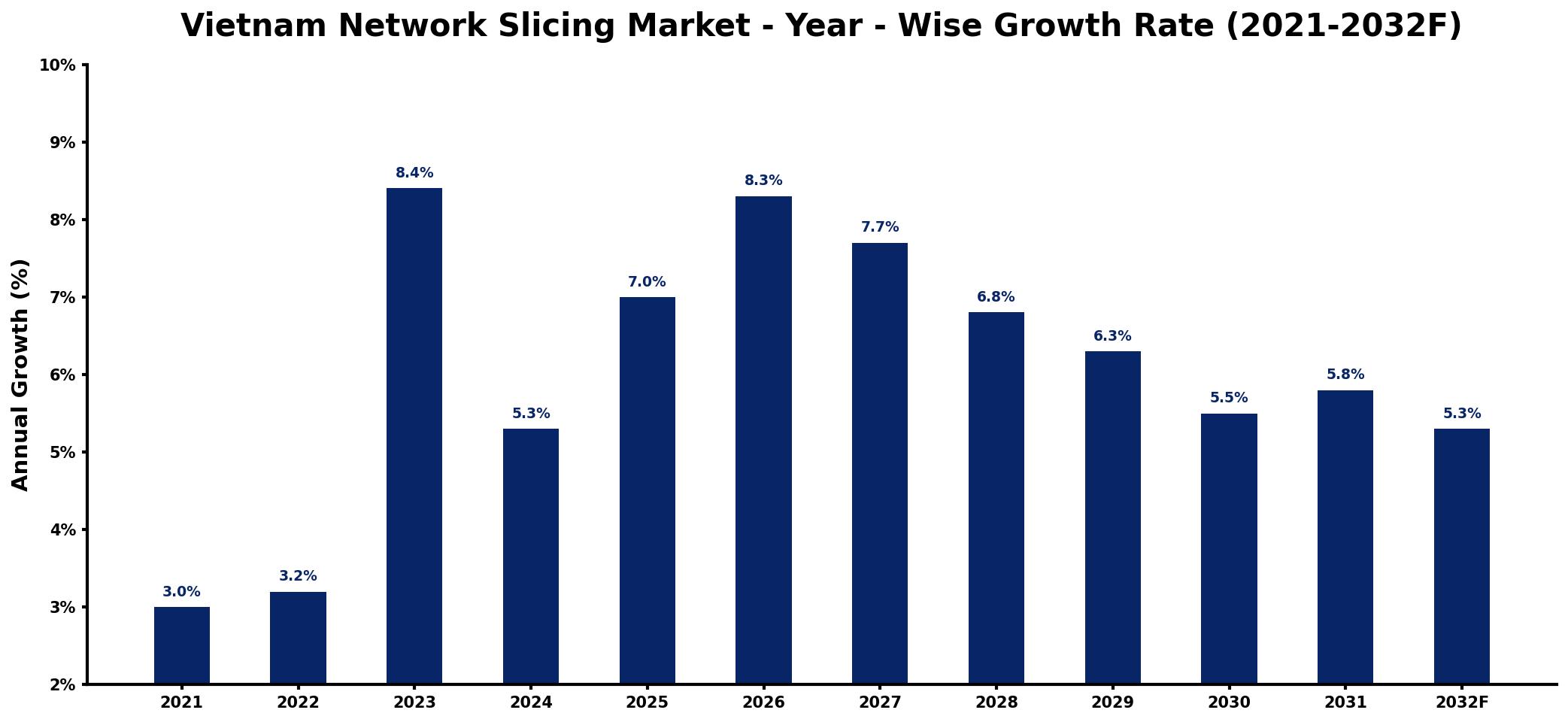
The table below presents the year‑wise growth rates along with the key drivers influencing the market
| Year | Growth Rate | Major Drivers |
| 2021 | 3.0% | Emerging technologies drive adoption |
| 2022 | 3.2% | Increased investments in 5G infrastructure |
| 2023 | 8.4% | Demand from IoT applications rises |
| 2024 | 5.3% | Growth in smart city initiatives |
| 2025 | 7.0% | Expansion of cloud services market |
| 2026 | 8.3% | Enhanced mobile broadband requirements |
| 2027 | 7.7% | Rising need for data privacy |
| 2028 | 6.8% | Increased remote work solutions demand |
| 2029 | 6.3% | increased overall sector activity |
| 2030 | 5.5% | Investments in edge computing solutions |
| 2031 | 5.8% | Surge in digital transformation efforts |
| 2032 | 5.3% | Adoption of AI in businesses |
Note: Market size estimations and growth projections presented in this report are based on 6Wresearch's proprietary forecasting methodology, utilizing the latest available industry data, government publications, and primary research inputs.
Vietnam Network Slicing Market Synopsis
In the evolving landscape of telecommunications, Vietnam is witnessing a significant shift towards network slicing, a revolutionary approach to managing and utilizing network resources. This technology is particularly crucial in the context of 5G, allowing for the provisioning of distinct virtual networks, each designed to cater to specific user requirements and applications.
As businesses in Vietnam's key sectors, including healthcare and manufacturing, seek specialized services that demand unique connectivity solutions, network slicing stands out as a critical enabler. The growing need for flexible, scalable network resources underscores the importance of this market, marking it as a focal point for future telecommunications developments.
Vietnam Network Slicing Market Key Takeaways
- Network slicing is pivotal for optimizing 5G networks, enabling tailored services for diverse applications.
- The market is witnessing increasing demand from industries seeking specialized connectivity solutions.
- Investment in infrastructure and technology remains essential for the successful implementation of network slicing.
- Challenges such as security, skilled workforce requirements, and regulatory compliance persist.
- Recent trends indicate a shift towards more flexible, customizable network configurations to support various business needs.
Evaluation of Restraints in Vietnam Network Slicing Market
Despite the promising outlook for network slicing in Vietnam, several restraints limit the market's potential. A major challenge is the high capital investment required to develop and implement the necessary infrastructure. Creating a dynamic network that can efficiently allocate resources across multiple slices is technically complex, requiring advanced technology and expertise. Furthermore, ensuring the security and isolation of these slices is crucial, as vulnerabilities in one area can compromise the entire network. The shortage of skilled professionals capable of managing these intricate systems adds another layer of difficulty. Lastly, regulatory hurdles related to spectrum management need to be addressed to foster a conducive environment for growth in this sector.
Vietnam Network Slicing Market Trends
The Vietnam Network Slicing market is currently shaped by several notable trends. The increased adoption of smart technologies, driven by 5G, is pushing businesses to explore network slicing for enhanced operational efficiencies. This trend is particularly pronounced in sectors such as transportation and logistics, where low-latency communication is critical. Moreover, the rising significance of IoT devices necessitates networks that can support numerous connections simultaneously, further boosting the demand for slicing capabilities. Collaboration among telecom providers and technology firms is also on the rise, aimed at developing innovative solutions tailored to specific industry needs.
Vietnam Network Slicing Market Opportunities
Opportunities abound in the Vietnam Network Slicing market, particularly as sectors like healthcare and smart cities seek advanced connectivity solutions. The rise of remote monitoring and telemedicine is fueling demand for reliable network slicing services that can support high-bandwidth applications. Furthermore, industries focused on automation and real-time data processing are also looking to leverage network slicing to enhance operational efficiency. The governments commitment to digital transformation initiatives presents a favorable environment for investments in this market, making it an attractive prospect for stakeholders.
Government Initiatives in the Vietnam Network Slicing Market
The Vietnamese government has recognized the strategic importance of network slicing in advancing the nations telecommunications infrastructure. Initiatives promoting the adoption of 5G technology are underway, with public spending aimed at enhancing digital connectivity across the country. Programs focused on boosting research and development in telecommunications, along with potential incentives for private sector partnerships, indicate a robust policy framework to support the growth of the network slicing market.
Future Insights of the Vietnam Network Slicing Market
Looking ahead, the Vietnam Network Slicing Market is set to witness substantial evolution from 2026 to 2032. As the demand for seamless connectivity continues to rise, telecom operators will increasingly adopt slicing technologies to cater to diverse customer needs. The anticipated growth in sectors such as smart manufacturing and urban infrastructure will further drive investments. Additionally, advancements in AI and machine learning are likely to enhance the capabilities of network slicing, enabling more dynamic and efficient resource management. In this landscape, the market stands to play a pivotal role in shaping Vietnam's digital future.
Vietnam Network Slicing Market Latest Developments (2025 - 2026)
Recent developments in the Vietnam Network Slicing market reflect a growing focus on collaborative projects between telecom operators and technology firms. Innovations in slicing solutions are being explored to address industry-specific needs, particularly in healthcare and logistics. Additionally, there is an observable trend toward integrating artificial intelligence in network management, which is expected to enhance the efficiency and reliability of network slicing applications.
Vietnam Network Slicing Market - Key Attractiveness of the Report
- 10 Years of Market Numbers
- Historical Data Starting from 2022 to 2025
- Base Year: 2025
- Forecast Data until 2032
- Key Performance Indicators Impacting the Market
- Major Upcoming Developments and Projects
Key Highlights of the Report:
- Vietnam Network Slicing Market Outlook
- Market Size of Vietnam Network Slicing Market, 2025
- Forecast of Vietnam Network Slicing Market, 2032
- Historical Data and Forecast of Vietnam Network Slicing Revenues & Volume for the Period 2022-2032F
- Vietnam Network Slicing Market Trend Evolution
- Vietnam Network Slicing Market Drivers and Challenges
- Vietnam Network Slicing Price Trends
- Vietnam Network Slicing Porter's Five Forces
- Vietnam Network Slicing Industry Life Cycle
- Historical Data and Forecast of Vietnam Network Slicing Market Revenues & Volume By Component for the Period 2022-2032F
- Historical Data and Forecast of Vietnam Network Slicing Market Revenues & Volume By Solution for the Period 2022-2032F
- Historical Data and Forecast of Vietnam Network Slicing Market Revenues & Volume By Services (Professional & Managed) for the Period 2022-2032F
- Historical Data and Forecast of Vietnam Network Slicing Market Revenues & Volume By End User for the Period 2022-2032F
- Historical Data and Forecast of Vietnam Network Slicing Market Revenues & Volume By Telecom Operators for the Period 2022-2032F
- Historical Data and Forecast of Vietnam Network Slicing Market Revenues & Volume By Enterprises for the Period 2022-2032F
- Historical Data and Forecast of Vietnam Network Slicing Market Revenues & Volume By Application for the Period 2022-2032F
- Historical Data and Forecast of Vietnam Network Slicing Market Revenues & Volume By Manufacturing for the Period 2022-2032F
- Historical Data and Forecast of Vietnam Network Slicing Market Revenues & Volume By Government for the Period 2022-2032F
- Historical Data and Forecast of Vietnam Network Slicing Market Revenues & Volume By Automotive for the Period 2022-2032F
- Historical Data and Forecast of Vietnam Network Slicing Market Revenues & Volume By Media and Entertainment for the Period 2022-2032F
- Vietnam Network Slicing Import Export Trade Statistics
- Market Opportunity Assessment By Component
- Market Opportunity Assessment By End User
- Market Opportunity Assessment By Application
- Vietnam Network Slicing Top Companies Market Share
- Vietnam Network Slicing Competitive Benchmarking By Technical and Operational Parameters
- Vietnam Network Slicing Company Profiles
- Vietnam Network Slicing Key Strategic Recommendations






































