Vietnam Non-ferrous Metal Market Summary
The vietnam non-ferrous metal market was estimated at USD 460 Million in 2025 and is projected to reach USD 649 Million by 2032, growing at a CAGR of 8.3% from 2026 to 2032.
Vietnam Non-ferrous Metal Market Year-wise Growth Rate and Key Drivers
This graph highlights how the Vietnam Non-ferrous Metal Market has steadily grown over the past five years, supported by major growth factors.
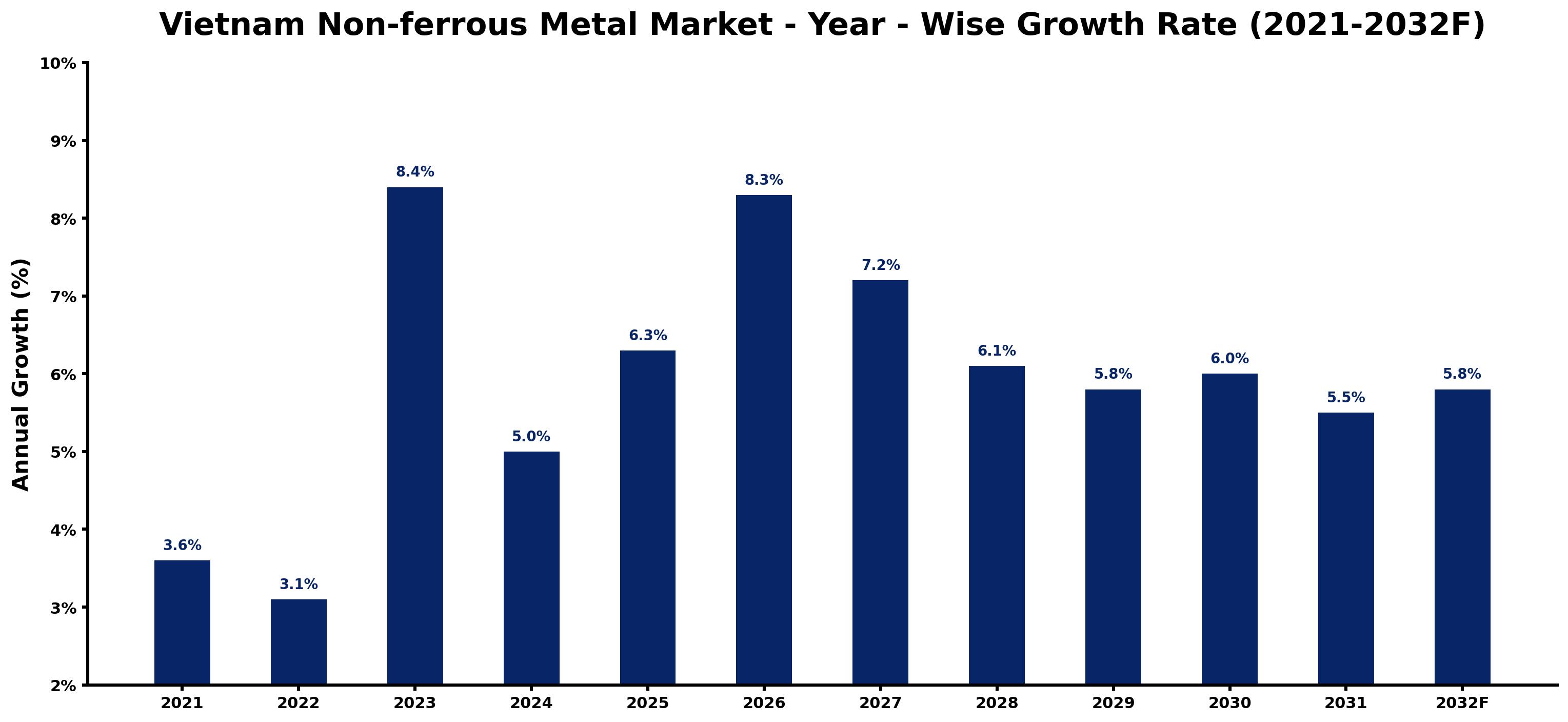
The table below presents the year wise growth rates along with the key drivers influencing the market
| Year | Growth Rate | Major Drivers |
| 2021 | 3.6% | Manufacturing relocation to Vietnam enhances non-ferrous metal demand across multiple sectors. |
| 2022 | 3.1% | Rural electrification projects initiate a surge in copper and aluminum usage. |
| 2023 | 8.4% | Increased investment in renewable energy systems boosts the need for specialized metals. |
| 2024 | 5.0% | Infrastructure developments in urban areas require more robust material supply chains. |
| 2025 | 6.3% | Emerging technologies in construction showcase the utility of advanced non-ferrous metals. |
| 2026 | 8.3% | Vietnam's participation in global trade agreements opens new market opportunities. |
| 2027 | 7.2% | Local companies are focusing on sustainable practices, enhancing recycling initiatives. |
| 2028 | 6.1% | Growing automotive production necessitates lighter materials for improved fuel efficiency. |
| 2029 | 5.8% | Demand for electric vehicles underscores the importance of copper and aluminum components. |
| 2030 | 6.0% | Evolving consumer preferences drive innovation in durable non-ferrous metal applications. |
| 2031 | 5.5% | Global supply chain challenges push Vietnam to develop local production capabilities. |
| 2032 | 5.8% | Increased foreign investments lead to advanced processing technologies for non-ferrous metals. |
Note - Market size estimations and growth projections presented in this report are based on 6Wresearch's advanced forecasting approach, validated with industry datasets as of June 2026.
Vietnam Non-ferrous Metal Market Synopsis
The Vietnam Non-ferrous Metal Market is projected to reach 8.3% and witness significant growth during the forecast period (2026-2032). This growth is driven by the increasing demand for non-ferrous metals such as copper, aluminum, zinc, and lead, which are crucial for a variety of sectors, including construction, automotive, electronics, and aerospace. As Vietnam's industrial and manufacturing activities expand, the need for these metals is set to rise, positioning the market for continued development.
Vietnam Non-ferrous Metal Market Growth Drivers
Several key drivers are propelling the growth of the Vietnam non-ferrous metal market. The first major factor is the rapid urbanization and significant infrastructure projects underway in the country, which are increasing the demand for non-ferrous metals in construction applications. Moreover, the automotive and electronics sectors are expanding rapidly in Vietnam, leading to a heightened need for non-ferrous metals to manufacture components and parts. Additionally, the government's proactive stance on attracting foreign investments and fostering industrial growth has further enriched the market landscape.
- The construction industry's expansion is leading to increased procurement of non-ferrous metals, essential for building structures and infrastructure.
- The automotive sector's growth is driving demand for lightweight materials, where aluminum and other non-ferrous metals play a crucial role.
- Investment incentives provided by the government are creating a favorable environment for the non-ferrous metal industry.
- The rise of electronic goods manufacturing increases the consumption of metals like copper and aluminum in electronic components.
- The overall economic growth of Vietnam is leading to enhanced manufacturing capabilities, necessitating a steady supply of non-ferrous metals.
Vietnam Non-ferrous Metal Market Challenges and Restraints
Despite the positive outlook for the Vietnam non-ferrous metal market, several challenges need to be navigated. Fluctuations in global metal prices pose a risk to profitability, making it essential for producers and suppliers to manage costs effectively to ensure stability. Furthermore, the industry must contend with environmental concerns arising from mining and metal processing activities, necessitating the implementation of eco-friendly practices. Addressing these challenges is vital for the long-term sustainability and reputation of the industry.
- Volatility in global metal prices can create uncertainty for producers and downstream users, affecting overall market stability.
- Environmental regulations are becoming stricter, requiring industries to adopt sustainable practices throughout the metal production process.
- Competition from other regions with lower production costs can potentially hamper local manufacturers' market share.
- Supply chain disruptions caused by external factors can lead to production delays and increased operational costs.
- The need for skilled labor and technological advances can strain the industry's capacity for innovation and efficient production.
Vietnam Non-ferrous Metal Market COVID-19 Impact
The COVID-19 pandemic significantly impacted the Vietnam non-ferrous metal market, primarily during its initial phases. Disruptions in global supply chains, reduced industrial activities, and general economic uncertainties led to fluctuations in demand and pricing for non-ferrous metals. However, as economic activities resumed and recovery efforts began, the market started to show signs of gradual resurgence. The pandemic underscored the importance of supply chain resilience, prompting many companies to focus on diversifying their sources of raw materials to adapt to the evolving market dynamics.
Vietnam Non-ferrous Metal Market Government Investment and Initiatives
The Vietnamese government has made concerted efforts to bolster the non-ferrous metal market through various investment initiatives and policy frameworks. Key initiatives include the promotion of foreign direct investment (FDI) in the manufacturing sector, coupled with incentives aimed at enhancing industrial productivity. Infrastructure development plans are also part of the national strategy, directly influencing the demand for non-ferrous metals. Furthermore, public spending on large-scale projects has been increasing, ensuring a sustained requirement for metal materials.
- Government policies are focused on creating an investment-friendly environment to attract FDI into the non-ferrous metal sector.
- National infrastructure development projects are being prioritized, leading to increased demand for non-ferrous metals in construction.
- Initiatives promoting technological upgrades within the metal processing industry aim to enhance efficiency and reduce environmental impact.
- Public-private partnerships are being encouraged to finance large-scale projects that will demand significant quantities of non-ferrous metals.
- Regulatory support for sustainable practices is being emphasized to align with global environmental standards, improving the industry's public perception.
Vietnam Non-ferrous Metal Market Latest Developments (May 2025 - June 2026)
Recent developments in the Vietnam non-ferrous metal market have been marked by a series of initiatives aimed at sustainability and innovation. Industry players have begun to explore methods to enhance recycling processes for metals, reflecting a growing emphasis on sustainability. Additionally, collaborations between local and international firms are being fostered to leverage technological advancements in metal processing. The government is also set to release new guidelines that will promote environmentally-friendly mining practices, contributing to the industry's long-term growth and compliance with international standards.
Vietnam Non-ferrous Metal Market - Key Attractiveness of the Report
- 10 Years of Market Numbers
- Historical Data Starting from 2022 to 2025
- Base Year: 2025
- Forecast Data until 2032
- Key Performance Indicators Impacting the Market
- Major Upcoming Developments and Projects
Key Highlights of the Report:
- Vietnam Non-ferrous Metal Market Outlook
- Market Size of Vietnam Non-ferrous Metal Market, 2025
- Forecast of Vietnam Non-ferrous Metal Market, 2032
- Historical Data and Forecast of Vietnam Non-ferrous Metal Revenues & Volume for the Period 2022-2032F
- Vietnam Non-ferrous Metal Market Trend Evolution
- Vietnam Non-ferrous Metal Market Drivers and Challenges
- Vietnam Non-ferrous Metal Price Trends
- Vietnam Non-ferrous Metal Porter's Five Forces
- Vietnam Non-ferrous Metal Industry Life Cycle
- Historical Data and Forecast of Vietnam Non-ferrous Metal Market Revenues & Volume By Types for the Period 2022-2032F
- Historical Data and Forecast of Vietnam Non-ferrous Metal Market Revenues & Volume By Aluminum for the Period 2022-2032F
- Historical Data and Forecast of Vietnam Non-ferrous Metal Market Revenues & Volume By Copper for the Period 2022-2032F
- Historical Data and Forecast of Vietnam Non-ferrous Metal Market Revenues & Volume By Lead for the Period 2022-2032F
- Historical Data and Forecast of Vietnam Non-ferrous Metal Market Revenues & Volume By Tin for the Period 2022-2032F
- Historical Data and Forecast of Vietnam Non-ferrous Metal Market Revenues & Volume By Nickel for the Period 2022-2032F
- Historical Data and Forecast of Vietnam Non-ferrous Metal Market Revenues & Volume By Titanium for the Period 2022-2032F
- Historical Data and Forecast of Vietnam Non-ferrous Metal Market Revenues & Volume By Zinc for the Period 2022-2032F
- Historical Data and Forecast of Vietnam Non-ferrous Metal Market Revenues & Volume By Applications for the Period 2022-2032F
- Historical Data and Forecast of Vietnam Non-ferrous Metal Market Revenues & Volume By Automobile Industry for the Period 2022-2032F
- Historical Data and Forecast of Vietnam Non-ferrous Metal Market Revenues & Volume By Electronic Power Industry for the Period 2022-2032F
- Historical Data and Forecast of Vietnam Non-ferrous Metal Market Revenues & Volume By Construction Industry for the Period 2022-2032F
- Historical Data and Forecast of Vietnam Non-ferrous Metal Market Revenues & Volume By Other for the Period 2022-2032F
- Vietnam Non-ferrous Metal Import Export Trade Statistics
- Market Opportunity Assessment By Types
- Market Opportunity Assessment By Applications
- Vietnam Non-ferrous Metal Top Companies Market Share
- Vietnam Non-ferrous Metal Competitive Benchmarking By Technical and Operational Parameters
- Vietnam Non-ferrous Metal Company Profiles
- Vietnam Non-ferrous Metal Key Strategic Recommendations






































