Vietnam Non-Metallic Mineral Deposit Market Summary
The vietnam non-metallic mineral deposit market was estimated at USD 257 Million in 2025 and is projected to reach USD 362 Million by 2032, growing at a CAGR of 7.7% from 2026 to 2032.
Vietnam Non-Metallic Mineral Deposit Market Year-wise Growth Rate and Key Drivers
This graph highlights how the Vietnam Non-Metallic Mineral Deposit Market has steadily grown over the past five years, supported by major growth factors.
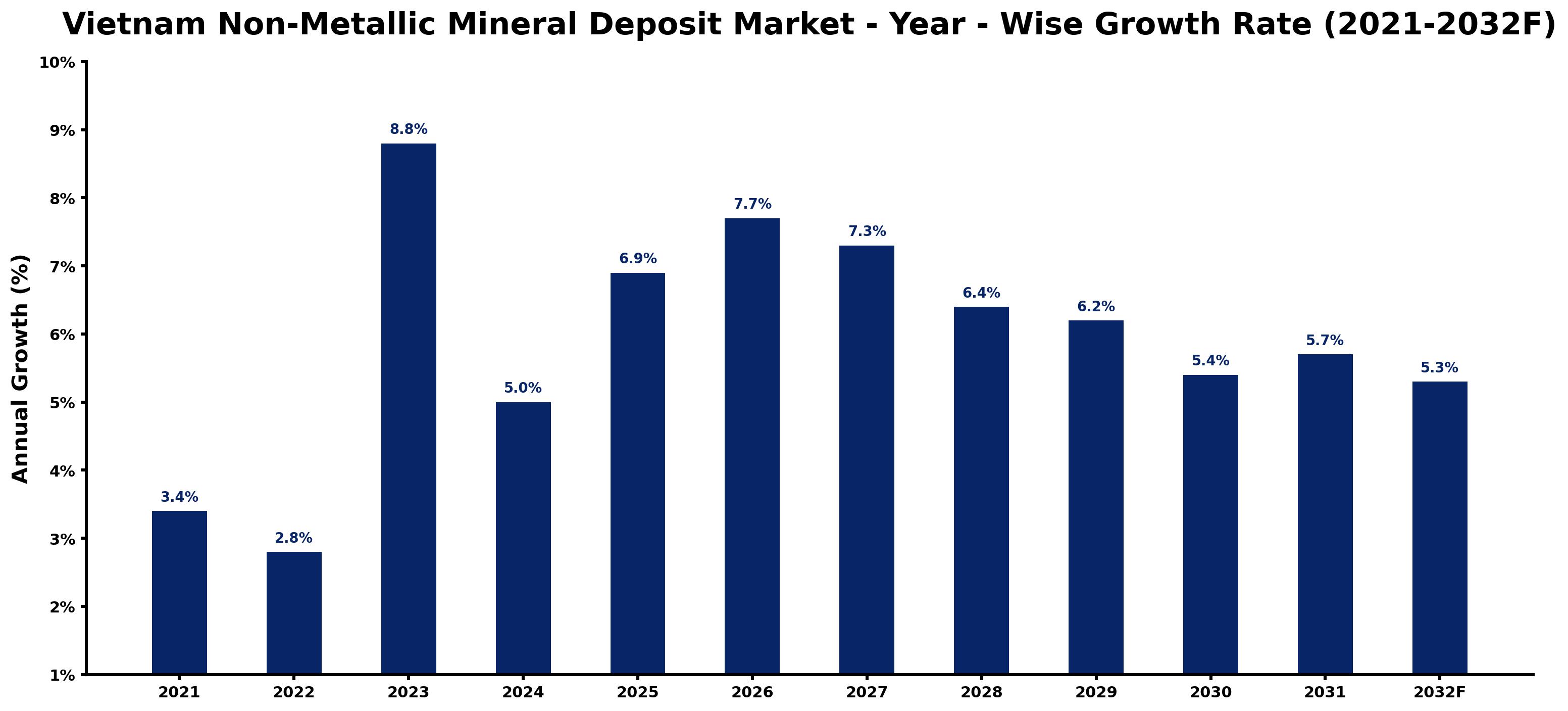
The table below presents the year wise growth rates along with the key drivers influencing the market
| Year | Growth Rate | Major Drivers |
| 2021 | 3.4% | Vietnam's manufacturing sector becomes critical for regional supply chain resilience post-pandemic. |
| 2022 | 2.8% | International companies seek local mineral sources to reduce reliance on imports from China. |
| 2023 | 8.8% | Infrastructure expansion projects boost the need for non-metallic minerals in construction. |
| 2024 | 5.0% | Consumer demand for sustainable products influences the mineral extraction industry's practices. |
| 2025 | 6.9% | Technological innovation in mining enhances efficiency and reduces environmental impact significantly. |
| 2026 | 7.7% | Vietnam positions itself as a key player in the ASEAN mineral supply chain landscape. |
| 2027 | 7.3% | Emerging markets show an increasing appetite for Vietnam's non-metallic mineral resources. |
| 2028 | 6.4% | Sustainability initiatives push local companies towards eco-friendly mineral production methods. |
| 2029 | 6.2% | Urbanization trends create higher demand for construction materials derived from non-metallic minerals. |
| 2030 | 5.4% | Partnerships between local firms and foreign investors accelerate technological advancement in mining. |
| 2031 | 5.7% | Increased exploration activities uncover new reserves, expanding the market potential considerably. |
| 2032 | 5.3% | Vietnam's mineral deposit market attracts global players seeking diversified investment opportunities. |
Note - Market size estimations and growth projections presented in this report are based on 6Wresearch's advanced forecasting approach, validated with industry datasets as of June 2026.
Vietnam Non-Metallic Mineral Deposit Market Synopsis
The Vietnam Non-Metallic Mineral Deposit Market is projected to reach 7.7% and witness significant growth during the forecast period (2026-2032). This market encompasses a range of non-metallic minerals that serve as crucial raw materials across various industries such as construction, ceramics, glass, cement, and chemicals. The primary materials under this sector include limestone, clay, gypsum, silica, and kaolin, all of which play essential roles in manufacturing and industrial processes.
Vietnam Non-Metallic Mineral Deposit Market Growth Drivers
The proliferation of the construction sector in Vietnam has been a primary driver of the non-metallic mineral deposit market. The escalating demand for infrastructure development necessitates significant volumes of materials such as limestone and sand, which are integral to construction projects. Additionally, the growth of ceramic and glass manufacturing industries further bolsters the market, as these sectors utilize a variety of non-metallic minerals in their production processes.
Furthermore, the cement industry in Vietnam heavily relies on non-metallic minerals, particularly limestone and clay, as key inputs for cement production. As urbanization continues to rise, the need for cement as a fundamental building material is expected to drive the demand for these minerals. Moreover, opportunities for exporting non-metallic minerals to regional markets create additional avenues for growth, positioning Vietnam as a significant player in the international mineral landscape.
Vietnam Non-Metallic Mineral Deposit Market Trends and Opportunities
Several trends are shaping the Vietnam Non-Metallic Mineral Deposit Market, with an increasing emphasis on sustainable mining practices and technological advancements in extraction and processing techniques. Companies are exploring innovative solutions to minimize environmental impacts and enhance operational efficiency. This shift towards sustainability not only aligns with global environmental standards but also meets growing consumer and regulatory demands for eco-friendly practices.
Additionally, collaborations between private enterprises and research institutions are fostering the development of new applications for non-metallic minerals. As industries seek to diversify their product offerings, the versatility of these minerals presents significant opportunities for innovation, especially in sectors like building materials and environmentally friendly products.
Vietnam Non-Metallic Mineral Deposit Market Challenges and Restraints
Despite the growth potential, the Vietnam Non-Metallic Mineral Deposit Market faces several challenges. Notably, the environmental consequences of mining and processing operations can lead to soil and water pollution, necessitating strict adherence to regulatory frameworks. Companies must invest in environmentally responsible practices to mitigate these impacts.
Additionally, price volatility linked to global market dynamics poses a risk for stakeholders in this sector. Fluctuations in demand from various industries can result in significant shifts in mineral prices, impacting profitability and strategic planning. The market also encounters competition from imported non-metallic minerals, which may offer different pricing structures and quality standards, compelling domestic producers to enhance their competitiveness.
Vietnam Non-Metallic Mineral Deposit Market Government Investment and Initiatives
The Vietnamese government has underscored the importance of the non-metallic mineral sector in its development agenda, aiming to bolster local production capacities and minimize dependence on imports. Public investments are being directed towards improving mining infrastructure and enhancing the regulatory framework governing mineral extraction and processing.
In particular, policies promoting sustainable mining practices and encouraging foreign investments are pivotal in shaping the landscape of the non-metallic mineral deposit market. Initiatives aimed at modernizing mining technology, along with incentives for companies that adhere to environmental standards, reflect the government's commitment to fostering a sustainable and competitive sector.
Vietnam Non-Metallic Mineral Deposit Market Latest Developments (May 2025 - June 2026)
Recent industry developments indicate a growing focus on innovation within the Vietnam Non-Metallic Mineral Deposit Market. Businesses are increasingly adopting advanced extraction technologies to enhance efficiency while reducing environmental footprints. Concurrently, there has been a noticeable shift towards forming partnerships between private firms and academic institutions, aimed at exploring new applications of non-metallic minerals.
As the construction industry continues to expand, projects targeting infrastructure development have resumed following pandemic-related disruptions, stimulating demand for essential minerals. This resurgence is expected to reinforce the market's growth trajectory, with stakeholders positioning themselves to seize emerging opportunities in the face of evolving consumer preferences and regulatory landscapes.
Vietnam Non-Metallic Mineral Deposit Market - Key Attractiveness of the Report
- 10 Years of Market Numbers
- Historical Data Starting from 2022 to 2025
- Base Year: 2025
- Forecast Data until 2032
- Key Performance Indicators Impacting the Market
- Major Upcoming Developments and Projects
Key Highlights of the Report:
- Vietnam Non-Metallic Mineral Deposit Market Outlook
- Market Size of Vietnam Non-Metallic Mineral Deposit Market, 2025
- Forecast of Vietnam Non-Metallic Mineral Deposit Market, 2032
- Historical Data and Forecast of Vietnam Non-Metallic Mineral Deposit Revenues & Volume for the Period 2022-2032F
- Vietnam Non-Metallic Mineral Deposit Market Trend Evolution
- Vietnam Non-Metallic Mineral Deposit Market Drivers and Challenges
- Vietnam Non-Metallic Mineral Deposit Price Trends
- Vietnam Non-Metallic Mineral Deposit Porter's Five Forces
- Vietnam Non-Metallic Mineral Deposit Industry Life Cycle
- Historical Data and Forecast of Vietnam Non-Metallic Mineral Deposit Market Revenues & Volume By Form Types for the Period 2022-2032F
- Historical Data and Forecast of Vietnam Non-Metallic Mineral Deposit Market Revenues & Volume By Powder Form for the Period 2022-2032F
- Historical Data and Forecast of Vietnam Non-Metallic Mineral Deposit Market Revenues & Volume By Liquid Form for the Period 2022-2032F
- Historical Data and Forecast of Vietnam Non-Metallic Mineral Deposit Market Revenues & Volume By Applications for the Period 2022-2032F
- Historical Data and Forecast of Vietnam Non-Metallic Mineral Deposit Market Revenues & Volume By Construction for the Period 2022-2032F
- Historical Data and Forecast of Vietnam Non-Metallic Mineral Deposit Market Revenues & Volume By Jewellery for the Period 2022-2032F
- Historical Data and Forecast of Vietnam Non-Metallic Mineral Deposit Market Revenues & Volume By Iron & Ore for the Period 2022-2032F
- Vietnam Non-Metallic Mineral Deposit Import Export Trade Statistics
- Market Opportunity Assessment By Form Types
- Market Opportunity Assessment By Applications
- Vietnam Non-Metallic Mineral Deposit Top Companies Market Share
- Vietnam Non-Metallic Mineral Deposit Competitive Benchmarking By Technical and Operational Parameters
- Vietnam Non-Metallic Mineral Deposit Company Profiles
- Vietnam Non-Metallic Mineral Deposit Key Strategic Recommendations






































