Vietnam Nylon Filament Yarn Market Size, Share & Growth Rate
The Vietnam Nylon Filament Yarn Market was estimated at USD 1418 Million in 2025 and is projected to reach USD 2013 Million by 2032, growing at a CAGR of 5.1% from 2026 to 2032. This upward trajectory is primarily driven by the burgeoning demand in textile, automotive, and industrial applications, underscoring the material's versatility and durability. As Vietnam continues to enhance its manufacturing capabilities, both domestic consumption and export opportunities for nylon filament yarn are likely to expand significantly.
Vietnam Nylon Filament Yarn Market Year-wise Growth Rate and Key Drivers
This graph highlights how the Vietnam Nylon Filament Yarn Market has steadily grown over the years, supported by major growth factors.
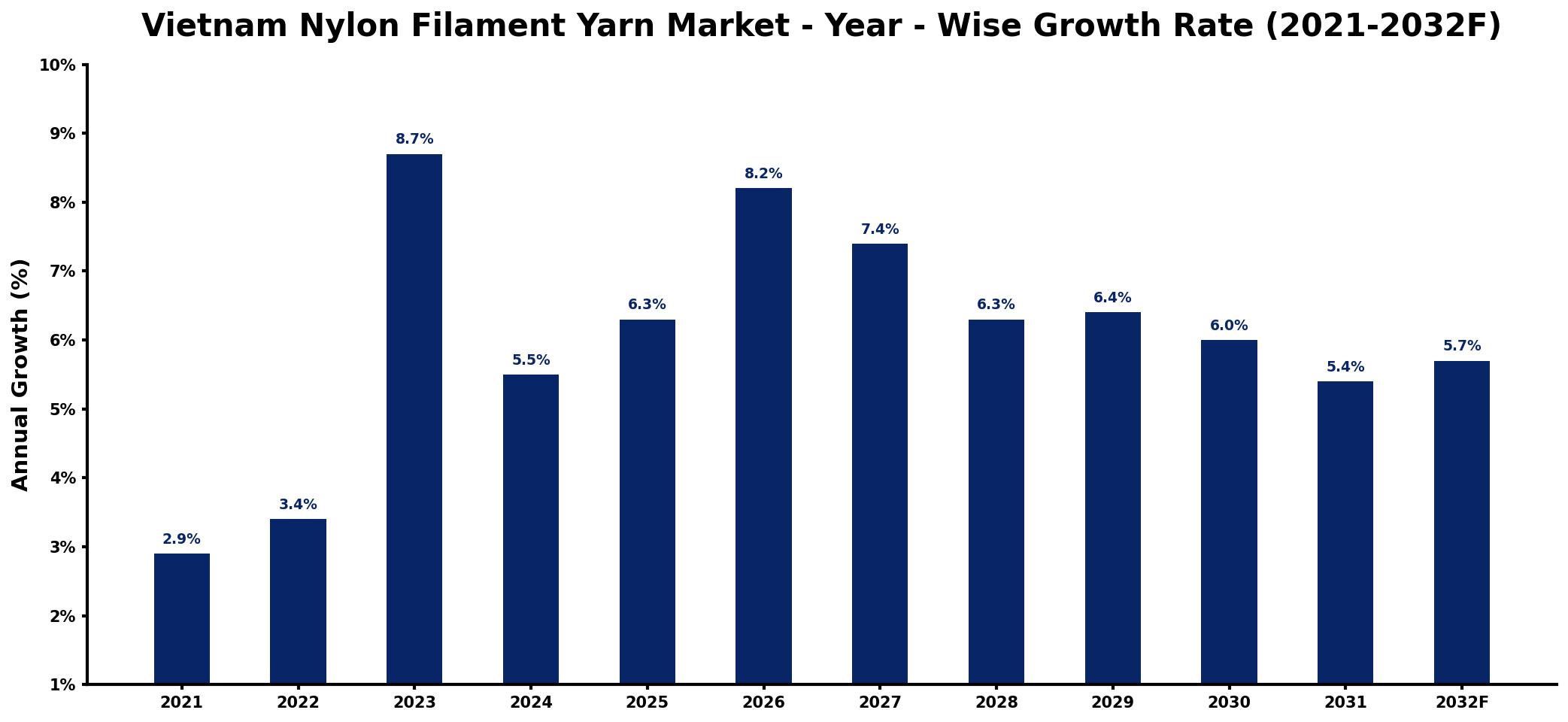
The table below presents the year‑wise growth rates along with the key drivers influencing the market
| Year | Growth Rate | Major Drivers |
| 2021 | 2.9% | Rising demand from textile industry |
| 2022 | 3.4% | Increased investment in manufacturing |
| 2023 | 8.7% | Expansion of export markets |
| 2024 | 5.5% | Growth in automotive applications |
| 2025 | 6.3% | Surge in consumer goods production |
| 2026 | 8.2% | Technological advancements in production |
| 2027 | 7.4% | Emerging markets increasing demand |
| 2028 | 6.3% | Sustainability trends driving innovation |
| 2029 | 6.4% | growing automotive sector requirements |
| 2030 | 6.0% | Increased usage in sportswear |
| 2031 | 5.4% | Rising interest in eco-friendly materials |
| 2032 | 5.7% | rising export shipment volumes |
Note: Market size estimations and growth projections presented in this report are based on 6Wresearch's proprietary forecasting methodology, utilizing the latest available industry data, government publications, and primary research inputs.
Vietnam Nylon Filament Yarn Market Synopsis
Currently, the Vietnam nylon filament yarn market is experiencing robust growth, fueled by the increasing adoption of nylon in diverse industries. Its unique properties, including strength and abrasion resistance, make it a preferred choice for manufacturers looking to innovate within textiles and other sectors.
The market is also benefiting from strong government support aimed at bolstering the manufacturing infrastructure. This strategic backing aligns with global trends favoring sustainable and durable materials, further promoting the use of nylon filament yarn across various applications.
Vietnam Nylon Filament Yarn Market Key Takeaways
- The market is projected to grow from USD 1418 Million in 2025 to USD 2013 Million by 2032.
- Nylon filament yarn's superior properties contribute to its increasing demand across multiple sectors.
- Government initiatives and investments are enhancing manufacturing capabilities.
- There is a competitive landscape characterized by the presence of alternative synthetic materials.
- The recovery from the COVID-19 pandemic has reinforced the need for product diversification within the industry.
Evaluation of Restraints in Vietnam Nylon Filament Yarn Market
While the market shows promising growth, it is not without its challenges. The competition posed by alternative synthetic fibers, such as polyester and polypropylene, continues to pressure market players to innovate. Additionally, fluctuations in the prices of nylon polymer resins can create uncertainties in cost management, potentially affecting profitability. Thus, companies need to prioritize quality control and develop unique offerings to maintain a competitive edge.
Vietnam Nylon Filament Yarn Market Trends
Several trends are shaping the Vietnam nylon filament yarn market, including an increasing focus on eco-friendly production processes. As sustainability becomes a priority, manufacturers are exploring ways to minimize environmental impact while maintaining product quality. Furthermore, advancements in textile technology are leading to enhanced functionalities in nylon yarn, opening new avenues for application in high-performance textiles and specialized industrial uses.
Vietnam Nylon Filament Yarn Market Opportunities
The future holds numerous growth opportunities within the Vietnam nylon filament yarn market. As industries seek to optimize supply chains and reduce reliance on traditional materials, there is a significant scope for innovative applications of nylon filament yarn. The rising demand for lightweight, durable materials in automotive and consumer goods presents a lucrative opportunity for manufacturers to expand their offerings and increase market penetration.
Government Initiatives in the Vietnam Nylon Filament Yarn Market
The Vietnamese government has implemented several initiatives aimed at supporting the manufacturing sector, including public spending on infrastructure improvements and incentives for sustainable practices. These policies are designed to enhance the competitiveness of local industries, thereby fostering a favorable environment for growth in the nylon filament yarn market. As global standards evolve, government support is crucial for equipping manufacturers to adapt and thrive.
Future Insights of the Vietnam Nylon Filament Yarn Market
Looking ahead to 2026-2032, the Vietnam nylon filament yarn market is poised for sustained growth. The ongoing expansion of manufacturing capabilities, coupled with rising domestic consumption and export potential, will be key drivers. Additionally, as industries evolve and prioritize sustainable practices, companies that invest in innovation and quality assurance are likely to capture significant market share. Overall, the future appears bright for stakeholders in this dynamic sector.
Vietnam Nylon Filament Yarn Market Latest Developments (2025 - 2026)
Recent developments within the Vietnam nylon filament yarn market indicate a significant push towards innovation and product diversification. Manufacturers are increasingly investing in research and development to enhance the properties of nylon yarn, making it suitable for specialized applications. Additionally, industry collaborations are becoming more common, aimed at leveraging collective expertise to drive market growth and respond to evolving consumer demands.
Vietnam Nylon Filament Yarn Market - Key Attractiveness of the Report
- 10 Years of Market Numbers
- Historical Data Starting from 2022 to 2025
- Base Year: 2025
- Forecast Data until 2032
- Key Performance Indicators Impacting the Market
- Major Upcoming Developments and Projects
Key Highlights of the Report:
- Vietnam Nylon Filament Yarn Market Outlook
- Market Size of Vietnam Nylon Filament Yarn Market, 2025
- Forecast of Vietnam Nylon Filament Yarn Market, 2032
- Historical Data and Forecast of Vietnam Nylon Filament Yarn Revenues & Volume for the Period 2022-2032F
- Vietnam Nylon Filament Yarn Market Trend Evolution
- Vietnam Nylon Filament Yarn Market Drivers and Challenges
- Vietnam Nylon Filament Yarn Price Trends
- Vietnam Nylon Filament Yarn Porter's Five Forces
- Vietnam Nylon Filament Yarn Industry Life Cycle
- Historical Data and Forecast of Vietnam Nylon Filament Yarn Market Revenues & Volume By Grade for the Period 2022-2032F
- Historical Data and Forecast of Vietnam Nylon Filament Yarn Market Revenues & Volume By Flat Yarn for the Period 2022-2032F
- Historical Data and Forecast of Vietnam Nylon Filament Yarn Market Revenues & Volume By Textured Yarn for the Period 2022-2032F
- Historical Data and Forecast of Vietnam Nylon Filament Yarn Market Revenues & Volume By Partially Oriented Yarn for the Period 2022-2032F
- Historical Data and Forecast of Vietnam Nylon Filament Yarn Market Revenues & Volume By Fully Drawn Yarn for the Period 2022-2032F
- Historical Data and Forecast of Vietnam Nylon Filament Yarn Market Revenues & Volume By Dyed Yarns for the Period 2022-2032F
- Historical Data and Forecast of Vietnam Nylon Filament Yarn Market Revenues & Volume By Application for the Period 2022-2032F
- Historical Data and Forecast of Vietnam Nylon Filament Yarn Market Revenues & Volume By Textiles for the Period 2022-2032F
- Historical Data and Forecast of Vietnam Nylon Filament Yarn Market Revenues & Volume By Sports Apparels for the Period 2022-2032F
- Historical Data and Forecast of Vietnam Nylon Filament Yarn Market Revenues & Volume By Sports and Adventure Equipment for the Period 2022-2032F
- Historical Data and Forecast of Vietnam Nylon Filament Yarn Market Revenues & Volume By Travel Accessories for the Period 2022-2032F
- Historical Data and Forecast of Vietnam Nylon Filament Yarn Market Revenues & Volume By Fishing Nets for the Period 2022-2032F
- Historical Data and Forecast of Vietnam Nylon Filament Yarn Market Revenues & Volume By Fabric for the Period 2022-2032F
- Historical Data and Forecast of Vietnam Nylon Filament Yarn Market Revenues & Volume By Sales Channel for the Period 2022-2032F
- Historical Data and Forecast of Vietnam Nylon Filament Yarn Market Revenues & Volume By Direct Company Sale for the Period 2022-2032F
- Historical Data and Forecast of Vietnam Nylon Filament Yarn Market Revenues & Volume By Direct Import for the Period 2022-2032F
- Historical Data and Forecast of Vietnam Nylon Filament Yarn Market Revenues & Volume By Distributors & Traders for the Period 2022-2032F
- Historical Data and Forecast of Vietnam Nylon Filament Yarn Market Revenues & Volume By Retailers for the Period 2022-2032F
- Vietnam Nylon Filament Yarn Import Export Trade Statistics
- Market Opportunity Assessment By Grade
- Market Opportunity Assessment By Application
- Market Opportunity Assessment By Sales Channel
- Vietnam Nylon Filament Yarn Top Companies Market Share
- Vietnam Nylon Filament Yarn Competitive Benchmarking By Technical and Operational Parameters
- Vietnam Nylon Filament Yarn Company Profiles
- Vietnam Nylon Filament Yarn Key Strategic Recommendations






































