Vietnam Oil & Gas Pumps Market Size, Share & Growth Rate
The Vietnam Oil & Gas Pumps Market was estimated at USD 771 Million in 2025 and is projected to reach USD 1098 Million by 2032, growing at a CAGR of 5.2% from 2026 to 2032. This growth trajectory is primarily fueled by the ongoing expansion of Vietnam's energy infrastructure, driven by both domestic production enhancements and increasing investments in exploration and extraction initiatives. As the country seeks to optimize its oil and gas capabilities, the demand for efficient and reliable pumping solutions is set to escalate.
Vietnam Oil & Gas Pumps Market Year-wise Growth Rate and Key Drivers
This graph highlights how the Vietnam Oil & Gas Pumps Market has steadily grown over the years, supported by major growth factors.
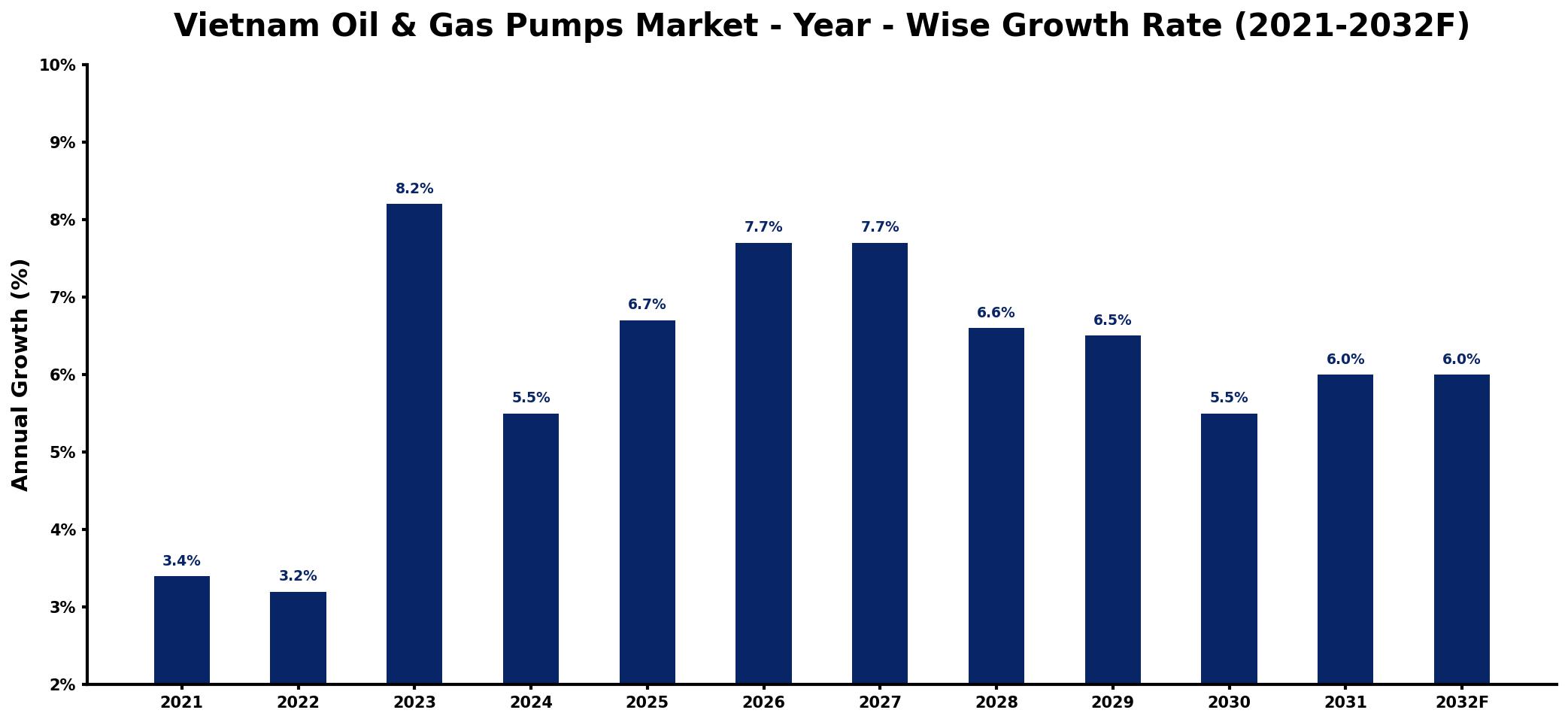
The table below presents the year‑wise growth rates along with the key drivers influencing the market
| Year | Growth Rate | Major Drivers |
| 2021 | 3.4% | Rising industrial manufacturing activities |
| 2022 | 3.2% | Increased infrastructure development projects |
| 2023 | 8.2% | Growing energy sector investments |
| 2024 | 5.5% | Surge in construction sector demand |
| 2025 | 6.7% | Expansion of transportation networks |
| 2026 | 7.7% | Higher agricultural production needs |
| 2027 | 7.7% | Boost in urbanization trends |
| 2028 | 6.6% | Increasing environmental regulations compliance |
| 2029 | 6.5% | Growth in renewable energy initiatives |
| 2030 | 5.5% | Enhanced technological advancements adoption |
| 2031 | 6.0% | Rising demand for efficiency solutions |
| 2032 | 6.0% | Strengthening regional trade agreements |
Note: Market size estimations and growth projections presented in this report are based on 6Wresearch's proprietary forecasting methodology, utilizing the latest available industry data, government publications, and primary research inputs.
Vietnam Oil & Gas Pumps Market Synopsis
Recently, the Vietnam oil and gas pumps market has experienced a surge, reflecting the countrys strategic emphasis on energy security and self-sufficiency. However, as the sector evolves, there are significant changes on the horizon, including advancements in pump technology and sustainability practices that are reshaping market dynamics.
As Vietnams energy sector develops, the reliance on advanced pumping solutions becomes more pronounced. This shift not only aims to increase efficiency in oil and gas operations but also responds to growing environmental regulations, which necessitate the adoption of greener technologies. The interplay between traditional practices and innovative advancements will define the market's future landscape.
- The market is poised for substantial growth due to increasing energy demands and infrastructure developments.
- Technological advancements are crucial for improving efficiency and sustainability within the industry.
- Regulatory pressures are driving a shift towards environmentally friendly pump technologies.
- The market remains sensitive to global economic conditions, particularly oil price fluctuations.
- Supply chain stability is critical, especially regarding imported materials and components.
While the Vietnam oil and gas pumps market is on an upward trajectory, it faces notable restraints that could impact its growth. Chief among these is the sectors vulnerability to the volatility of global oil prices, which can adversely affect capital investment and operational budgets. Furthermore, the geographical diversity of oil fields often complicates logistics for maintenance and service of pumping equipment, leading to potential downtimes and production inefficiencies. As environmental regulations tighten, companies must balance compliance with operational costs, adding another layer of complexity to market dynamics.
Several trends are currently shaping the Vietnam oil and gas pumps market. The integration of digital technologies, such as IoT and AI, is enhancing operational efficiencies and predictive maintenance capabilities. Additionally, there's a clear shift towards the development of pumps that minimize energy consumption and lower emissions, aligning with global sustainability initiatives. Companies are also focusing on creating more versatile pumps that can handle varying viscosities and pressures, thereby improving adaptability in different extraction environments.
Significant growth opportunities exist within the Vietnam oil and gas pumps market, particularly in the realm of innovation. As the industry looks to modernize its infrastructure, there is a rising demand for advanced pumping solutions that enhance efficiency and environmental performance. Investment in R&D for energy-efficient technologies presents an attractive avenue for stakeholders aiming to capture market share. Furthermore, partnerships with local players for localized manufacturing can mitigate supply chain risks and foster sustainable practices.
The Vietnamese government is actively promoting initiatives aimed at strengthening its energy sector, which directly impacts the oil and gas pumps market. Policies aimed at increasing domestic production, along with incentives for adopting environmentally friendly technologies, are paving the way for growth. Public spending on infrastructure projects, alongside regulatory support for innovations in energy efficiency, is vital to enhancing the countrys energy self-sufficiency and sustainability objectives.
Looking ahead to 2026-2032, the Vietnam oil and gas pumps market is expected to undergo transformative changes. The continuing evolution towards automation and the integration of smart technologies will likely revolutionize operational practices. Additionally, as Vietnam expands its exploration efforts, demand for sophisticated pumping solutions will rise. Overall, as the governments energy policies align with market needs, this sector is poised for robust growth, setting the stage for a more resilient and sustainable oil and gas landscape.
In the recent months, the Vietnam oil and gas pumps market has witnessed strategic shifts, with increasing collaborations between domestic and international manufacturers aimed at enhancing product offerings. Innovations in pump design, focusing on sustainability and efficiency, have garnered attention, reflecting a broader industry trend. Additionally, infrastructure projects are seeing renewed momentum, as stakeholders cautiously revive initiatives halted during the pandemic, signaling a revitalization of investment in the energy sector.
- 10 Years of Market Numbers
- Historical Data Starting from 2022 to 2025
- Base Year: 2025
- Forecast Data until 2032
- Key Performance Indicators Impacting the Market
- Major Upcoming Developments and Projects
Key Highlights of the Report:
- Vietnam Oil & Gas Pumps Market Outlook
- Market Size of Vietnam Oil & Gas Pumps Market, 2025
- Forecast of Vietnam Oil & Gas Pumps Market, 2032
- Historical Data and Forecast of Vietnam Oil & Gas Pumps Revenues & Volume for the Period 2022-2032F
- Vietnam Oil & Gas Pumps Market Trend Evolution
- Vietnam Oil & Gas Pumps Market Drivers and Challenges
- Vietnam Oil & Gas Pumps Price Trends
- Vietnam Oil & Gas Pumps Porter's Five Forces
- Vietnam Oil & Gas Pumps Industry Life Cycle
- Historical Data and Forecast of Vietnam Oil & Gas Pumps Market Revenues & Volume By Type for the Period 2022-2032F
- Historical Data and Forecast of Vietnam Oil & Gas Pumps Market Revenues & Volume By Submersible Pumps for the Period 2022-2032F
- Historical Data and Forecast of Vietnam Oil & Gas Pumps Market Revenues & Volume By Non-submersible Pumps for the Period 2022-2032F
- Historical Data and Forecast of Vietnam Oil & Gas Pumps Market Revenues & Volume By Pump Type for the Period 2022-2032F
- Historical Data and Forecast of Vietnam Oil & Gas Pumps Market Revenues & Volume By Centrifugal Pump for the Period 2022-2032F
- Historical Data and Forecast of Vietnam Oil & Gas Pumps Market Revenues & Volume By Positive Displacement Pump for the Period 2022-2032F
- Historical Data and Forecast of Vietnam Oil & Gas Pumps Market Revenues & Volume By Cryogenic Pump for the Period 2022-2032F
- Historical Data and Forecast of Vietnam Oil & Gas Pumps Market Revenues & Volume By Application for the Period 2022-2032F
- Historical Data and Forecast of Vietnam Oil & Gas Pumps Market Revenues & Volume By Upstream for the Period 2022-2032F
- Historical Data and Forecast of Vietnam Oil & Gas Pumps Market Revenues & Volume By Midstream for the Period 2022-2032F
- Historical Data and Forecast of Vietnam Oil & Gas Pumps Market Revenues & Volume By Downstream for the Period 2022-2032F
- Vietnam Oil & Gas Pumps Import Export Trade Statistics
- Market Opportunity Assessment By Type
- Market Opportunity Assessment By Pump Type
- Market Opportunity Assessment By Application
- Vietnam Oil & Gas Pumps Top Companies Market Share
- Vietnam Oil & Gas Pumps Competitive Benchmarking By Technical and Operational Parameters
- Vietnam Oil & Gas Pumps Company Profiles
- Vietnam Oil & Gas Pumps Key Strategic Recommendations






































