Vietnam Oilcake Market Size, Share & Growth Rate
The Vietnam Oilcake Market was estimated at USD 192 Million in 2025 and is projected to reach USD 271 Million by 2032, growing at a CAGR of 5.0% from 2026 to 2032. This growth trajectory is underpinned by the escalating demand for nutritious and cost-effective animal feed, driven by the expanding livestock sector in Vietnam. As consumer preferences shift towards higher quality meat products, the adoption of oilcake in feed formulations is becoming increasingly prominent, reinforcing its critical role in the agricultural landscape.
Vietnam Oilcake Market Year-wise Growth Rate and Key Drivers
This graph highlights how the Vietnam Oilcake Market has steadily grown over the years, supported by major growth factors.
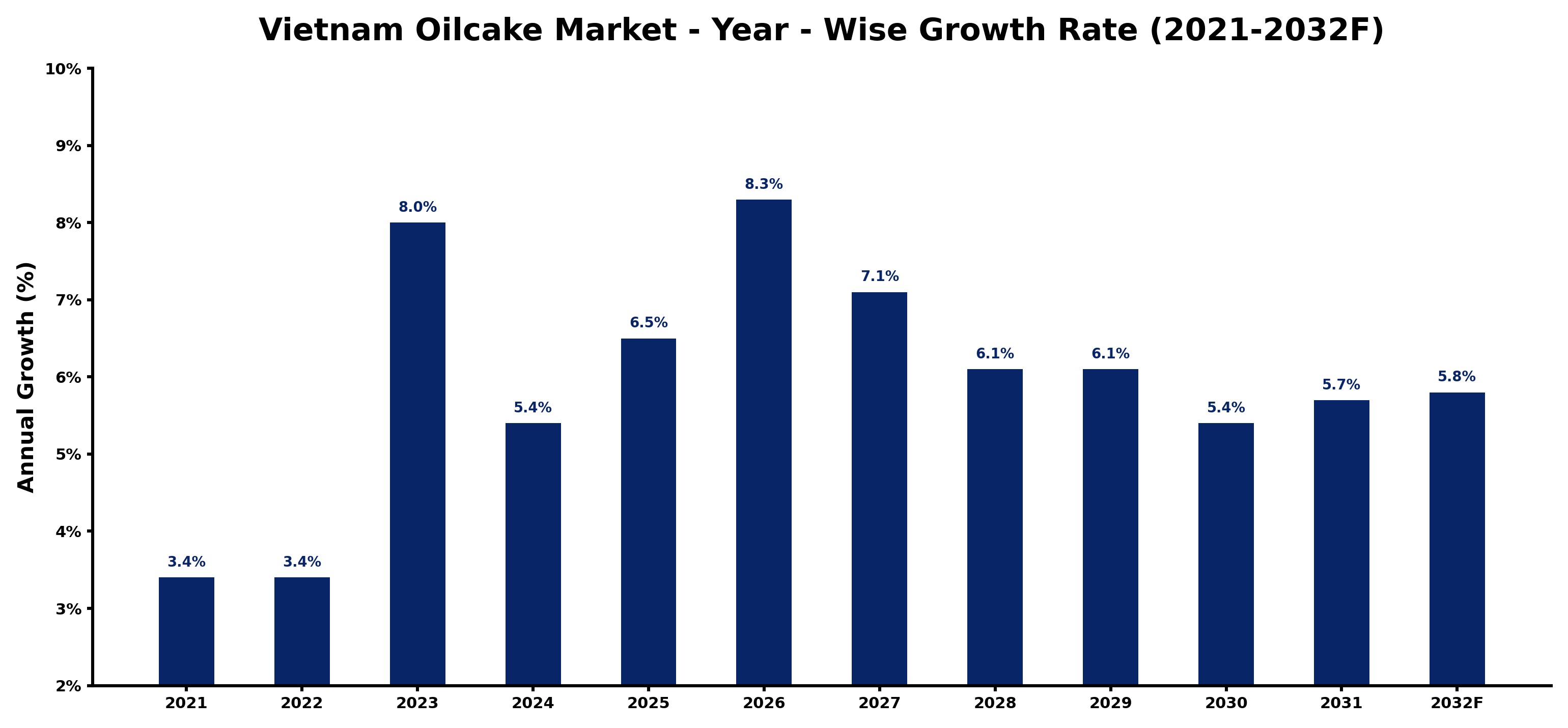
The table below presents the year‑wise growth rates along with the key drivers influencing the market
| Year | Growth Rate | Major Drivers |
| 2021 | 3.4% | Growing urbanization and commercial development |
| 2022 | 3.4% | Rapid growth in telecom and data center sectors |
| 2023 | 8.0% | Expansion of manufacturing activities |
| 2024 | 5.4% | Expansion of manufacturing activities |
| 2025 | 6.5% | Growing renewable energy integration projects |
| 2026 | 8.3% | Expansion of transportation and logistics networks |
| 2027 | 7.1% | Expansion of manufacturing activities |
| 2028 | 6.1% | Increasing smart city development projects |
| 2029 | 6.1% | Increasing industrial infrastructure investments |
| 2030 | 5.4% | Government infrastructure modernization initiatives |
| 2031 | 5.7% | Increasing industrial automation investments |
| 2032 | 5.8% | Increasing adoption of advanced technologies |
Note - Market size estimations and growth projections presented in this report are based on 6Wresearch's advanced forecasting approach, validated with industry datasets as of June 2026.
Vietnam Oilcake Market Synopsis
In Vietnam, the oilcake market is a vibrant segment that reflects the country's robust agricultural sector, particularly its livestock and poultry industries. Oilcake, as a byproduct of oil extraction, has carved a niche as a vital ingredient for animal feed, addressing the growing need for protein-rich nutrition in livestock diets.
With the continuous rise in meat consumption, the demand for high-quality animal feed, including oilcake, is accelerating. This shift is coupled with government initiatives aimed at enhancing local production capabilities and ensuring feed self-sufficiency, thus positioning oilcake as a cornerstone of sustainable livestock farming in Vietnam.
Vietnam Oilcake Market Key Takeaways
- The Vietnam Oilcake Market is expected to grow significantly, driven by the rising demand for nutritious animal feed.
- Government policies are fostering an environment conducive to increased production of oilcake as an essential feed ingredient.
- Volatility in raw material prices, particularly of oilseeds, remains a critical factor impacting market stability.
- The market is adapting to shifts in consumer preferences towards sustainable and locally sourced animal feed products.
- Key players are focusing on innovation and efficiency to enhance the quality and nutritional value of oilcake products.
Evaluation of Restraints in Vietnam Oilcake Market
Despite its growth potential, the Vietnam Oilcake Market faces several restraints that could hinder progress. Fluctuations in the prices of raw materials, particularly soybean and rapeseed, are significant challenges that can disrupt production costs and supply chain stability. Such volatility affects the overall profitability for producers and may lead to inconsistent feed quality. Additionally, as demand surges, ensuring a stable supply of high-quality raw materials and exploring cost-effective alternatives are vital for market sustainability.
Vietnam Oilcake Market Trends
One of the prevailing trends in the Vietnam Oilcake Market is the increasing emphasis on sustainability in livestock farming. Producers are gravitating towards eco-friendly practices and feed alternatives that not only enhance animal nutrition but also address environmental concerns. Moreover, technological advancements in feed formulation are shaping the production of oilcake, allowing for higher nutritional profiles tailored to the specific needs of livestock.
Additionally, the market is witnessing a growing interest in locally sourced and processed oilcake, as consumers and businesses alike prioritize sustainability and food security. This movement aligns with global trends focusing on traceability and transparency in food production, further integrating oilcake into the broader agricultural supply chain.
Vietnam Oilcake Market Opportunities
Significant growth opportunities lie within the Vietnam Oilcake Market as demand for animal feed continues to surge. The increasing shift toward premium animal products creates a ripe environment for innovation in feed formulations that leverage oilcake's nutritional benefits. Furthermore, investments in local processing capabilities and the exploration of alternative oilseed sources can enhance supply chain resilience. Collaborations with research institutions to develop advanced feed technologies also represent promising avenues for growth.
Government Initiatives in the Vietnam Oilcake Market
The Vietnamese government has implemented various initiatives aimed at bolstering the agricultural sector, particularly in livestock production. These efforts include providing incentives for local farmers and businesses to invest in domestic feed production and enhancing research in sustainable farming practices. Policies promoting self-sufficiency in animal feed are crucial in reducing import dependence and ensuring food security. Moreover, public spending directed towards agricultural innovation and infrastructure development is creating a supportive environment for the oilcake market.
Future Insights of the Vietnam Oilcake Market
Looking ahead to 2026-2032, the Vietnam Oilcake Market is poised for robust growth, driven by both domestic consumption and export opportunities. The ongoing evolution of consumer preferences toward higher quality and more sustainable animal products will likely propel further integration of oilcake into livestock feed. Additionally, the rise of digital technologies in agriculture could enhance efficiencies in production and distribution, ultimately fortifying the market's position within the global supply chain.
Vietnam Oilcake Market Latest Developments (May 2025 - June 2026)
Recent developments in the Vietnam Oilcake Market reflect a keen focus on innovation and sustainability. Industry players are increasingly investing in research and development to enhance the nutritional profile of oilcake, aligning with consumer trends for healthier animal products. Collaborative efforts between private enterprises and academic institutions are gaining momentum to explore innovative production methods and eco-friendly practices. As the market adapts to shifting dynamics, these developments are shaping the future landscape of oilcake utilization in animal feed.
Vietnam Oilcake Market - Key Attractiveness of the Report
- 10 Years of Market Numbers
- Historical Data Starting from 2022 to 2025
- Base Year: 2025
- Forecast Data until 2032
- Key Performance Indicators Impacting the Market
- Major Upcoming Developments and Projects
Key Highlights of the Report:
- Vietnam Oilcake Market Outlook
- Market Size of Vietnam Oilcake Market, 2025
- Forecast of Vietnam Oilcake Market, 2032
- Historical Data and Forecast of Vietnam Oilcake Revenues & Volume for the Period 2022-2032F
- Vietnam Oilcake Market Trend Evolution
- Vietnam Oilcake Market Drivers and Challenges
- Vietnam Oilcake Price Trends
- Vietnam Oilcake Porter's Five Forces
- Vietnam Oilcake Industry Life Cycle
- Historical Data and Forecast of Vietnam Oilcake Market Revenues & Volume By Source Type for the Period 2022-2032F
- Historical Data and Forecast of Vietnam Oilcake Market Revenues & Volume By Palm Kernel for the Period 2022-2032F
- Historical Data and Forecast of Vietnam Oilcake Market Revenues & Volume By Sunflower for the Period 2022-2032F
- Historical Data and Forecast of Vietnam Oilcake Market Revenues & Volume By Sesame for the Period 2022-2032F
- Historical Data and Forecast of Vietnam Oilcake Market Revenues & Volume By Coconut for the Period 2022-2032F
- Historical Data and Forecast of Vietnam Oilcake Market Revenues & Volume By Mustard for the Period 2022-2032F
- Historical Data and Forecast of Vietnam Oilcake Market Revenues & Volume By Groundnut for the Period 2022-2032F
- Historical Data and Forecast of Vietnam Oilcake Market Revenues & Volume By Cottonseed for the Period 2022-2032F
- Historical Data and Forecast of Vietnam Palm Kernel Oilcake Market Revenues & Volume By Others for the Period 2022-2032F
- Historical Data and Forecast of Vietnam Oilcake Market Revenues & Volume By Type for the Period 2022-2032F
- Historical Data and Forecast of Vietnam Oilcake Market Revenues & Volume By Edible Oil Cake for the Period 2022-2032F
- Historical Data and Forecast of Vietnam Oilcake Market Revenues & Volume By Non-edible Oil Cake for the Period 2022-2032F
- Vietnam Oilcake Import Export Trade Statistics
- Market Opportunity Assessment By Source Type
- Market Opportunity Assessment By Type
- Vietnam Oilcake Top Companies Market Share
- Vietnam Oilcake Competitive Benchmarking By Technical and Operational Parameters
- Vietnam Oilcake Company Profiles
- Vietnam Oilcake Key Strategic Recommendations






































