Vietnam Optical Glass Market Size, Share & Growth Rate
The Vietnam Optical Glass Market was estimated at USD 1252 Million in 2025 and is projected to reach USD 1776 Million by 2032, growing at a CAGR of 5.1% from 2026 to 2032. This upward trajectory is primarily driven by the increasing demand for high-precision optical components across various sectors, including telecommunications, automotive, and healthcare. Additionally, the growing emphasis on technological advancements and innovations in imaging solutions contributes significantly to the market's expansion.
Vietnam Optical Glass Market Year-wise Growth Rate and Key Drivers
This graph highlights how the Vietnam Optical Glass Market has steadily grown over the years, supported by major growth factors.
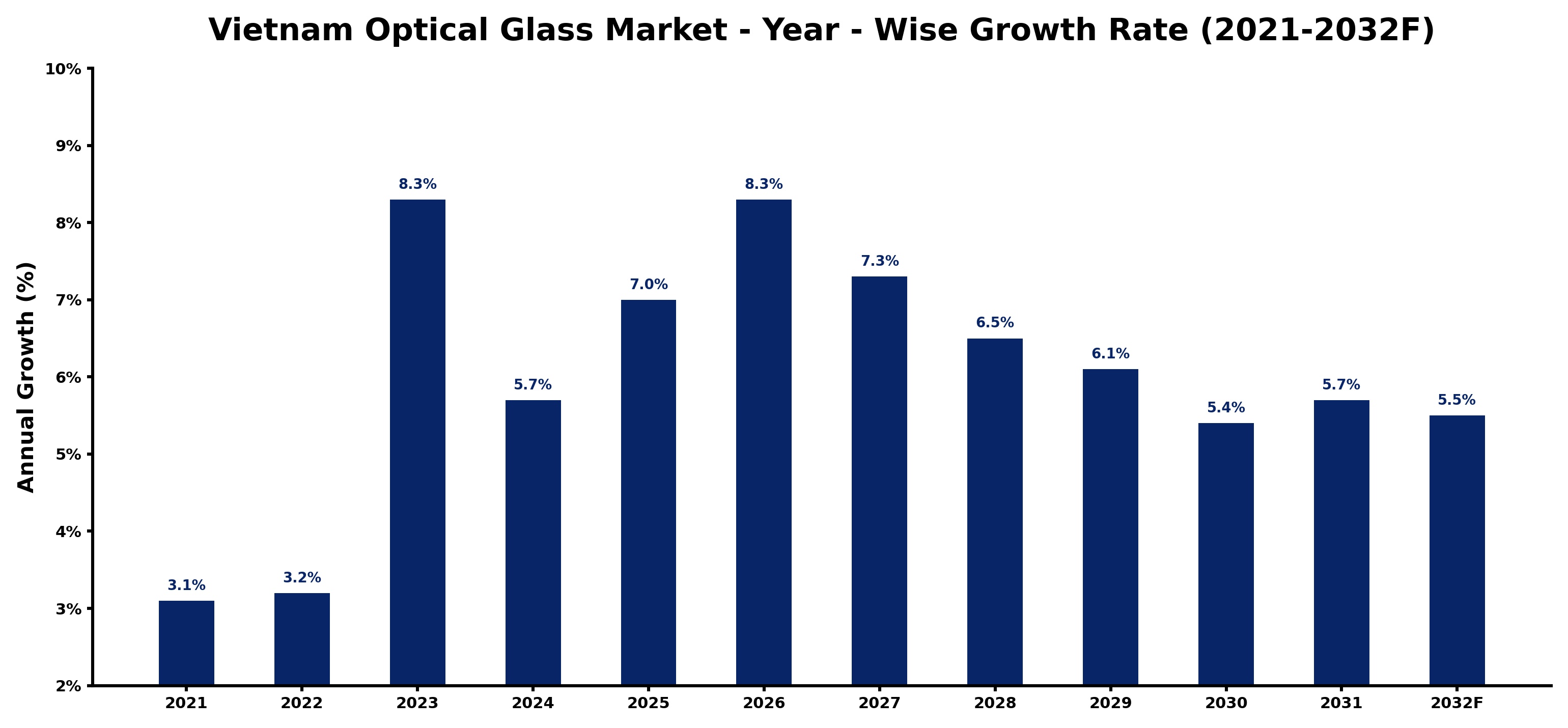
The table below presents the year‑wise growth rates along with the key drivers influencing the market
| Year | Growth Rate | Major Drivers |
| 2021 | 3.1% | Automation advancements in optical glass manufacturing enhanced export competitiveness |
| 2022 | 3.2% | Export demand for optical glass components boosted local production capacity |
| 2023 | 8.3% | Foreign direct investment boosts optical glass production capabilities in Vietnam |
| 2024 | 5.7% | Foreign investments boosted optical glass production for automotive exports |
| 2025 | 7.0% | New optical glass production lines enhance export capabilities significantly |
| 2026 | 8.3% | Foreign investments in optical glass boost local manufacturing capabilities |
| 2027 | 7.3% | Export contracts for optical components fueled manufacturing investment in Vietnam |
| 2028 | 6.5% | Modernized glass manufacturing boosts export capabilities for automotive sector |
| 2029 | 6.1% | Technology integration boosts precision in optical glass production processes |
| 2030 | 5.4% | Foreign investments in Vietnam boost precision glass manufacturing capabilities |
| 2031 | 5.7% | Increased optical glass demand drives advanced manufacturing capacity investments |
| 2032 | 5.5% | Foreign investments boost optical glass manufacturing capacity and technology |
Note - Market size estimations and growth projections presented in this report are based on 6Wresearch's advanced forecasting approach, validated with industry datasets as of June 2026.
Vietnam Optical Glass Market Synopsis
The demand for high-quality optical glass is surging, fueled by advancements in camera and lens technology, which are pivotal in industries such as healthcare and telecommunications. Vietnam, leveraging its growing manufacturing capabilities, is positioning itself as a crucial player in the global optical glass supply chain.
With a focus on research and development, local manufacturers are continually innovating to meet the diverse needs of the optical market. This not only enhances product quality but also strengthens the overall competitiveness of Vietnam's optical glass offerings on the international stage.
Vietnam Optical Glass Market Key Takeaways
- The market is set to expand significantly, reflecting a growing investment in high-quality optical technologies.
- Technological innovations are central to meeting the evolving demands of precision optics.
- Key industries driving demand include telecommunications, healthcare, and automotive sectors.
- Vietnam's positioning in the global supply chain is becoming more pronounced as manufacturing capabilities improve.
- Companies are investing in R&D to remain competitive and fulfill market needs effectively.
Evaluation of Restraints in Vietnam Optical Glass Market
Despite the promising growth trajectory, the Vietnam Optical Glass market faces challenges related to rapid technological advancements and the pressures of global competition. Maintaining stringent precision standards in glass manufacturing requires ongoing investment and innovation. Moreover, sourcing specialized raw materials remains a critical concern, potentially impacting pricing strategies and the stability of supply chains. Such constraints necessitate strategic planning among industry players to ensure sustainable growth in this competitive landscape.
Vietnam Optical Glass Market Trends
Currently, there is a noticeable shift towards sustainable manufacturing practices in the optical glass sector. Companies are increasingly focusing on eco-friendly materials and processes to meet both regulatory standards and consumer expectations. Additionally, the rise of digital technologies and smart devices is intensifying the demand for advanced optical components, driving innovation and market dynamism.
Vietnam Optical Glass Market Opportunities
The market presents significant growth opportunities, particularly in sectors such as augmented reality (AR) and virtual reality (VR), where optical glass is essential for creating immersive experiences. Moreover, the ongoing development of healthcare technologies, including diagnostic and imaging systems, is set to further expand the market. Investment in education and training initiatives to build a skilled workforce in optics and materials science will also enhance the industry's capabilities.
Government Initiatives in the Vietnam Optical Glass Market
The Vietnamese government has recognized the importance of the optics and imaging industry, promoting policies that encourage investment in research and development. Public spending initiatives are aimed at enhancing local manufacturing capabilities, with incentives for companies that innovate in optical technology. Collaborative programs with educational institutions are also underway to cultivate a skilled workforce in this high-tech sector, laying the groundwork for sustained growth.
Future Insights of the Vietnam Optical Glass Market
Looking ahead to the years 2026 to 2032, the Vietnam Optical Glass market is poised for robust growth, driven by the continued expansion of high-tech industries. As consumer demand for high-quality imaging solutions increases, manufacturers will likely focus on advanced research and partnerships to enhance their product offerings. The integration of new materials and technologies, coupled with a shift towards sustainable practices, will define the future trajectory of this vibrant market.
Vietnam Optical Glass Market Latest Developments (May 2025 - June 2026)
The industry is experiencing notable advancements in manufacturing techniques, emphasizing increased efficiency and product quality. Several manufacturers are exploring partnerships to broaden their market reach and enhance their technological capabilities. Furthermore, there is a growing focus on developing specialized optical components for emerging technologies, ensuring that Vietnam maintains its competitive edge in the global market.
Vietnam Optical Glass Market - Key Attractiveness of the Report
- 10 Years of Market Numbers
- Historical Data Starting from 2022 to 2025
- Base Year: 2025
- Forecast Data until 2032
- Key Performance Indicators Impacting the Market
- Major Upcoming Developments and Projects
Key Highlights of the Report:
- Vietnam Optical Glass Market Outlook
- Market Size of Vietnam Optical Glass Market, 2025
- Forecast of Vietnam Optical Glass Market, 2032
- Historical Data and Forecast of Vietnam Optical Glass Revenues & Volume for the Period 2022-2032F
- Vietnam Optical Glass Market Trend Evolution
- Vietnam Optical Glass Market Drivers and Challenges
- Vietnam Optical Glass Price Trends
- Vietnam Optical Glass Porter's Five Forces
- Vietnam Optical Glass Industry Life Cycle
- Historical Data and Forecast of Vietnam Optical Glass Market Revenues & Volume By Type for the Period 2022-2032F
- Historical Data and Forecast of Vietnam Optical Glass Market Revenues & Volume By Colorless for the Period 2022-2032F
- Historical Data and Forecast of Vietnam Optical Glass Market Revenues & Volume By Colored for the Period 2022-2032F
- Historical Data and Forecast of Vietnam Optical Glass Market Revenues & Volume By Supply Form for the Period 2022-2032F
- Historical Data and Forecast of Vietnam Optical Glass Market Revenues & Volume By Plate for the Period 2022-2032F
- Historical Data and Forecast of Vietnam Optical Glass Market Revenues & Volume By Round Plate for the Period 2022-2032F
- Historical Data and Forecast of Vietnam Optical Glass Market Revenues & Volume By Worked Rod for the Period 2022-2032F
- Historical Data and Forecast of Vietnam Optical Glass Market Revenues & Volume By Prism for the Period 2022-2032F
- Historical Data and Forecast of Vietnam Optical Glass Market Revenues & Volume By Others for the Period 2022-2032F
- Historical Data and Forecast of Vietnam Optical Glass Market Revenues & Volume By Application for the Period 2022-2032F
- Historical Data and Forecast of Vietnam Optical Glass Market Revenues & Volume By Consumer Optics for the Period 2022-2032F
- Historical Data and Forecast of Vietnam Optical Glass Market Revenues & Volume By Astronomy for the Period 2022-2032F
- Historical Data and Forecast of Vietnam Optical Glass Market Revenues & Volume By Industrial Equipment for the Period 2022-2032F
- Historical Data and Forecast of Vietnam Optical Glass Market Revenues & Volume By Medical & Biotech for the Period 2022-2032F
- Historical Data and Forecast of Vietnam Optical Glass Market Revenues & Volume By Electronics & Semiconductors for the Period 2022-2032F
- Historical Data and Forecast of Vietnam Optical Glass Market Revenues & Volume By Others for the Period 2022-2032F
- Vietnam Optical Glass Import Export Trade Statistics
- Market Opportunity Assessment By Type
- Market Opportunity Assessment By Supply Form
- Market Opportunity Assessment By Application
- Vietnam Optical Glass Top Companies Market Share
- Vietnam Optical Glass Competitive Benchmarking By Technical and Operational Parameters
- Vietnam Optical Glass Company Profiles
- Vietnam Optical Glass Key Strategic Recommendations






































