Vietnam Organic Cotton Market Size, Share & Growth Rate
The Vietnam Organic Cotton Market was estimated at USD 170 Million in 2025 and is projected to reach USD 240 Million by 2032, growing at a CAGR of 5.0% from 2026 to 2032. This growth trajectory is being driven by a significant shift in consumer preferences towards sustainable and ethically produced textiles. Increased awareness of the environmental impact of traditional cotton farming is pushing both manufacturers and consumers to opt for organic cotton alternatives, establishing a robust foundation for future expansion.
Vietnam Organic Cotton Market Year-wise Growth Rate and Key Drivers
This graph highlights how the Vietnam Organic Cotton Market has steadily grown over the years, supported by major growth factors.
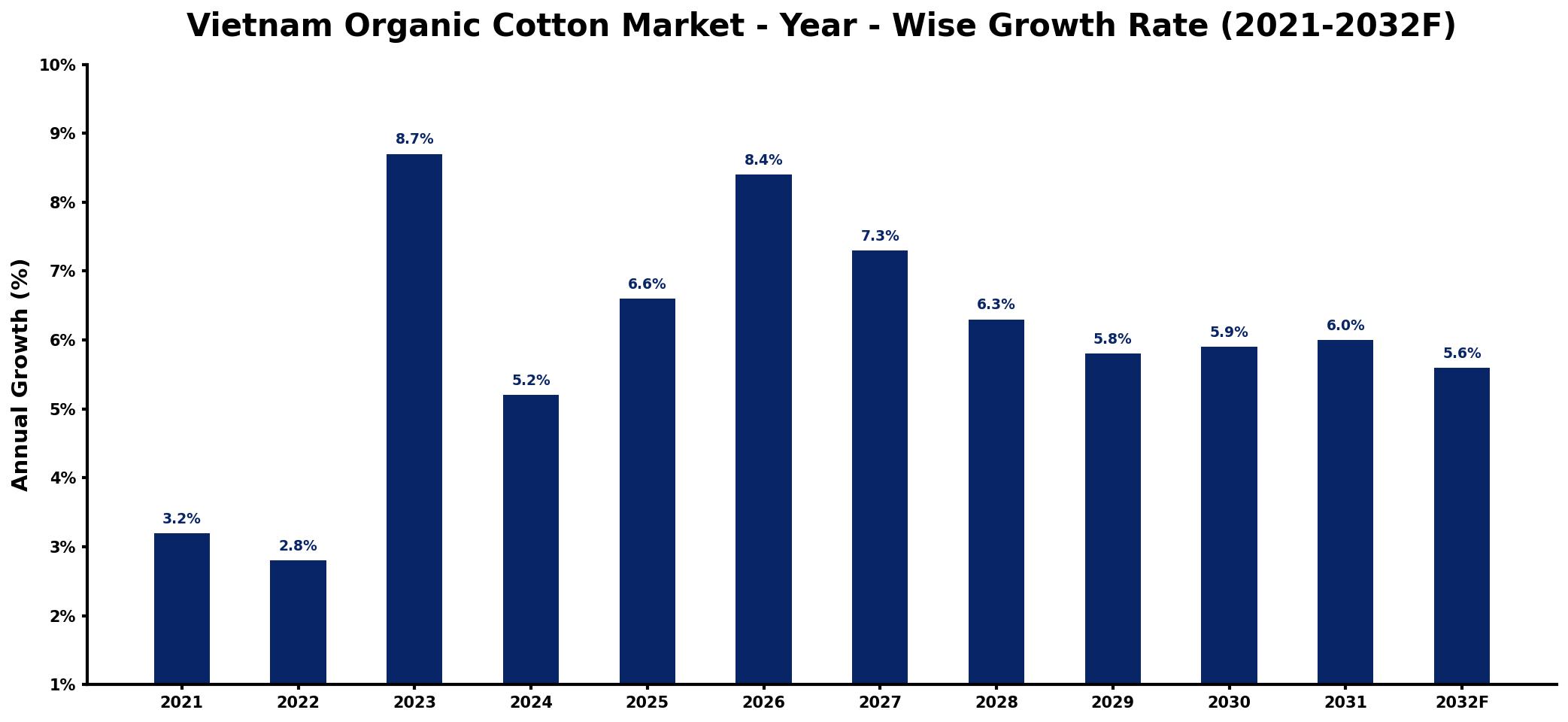
The table below presents the year‑wise growth rates along with the key drivers influencing the market
| Year | Growth Rate | Major Drivers |
| 2021 | 3.2% | Rise in sustainable apparel demand |
| 2022 | 2.8% | Increased consumer awareness sustainability |
| 2023 | 8.7% | Expansion of eco-friendly brands |
| 2024 | 5.2% | Growth in ethical fashion initiatives |
| 2025 | 6.6% | Higher investment in sustainable practices |
| 2026 | 8.4% | Surge in green certifications popularity |
| 2027 | 7.3% | Boost in retail sustainability campaigns |
| 2028 | 6.3% | Increase in eco-conscious consumer base |
| 2029 | 5.8% | strengthening underlying market demand |
| 2030 | 5.9% | rising end-use demand growth |
| 2031 | 6.0% | rising demand from electronics |
| 2032 | 5.6% | expanding manufacturing base activity |
Note: Market size estimations and growth projections presented in this report are based on 6Wresearch's proprietary forecasting methodology, utilizing the latest available industry data, government publications, and primary research inputs.
Vietnam Organic Cotton Market Synopsis
Recent years have shown positive momentum for the Vietnam organic cotton market, characterized by a rising demand for eco-friendly products amid a global shift towards sustainable fashion. However, this market is poised for further growth as it addresses challenges related to production capacity and consumer education on the benefits of organic materials.
The organic cotton sector in Vietnam is becoming increasingly integral to the country's textile industry. As more consumers demand ethically sourced options, market players are focusing on developing innovative products that meet these criteria, creating a sustainable ecosystem around organic cotton cultivation and usage.
Vietnam Organic Cotton Market Key Takeaways
- Increasing consumer demand for eco-friendly textiles is a primary driver of market growth.
- Despite challenges in domestic cultivation, the market is adapting through import strategies.
- Education and awareness initiatives are essential for promoting the benefits of organic cotton.
- Post-pandemic recovery is fueling renewed interest in sustainable fashion.
- Collaboration among industry stakeholders is crucial for achieving scalability and certification compliance.
Evaluation of Restraints in Vietnam Organic Cotton Market
The Vietnam organic cotton market faces several restraints that could impede its growth potential. One of the most pressing issues is the limited scope of domestic organic cotton cultivation, which has resulted in a significant reliance on imports to meet the growing demand. Additionally, the complexities surrounding organic farming practices and certification processes pose hurdles for many local producers. Another challenge lies in educating consumers about the distinct benefits of organic cotton, which is essential for driving broader market acceptance and uptake.
Vietnam Organic Cotton Market Trends
Current trends in the Vietnam organic cotton market highlight a burgeoning interest in sustainable fashion, coupled with innovative textile production methods. The rise of eco-conscious brands is shifting consumer purchasing behaviors toward ethically sourced materials, promoting a circular economy approach. Furthermore, technological advancements in organic farming and textile production processes are set to enhance yield and quality, ultimately attracting more players to the market.
Vietnam Organic Cotton Market Opportunities
As the market continues to evolve, numerous growth opportunities arise. There is significant potential for investment in local organic cotton cultivation to reduce import dependency and support sustainable farming initiatives. Additionally, partnerships with eco-conscious brands can create new revenue streams, while expanded marketing efforts aimed at educating consumers can further enhance market penetration and acceptance of organic cotton products.
Government Initiatives in the Vietnam Organic Cotton Market
The Vietnamese government is increasingly recognizing the importance of sustainable agriculture, including organic cotton production. Initiatives aimed at promoting organic farming practices, providing subsidies for sustainable farming equipment, and developing infrastructure to support organic certification are all part of an effort to bolster this sector. Public spending focused on environmental sustainability also paves the way for greater investments in organic cotton cultivation and production.
Future Insights of the Vietnam Organic Cotton Market
Looking ahead to 2026-2032, the Vietnam organic cotton market is expected to witness robust growth driven by continuing consumer preference for sustainable textiles. This shift will likely encourage more local farmers to adopt organic practices, thereby increasing domestic production capacity. Additionally, collaboration among stakeholders will be crucial to achieving a comprehensive organic supply chain, further solidifying Vietnam's position in the global organic cotton marketplace.
Vietnam Organic Cotton Market Latest Developments (2025 - 2026)
In recent months, the Vietnam organic cotton market has experienced notable developments, particularly in the area of production and sustainability practices. Innovations in organic farming techniques are being explored, enhancing yield and minimizing environmental impact. Moreover, collaborations among brands to promote organic cotton and increase consumer awareness are gaining traction, reflecting a positive direction towards a more sustainable textile industry in Vietnam.
Vietnam Organic Cotton Market - Key Attractiveness of the Report
- 10 Years of Market Numbers
- Historical Data Starting from 2022 to 2025
- Base Year: 2025
- Forecast Data until 2032
- Key Performance Indicators Impacting the Market
- Major Upcoming Developments and Projects
Key Highlights of the Report:
- Vietnam Organic Cotton Market Outlook
- Market Size of Vietnam Organic Cotton Market, 2025
- Forecast of Vietnam Organic Cotton Market, 2032
- Historical Data and Forecast of Vietnam Organic Cotton Revenues & Volume for the Period 2022-2032F
- Vietnam Organic Cotton Market Trend Evolution
- Vietnam Organic Cotton Market Drivers and Challenges
- Vietnam Organic Cotton Price Trends
- Vietnam Organic Cotton Porter's Five Forces
- Vietnam Organic Cotton Industry Life Cycle
- Historical Data and Forecast of Vietnam Organic Cotton Market Revenues & Volume By Type for the Period 2022-2032F
- Historical Data and Forecast of Vietnam Organic Cotton Market Revenues & Volume By Long-Staple Cotton for the Period 2022-2032F
- Historical Data and Forecast of Vietnam Organic Cotton Market Revenues & Volume By Short-Staple Cotton for the Period 2022-2032F
- Historical Data and Forecast of Vietnam Organic Cotton Market Revenues & Volume By Middle Staple Cotton for the Period 2022-2032F
- Historical Data and Forecast of Vietnam Organic Cotton Market Revenues & Volume By Extra-long Staple Cotton for the Period 2022-2032F
- Historical Data and Forecast of Vietnam Organic Cotton Market Revenues & Volume By Others for the Period 2022-2032F
- Historical Data and Forecast of Vietnam Organic Cotton Market Revenues & Volume By Quality Type for the Period 2022-2032F
- Historical Data and Forecast of Vietnam Organic Cotton Market Revenues & Volume By Supima/Pima for the Period 2022-2032F
- Historical Data and Forecast of Vietnam Organic Cotton Market Revenues & Volume By Upland for the Period 2022-2032F
- Historical Data and Forecast of Vietnam Organic Cotton Market Revenues & Volume By Giza for the Period 2022-2032F
- Historical Data and Forecast of Vietnam Organic Cotton Market Revenues & Volume By Others for the Period 2022-2032F
- Historical Data and Forecast of Vietnam Organic Cotton Market Revenues & Volume By Application for the Period 2022-2032F
- Historical Data and Forecast of Vietnam Organic Cotton Market Revenues & Volume By Apparel for the Period 2022-2032F
- Historical Data and Forecast of Vietnam Organic Cotton Market Revenues & Volume By Packaging for the Period 2022-2032F
- Historical Data and Forecast of Vietnam Organic Cotton Market Revenues & Volume By Others for the Period 2022-2032F
- Vietnam Organic Cotton Import Export Trade Statistics
- Market Opportunity Assessment By Type
- Market Opportunity Assessment By Quality Type
- Market Opportunity Assessment By Application
- Vietnam Organic Cotton Top Companies Market Share
- Vietnam Organic Cotton Competitive Benchmarking By Technical and Operational Parameters
- Vietnam Organic Cotton Company Profiles
- Vietnam Organic Cotton Key Strategic Recommendations






































