Vietnam Organic Food Market Size, Share & Growth Rate
The Vietnam Organic Food Market was estimated at USD 1292 Million in 2025 and is projected to reach USD 1837 Million by 2032, growing at a CAGR of 5.2% from 2026 to 2032. This promising trajectory is largely driven by a notable shift in consumer preferences towards healthier lifestyles and an increased awareness of environmental sustainability. As Vietnamese consumers prioritize organic options, both local and international demand is on the rise, further stimulated by government initiatives aimed at promoting organic farming practices.
Vietnam Organic Food Market Year-wise Growth Rate and Key Drivers
This graph highlights how the Vietnam Organic Food Market has steadily grown over the years, supported by major growth factors.
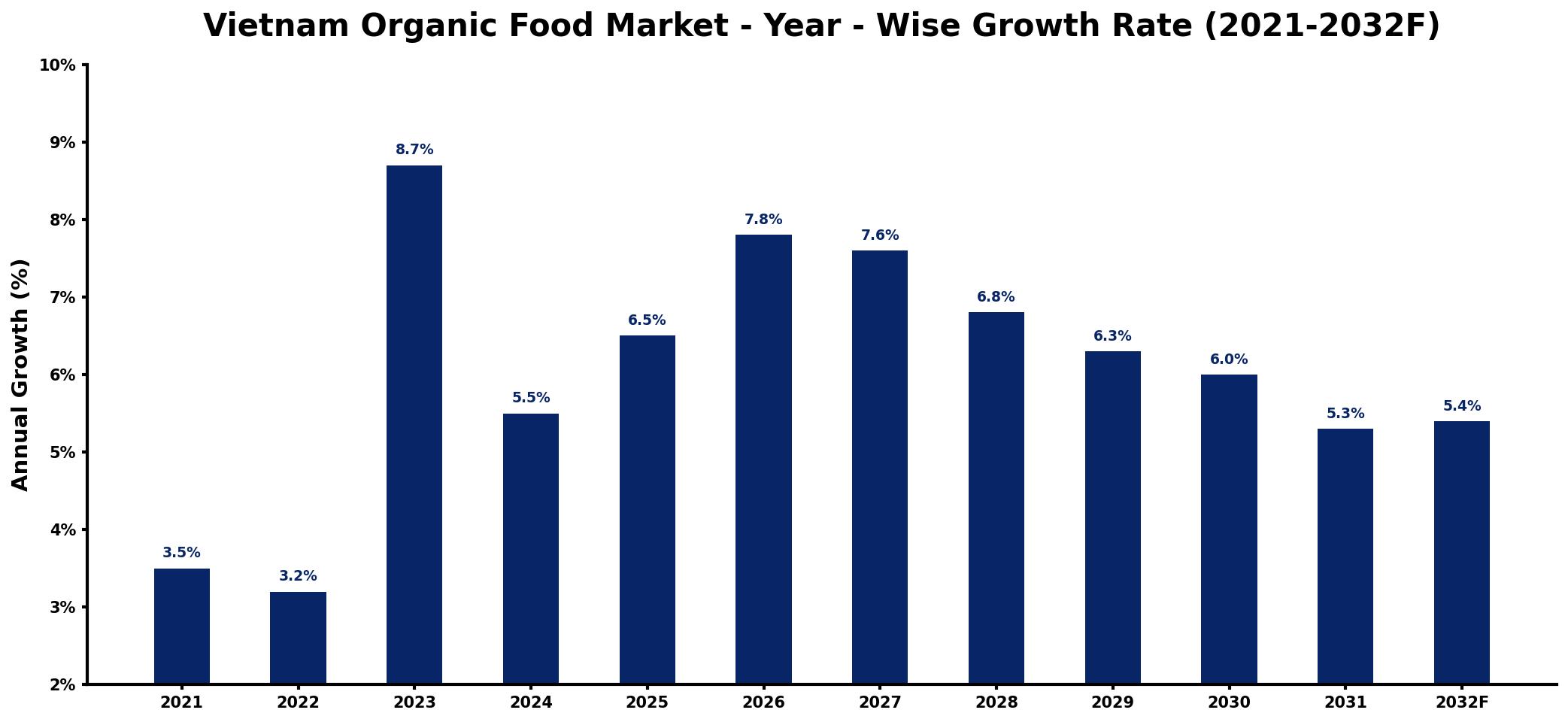
The table below presents the year‑wise growth rates along with the key drivers influencing the market
| Year | Growth Rate | Major Drivers |
| 2021 | 3.5% | Rising consumer health awareness |
| 2022 | 3.2% | Increased availability of alternatives |
| 2023 | 8.7% | Growing e-commerce penetration rates |
| 2024 | 5.5% | Expansion of retail distribution channels |
| 2025 | 6.5% | Higher investment in sustainability initiatives |
| 2026 | 7.8% | Surge in local production capacity |
| 2027 | 7.6% | Increased collaboration with farmers |
| 2028 | 6.8% | Growth in urban population dynamics |
| 2029 | 6.3% | Emergence of new market players |
| 2030 | 6.0% | Enhanced product labeling standards |
| 2031 | 5.3% | Shift towards premium purchasing behavior |
| 2032 | 5.4% | stronger distribution network expansion |
Note: Market size estimations and growth projections presented in this report are based on 6Wresearch's proprietary forecasting methodology, utilizing the latest available industry data, government publications, and primary research inputs.
Vietnam Organic Food Market Synopsis
The Vietnam Organic Food Market is witnessing a dynamic transformation, as consumers increasingly favor organic produce and processed foods. This market is characterized by a burgeoning interest in the cultivation of fruits, vegetables, and grains that adhere to organic farming principles, free from synthetic pesticides and chemicals. As a result, organic offerings have become integral to both local diets and export strategies.
Currently, the market serves a dual purpose: fulfilling domestic needs while also catering to a growing international appetite for Vietnamese organic products. With rigorous organic certification standards being embraced, both consumers and producers are aligning their efforts toward sustainable practices, further solidifying the market's foundation.
Vietnam Organic Food Market Key Takeaways
- Consumer health consciousness is a primary driver for the increasing demand for organic food options.
- The market is bolstered by government initiatives that support organic farming and certification processes.
- Supply chain disruptions during the COVID-19 pandemic highlighted the vulnerabilities in sourcing and transportation of organic products.
- Price competition remains a significant challenge, as organic products typically come at a premium compared to conventional offerings.
- Trust in organic certification is critical for market expansion, as consumers seek assurances regarding product authenticity.
Evaluation of Restraints in Vietnam Organic Food Market
Despite its robust growth, the Vietnam Organic Food Market faces notable restraints that hinder its full potential. One major barrier is the complexity and cost associated with obtaining organic certification, which can deter farmers from transitioning to organic practices. Additionally, consumer trust remains a concern, as the market contends with skepticism regarding the authenticity of products labeled as organic. Price sensitivity further complicates matters, as many potential buyers may prioritize affordability over organic options, particularly in a market where prices for organic goods can be significantly higher than their conventional counterparts.
Vietnam Organic Food Market Trends
Emerging trends in the Vietnam Organic Food Market point towards a growing inclination towards plant-based diets, driven by both health considerations and environmental awareness. Additionally, the rise of online shopping platforms has revolutionized how consumers access organic products, making them more readily available. Moreover, the increasing integration of technology in farming practices is enhancing productivity and transparency, thereby fostering consumer confidence in organic labeling. These trends collectively position the market for continued growth and innovation.
Vietnam Organic Food Market Opportunities
Genuine growth opportunities within the Vietnam Organic Food Market lie in the development of local supply chains that can support organic farmers and improve accessibility for consumers. Investments in educational programs aimed at farmers regarding organic practices and certification can further enhance production capabilities. Furthermore, partnerships with international distributors could open new avenues for Vietnamese organic products in global markets, thereby expanding reach and increasing profitability. The push for sustainable and organic practices also presents opportunities for new product innovations, aligning with global consumer trends.
Government Initiatives in the Vietnam Organic Food Market
The Vietnamese government has implemented several initiatives to promote organic farming, including subsidies for organic certification and training programs for farmers. Policies aimed at enhancing the sustainability of agricultural practices are also gaining momentum, as authorities recognize the long-term economic and health benefits of a robust organic sector. Additionally, public awareness campaigns are being launched to educate consumers on the advantages of choosing organic products, further supporting market growth.
Future Insights of the Vietnam Organic Food Market
Looking ahead to the period from 2026 to 2032, the Vietnam Organic Food Market is poised for significant expansion. A steady increase in health-conscious consumer behavior is expected to drive further demand for organic options. As government policies continue to evolve in support of sustainable practices, market players will have the opportunity to innovate and improve efficiency in their operations. The integration of technology in farming and distribution will also pave the way for more robust market dynamics, ultimately leading to a more diversified product offering and enhanced consumer trust.
Vietnam Organic Food Market Latest Developments (2025 - 2026)
In the last year, the Vietnam Organic Food Market has seen a surge in collaborations between organic farmers and retail platforms aimed at expanding distribution channels. Innovations in logistics have been prioritized to overcome previous supply chain disruptions, ensuring a steadier flow of organic products to consumers. Increased interest in online sales has prompted many producers to enhance their digital presence, facilitating a better connection with health-conscious consumers. Additionally, awareness campaigns by various stakeholders have contributed to a growing consumer base prioritizing organic food in their purchasing decisions.
Vietnam Organic Food Market - Key Attractiveness of the Report
- 10 Years of Market Numbers
- Historical Data Starting from 2022 to 2025
- Base Year: 2025
- Forecast Data until 2032
- Key Performance Indicators Impacting the Market
- Major Upcoming Developments and Projects
Key Highlights of the Report:
- Vietnam Organic Food Market Outlook
- Market Size of Vietnam Organic Food Market, 2025
- Forecast of Vietnam Organic Food Market, 2032
- Historical Data and Forecast of Vietnam Organic Food Revenues & Volume for the Period 2022-2032F
- Vietnam Organic Food Market Trend Evolution
- Vietnam Organic Food Market Drivers and Challenges
- Vietnam Organic Food Price Trends
- Vietnam Organic Food Porter's Five Forces
- Vietnam Organic Food Industry Life Cycle
- Historical Data and Forecast of Vietnam Organic Food Market Revenues & Volume By Food Type for the Period 2022-2032F
- Historical Data and Forecast of Vietnam Organic Food Market Revenues & Volume By Fruit & Vegetables for the Period 2022-2032F
- Historical Data and Forecast of Vietnam Organic Food Market Revenues & Volume By Meat for the Period 2022-2032F
- Historical Data and Forecast of Vietnam Organic Food Market Revenues & Volume By Fish & Poultry for the Period 2022-2032F
- Historical Data and Forecast of Vietnam Organic Food Market Revenues & Volume By Dairy Products for the Period 2022-2032F
- Historical Data and Forecast of Vietnam Organic Food Market Revenues & Volume By Frozen & Processed Foods for the Period 2022-2032F
- Historical Data and Forecast of Vietnam Organic Food Market Revenues & Volume By Others for the Period 2022-2032F
- Historical Data and Forecast of Vietnam Organic Food Market Revenues & Volume By Application for the Period 2022-2032F
- Historical Data and Forecast of Vietnam Organic Food Market Revenues & Volume By Commercial for the Period 2022-2032F
- Historical Data and Forecast of Vietnam Organic Food Market Revenues & Volume By Cosmetics & Personal Care for the Period 2022-2032F
- Historical Data and Forecast of Vietnam Organic Food Market Revenues & Volume By Households for the Period 2022-2032F
- Historical Data and Forecast of Vietnam Organic Food Market Revenues & Volume By Others for the Period 2022-2032F
- Vietnam Organic Food Import Export Trade Statistics
- Market Opportunity Assessment By Food Type
- Market Opportunity Assessment By Application
- Vietnam Organic Food Top Companies Market Share
- Vietnam Organic Food Competitive Benchmarking By Technical and Operational Parameters
- Vietnam Organic Food Company Profiles
- Vietnam Organic Food Key Strategic Recommendations






































