Vietnam Organic Fruits And Vegetables Market Size, Share & Growth Rate
The Vietnam Organic Fruits And Vegetables Market was estimated at USD 406 Million in 2025 and is projected to reach USD 574 Million by 2032, growing at a CAGR of 5.1% from 2026 to 2032. This growth trajectory is fueled by a burgeoning health-conscious consumer base increasingly prioritizing pesticide-free produce, alongside a push for sustainable agricultural practices. As awareness surrounding the benefits of organic food continues to rise, so too does the support from government initiatives aimed at enhancing organic farming in the country.
Vietnam Organic Fruits And Vegetables Market Year-wise Growth Rate and Key Drivers
This graph highlights how the Vietnam Organic Fruits And Vegetables Market has steadily grown over the years, supported by major growth factors.
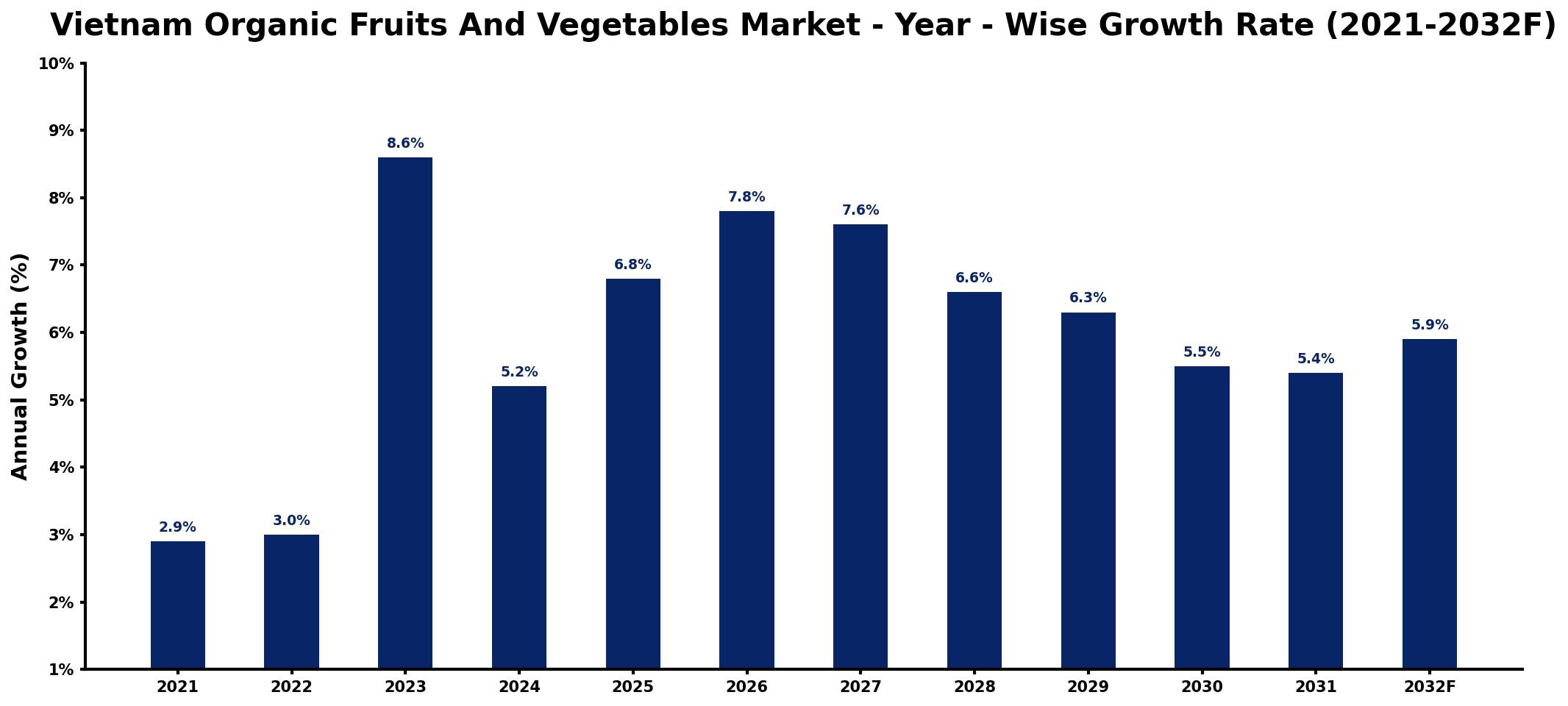
The table below presents the year‑wise growth rates along with the key drivers influencing the market
| Year | Growth Rate | Major Drivers |
| 2021 | 2.9% | Increased health awareness among consumers |
| 2022 | 3.0% | Rising disposable income levels |
| 2023 | 8.6% | Growing demand for sustainable practices |
| 2024 | 5.2% | Expansion of distribution channels |
| 2025 | 6.8% | Investment in agricultural technologies |
| 2026 | 7.8% | Enhanced consumer education programs |
| 2027 | 7.6% | Strengthening local farming initiatives |
| 2028 | 6.6% | Increased online shopping platforms |
| 2029 | 6.3% | Growing interest in nutrition education |
| 2030 | 5.5% | Supportive government policies introduced |
| 2031 | 5.4% | Rising popularity of eco-friendly products |
| 2032 | 5.9% | Strengthened international trade agreements |
Note: Market size estimations and growth projections presented in this report are based on 6Wresearch's proprietary forecasting methodology, utilizing the latest available industry data, government publications, and primary research inputs.
Vietnam Organic Fruits And Vegetables Market Synopsis
In Vietnam, the organic fruits and vegetables market is experiencing a notable transformation. With a growing segment of the population advocating for healthier lifestyles and environmentally sustainable choices, demand for organic produce is on the rise. Farmers are beginning to adapt, implementing organic farming methods to meet this surging demand.
Despite its promising potential, the market remains in a developmental phase, with challenges such as limited farmer knowledge and resource availability still prevalent. However, the convergence of rising health awareness and government endorsement of organic agriculture is setting the stage for robust market growth in the coming years.
Vietnam Organic Fruits And Vegetables Market Key Takeaways
- Consumer preference is shifting towards organic produce due to health and environmental awareness.
- Government support is bolstering the organic farming sector, driving growth and development.
- Modern retail channels are expanding access to organic fruits and vegetables for consumers.
- Challenges in farmer training and resources hinder the rapid adoption of organic farming methods.
- Online platforms are enhancing the reach of organic produce, particularly post-COVID-19.
Evaluation of Restraints in Vietnam Organic Fruits And Vegetables Market
One of the most significant barriers facing the Vietnam organic fruits and vegetables market is the limited adoption of organic farming practices among the farming community. Many farmers are entrenched in conventional agriculture, and transitioning to organic methods presents a steep learning curve, compounded by the lack of resources. The perception of higher prices for organic products compared to conventional options further suppresses consumer demand. Additionally, the complexities surrounding certification and labeling of organic goods lead to confusion, stunting market growth. Lastly, logistical challenges in distribution often restrict the availability of organic produce in remote areas.
Vietnam Organic Fruits And Vegetables Market Trends
Several emerging trends are shaping the Vietnam organic fruits and vegetables market. The rise of e-commerce is revolutionizing how consumers access organic produce, enabling direct connections between farmers and buyers through online platforms. Furthermore, there is a growing inclination among consumers to understand the origin and farming practices of their food, fostering transparency in the market. This trend is accompanied by a stronger focus on sustainability, with both consumers and producers advocating for environmentally friendly practices in agriculture. As awareness around nutrition and health continues to rise, these trends are expected to evolve and strengthen the market.
Vietnam Organic Fruits And Vegetables Market Opportunities
The Vietnam Organic Fruits and Vegetables market presents numerous growth opportunities. With rising health awareness and a supportive government framework, investment in organic farming technologies and practices can yield significant returns. Moreover, expanding distribution networks that include modern retail and online sales can facilitate broader market penetration. There is also an opportunity to develop targeted educational programs for farmers, enhancing their capacity to transition to organic methods efficiently. Additionally, partnerships between private sector players and farmers can stimulate innovation and improve the overall sustainability of the sector.
Government Initiatives in the Vietnam Organic Fruits And Vegetables Market
The Vietnamese government is actively promoting organic agriculture through various initiatives aimed at enhancing production capacity and farmer engagement. Policies encouraging sustainable farming practices and financial incentives for organic certification are key components of this effort. Additionally, educational programs that aim to inform farmers about organic practices are being implemented, highlighting the government's commitment to fostering a robust organic farming environment. These initiatives are crucial in shaping a vibrant and sustainable organic fruits and vegetables market.
Future Insights of the Vietnam Organic Fruits And Vegetables Market
Looking ahead to 2026-2032, the Vietnam Organic Fruits and Vegetables market is poised for significant evolution. With increasing consumer advocacy for health and sustainability, demand for organic products is expected to rise. The combination of governmental support and heightened consumer awareness will likely foster the expansion of organic farming practices. As more farmers adopt these methods, improved supply chains and distribution channels will emerge, making organic produce more accessible. Overall, this sector is anticipated to flourish, driven by changing consumer preferences and ongoing investments in sustainable agriculture.
Vietnam Organic Fruits And Vegetables Market Latest Developments (2025 - 2026)
Recent developments in the Vietnam organic fruits and vegetables market indicate a growing momentum toward organic farming practices. Various initiatives focusing on enhancing training for farmers are being launched, aiming to increase knowledge of organic methods and sustainable practices. Additionally, consumer engagement through digital platforms is on the rise, facilitating greater access to organic products. As COVID-19 pushed consumers towards health-centric choices, organic produce sales channels are adapting to meet this evolving demand, creating a more dynamic market landscape.
Vietnam Organic Fruits And Vegetables Market - Key Attractiveness of the Report
- 10 Years of Market Numbers
- Historical Data Starting from 2022 to 2025
- Base Year: 2025
- Forecast Data until 2032
- Key Performance Indicators Impacting the Market
- Major Upcoming Developments and Projects
Key Highlights of the Report:
- Vietnam Organic Fruits And Vegetables Market Outlook
- Market Size of Vietnam Organic Fruits And Vegetables Market, 2025
- Forecast of Vietnam Organic Fruits And Vegetables Market, 2032
- Historical Data and Forecast of Vietnam Organic Fruits And Vegetables Revenues & Volume for the Period 2022-2032F
- Vietnam Organic Fruits And Vegetables Market Trend Evolution
- Vietnam Organic Fruits And Vegetables Market Drivers and Challenges
- Vietnam Organic Fruits And Vegetables Price Trends
- Vietnam Organic Fruits And Vegetables Porter's Five Forces
- Vietnam Organic Fruits And Vegetables Industry Life Cycle
- Historical Data and Forecast of Vietnam Organic Fruits And Vegetables Market Revenues & Volume By Product Type for the Period 2022-2032F
- Historical Data and Forecast of Vietnam Organic Fruits And Vegetables Market Revenues & Volume By Organic Fruits for the Period 2022-2032F
- Historical Data and Forecast of Vietnam Organic Fruits And Vegetables Market Revenues & Volume By Organic Vegetables for the Period 2022-2032F
- Historical Data and Forecast of Vietnam Organic Fruits And Vegetables Market Revenues & Volume By Form for the Period 2022-2032F
- Historical Data and Forecast of Vietnam Organic Fruits And Vegetables Market Revenues & Volume By Fresh for the Period 2022-2032F
- Historical Data and Forecast of Vietnam Organic Fruits And Vegetables Market Revenues & Volume By Frozen for the Period 2022-2032F
- Historical Data and Forecast of Vietnam Organic Fruits And Vegetables Market Revenues & Volume By End User for the Period 2022-2032F
- Historical Data and Forecast of Vietnam Organic Fruits And Vegetables Market Revenues & Volume By Residential for the Period 2022-2032F
- Historical Data and Forecast of Vietnam Organic Fruits And Vegetables Market Revenues & Volume By Commercial for the Period 2022-2032F
- Historical Data and Forecast of Vietnam Organic Fruits And Vegetables Market Revenues & Volume By Distribution Channel for the Period 2022-2032F
- Historical Data and Forecast of Vietnam Organic Fruits And Vegetables Market Revenues & Volume By Supermarket for the Period 2022-2032F
- Historical Data and Forecast of Vietnam Organic Fruits And Vegetables Market Revenues & Volume By Hypermarket for the Period 2022-2032F
- Historical Data and Forecast of Vietnam Organic Fruits And Vegetables Market Revenues & Volume By Convenience Store for the Period 2022-2032F
- Historical Data and Forecast of Vietnam Organic Fruits And Vegetables Market Revenues & Volume By Online Sale Channel for the Period 2022-2032F
- Historical Data and Forecast of Vietnam Organic Fruits And Vegetables Market Revenues & Volume By Others for the Period 2022-2032F
- Vietnam Organic Fruits And Vegetables Import Export Trade Statistics
- Market Opportunity Assessment By Product Type
- Market Opportunity Assessment By Form
- Market Opportunity Assessment By End User
- Market Opportunity Assessment By Distribution Channel
- Vietnam Organic Fruits And Vegetables Top Companies Market Share
- Vietnam Organic Fruits And Vegetables Competitive Benchmarking By Technical and Operational Parameters
- Vietnam Organic Fruits And Vegetables Company Profiles
- Vietnam Organic Fruits And Vegetables Key Strategic Recommendations






































