Vietnam Oscillograph Recorders Market Size, Share & Growth Rate
The Vietnam Oscillograph Recorders Market was estimated at USD 286 Million in 2025 and is projected to reach USD 403 Million by 2032, growing at a CAGR of 5.0% from 2026 to 2032. This anticipated growth trajectory can be attributed to several key factors, including the rapid expansion of Vietnam's electronics manufacturing sector and the increasing emphasis on precise data monitoring in industries such as telecommunications and power generation. As these sectors modernize and innovate, the demand for advanced oscillograph recording solutions continues to climb.
Vietnam Oscillograph Recorders Market Year-wise Growth Rate and Key Drivers
This graph highlights how the Vietnam Oscillograph Recorders Market has steadily grown over the years, supported by major growth factors.
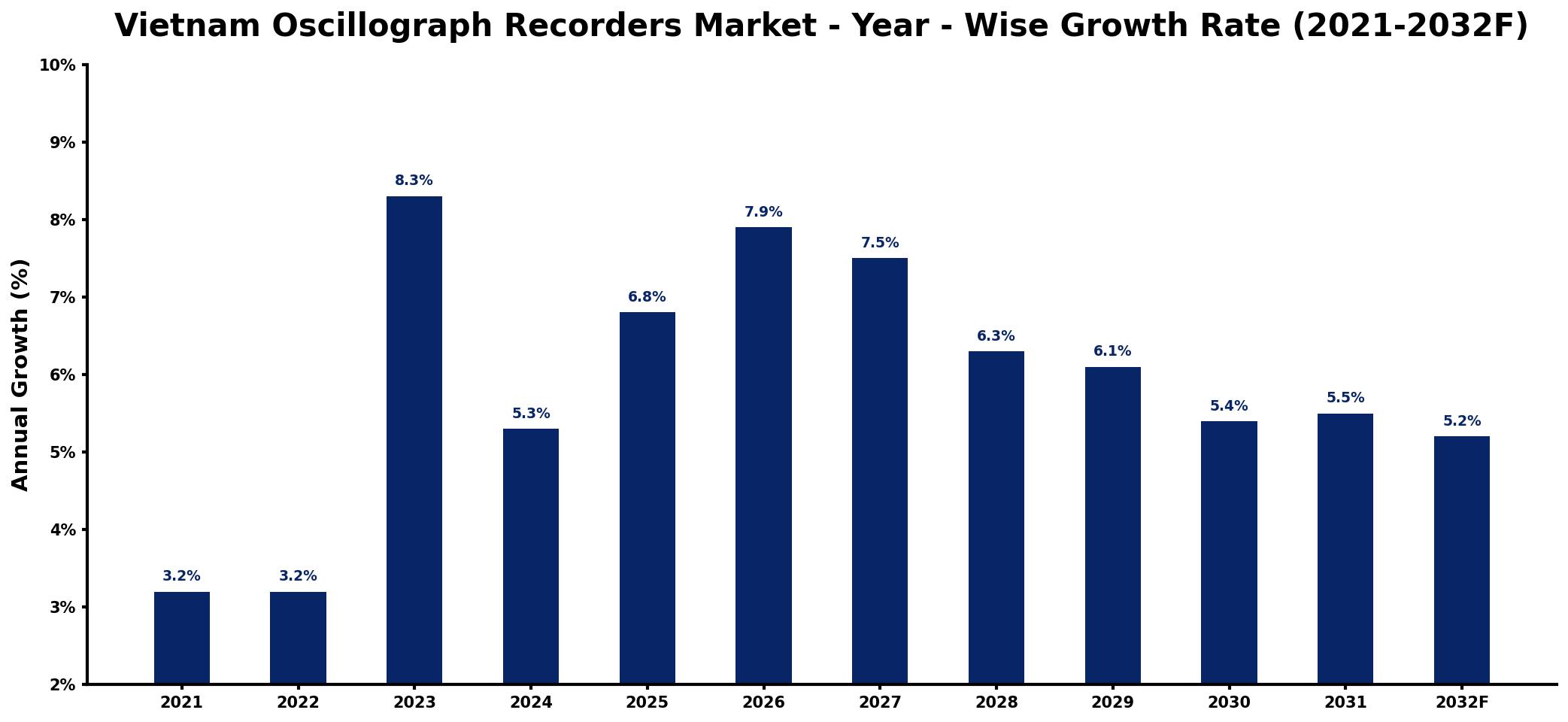
The table below presents the year‑wise growth rates along with the key drivers influencing the market
| Year | Growth Rate | Major Drivers |
| 2021 | 3.2% | Emerging technologies in diagnostics |
| 2022 | 3.2% | Increased industrial automation investments |
| 2023 | 8.3% | Expansion of renewable energy projects |
| 2024 | 5.3% | Growing demand for data analysis |
| 2025 | 6.8% | Rising healthcare infrastructure spending |
| 2026 | 7.9% | Technological advancements in monitoring |
| 2027 | 7.5% | Increased focus on quality assurance |
| 2028 | 6.3% | Surge in regulatory compliance needs |
| 2029 | 6.1% | Growth in educational research funding |
| 2030 | 5.4% | Enhancements in telecommunications infrastructure |
| 2031 | 5.5% | Rising interest in environmental monitoring |
| 2032 | 5.2% | Development of smart manufacturing solutions |
Note: Market size estimations and growth projections presented in this report are based on 6Wresearch's proprietary forecasting methodology, utilizing the latest available industry data, government publications, and primary research inputs.
Vietnam Oscillograph Recorders Market Synopsis
Currently, the Vietnam oscillograph recorders market is witnessing significant momentum driven by technological advancements and the pressing need for accurate electrical measurement. The integration of these instruments into diverse applications—from utility monitoring to sophisticated telecommunications systems—underscores their vital role in maintaining operational integrity and efficiency.
Market participants are pivoting towards innovative product offerings that enhance functionality while catering to the specific needs of various sectors. The interplay between growing industrialization and the push for enhanced electrical infrastructure is propelling the demand for oscillograph recorders in Vietnam.
Vietnam Oscillograph Recorders Market Key Takeaways
- The market is characterized by strong growth driven by industrial expansion and modernization.
- Precision data monitoring and analysis are paramount across industries such as electronics and power generation.
- Government initiatives are facilitating investments in advanced electrical monitoring solutions.
- The shift towards digital technologies is influencing product innovation within the market.
- Post-COVID-19 recovery highlights the growing importance of reliable data recording capabilities.
Evaluation of Restraints in Vietnam Oscillograph Recorders Market
While the Vietnam oscillograph recorders market is poised for growth, several factors may limit its potential. The rapid pace of technological advancement poses a challenge, as older analog systems face obsolescence in the face of newer, digital alternatives. Furthermore, the competition from multi-functional data recording devices could divert investments from traditional oscillograph recorders, compelling manufacturers to continuously innovate in order to maintain relevance and market share.
Vietnam Oscillograph Recorders Market Trends
The market is increasingly shifting towards hybrid and digital oscillograph recorders that offer enhanced features, such as remote monitoring and advanced data analytics. This trend is particularly relevant as industries aim to adopt more integrated solutions that can handle diverse data inputs. Additionally, the rise of IoT devices is influencing oscillograph recorder design, prompting manufacturers to develop models that seamlessly connect with smart technology ecosystems.
Vietnam Oscillograph Recorders Market Opportunities
Significant growth opportunities exist within the Vietnam oscillograph recorders market, particularly in sectors such as renewable energy and smart grid technology. As Vietnam commits to enhancing its electrical infrastructure, there is a burgeoning need for sophisticated monitoring equipment. Moreover, the increasing focus on energy efficiency and sustainability provides a compelling avenue for investment, allowing market players to expand their offerings and cater to evolving regulatory standards.
Government Initiatives in the Vietnam Oscillograph Recorders Market
The Vietnamese government is actively promoting initiatives aimed at modernizing the nation's electrical infrastructure and enhancing grid reliability. Policies focused on increasing investment in technology-driven monitoring solutions are becoming more common. Such initiatives are geared towards bolstering energy efficiency, thereby creating a favorable environment for the oscillograph recorders market to flourish.
Future Insights of the Vietnam Oscillograph Recorders Market
Looking ahead to 2026-2032, the Vietnam oscillograph recorders market is expected to experience robust growth, driven by continuous advancements in technology and increased industrial applications. The increasing integration of artificial intelligence and machine learning into data analysis presents an exciting frontier for oscillograph recording technologies. With the persistent push for modernization and efficiency across various sectors, this market is well-positioned to capitalize on emerging trends and innovations.
Vietnam Oscillograph Recorders Market Latest Developments (2025 - 2026)
Recent developments in the Vietnam oscillograph recorders market have focused on enhancing connectivity and user interface. Innovations in software integration are paving the way for more intuitive and user-friendly devices, which are critical in the context of modern industrial requirements. Additionally, industry stakeholders are increasingly prioritizing sustainability in their product designs, aligning with global trends towards environmentally responsible manufacturing practices.
Vietnam Oscillograph Recorders Market - Key Attractiveness of the Report
- 10 Years of Market Numbers
- Historical Data Starting from 2022 to 2025
- Base Year: 2025
- Forecast Data until 2032
- Key Performance Indicators Impacting the Market
- Major Upcoming Developments and Projects
Key Highlights of the Report:
- Vietnam Oscillograph Recorders Market Outlook
- Market Size of Vietnam Oscillograph Recorders Market, 2025
- Forecast of Vietnam Oscillograph Recorders Market, 2032
- Historical Data and Forecast of Vietnam Oscillograph Recorders Revenues & Volume for the Period 2022-2032F
- Vietnam Oscillograph Recorders Market Trend Evolution
- Vietnam Oscillograph Recorders Market Drivers and Challenges
- Vietnam Oscillograph Recorders Price Trends
- Vietnam Oscillograph Recorders Porter's Five Forces
- Vietnam Oscillograph Recorders Industry Life Cycle
- Historical Data and Forecast of Vietnam Oscillograph Recorders Market Revenues & Volume By Type for the Period 2022-2032F
- Historical Data and Forecast of Vietnam Oscillograph Recorders Market Revenues & Volume By Desktop for the Period 2022-2032F
- Historical Data and Forecast of Vietnam Oscillograph Recorders Market Revenues & Volume By Handheld for the Period 2022-2032F
- Historical Data and Forecast of Vietnam Oscillograph Recorders Market Revenues & Volume By Portable for the Period 2022-2032F
- Historical Data and Forecast of Vietnam Oscillograph Recorders Market Revenues & Volume By Application for the Period 2022-2032F
- Historical Data and Forecast of Vietnam Oscillograph Recorders Market Revenues & Volume By Power Supply for the Period 2022-2032F
- Historical Data and Forecast of Vietnam Oscillograph Recorders Market Revenues & Volume By Traffic Route for the Period 2022-2032F
- Historical Data and Forecast of Vietnam Oscillograph Recorders Market Revenues & Volume By Others for the Period 2022-2032F
- Vietnam Oscillograph Recorders Import Export Trade Statistics
- Market Opportunity Assessment By Type
- Market Opportunity Assessment By Application
- Vietnam Oscillograph Recorders Top Companies Market Share
- Vietnam Oscillograph Recorders Competitive Benchmarking By Technical and Operational Parameters
- Vietnam Oscillograph Recorders Company Profiles
- Vietnam Oscillograph Recorders Key Strategic Recommendations






































