Vietnam Paint Glass Market Size, Share & Growth Rate
The Vietnam Paint Glass Market was estimated at USD 1303 Million in 2025 and is projected to reach USD 2124 Million by 2032, growing at a CAGR of 7.2% from 2026 to 2032. This remarkable growth trajectory is primarily fueled by increasing demand from the construction and automotive sectors, where high-quality decorative glass products are becoming essential. The emphasis on sustainable and innovative building materials, coupled with a growing preference for customized glass surfaces, further accelerates market expansion.
Vietnam Paint Glass Market Year-wise Growth Rate and Key Drivers
This graph highlights how the Vietnam Paint Glass Market has steadily grown over the years, supported by major growth factors.
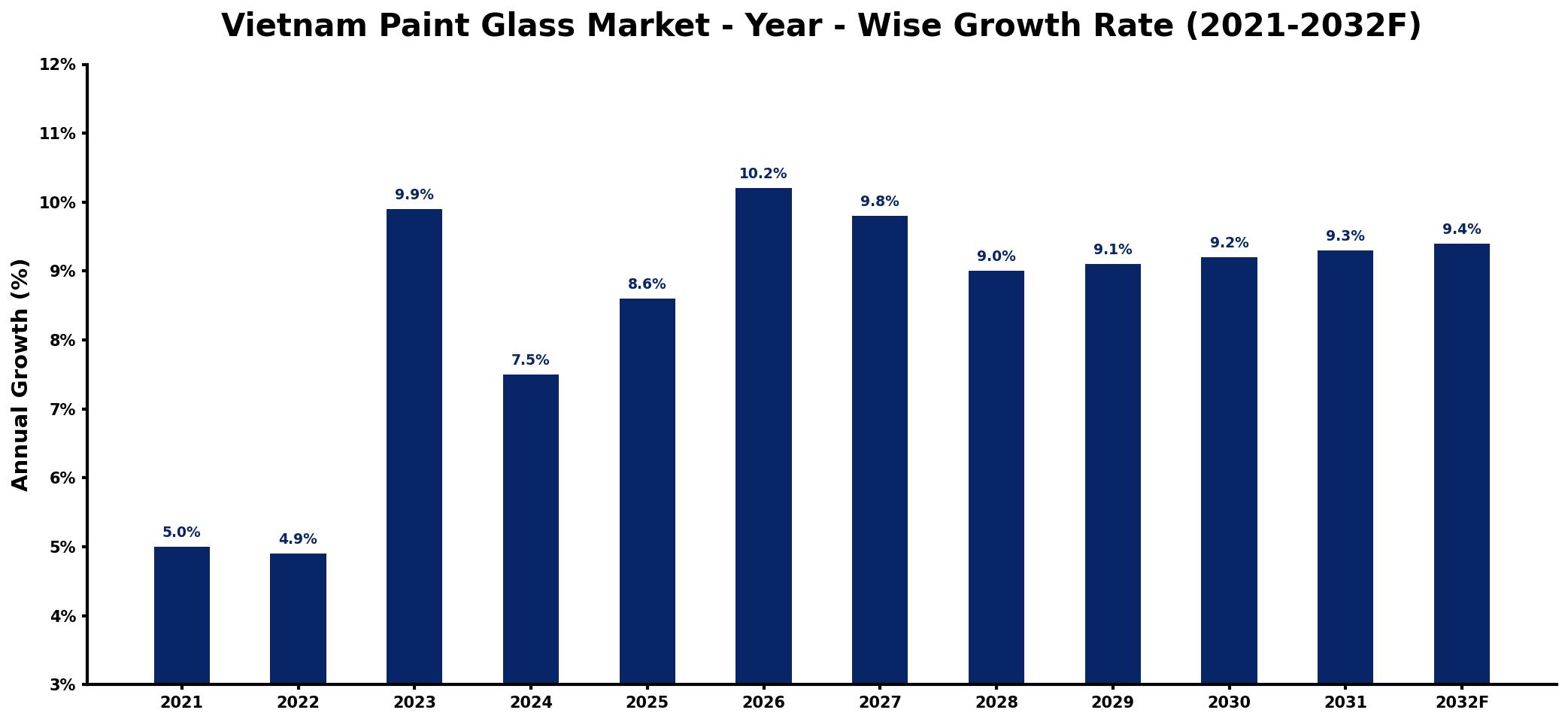
The table below presents the year‑wise growth rates along with the key drivers influencing the market
| Year | Growth Rate | Major Drivers |
| 2021 | 5.0% | Increased construction sector investments |
| 2022 | 4.9% | Growing residential renovation projects |
| 2023 | 9.9% | Surge in industrial applications demand |
| 2024 | 7.5% | Expansion of infrastructure development initiatives |
| 2025 | 8.6% | Rising urbanization and population growth |
| 2026 | 10.2% | Technological advancements in manufacturing |
| 2027 | 9.8% | Boost in export market opportunities |
| 2028 | 9.0% | Increase in eco-friendly product demand |
| 2029 | 9.1% | increased capital investment inflows |
| 2030 | 9.2% | Enhanced consumer spending patterns |
| 2031 | 9.3% | Development of smart city projects |
| 2032 | 9.4% | Strengthening regional trade partnerships |
Note: Market size estimations and growth projections presented in this report are based on 6Wresearch's proprietary forecasting methodology, utilizing the latest available industry data, government publications, and primary research inputs.
Vietnam Paint Glass Market Synopsis
The paint glass market in Vietnam has emerged as a dynamic segment within the broader glass industry, characterized by a range of applications in architecture and automotive design. Coated with specialized paints, these glass products provide not just aesthetic appeal but also functional benefits like UV protection and enhanced privacy.
In a country experiencing rapid urbanization and infrastructural development, the demand for paint glass is set to rise significantly. Architects and designers are increasingly seeking innovative solutions that not only meet practical needs but also enhance the visual aspects of buildings, contributing to the growth of this specialized market.
Vietnam Paint Glass Market Key Takeaways
- The market is driven by strong demand from both construction and automotive sectors.
- Architectural innovations and sustainability trends are pushing manufacturers to develop advanced paint glass solutions.
- Vietnams increasing urbanization is significantly impacting the growth of interior and architectural applications.
- Key domestic and international players are contributing to a competitive landscape in paint glass supply.
- The market is adapting to changing consumer preferences in aesthetics and functionality.
Evaluation of Restraints in Vietnam Paint Glass Market
Despite the promising growth outlook, the Vietnam paint glass market is not without its challenges. Price volatility in raw materials used for glass coatings can strain manufacturer margins. Additionally, fluctuations in international trade dynamics may hinder export capabilities, affecting competitive positioning in the global market. These factors compel manufacturers to innovate continuously while managing costs effectively, ensuring they can capitalize on emerging opportunities.
Vietnam Paint Glass Market Trends
Several trends are shaping the Vietnam paint glass market. Firstly, there is a notable shift towards eco-friendly coatings, as environmental awareness among consumers continues to rise. Manufacturers are increasingly investing in sustainable production techniques and materials. Secondly, the demand for customized and decorative glass solutions is soaring, driven by an evolving design aesthetic in urban architecture and residential spaces. Lastly, the integration of smart technologies into glass products is beginning to gain traction, offering functionalities like energy efficiency and automated shading.
Vietnam Paint Glass Market Opportunities
Opportunities abound in the Vietnam paint glass market as it seeks to address emerging consumer demands. The ongoing urban development and infrastructure projects present a lucrative landscape for manufacturers to introduce innovative products that cater to modern architectural needs. Furthermore, potential collaborations with technology firms to develop smart glass solutions could tap into a new segment of the market, enhancing both functionality and appeal to architects and designers.
Government Initiatives in the Vietnam Paint Glass Market
The Vietnamese government is actively promoting construction practices that emphasize sustainability and energy efficiency. This includes public spending on infrastructure projects that prioritize the use of innovative materials like paint glass. Additionally, regulatory frameworks are being established to support the development of environmentally friendly construction materials, thereby encouraging manufacturers to invest in advanced glass coating technologies.
Future Insights of the Vietnam Paint Glass Market
Looking ahead to 2026-2032, the Vietnam paint glass market is positioned for significant advancements. The alignment of market growth with governmental policies supporting sustainable construction will likely foster an environment of innovation. As consumer preferences evolve toward more customized and functional architectural solutions, manufacturers will need to prioritize R&D to stay competitive. The anticipated rebound in the construction sector post-pandemic also suggests a robust demand outlook, making this an opportune time for investment in paint glass technologies.
Vietnam Paint Glass Market Latest Developments (2025 - 2026)
Recent industry developments indicate a shift towards enhanced product offerings in the Vietnam paint glass market. Companies are exploring new technologies for eco-friendly glass coatings and focusing on innovative design features to attract architects and designers. Additionally, strategic partnerships are being formed to enhance distribution channels and improve product accessibility across different regions in Vietnam.
Vietnam Paint Glass Market - Key Attractiveness of the Report
- 10 Years of Market Numbers
- Historical Data Starting from 2022 to 2025
- Base Year: 2025
- Forecast Data until 2032
- Key Performance Indicators Impacting the Market
- Major Upcoming Developments and Projects
Key Highlights of the Report:
- Vietnam Paint Glass Market Outlook
- Market Size of Vietnam Paint Glass Market, 2025
- Forecast of Vietnam Paint Glass Market, 2032
- Historical Data and Forecast of Vietnam Paint Glass Revenues & Volume for the Period 2022-2032F
- Vietnam Paint Glass Market Trend Evolution
- Vietnam Paint Glass Market Drivers and Challenges
- Vietnam Paint Glass Price Trends
- Vietnam Paint Glass Porter's Five Forces
- Vietnam Paint Glass Industry Life Cycle
- Historical Data and Forecast of Vietnam Paint Glass Market Revenues & Volume By Type for the Period 2022-2032F
- Historical Data and Forecast of Vietnam Paint Glass Market Revenues & Volume By Water Based for the Period 2022-2032F
- Historical Data and Forecast of Vietnam Paint Glass Market Revenues & Volume By Solvent Based for the Period 2022-2032F
- Historical Data and Forecast of Vietnam Paint Glass Market Revenues & Volume By Application for the Period 2022-2032F
- Historical Data and Forecast of Vietnam Paint Glass Market Revenues & Volume By Construction Glass for the Period 2022-2032F
- Historical Data and Forecast of Vietnam Paint Glass Market Revenues & Volume By Furniture Glass for the Period 2022-2032F
- Historical Data and Forecast of Vietnam Paint Glass Market Revenues & Volume By Crafts for the Period 2022-2032F
- Historical Data and Forecast of Vietnam Paint Glass Market Revenues & Volume By Others for the Period 2022-2032F
- Vietnam Paint Glass Import Export Trade Statistics
- Market Opportunity Assessment By Type
- Market Opportunity Assessment By Application
- Vietnam Paint Glass Top Companies Market Share
- Vietnam Paint Glass Competitive Benchmarking By Technical and Operational Parameters
- Vietnam Paint Glass Company Profiles
- Vietnam Paint Glass Key Strategic Recommendations






































