Vietnam Parking Meter Market Size, Share & Growth Rate
The Vietnam Parking Meter Market was estimated at USD 607 Million in 2025 and is projected to reach USD 863 Million by 2032, growing at a CAGR of 5.2% from 2026 to 2032. This growth trajectory is primarily driven by rapid urbanization and the pressing need for effective parking management solutions amidst escalating traffic congestion in urban centers. Additionally, the adoption of smart technologies, including mobile payment systems, is enhancing operational efficiency and improving user experience.
Vietnam Parking Meter Market Year-wise Growth Rate and Key Drivers
This graph highlights how the Vietnam Parking Meter Market has steadily grown over the years, supported by major growth factors.
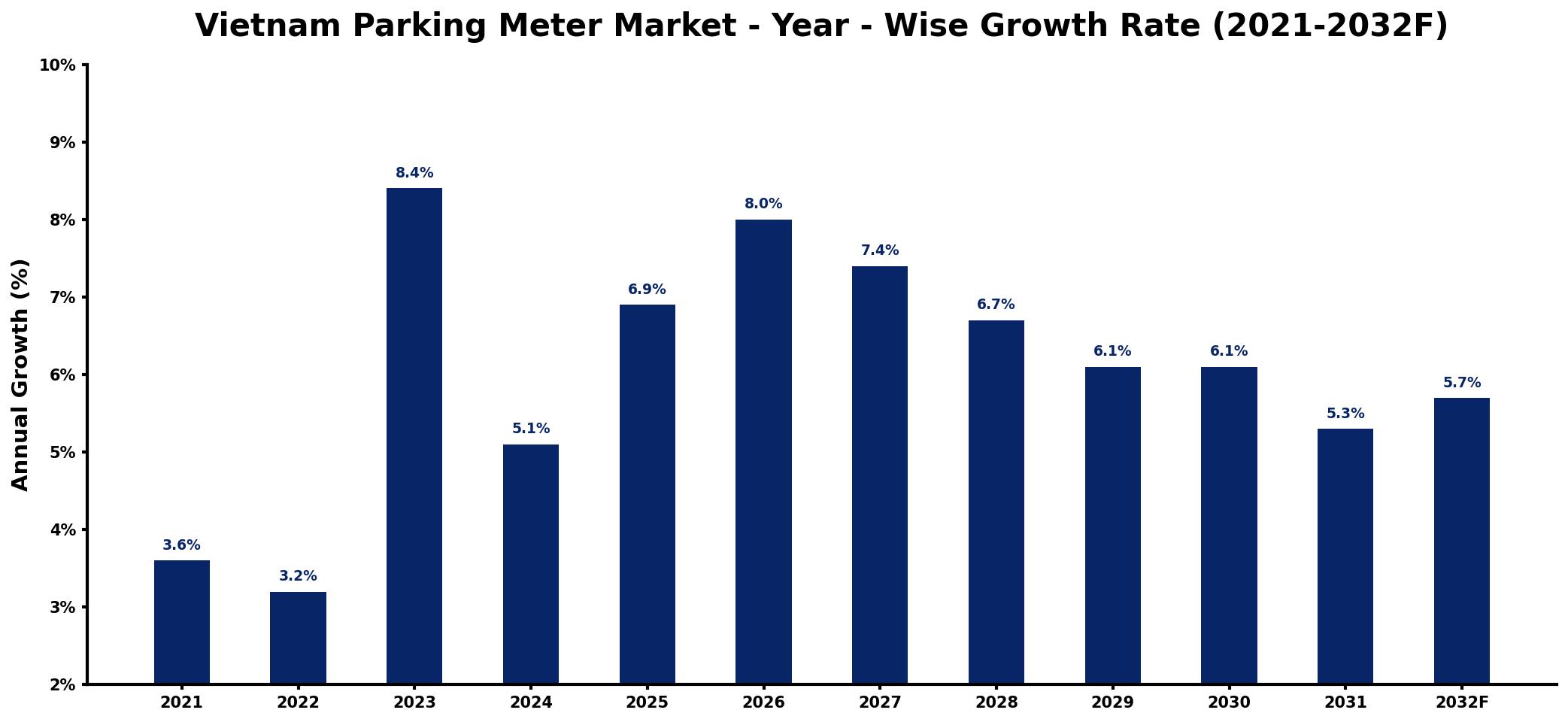
The table below presents the year‑wise growth rates along with the key drivers influencing the market
| Year | Growth Rate | Major Drivers |
| 2021 | 3.6% | Rising urban vehicle ownership rates |
| 2022 | 3.2% | Increased investments in infrastructure |
| 2023 | 8.4% | Expansion of smart city initiatives |
| 2024 | 5.1% | Growing demand for automation solutions |
| 2025 | 6.9% | Enhanced focus on sustainability practices |
| 2026 | 8.0% | Development of urban mobility strategies |
| 2027 | 7.4% | Surge in public transportation projects |
| 2028 | 6.7% | Emergence of innovative technology solutions |
| 2029 | 6.1% | Strengthening of regulatory frameworks |
| 2030 | 6.1% | Increase in urban population density |
| 2031 | 5.3% | growing commercial sector adoption |
| 2032 | 5.7% | Rise in shared mobility services |
Note: Market size estimations and growth projections presented in this report are based on 6Wresearch's proprietary forecasting methodology, utilizing the latest available industry data, government publications, and primary research inputs.
Vietnam Parking Meter Market Synopsis
Urbanization is the strongest force shaping the Vietnam Parking Meter Market today. As cities expand and traffic congestion worsens, local authorities are increasingly deploying parking meters and automated payment systems to regulate parking and generate revenue. This shift towards modern parking solutions is crucial for managing the growing demand for organized parking in busy urban areas.
The ongoing technological advancements in the parking meter sector, particularly mobile payment integration, are redefining user convenience. By allowing contactless payments and facilitating real-time data access, these innovations are not only streamlining parking operations but also driving further adoption of smart parking solutions across the country.
Vietnam Parking Meter Market Key Takeaways
- The market is expanding rapidly due to urbanization and the need for efficient parking solutions.
- Mobile payment technologies are increasingly being integrated into parking management systems.
- Local authorities are focusing on revenue generation through organized parking spaces.
- The pandemic has reshaped market dynamics, emphasizing contactless solutions.
- Government initiatives are supporting infrastructure development and enhancing urban mobility.
Evaluation of Restraints in Vietnam Parking Meter Market
Despite its promising growth, the Vietnam Parking Meter Market faces several restraints. One significant limitation is the need for modernization in existing parking infrastructure. Many cities require substantial investments to update aging systems, which can deter local authorities from making necessary upgrades. Furthermore, the consistent enforcement of parking regulations remains a challenge, often leading to confusion and inefficiencies in parking management. Addressing these issues will be crucial for realizing the market's full potential.
Vietnam Parking Meter Market Trends
Current trends in the Vietnam Parking Meter Market include the growing integration of technology, such as real-time data analytics and smart parking solutions. These trends are geared towards improving user experience and operational efficiency. Additionally, the emergence of mobile applications for parking management is gaining traction, enabling drivers to find available spaces effortlessly and make payments without physical interaction. There is also an increasing emphasis on sustainability and eco-friendly practices within the parking sector, driving demand for energy-efficient solutions.
Vietnam Parking Meter Market Opportunities
Significant growth opportunities exist in the Vietnam Parking Meter Market, particularly in expanding urban centers. The potential for developing integrated parking solutions that incorporate data analytics, cloud computing, and AI presents a lucrative avenue for investment. Additionally, as smart cities evolve, there will be increasing demand for comprehensive parking management systems that enhance urban mobility. Public-private partnerships may also play a pivotal role in accelerating infrastructure development and deployment of advanced parking technologies.
Government Initiatives in the Vietnam Parking Meter Market
The Vietnamese government is actively promoting initiatives aimed at enhancing urban mobility and addressing traffic congestion. Policies that encourage the installation of modern parking meters are being prioritized, along with incentives for local authorities to adopt smart parking solutions. Investments in urban infrastructure and technology will not only facilitate the expansion of parking systems but also support sustainable development goals in the rapidly growing cities across Vietnam.
Future Insights of the Vietnam Parking Meter Market
Looking ahead to 2026-2032, the Vietnam Parking Meter Market is expected to experience substantial transformation driven by technological advancements and urban growth. The market will likely shift toward more integrated and user-friendly solutions, emphasizing contactless payments and enhanced user engagement. As municipalities recognize the revenue-generating potential of organized parking, further investment in modernization and efficiency-enhancing technologies will become a focal point, setting the stage for sustained growth and innovation.
Vietnam Parking Meter Market Latest Developments (2025 - 2026)
Recent developments in the Vietnam Parking Meter Market indicate a strong push towards implementing smart parking technologies. Municipalities are increasingly adopting systems that allow for real-time updates on parking availability and efficient payment methods. The ongoing focus on enhancing user convenience through technology-driven solutions is evident, with a growing number of cities launching pilot projects aimed at integrating mobile payment systems into their parking management frameworks.
Vietnam Parking Meter Market - Key Attractiveness of the Report
- 10 Years of Market Numbers
- Historical Data Starting from 2022 to 2025
- Base Year: 2025
- Forecast Data until 2032
- Key Performance Indicators Impacting the Market
- Major Upcoming Developments and Projects
Key Highlights of the Report:
- Vietnam Parking Meter Market Outlook
- Market Size of Vietnam Parking Meter Market, 2025
- Forecast of Vietnam Parking Meter Market, 2032
- Historical Data and Forecast of Vietnam Parking Meter Revenues & Volume for the Period 2022-2032F
- Vietnam Parking Meter Market Trend Evolution
- Vietnam Parking Meter Market Drivers and Challenges
- Vietnam Parking Meter Price Trends
- Vietnam Parking Meter Porter's Five Forces
- Vietnam Parking Meter Industry Life Cycle
- Historical Data and Forecast of Vietnam Parking Meter Market Revenues & Volume By Technology for the Period 2022-2032F
- Historical Data and Forecast of Vietnam Parking Meter Market Revenues & Volume By Parking Meter (Single Space) for the Period 2022-2032F
- Historical Data and Forecast of Vietnam Parking Meter Market Revenues & Volume By Parking Kiosks (Multi Space) for the Period 2022-2032F
- Historical Data and Forecast of Vietnam Parking Meter Market Revenues & Volume By Government Institutions for the Period 2022-2032F
- Historical Data and Forecast of Vietnam Parking Meter Market Revenues & Volume By Application for the Period 2022-2032F
- Historical Data and Forecast of Vietnam Parking Meter Market Revenues & Volume By Hospitals for the Period 2022-2032F
- Historical Data and Forecast of Vietnam Parking Meter Market Revenues & Volume By Parks for the Period 2022-2032F
- Historical Data and Forecast of Vietnam Parking Meter Market Revenues & Volume By Transit Systems for the Period 2022-2032F
- Historical Data and Forecast of Vietnam Parking Meter Market Revenues & Volume By Malls & Stadiums for the Period 2022-2032F
- Historical Data and Forecast of Vietnam Parking Meter Market Revenues & Volume By Others for the Period 2022-2032F
- Historical Data and Forecast of Vietnam Parking Meter Market Revenues & Volume By Parking Mode for the Period 2022-2032F
- Historical Data and Forecast of Vietnam Parking Meter Market Revenues & Volume By Pay & Display for the Period 2022-2032F
- Historical Data and Forecast of Vietnam Parking Meter Market Revenues & Volume By Plate for the Period 2022-2032F
- Historical Data and Forecast of Vietnam Parking Meter Market Revenues & Volume By Space for the Period 2022-2032F
- Historical Data and Forecast of Vietnam Parking Meter Market Revenues & Volume By Others for the Period 2022-2032F
- Vietnam Parking Meter Import Export Trade Statistics
- Market Opportunity Assessment By Technology
- Market Opportunity Assessment By Application
- Market Opportunity Assessment By Parking Mode
- Vietnam Parking Meter Top Companies Market Share
- Vietnam Parking Meter Competitive Benchmarking By Technical and Operational Parameters
- Vietnam Parking Meter Company Profiles
- Vietnam Parking Meter Key Strategic Recommendations






































