Vietnam Paving Blocks Market Summary
The vietnam paving blocks market was estimated at USD 1460 Million in 2025 and is projected to reach USD 2078 Million by 2032, growing at a CAGR of 8.3% from 2026 to 2032.
Vietnam Paving Blocks Market Year-wise Growth Rate and Key Drivers
This graph highlights how the Vietnam Paving Blocks Market has steadily grown over the past five years, supported by major growth factors.
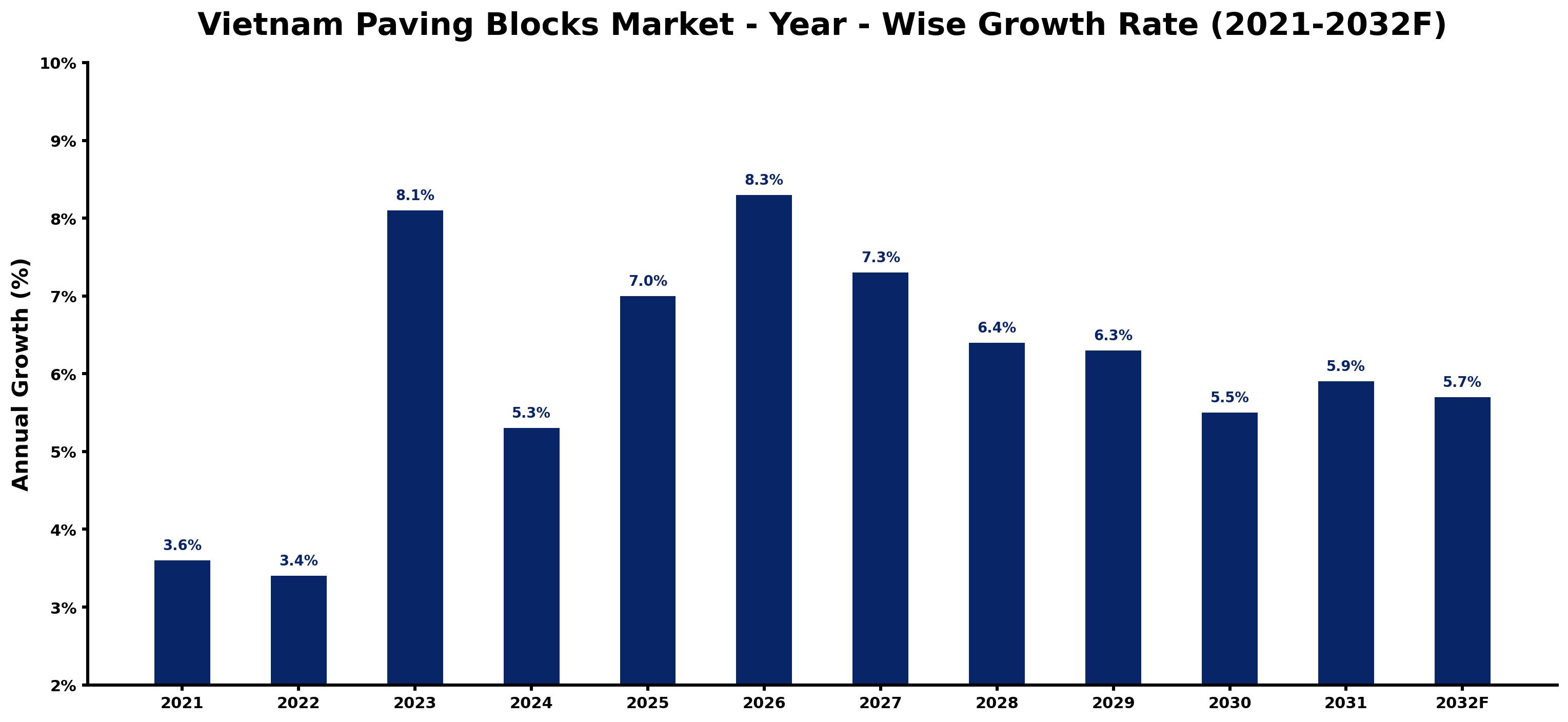
The table below presents the year wise growth rates along with the key drivers influencing the market
| Year | Growth Rate | Major Drivers |
| 2021 | 3.6% | Post-lockdown construction projects invigorate investment in urban infrastructure development. |
| 2022 | 3.4% | Emerging e-commerce trends increase demand for durable and attractive paving solutions. |
| 2023 | 8.1% | Manufacturing shifts towards Vietnam enhance local production capacity for paving blocks. |
| 2024 | 5.3% | Urbanization leads to expansion in residential and commercial developments requiring paving. |
| 2025 | 7.0% | Increased awareness of aesthetic landscaping promotes decorative paving block installations. |
| 2026 | 8.3% | Technological enhancements in block manufacturing improve quality and reduce production costs. |
| 2027 | 7.3% | Growing environmental concerns push interest in sustainable building materials, including paving blocks. |
| 2028 | 6.4% | Investment in renewable energy projects creates demand for infrastructure paving solutions. |
| 2029 | 6.3% | Rural development initiatives stimulate demand for durable roads and pathways in communities. |
| 2030 | 5.5% | Shift towards modern city designs emphasizes the need for advanced paving solutions. |
| 2031 | 5.9% | Local government incentives for public works projects drive paving block consumption significantly. |
| 2032 | 5.7% | Emerging smart city concepts integrate innovative paving materials into urban planning frameworks. |
Note - Market size estimations and growth projections presented in this report are based on 6Wresearch's advanced forecasting approach, validated with industry datasets as of June 2026.
Vietnam Paving Blocks Market Synopsis
The Vietnam Paving Blocks Market is projected to reach 8.3% and witness significant growth during the forecast period (2026-2032). This expansion is attributed to the country's rapid infrastructure development, increasing urbanization, and a rising preference for aesthetically pleasing pavements in both residential and commercial environments. Paving blocks, often referred to as concrete or brick pavers, are favored for their durability, versatility, and ease of installation. These qualities make them an integral choice for outdoor spaces including driveways, walkways, and public areas.
Vietnam Paving Blocks Market Growth Drivers
The growth of the Vietnam paving blocks market is propelled by several key factors. Firstly, ongoing infrastructure projects, such as road construction and urban renewal initiatives, are significantly increasing the demand for paving blocks. These projects provide a substantial opportunity for manufacturers and suppliers to cater to the growing needs of urban areas.
- As cities expand, there is an escalating necessity for well-designed and durable pavements that can support the increasing population and urban traffic.
- Paving blocks come in various colors, shapes, and patterns, enabling creative design choices that appeal to consumers interested in enhancing exterior aesthetics.
- Compared to traditional materials like concrete or asphalt, paving blocks offer a more cost-effective solution for outdoor flooring, which is a compelling advantage for budget-conscious projects.
- The lower maintenance costs and simpler replacement procedures associated with paving blocks contribute to their rising popularity among property developers and homeowners.
- The unique features and versatility of paving blocks have also catalyzed their increased adoption in landscaping and exterior design, augmenting their market presence.
Vietnam Paving Blocks Market Challenges and Restraints
Despite the promising growth prospects, the Vietnam paving blocks market faces several challenges. The availability and cost of raw materials, such as concrete aggregates and cement, can directly influence production costs and supply chain stability.
- Competition from alternative materials like asphalt, natural stone, and interlocking tiles remains a significant challenge for the market; manufacturers must emphasize the benefits of paving blocks to stand out.
- Increasing environmental regulations and sustainability demands require the market to innovate eco-friendly paving solutions while adopting sustainable production practices.
- The fluctuating costs of raw materials can cause instability in pricing strategies, affecting both producers and consumers.
- Market players need to invest in research and development to create more efficient production methods and enhance the environmental performance of paving blocks.
- Consumer awareness regarding sustainability may shift preferences towards greener alternatives, thus posing a challenge to traditional paving block products.
Vietnam Paving Blocks Market Government Investment and Initiatives
The government plays a pivotal role in the development of the Vietnam paving blocks market through various investment initiatives and public spending programs. Substantial funds are allocated to infrastructure projects aimed at urban renewal and expansion, which in turn drives the demand for paving materials.
- Policies focused on improving public infrastructure emphasize the development of pedestrian-friendly environments where paving blocks are utilized extensively.
- Government incentives for sustainable construction practices encourage manufacturers to explore eco-friendly alternatives in the paving blocks segment.
- Public-private partnerships are being fostered to enhance infrastructure capabilities, creating a collaborative approach to paving block applications.
- In response to urban population growth, local and national government initiatives prioritize transportation networks, further boosting paving block demand.
- The government's commitment to enhancing urban spaces through improved aesthetics aligns with the adoption of visually appealing paving solutions, reinforcing the market's growth trajectory.
Vietnam Paving Blocks Market Latest Developments (May 2025 - June 2026)
The Vietnam paving blocks market has seen several noteworthy developments between May 2025 and June 2026. Industry players have increasingly focused on innovation and the introduction of new designs that cater to both aesthetic and functionality needs. Enhanced supply chain strategies have emerged to address previous disruptions caused by the COVID-19 pandemic.
- Investment in sustainable manufacturing practices has grown, aligning with global trends towards environmentally-friendly products, which has become a critical market differentiator.
- New government policies promoting urban green spaces have stimulated demand for paving blocks that support landscaping and public area beautification initiatives.
- The spotlight has been on technological advancements in production processes, improving the quality and durability of paving blocks while reducing environmental impacts.
- Market players have been engaging in collaborative efforts to enhance product visibility and foster relationships with contractors and builders, creating a more interconnected industry network.
- Furthermore, demand for paving blocks has surged in response to the increasing focus on outdoor living spaces, as communities seek to enhance their outdoor environments for recreational and aesthetic purposes.
Vietnam Paving Blocks Market - Key Attractiveness of the Report
- 10 Years of Market Numbers
- Historical Data Starting from 2022 to 2025
- Base Year: 2025
- Forecast Data until 2032
- Key Performance Indicators Impacting the Market
- Major Upcoming Developments and Projects
Key Highlights of the Report:
- Vietnam Paving Blocks Market Outlook
- Market Size of Vietnam Paving Blocks Market, 2025
- Forecast of Vietnam Paving Blocks Market, 2032
- Historical Data and Forecast of Vietnam Paving Blocks Revenues & Volume for the Period 2022-2032F
- Vietnam Paving Blocks Market Trend Evolution
- Vietnam Paving Blocks Market Drivers and Challenges
- Vietnam Paving Blocks Price Trends
- Vietnam Paving Blocks Porter's Five Forces
- Vietnam Paving Blocks Industry Life Cycle
- Historical Data and Forecast of Vietnam Paving Blocks Market Revenues & Volume By Product for the Period 2022-2032F
- Historical Data and Forecast of Vietnam Paving Blocks Market Revenues & Volume By Pavers for the Period 2022-2032F
- Historical Data and Forecast of Vietnam Paving Blocks Market Revenues & Volume By Glazed Clay Bricks for the Period 2022-2032F
- Historical Data and Forecast of Vietnam Paving Blocks Market Revenues & Volume By Wall Block for the Period 2022-2032F
- Historical Data and Forecast of Vietnam Paving Blocks Market Revenues & Volume By Material for the Period 2022-2032F
- Historical Data and Forecast of Vietnam Paving Blocks Market Revenues & Volume By Clay for the Period 2022-2032F
- Historical Data and Forecast of Vietnam Paving Blocks Market Revenues & Volume By Building Bricks for the Period 2022-2032F
- Historical Data and Forecast of Vietnam Paving Blocks Market Revenues & Volume By Concrete for the Period 2022-2032F
- Historical Data and Forecast of Vietnam Paving Blocks Market Revenues & Volume By End-users for the Period 2022-2032F
- Historical Data and Forecast of Vietnam Paving Blocks Market Revenues & Volume By General for the Period 2022-2032F
- Historical Data and Forecast of Vietnam Paving Blocks Market Revenues & Volume By Structural for the Period 2022-2032F
- Historical Data and Forecast of Vietnam Paving Blocks Market Revenues & Volume By Hardscaping for the Period 2022-2032F
- Historical Data and Forecast of Vietnam Paving Blocks Market Revenues & Volume By Siding for the Period 2022-2032F
- Historical Data and Forecast of Vietnam Paving Blocks Market Revenues & Volume By Fireplace for the Period 2022-2032F
- Historical Data and Forecast of Vietnam Paving Blocks Market Revenues & Volume By Other for the Period 2022-2032F
- Vietnam Paving Blocks Import Export Trade Statistics
- Market Opportunity Assessment By Product
- Market Opportunity Assessment By Material
- Market Opportunity Assessment By End-users
- Vietnam Paving Blocks Top Companies Market Share
- Vietnam Paving Blocks Competitive Benchmarking By Technical and Operational Parameters
- Vietnam Paving Blocks Company Profiles
- Vietnam Paving Blocks Key Strategic Recommendations






































