Vietnam Peer-to-peer (P2P) lending Market Size, Share & Growth Rate
The Vietnam Peer-to-peer (P2P) lending Market was estimated at USD 473 Million in 2025 and is projected to reach USD 669 Million by 2032, growing at a CAGR of 5.1% from 2026 to 2032. This growth trajectory is primarily driven by an expanding digital economy, which facilitates easier access to credit for borrowers, including individuals and SMEs. As financial inclusion improves, more Vietnamese citizens are leveraging P2P platforms for quick and efficient borrowing solutions.
Vietnam Peer-to-peer (P2P) lending Market Year-wise Growth Rate and Key Drivers
This graph highlights how the Vietnam Peer-to-peer (P2P) lending Market has steadily grown over the years, supported by major growth factors.
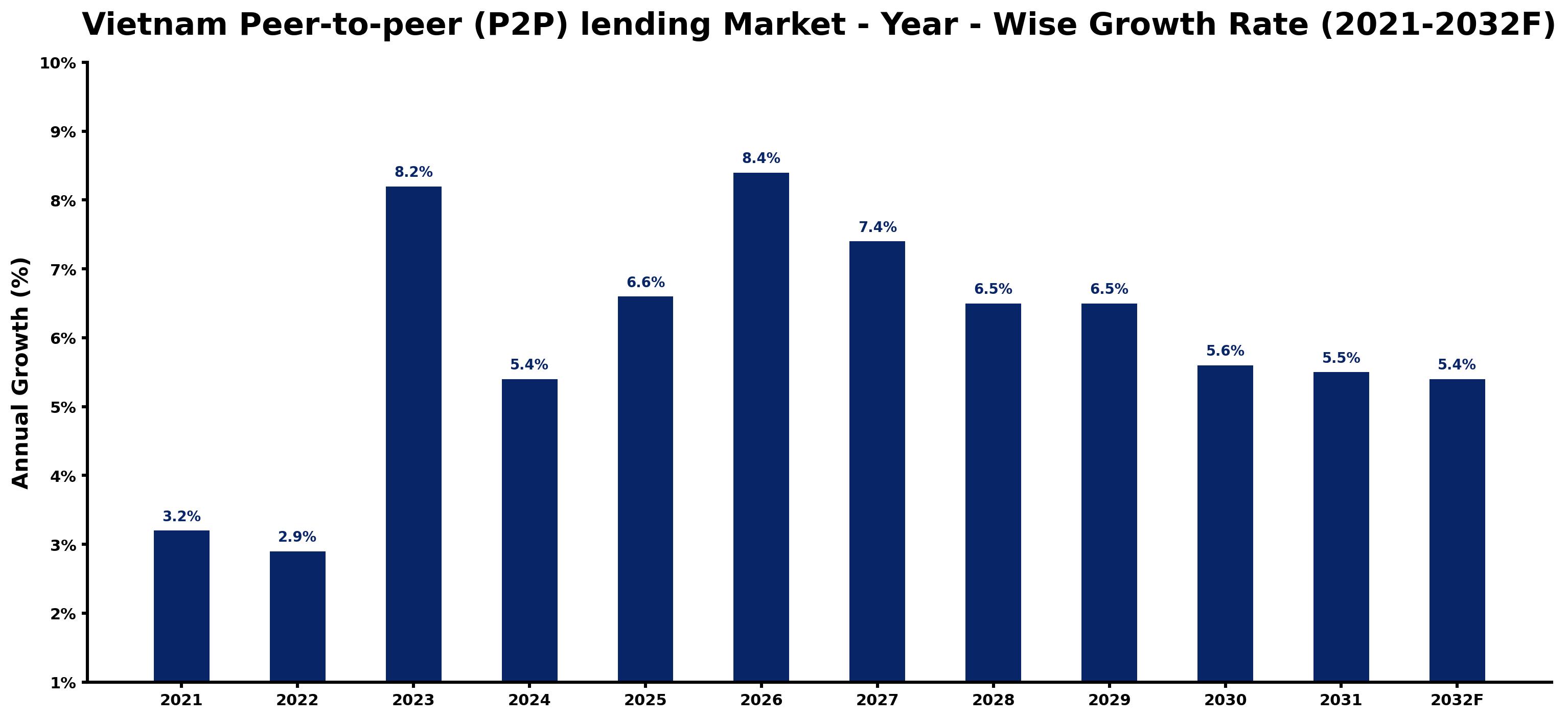
The table below presents the year‑wise growth rates along with the key drivers influencing the market
| Year | Growth Rate | Major Drivers |
| 2021 | 3.2% | Increasing industrial infrastructure investments |
| 2022 | 2.9% | Increasing industrial automation investments |
| 2023 | 8.2% | Expansion of transportation and logistics networks |
| 2024 | 5.4% | Growing urbanization and commercial development |
| 2025 | 6.6% | Expansion of transportation and logistics networks |
| 2026 | 8.4% | Growing renewable energy integration projects |
| 2027 | 7.4% | Increasing industrial infrastructure investments |
| 2028 | 6.5% | Expansion of manufacturing activities |
| 2029 | 6.5% | Increasing smart city development projects |
| 2030 | 5.6% | Growing renewable energy integration projects |
| 2031 | 5.5% | Increasing industrial infrastructure investments |
| 2032 | 5.4% | Rising electricity demand across industries |
Note - Market size estimations and growth projections presented in this report are based on 6Wresearch's advanced forecasting approach, validated with industry datasets as of June 2026.
Vietnam Peer-to-peer (P2P) lending Market Synopsis
The most significant force shaping the Vietnam P2P lending market is the increasing demand for alternative financing solutions, which has been amplified by the country's rapid digital transformation. This shift not only streamlines the borrowing process but also attracts a growing base of both borrowers and investors seeking high-yield opportunities.
While the market showcases promising potential, it is tempered by regulatory complexities that influence the framework within which these platforms operate. Adapting to evolving regulations will be critical for P2P lenders as they work to ensure borrower creditworthiness and maintain investor confidence.
Vietnam Peer-to-peer (P2P) lending Market Key Takeaways
- The P2P lending market in Vietnam is rapidly growing, driven by digital innovation and demand for accessible financing.
- Regulatory challenges pose both risks and opportunities for market players, necessitating adaptive strategies.
- Financial inclusion is improving, leading to increased participation from both borrowers and investors.
- COVID-19 has accelerated the shift towards digital lending solutions, highlighting their value in times of economic uncertainty.
- Government initiatives are increasingly focused on promoting fintech solutions, further supporting market growth.
Evaluation of Restraints in Vietnam Peer-to-peer (P2P) lending Market
The Vietnam P2P lending market faces significant constraints primarily due to regulatory uncertainties and the complexities involved in accurately assessing borrower credit risk. As authorities establish new policies aimed at striking a balance between fostering innovation and protecting consumers and investors, P2P lending platforms must navigate these evolving regulations carefully. This need for compliance can slow down market entry and create hesitancy among potential investors. Moreover, maintaining robust credit risk assessment mechanisms is essential to mitigate default rates, which in turn influences the overall credibility and sustainability of the market.
Vietnam Peer-to-peer (P2P) lending Market Trends
Several trends are shaping the landscape of the Vietnam P2P lending market. The adoption of AI and machine learning for credit scoring is gaining traction, enabling platforms to enhance their risk assessment processes. Additionally, the growth of digital wallets and mobile payments is facilitating seamless transactions, thereby improving user experience. There is also a notable increase in educational initiatives aimed at enhancing financial literacy among potential borrowers, which could lead to a more informed and engaged clientele.
Vietnam Peer-to-peer (P2P) lending Market Opportunities
Opportunities for growth within the Vietnam P2P lending market lie in expanding offerings to underserved segments such as rural populations and micro-enterprises. Additionally, partnerships with fintech companies to integrate advanced technologies can further enhance platform capabilities. With rising interest from international investors looking for emerging market opportunities, there is potential for significant capital influx, which could catalyze growth and innovation within this space.
Government Initiatives in the Vietnam Peer-to-peer (P2P) lending Market
The Vietnamese government is increasingly focused on creating a favorable environment for fintech solutions, including P2P lending. Initiatives aim to enhance regulatory frameworks to ensure consumer protection while simultaneously promoting financial innovation. By supporting digital financial services through public investments and incentives, the government is laying the groundwork for a robust ecosystem that encourages participation from diverse stakeholders.
Future Insights of the Vietnam Peer-to-peer (P2P) lending Market
Looking ahead to 2026-2032, the Vietnam P2P lending market is poised for considerable growth, driven by continued digital transformation and financial inclusion efforts. The demand for alternative financing solutions will likely increase, particularly as more SMEs seek flexible funding options post-pandemic. Innovations in technology will enhance platforms' efficiency and borrower assessment methods, ensuring that the market adapts to evolving consumer needs and expectations. As regulatory frameworks solidify, investor confidence will improve, further fueling market expansion.
Vietnam Peer-to-peer (P2P) lending Market Latest Developments (May 2025 - June 2026)
Recent developments in the Vietnam P2P lending market highlight a strong focus on integrating advanced technologies and refining risk assessment methodologies. Platforms are investing in digital tools that enhance customer experience and streamline processes. Additionally, there has been a notable increase in collaborations between P2P lenders and financial institutions to broaden service offerings, further strengthening the market ecosystem.
Vietnam Peer-to-peer (P2P) lending Market - Key Attractiveness of the Report
- 10 Years of Market Numbers
- Historical Data Starting from 2022 to 2025
- Base Year: 2025
- Forecast Data until 2032
- Key Performance Indicators Impacting the Market
- Major Upcoming Developments and Projects
Key Highlights of the Report:
- Vietnam Peer-to-peer (P2P) lending Market Outlook
- Market Size of Vietnam Peer-to-peer (P2P) lending Market, 2025
- Forecast of Vietnam Peer-to-peer (P2P) lending Market, 2032
- Historical Data and Forecast of Vietnam Peer-to-peer (P2P) lending Revenues & Volume for the Period 2022-2032F
- Vietnam Peer-to-peer (P2P) lending Market Trend Evolution
- Vietnam Peer-to-peer (P2P) lending Market Drivers and Challenges
- Vietnam Peer-to-peer (P2P) lending Price Trends
- Vietnam Peer-to-peer (P2P) lending Porter's Five Forces
- Vietnam Peer-to-peer (P2P) lending Industry Life Cycle
- Historical Data and Forecast of Vietnam Peer-to-peer (P2P) lending Market Revenues & Volume By Business Model for the Period 2022-2032F
- Historical Data and Forecast of Vietnam Peer-to-peer (P2P) lending Market Revenues & Volume By Alternate Marketplace Lending for the Period 2022-2032F
- Historical Data and Forecast of Vietnam Peer-to-peer (P2P) lending Market Revenues & Volume By Traditional Lending for the Period 2022-2032F
- Historical Data and Forecast of Vietnam Peer-to-peer (P2P) lending Market Revenues & Volume By Type for the Period 2022-2032F
- Historical Data and Forecast of Vietnam Peer-to-peer (P2P) lending Market Revenues & Volume By Consumer Lending for the Period 2022-2032F
- Historical Data and Forecast of Vietnam Peer-to-peer (P2P) lending Market Revenues & Volume By Business Lending for the Period 2022-2032F
- Historical Data and Forecast of Vietnam Peer-to-peer (P2P) lending Market Revenues & Volume By End User for the Period 2022-2032F
- Historical Data and Forecast of Vietnam Peer-to-peer (P2P) lending Market Revenues & Volume By Consumer Credit Loans for the Period 2022-2032F
- Historical Data and Forecast of Vietnam Peer-to-peer (P2P) lending Market Revenues & Volume By Small Business Loans for the Period 2022-2032F
- Historical Data and Forecast of Vietnam Peer-to-peer (P2P) lending Market Revenues & Volume By Student Loans for the Period 2022-2032F
- Historical Data and Forecast of Vietnam Peer-to-peer (P2P) lending Market Revenues & Volume By Real Estate Loans for the Period 2022-2032F
- Vietnam Peer-to-peer (P2P) lending Import Export Trade Statistics
- Market Opportunity Assessment By Business Model
- Market Opportunity Assessment By Type
- Market Opportunity Assessment By End User
- Vietnam Peer-to-peer (P2P) lending Top Companies Market Share
- Vietnam Peer-to-peer (P2P) lending Competitive Benchmarking By Technical and Operational Parameters
- Vietnam Peer-to-peer (P2P) lending Company Profiles
- Vietnam Peer-to-peer (P2P) lending Key Strategic Recommendations






































