Vietnam Piping System And Piping Spools Market Size, Share & Growth Rate
The Vietnam Piping System And Piping Spools Market was estimated at USD 1295 Million in 2025 and is projected to reach USD 1846 Million by 2032, growing at a CAGR of 5.2% from 2026 to 2032. This growth trajectory is primarily driven by the surge in infrastructure projects and industrial expansions across Vietnam, particularly in the oil, gas, and water treatment sectors. Additionally, the demand for advanced piping solutions that adhere to stringent environmental standards further propels market expansion.
Vietnam Piping System And Piping Spools Market Year-wise Growth Rate and Key Drivers
This graph highlights how the Vietnam Piping System And Piping Spools Market has steadily grown over the years, supported by major growth factors.
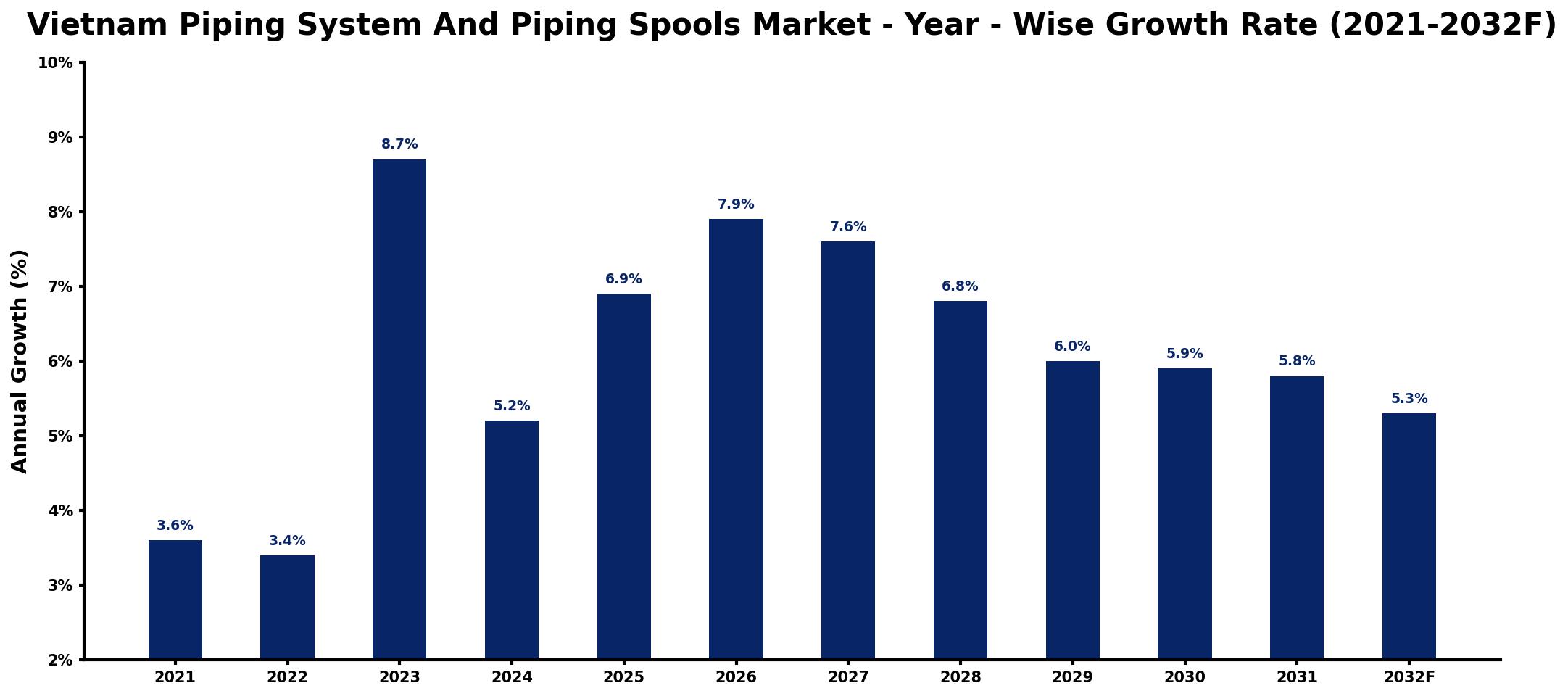
The table below presents the year‑wise growth rates along with the key drivers influencing the market
| Year | Growth Rate | Major Drivers |
| 2021 | 3.6% | Infrastructure investments in construction |
| 2022 | 3.4% | Rising demand from energy sector |
| 2023 | 8.7% | Expansion in manufacturing capacities |
| 2024 | 5.2% | Increased construction project launches |
| 2025 | 6.9% | Growing urbanization and development |
| 2026 | 7.9% | Enhanced industrial automation trends |
| 2027 | 7.6% | Technological advancements in production |
| 2028 | 6.8% | Strengthened regulations on safety |
| 2029 | 6.0% | Higher focus on sustainability initiatives |
| 2030 | 5.9% | Diversification of industrial applications |
| 2031 | 5.8% | Growing export opportunities globally |
| 2032 | 5.3% | Emerging market investment strategies |
Note: Market size estimations and growth projections presented in this report are based on 6Wresearch's proprietary forecasting methodology, utilizing the latest available industry data, government publications, and primary research inputs.
Vietnam Piping System And Piping Spools Market Synopsis
In recent years, Vietnam has seen a substantial increase in infrastructure development, which has directly impacted the piping system and piping spools market. This sector is integral to the construction of manufacturing facilities, utilities, and energy projects, providing essential components that ensure the efficiency and reliability of these systems.
The market is characterized by the introduction of technologically advanced piping solutions that cater to various industrial requirements. As projects in oil and gas, as well as wastewater treatment gain momentum, the need for durable and high-quality piping systems is becoming increasingly critical.
Vietnam Piping System And Piping Spools Market Key Takeaways
- The market is poised for substantial growth due to increased government investment in infrastructure and industrial projects.
- Technological advancements in piping systems are driving the demand for more efficient and sustainable solutions.
- Key challenges include maintaining quality assurance and effective project management to prevent costly delays.
- The impact of COVID-19 has highlighted the vulnerabilities in supply chains, affecting project timelines and material availability.
- Ongoing industrial expansion will continue to create opportunities for suppliers and manufacturers in the market.
Evaluation of Restraints in Vietnam Piping System And Piping Spools Market
Despite the optimistic growth outlook, the Vietnam piping system and piping spools market faces notable restraints. Quality assurance remains a significant concern, as defects in piping systems can result in costly operational failures. Additionally, project management efficiency is essential to align timelines and resources effectively. Delays stemming from these issues can deter investment and disrupt the supply chain. Ensuring stringent quality control standards and enhancing project management practices are critical for overcoming these barriers.
Vietnam Piping System And Piping Spools Market Trends
Emerging trends in the Vietnam piping system and piping spools market include a strong focus on sustainability and energy efficiency. With rising environmental concerns, the adoption of eco-friendly materials and energy-efficient technologies is becoming more prominent. Furthermore, the integration of smart technologies in piping systems is gaining traction, facilitating better monitoring and maintenance of infrastructure. As industries increasingly adopt these advanced solutions, manufacturers are compelled to innovate continuously.
Vietnam Piping System And Piping Spools Market Opportunities
Growth opportunities within the Vietnam piping system and piping spools market are abundant, particularly as government initiatives propel infrastructure upgrades. Investments in renewable energy projects and water treatment facilities are expected to create significant demand for advanced piping solutions. Additionally, ongoing industrialization within the country indicates a sustained need for high-quality piping systems in chemical processing and manufacturing sectors. These dynamics present an attractive landscape for investment and expansion in the market.
Government Initiatives in the Vietnam Piping System And Piping Spools Market
The Vietnamese government is prioritizing infrastructure development through various policies and public spending initiatives aimed at enhancing the countrys industrial capabilities. Programs designed to upgrade existing facilities and establish new energy and water projects are crucial for stimulating demand in the piping system market. Moreover, incentives for green technologies and sustainable practices further support the shift toward modernized piping solutions, creating a favorable regulatory environment for industry growth.
Future Insights of the Vietnam Piping System And Piping Spools Market
Looking ahead to 2026-2032, the Vietnam piping system and piping spools market is likely to experience robust growth driven by an escalating demand for infrastructure and industrial advancements. The focus on sustainability and technological innovations will shape future developments, with manufacturers adapting to stricter environmental regulations. Additionally, as supply chains stabilize post-pandemic, the industry is poised to leverage new opportunities in renewable energy and water management sectors, establishing a solid foundation for sustained market expansion.
Vietnam Piping System And Piping Spools Market Latest Developments (2025 - 2026)
Recent developments in the Vietnam piping system and piping spools market indicate a shift toward more sustainable practices and materials. Several industry stakeholders have begun collaborating on projects focused on enhancing efficiency and reducing environmental impact. Innovations in smart piping technology are also being explored, with an emphasis on real-time monitoring to optimize performance. These advancements reflect a growing commitment to modernizing the industry in response to both market demands and regulatory pressures.
Vietnam Piping System And Piping Spools Market - Key Attractiveness of the Report
- 10 Years of Market Numbers
- Historical Data Starting from 2022 to 2025
- Base Year: 2025
- Forecast Data until 2032
- Key Performance Indicators Impacting the Market
- Major Upcoming Developments and Projects
Key Highlights of the Report:
- Vietnam Piping System And Piping Spools Market Outlook
- Market Size of Vietnam Piping System And Piping Spools Market, 2025
- Forecast of Vietnam Piping System And Piping Spools Market, 2032
- Historical Data and Forecast of Vietnam Piping System And Piping Spools Revenues & Volume for the Period 2022-2032F
- Vietnam Piping System And Piping Spools Market Trend Evolution
- Vietnam Piping System And Piping Spools Market Drivers and Challenges
- Vietnam Piping System And Piping Spools Price Trends
- Vietnam Piping System And Piping Spools Porter's Five Forces
- Vietnam Piping System And Piping Spools Industry Life Cycle
- Historical Data and Forecast of Vietnam Piping System And Piping Spools Market Revenues & Volume By Material for the Period 2022-2032F
- Historical Data and Forecast of Vietnam Piping System And Piping Spools Market Revenues & Volume By Stainless steel for the Period 2022-2032F
- Historical Data and Forecast of Vietnam Piping System And Piping Spools Market Revenues & Volume By Carbon steel for the Period 2022-2032F
- Historical Data and Forecast of Vietnam Piping System And Piping Spools Market Revenues & Volume By Alloy steel for the Period 2022-2032F
- Historical Data and Forecast of Vietnam Piping System And Piping Spools Market Revenues & Volume By Others for the Period 2022-2032F
- Historical Data and Forecast of Vietnam Piping System And Piping Spools Market Revenues & Volume By End User for the Period 2022-2032F
- Historical Data and Forecast of Vietnam Piping System And Piping Spools Market Revenues & Volume By Power plant for the Period 2022-2032F
- Historical Data and Forecast of Vietnam Piping System And Piping Spools Market Revenues & Volume By Petroleum refineries for the Period 2022-2032F
- Historical Data and Forecast of Vietnam Piping System And Piping Spools Market Revenues & Volume By Offshore, shipbuilding, and marine for the Period 2022-2032F
- Historical Data and Forecast of Vietnam Piping System And Piping Spools Market Revenues & Volume By Chemical and fertilizers for the Period 2022-2032F
- Historical Data and Forecast of Vietnam Piping System And Piping Spools Market Revenues & Volume By Pharmaceuticals for the Period 2022-2032F
- Historical Data and Forecast of Vietnam Piping System And Piping Spools Market Revenues & Volume By Others for the Period 2022-2032F
- Vietnam Piping System And Piping Spools Import Export Trade Statistics
- Market Opportunity Assessment By Material
- Market Opportunity Assessment By End User
- Vietnam Piping System And Piping Spools Top Companies Market Share
- Vietnam Piping System And Piping Spools Competitive Benchmarking By Technical and Operational Parameters
- Vietnam Piping System And Piping Spools Company Profiles
- Vietnam Piping System And Piping Spools Key Strategic Recommendations






































