Vietnam Planes, Helicopters, and Spacecraft Market Size, Share & Growth Rate
The Vietnam Planes, Helicopters, and Spacecraft Market was estimated at USD 221 Million in 2025 and is projected to reach USD 312 Million by 2032, growing at a CAGR of 5.0% from 2026 to 2032. This growth trajectory is largely fueled by the increasing demand for both military and civilian aircraft as Vietnam continues to expand its defense capabilities and enhance its transportation infrastructure. Additionally, the rising interest in satellite technology and space exploration signifies a burgeoning segment within the market, promising further investment and development.
Vietnam Planes, Helicopters, and Spacecraft Market Year-wise Growth Rate and Key Drivers
This graph highlights how the Vietnam Planes, Helicopters, and Spacecraft Market has steadily grown over the years, supported by major growth factors.
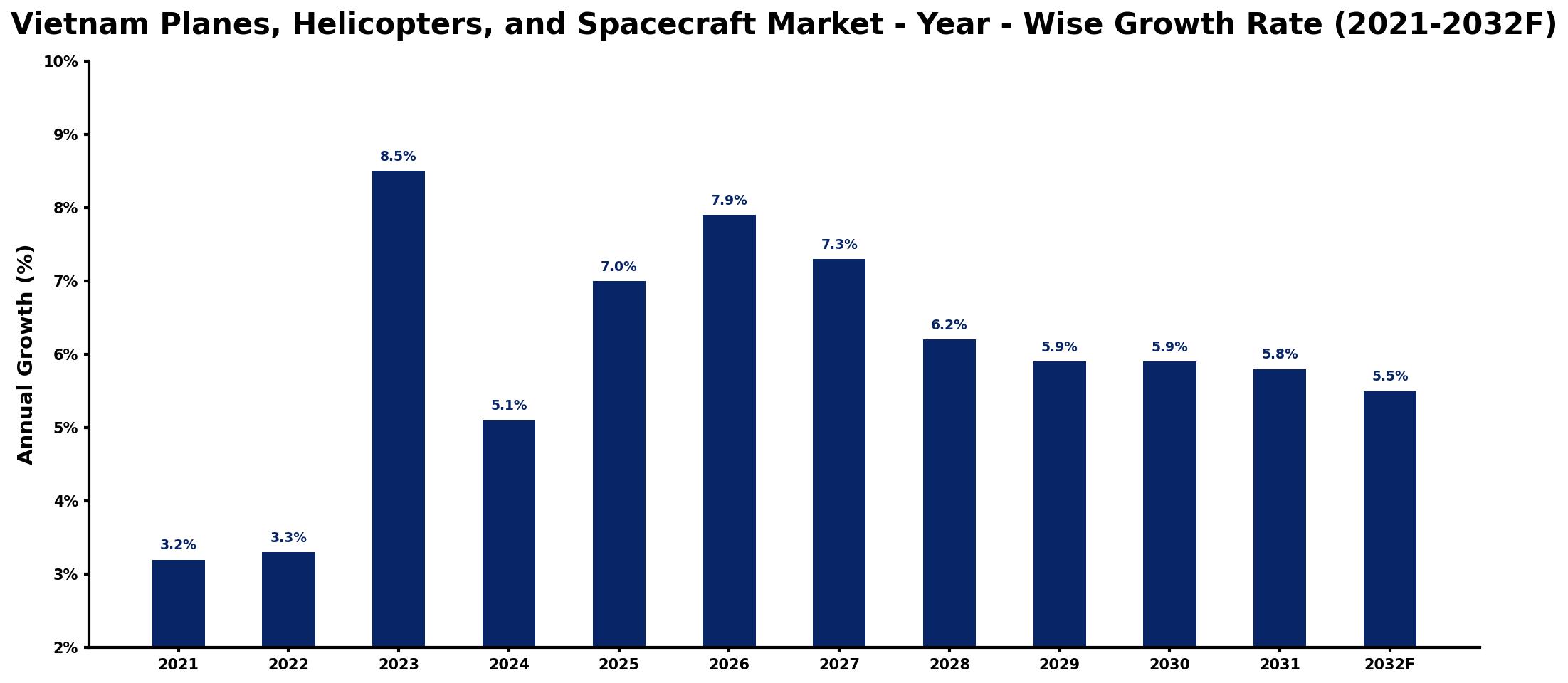
The table below presents the year‑wise growth rates along with the key drivers influencing the market
| Year | Growth Rate | Major Drivers |
| 2021 | 3.2% | improved raw material availability |
| 2022 | 3.3% | growing aviation industry investments |
| 2023 | 8.5% | expansion of logistics infrastructure |
| 2024 | 5.1% | rising demand for air travel |
| 2025 | 7.0% | enhanced regional security initiatives |
| 2026 | 7.9% | development of new technologies |
| 2027 | 7.3% | growing commercial sector adoption |
| 2028 | 6.2% | improved training and education programs |
| 2029 | 5.9% | increased private sector involvement |
| 2030 | 5.9% | growing demand for tourism services |
| 2031 | 5.8% | increased capital investment inflows |
| 2032 | 5.5% | investments in research and development |
Note: Market size estimations and growth projections presented in this report are based on 6Wresearch's proprietary forecasting methodology, utilizing the latest available industry data, government publications, and primary research inputs.
Vietnam Planes, Helicopters, and Spacecraft Market Synopsis
As Vietnam seeks to modernize its aerospace sector, there is a notable uptick in the procurement of aircraft for commercial use, driven by an expanding middle class and a growing tourism sector. Coupled with government initiatives aimed at enhancing national security, demand for military helicopters and planes is also increasing, highlighting the dual-purpose nature of the market.
Moreover, Vietnam's interest in space technology is beginning to take shape with initiatives focused on satellite development, thereby creating a nascent market for spacecraft. Collaboration with international aerospace firms is key, enabling the country to leverage global expertise and resources, thus fostering local capabilities.
Vietnam Planes, Helicopters, and Spacecraft Market Key Takeaways
- The market is projected to grow significantly, driven by both military and civilian needs.
- Infrastructure development and increased air travel are critical demand drivers.
- Collaboration with international firms is essential for advancing domestic aerospace capabilities.
- Space technology initiatives indicate a promising avenue for market expansion.
- Government investments are vital for overcoming current market challenges.
Evaluation of Restraints in Vietnam Planes, Helicopters, and Spacecraft Market
Despite the positive growth outlook, the Vietnam Planes, Helicopters, and Spacecraft Market faces several constraints that impede rapid advancement. High acquisition costs for aircraft and limited airport infrastructure present significant barriers to market entry and expansion. Additionally, stringent regulatory frameworks can deter foreign investment, which is crucial for developing local production capacities. These hurdles require strategic government initiatives and private sector partnerships to effectively navigate and enhance market dynamics.
Vietnam Planes, Helicopters, and Spacecraft Market Trends
Emerging trends in the Vietnam aerospace market indicate a shift towards more advanced technologies, including the adoption of eco-friendly aircraft and the integration of smart systems in aviation operations. Furthermore, there is a growing emphasis on enhancing satellite capabilities, driven by both national defense needs and the quest for technological independence. This trend aligns with global movements toward sustainable aerospace solutions and highlights Vietnam's commitment to participating in the global aerospace landscape.
Vietnam Planes, Helicopters, and Spacecraft Market Opportunities
Significant growth opportunities exist in the Vietnam aerospace sector, particularly in the realms of military defense and commercial aviation. The increasing demand for helicopters in both search-and-rescue operations and tourism presents unique investment avenues. Furthermore, as Vietnam embarks on space initiatives, partnerships with international space agencies could catalyze advancements in satellite technology and research. Leveraging these opportunities can position local firms competitively in a rapidly evolving market.
Government Initiatives in the Vietnam Planes, Helicopters, and Spacecraft Market
The Vietnamese government is actively investing in the development of its aerospace capabilities through various policies and initiatives. By increasing public spending on defense and infrastructure, the government aims to enhance national security and support the growth of commercial air transport. Additionally, initiatives promoting research and development in aerospace technology seek to foster local expertise and innovation, creating a conducive environment for both domestic and foreign investments.
Future Insights of the Vietnam Planes, Helicopters, and Spacecraft Market
Looking ahead to 2026-2032, the Vietnam Planes, Helicopters, and Spacecraft Market is poised for robust growth, driven by ongoing economic development and strategic government initiatives. The integration of advanced technologies in aviation and a concerted push towards self-reliance in space capabilities will further shape the market landscape. As Vietnam continues to strengthen its position in the global aerospace arena, it can expect increasing collaborations, enhanced infrastructure, and a burgeoning domestic market for both commercial and military applications.
Vietnam Planes, Helicopters, and Spacecraft Market Latest Developments (2025 - 2026)
Recent developments in the Vietnam aerospace market indicate a focus on expanding partnerships with international aerospace firms. Initiatives to enhance local manufacturing capabilities are underway, with an eye on both military and commercial sectors. Concurrently, the government is prioritizing the modernization of airport infrastructure to accommodate the anticipated increase in air traffic, while also emphasizing the importance of sustainable aviation practices in future investments.
Vietnam Planes, Helicopters, and Spacecraft Market - Key Attractiveness of the Report
- 10 Years of Market Numbers
- Historical Data Starting from 2022 to 2025
- Base Year: 2025
- Forecast Data until 2032
- Key Performance Indicators Impacting the Market
- Major Upcoming Developments and Projects
Key Highlights of the Report:
- Vietnam Planes, Helicopters, and Spacecraft Market Outlook
- Market Size of Vietnam Planes, Helicopters, and Spacecraft Market, 2025
- Forecast of Vietnam Planes, Helicopters, and Spacecraft Market, 2032
- Historical Data and Forecast of Vietnam Planes, Helicopters, and Spacecraft Revenues & Volume for the Period 2022-2032F
- Vietnam Planes, Helicopters, and Spacecraft Market Trend Evolution
- Vietnam Planes, Helicopters, and Spacecraft Market Drivers and Challenges
- Vietnam Planes, Helicopters, and Spacecraft Price Trends
- Vietnam Planes, Helicopters, and Spacecraft Porter's Five Forces
- Vietnam Planes, Helicopters, and Spacecraft Industry Life Cycle
- Historical Data and Forecast of Vietnam Planes, Helicopters, and Spacecraft Market Revenues & Volume By End User for the Period 2022-2032F
- Historical Data and Forecast of Vietnam Planes, Helicopters, and Spacecraft Market Revenues & Volume By Aviation for the Period 2022-2032F
- Historical Data and Forecast of Vietnam Planes, Helicopters, and Spacecraft Market Revenues & Volume By Military for the Period 2022-2032F
- Historical Data and Forecast of Vietnam Planes, Helicopters, and Spacecraft Market Revenues & Volume By Private for the Period 2022-2032F
- Historical Data and Forecast of Vietnam Planes, Helicopters, and Spacecraft Market Revenues & Volume By Others for the Period 2022-2032F
- Vietnam Planes, Helicopters, and Spacecraft Import Export Trade Statistics
- Market Opportunity Assessment By End User
- Vietnam Planes, Helicopters, and Spacecraft Top Companies Market Share
- Vietnam Planes, Helicopters, and Spacecraft Competitive Benchmarking By Technical and Operational Parameters
- Vietnam Planes, Helicopters, and Spacecraft Company Profiles
- Vietnam Planes, Helicopters, and Spacecraft Key Strategic Recommendations






































