Vietnam Plant-based Meat Market Size, Share & Growth Rate
The Vietnam Plant-based Meat Market was estimated at USD 1167 Million in 2025 and is projected to reach USD 1660 Million by 2032, growing at a CAGR of 5.2% from 2026 to 2032. This growth is fueled by a shift in dietary preferences driven by health and environmental concerns, as well as an increasing availability of diverse plant-based options that cater to local tastes. As awareness about the benefits of plant-based diets grows, so does the demand for innovative and accessible meat alternatives in Vietnamese households and restaurants.
Vietnam Plant-based Meat Market Year-wise Growth Rate and Key Drivers
This graph highlights how the Vietnam Plant-based Meat Market has steadily grown over the years, supported by major growth factors.
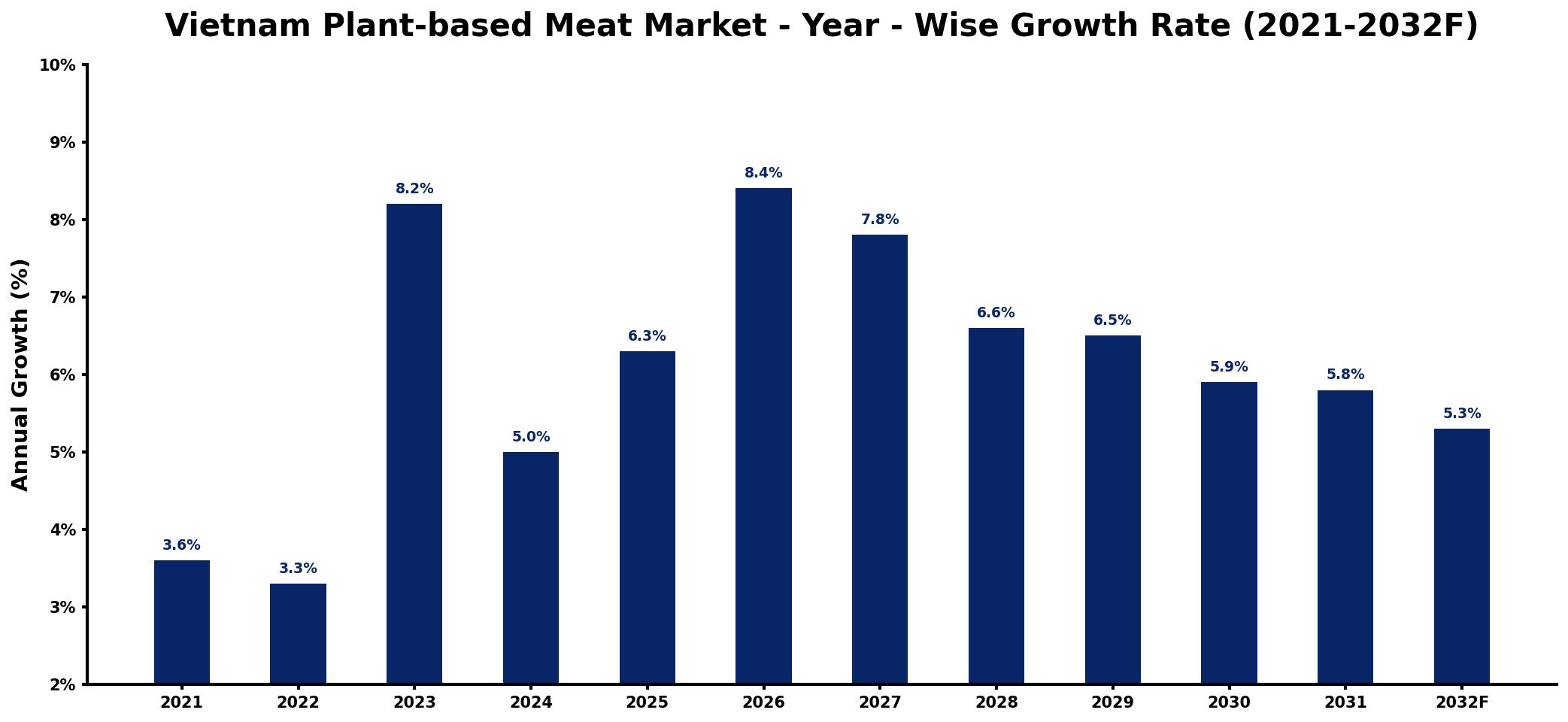
The table below presents the year‑wise growth rates along with the key drivers influencing the market
| Year | Growth Rate | Major Drivers |
| 2021 | 3.6% | Rising health consciousness among consumers |
| 2022 | 3.3% | Increased availability of alternatives |
| 2023 | 8.2% | Growing environmental awareness initiatives |
| 2024 | 5.0% | Expansion of retail distribution channels |
| 2025 | 6.3% | Innovations in food technology development |
| 2026 | 8.4% | Surge in consumer lifestyle changes |
| 2027 | 7.8% | Enhanced marketing strategies adopted |
| 2028 | 6.6% | Collaboration with foodservice providers |
| 2029 | 6.5% | Investment in sustainable sourcing practices |
| 2030 | 5.9% | Emergence of new consumer segments |
| 2031 | 5.8% | Strengthened regulatory support frameworks |
| 2032 | 5.3% | Wider acceptance of dietary shifts |
Note: Market size estimations and growth projections presented in this report are based on 6Wresearch's proprietary forecasting methodology, utilizing the latest available industry data, government publications, and primary research inputs.
Vietnam Plant-based Meat Market Synopsis
The most influential force in the Vietnam plant-based meat market is the rising consciousness surrounding health and sustainability. As consumers become more informed about the implications of their food choices, plant-based products are perceived as healthier and more environmentally friendly alternatives to traditional meat.
Additionally, the entrance of both local and international brands has significantly enriched the product landscape, offering consumers a variety of choices that meet diverse culinary preferences. This expansion is complemented by increasing retail availability and the growing presence of plant-based options on restaurant menus.
Vietnam Plant-based Meat Market Key Takeaways
- The market is expected to see a robust annual growth driven by shifting consumer attitudes toward health and sustainability.
- Innovative product offerings are essential to capturing the diverse palates of Vietnamese consumers.
- Distribution channels are evolving, with more plant-based options becoming available in grocery stores and eateries across Vietnam.
- Health-conscious consumers are looking for alternatives that not only replace meat but also enhance nutritional value.
- The market is witnessing increasing competition from both established meat producers and emerging plant-based brands.
Evaluation of Restraints in Vietnam Plant-based Meat Market
Despite its promising trajectory, the Vietnam plant-based meat market faces genuine challenges. A significant number of consumers hold a deep-seated preference for traditional meat, which poses a substantial barrier to adoption. Moreover, convincing consumers of the sensory attributes—taste and texture—of plant-based products remains a daunting task. The presence of established meat producers, combined with fluctuating supply chains for essential ingredients like soy and pea protein, complicates the market landscape further. Compliance with regulatory requirements and effective marketing strategies also play pivotal roles in shaping consumer perceptions and acceptance.
Vietnam Plant-based Meat Market Trends
Emerging trends in the Vietnam plant-based meat market include a marked increase in the diversification of products available, such as traditional dishes reimagined with plant-based ingredients. There's also a rise in collaborations between food tech companies and culinary experts to develop flavors that resonate with local tastes. Furthermore, educational initiatives aimed at raising awareness about the benefits of plant-based diets are becoming more prevalent, fostering a culture of health and sustainability among consumers.
Vietnam Plant-based Meat Market Opportunities
The Vietnam plant-based meat market presents considerable investment opportunities for businesses willing to innovate and cater to local tastes. Key avenues include the development of localized flavors and products that reflect traditional Vietnamese cuisine. Additionally, expanding distribution networks—particularly in rural and suburban areas—can capture untapped consumer segments. The rising interest in health and wellness opens pathways for new product lines that emphasize nutritional benefits alongside taste.
Government Initiatives in the Vietnam Plant-based Meat Market
Government initiatives aimed at promoting sustainable agriculture and healthy eating habits provide a supportive backdrop for the plant-based meat market. Policies advocating for reduced meat consumption and environmental sustainability contribute to a more favorable environment for plant-based products. Various public programs focused on food innovation and nutritional education further enhance the potential for growth in this sector.
Future Insights of the Vietnam Plant-based Meat Market
Looking ahead to 2026-2032, the Vietnam plant-based meat market is expected to evolve significantly, driven by continuous consumer education and product innovation. With an increasing number of options available, there will likely be a shift in consumer perception, making plant-based diets more mainstream. Collaborations within the food industry will likely lead to enhanced products that mirror traditional flavors, thereby appealing to a broader audience. Overall, the market is set to flourish as the alignment of health, sustainability, and culinary tradition creates fertile ground for growth.
Vietnam Plant-based Meat Market Latest Developments (2025 - 2026)
Recent developments in the market indicate an uptick in new product launches, with several companies debuting innovative plant-based alternatives that cater to local tastes. Additionally, there is a growing emphasis on partnerships between food manufacturers and health organizations to promote plant-based diets as a means to improve public health. Distribution strategies are also evolving, with online platforms gaining traction as consumers seek convenience alongside quality.
Vietnam Plant-based Meat Market - Key Attractiveness of the Report
- 10 Years of Market Numbers
- Historical Data Starting from 2022 to 2025
- Base Year: 2025
- Forecast Data until 2032
- Key Performance Indicators Impacting the Market
- Major Upcoming Developments and Projects
Key Highlights of the Report:
- Vietnam Plant-based Meat Market Outlook
- Market Size of Vietnam Plant-based Meat Market, 2025
- Forecast of Vietnam Plant-based Meat Market, 2032
- Historical Data and Forecast of Vietnam Plant-based Meat Revenues & Volume for the Period 2022-2032F
- Vietnam Plant-based Meat Market Trend Evolution
- Vietnam Plant-based Meat Market Drivers and Challenges
- Vietnam Plant-based Meat Price Trends
- Vietnam Plant-based Meat Porter's Five Forces
- Vietnam Plant-based Meat Industry Life Cycle
- Historical Data and Forecast of Vietnam Plant-based Meat Market Revenues & Volume By Source for the Period 2022-2032F
- Historical Data and Forecast of Vietnam Plant-based Meat Market Revenues & Volume By Soy for the Period 2022-2032F
- Historical Data and Forecast of Vietnam Plant-based Meat Market Revenues & Volume By Pea for the Period 2022-2032F
- Historical Data and Forecast of Vietnam Plant-based Meat Market Revenues & Volume By Wheat for the Period 2022-2032F
- Historical Data and Forecast of Vietnam Plant-based Meat Market Revenues & Volume By Others for the Period 2022-2032F
- Historical Data and Forecast of Vietnam Plant-based Meat Market Revenues & Volume By Product for the Period 2022-2032F
- Historical Data and Forecast of Vietnam Plant-based Meat Market Revenues & Volume By Burgers for the Period 2022-2032F
- Historical Data and Forecast of Vietnam Plant-based Meat Market Revenues & Volume By Sausages for the Period 2022-2032F
- Historical Data and Forecast of Vietnam Plant-based Meat Market Revenues & Volume By Patties for the Period 2022-2032F
- Historical Data and Forecast of Vietnam Plant-based Meat Market Revenues & Volume By Nuggets, for the Period 2022-2032F
- Historical Data and Forecast of Vietnam Plant-based Meat Market Revenues & Volume By Tenders & Cutlets for the Period 2022-2032F
- Historical Data and Forecast of Vietnam Plant-based Meat Market Revenues & Volume By Grounds for the Period 2022-2032F
- Historical Data and Forecast of Vietnam Plant-based Meat Market Revenues & Volume By Others for the Period 2022-2032F
- Historical Data and Forecast of Vietnam Plant-based Meat Market Revenues & Volume By Type for the Period 2022-2032F
- Historical Data and Forecast of Vietnam Plant-based Meat Market Revenues & Volume By Chicken for the Period 2022-2032F
- Historical Data and Forecast of Vietnam Plant-based Meat Market Revenues & Volume By Pork for the Period 2022-2032F
- Historical Data and Forecast of Vietnam Plant-based Meat Market Revenues & Volume By Beef for the Period 2022-2032F
- Historical Data and Forecast of Vietnam Plant-based Meat Market Revenues & Volume By Fish for the Period 2022-2032F
- Historical Data and Forecast of Vietnam Plant-based Meat Market Revenues & Volume By Others for the Period 2022-2032F
- Historical Data and Forecast of Vietnam Plant-based Meat Market Revenues & Volume By End-user for the Period 2022-2032F
- Historical Data and Forecast of Vietnam Plant-based Meat Market Revenues & Volume By Retail for the Period 2022-2032F
- Historical Data and Forecast of Vietnam Plant-based Meat Market Revenues & Volume By HORECA (Hotel/Restaurant/Caf) for the Period 2022-2032F
- Historical Data and Forecast of Vietnam Plant-based Meat Market Revenues & Volume By Storage for the Period 2022-2032F
- Historical Data and Forecast of Vietnam Plant-based Meat Market Revenues & Volume By Refrigerated Plant-based Meat for the Period 2022-2032F
- Historical Data and Forecast of Vietnam Plant-based Meat Market Revenues & Volume By Frozen Plant-based Meat for the Period 2022-2032F
- Historical Data and Forecast of Vietnam Plant-based Meat Market Revenues & Volume By Shelf-stable Plant-based Meat for the Period 2022-2032F
- Vietnam Plant-based Meat Import Export Trade Statistics
- Market Opportunity Assessment By Source
- Market Opportunity Assessment By Product
- Market Opportunity Assessment By Type
- Market Opportunity Assessment By End-user
- Market Opportunity Assessment By Storage
- Vietnam Plant-based Meat Top Companies Market Share
- Vietnam Plant-based Meat Competitive Benchmarking By Technical and Operational Parameters
- Vietnam Plant-based Meat Company Profiles
- Vietnam Plant-based Meat Key Strategic Recommendations






































