Vietnam Planting Equipment Market Size, Share & Growth Rate
The Vietnam Planting Equipment Market was estimated at USD 1088 Million in 2025 and is projected to reach USD 1549 Million by 2032, growing at a CAGR of 5.2% from 2026 to 2032. This growth is primarily driven by the increasing mechanization in agriculture, which is vital for enhancing productivity amid a rapidly growing population. Additionally, the government's initiatives toward modernizing agricultural practices are significantly influencing the adoption of advanced planting technologies across various farm sizes.
Vietnam Planting Equipment Market Year-wise Growth Rate and Key Drivers
This graph highlights how the Vietnam Planting Equipment Market has steadily grown over the years, supported by major growth factors.
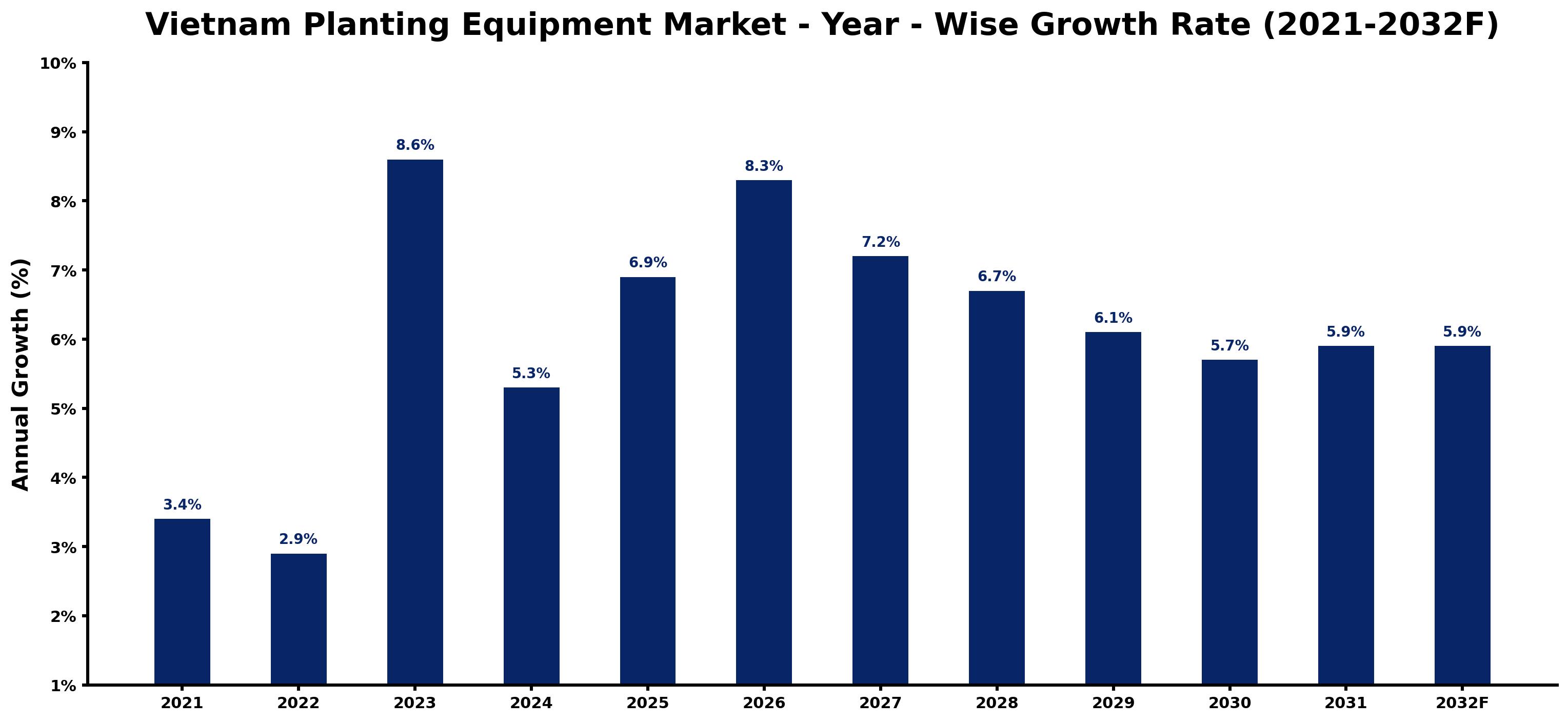
The table below presents the year‑wise growth rates along with the key drivers influencing the market
| Year | Growth Rate | Major Drivers |
| 2021 | 3.4% | Expansion of manufacturing activities |
| 2022 | 2.9% | Growing renewable energy integration projects |
| 2023 | 8.6% | Increasing industrial automation investments |
| 2024 | 5.3% | Rapid growth in telecom and data center sectors |
| 2025 | 6.9% | Expansion of commercial construction activities |
| 2026 | 8.3% | Increasing industrial infrastructure investments |
| 2027 | 7.2% | Expansion of transportation and logistics networks |
| 2028 | 6.7% | Government infrastructure modernization initiatives |
| 2029 | 6.1% | Rising electricity demand across industries |
| 2030 | 5.7% | Expansion of manufacturing activities |
| 2031 | 5.9% | Expansion of commercial construction activities |
| 2032 | 5.9% | Increasing smart city development projects |
Note - Market size estimations and growth projections presented in this report are based on 6Wresearch’s advanced forecasting approach, validated with industry datasets as of June 2026.
Vietnam Planting Equipment Market Synopsis
The strongest force currently shaping the Vietnam Planting Equipment Market is the government's commitment to agricultural modernization. With significant investments aimed at improving crop yields and sustainability, the market is witnessing a surge in demand for efficient planting machinery. This momentum is largely fueled by technological advancements that offer innovative solutions tailored to local agricultural needs.
Furthermore, the growing inclination towards precision farming and sustainable practices is encouraging farmers to invest in advanced planting equipment. This shift is not only enhancing operational efficiency but is also ensuring better resource management, thereby laying the groundwork for a more robust agricultural sector in Vietnam.
Vietnam Planting Equipment Market Key Takeaways
- The market is experiencing robust growth driven by increasing mechanization and government support.
- Technological advancements are pivotal in transforming traditional farming into more efficient practices.
- Small-scale farmers face challenges in accessing modern planting equipment due to financial constraints.
- Training and technical support are essential for maximizing the benefits of new planting technologies.
- The demand for planting equipment customized for various crop types is on the rise, reflecting diverse agricultural needs.
Evaluation of Restraints in Vietnam Planting Equipment Market
Despite its growth potential, the Vietnam Planting Equipment Market faces significant challenges, particularly for small-scale farmers. Financial constraints hinder their ability to invest in modern machinery, which can drastically improve efficiency. Without affordable and accessible solutions, the gap between larger enterprises and smallholders may widen. Additionally, the necessity for technical training to properly utilize these advanced tools underscores a critical barrier; without sufficient support and resources, the adoption of modern practices remains inconsistent.
Vietnam Planting Equipment Market Trends
Several trends are shaping the Vietnam Planting Equipment Market, with sustainability and precision farming emerging at the forefront. As farmers increasingly prioritize eco-friendly practices, the demand for equipment that minimizes resource wastage is on the rise. Moreover, the incorporation of smart technologies, such as IoT and automation, is revolutionizing planting operations, allowing for better yield predictions and resource management. These trends indicate a shift towards data-driven farming, which is likely to shape future investment and innovation in the sector.
Vietnam Planting Equipment Market Opportunities
The market presents genuine growth opportunities, particularly in developing affordable planting equipment for smallholder farmers. Companies focusing on providing tailored solutions that address the unique challenges faced by this demographic can capture significant market share. Additionally, the potential for partnerships with local governments and NGOs to facilitate training programs creates avenues for enhancing the overall agricultural landscape. Embracing digital solutions and smart farming technologies will also offer compelling investment opportunities as the sector evolves.
Government Initiatives in the Vietnam Planting Equipment Market
The Vietnamese government has implemented various initiatives to bolster the agricultural sector, including the promotion of modern farming techniques. Public spending is directed towards infrastructure improvements, research and development in agriculture, and providing subsidies for adopting advanced agricultural technologies. Programs aimed at educating farmers about the benefits of mechanization and precision farming are crucial in fostering an environment conducive to growth in the planting equipment market.
Future Insights of the Vietnam Planting Equipment Market
Looking ahead to 2026-2032, the Vietnam Planting Equipment Market is poised for substantial growth, driven by continuous advancements in agricultural technology and rising demand for food security. As the government reinforces its commitment to modernizing agriculture, we can expect more innovative solutions to emerge. The integration of artificial intelligence and data analytics in farming practices will further propel market growth, ensuring that Vietnamese agriculture remains competitive on a global scale.
Vietnam Planting Equipment Market Latest Developments (May 2025 - June 2026)
Recent developments in the Vietnam Planting Equipment Market reflect a strong shift towards digital farming solutions and greater collaboration between stakeholders. Innovations in planting technology are being explored, with pilot programs aimed at integrating smart systems into existing agricultural frameworks. These advancements are not only enhancing operational efficiencies but are also contributing to the overall sustainability of the agricultural sector.
Vietnam Planting Equipment Market - Key Attractiveness of the Report
- 10 Years of Market Numbers
- Historical Data Starting from 2022 to 2025
- Base Year: 2025
- Forecast Data until 2032
- Key Performance Indicators Impacting the Market
- Major Upcoming Developments and Projects
Key Highlights of the Report:
- Vietnam Planting Equipment Market Outlook
- Market Size of Vietnam Planting Equipment Market, 2025
- Forecast of Vietnam Planting Equipment Market, 2032
- Historical Data and Forecast of Vietnam Planting Equipment Revenues & Volume for the Period 2022-2032F
- Vietnam Planting Equipment Market Trend Evolution
- Vietnam Planting Equipment Market Drivers and Challenges
- Vietnam Planting Equipment Price Trends
- Vietnam Planting Equipment Porter's Five Forces
- Vietnam Planting Equipment Industry Life Cycle
- Historical Data and Forecast of Vietnam Planting Equipment Market Revenues & Volume By Type for the Period 2022-2032F
- Historical Data and Forecast of Vietnam Planting Equipment Market Revenues & Volume By Air seeders for the Period 2022-2032F
- Historical Data and Forecast of Vietnam Planting Equipment Market Revenues & Volume By Seed drills for the Period 2022-2032F
- Historical Data and Forecast of Vietnam Planting Equipment Market Revenues & Volume By Planters for the Period 2022-2032F
- Historical Data and Forecast of Vietnam Planting Equipment Market Revenues & Volume By Others for the Period 2022-2032F
- Historical Data and Forecast of Vietnam Planting Equipment Market Revenues & Volume By Design for the Period 2022-2032F
- Historical Data and Forecast of Vietnam Planting Equipment Market Revenues & Volume By Mechanical for the Period 2022-2032F
- Historical Data and Forecast of Vietnam Planting Equipment Market Revenues & Volume By Automatic for the Period 2022-2032F
- Historical Data and Forecast of Vietnam Planting Equipment Market Revenues & Volume By Crop Type for the Period 2022-2032F
- Historical Data and Forecast of Vietnam Planting Equipment Market Revenues & Volume By Cereals & grains for the Period 2022-2032F
- Historical Data and Forecast of Vietnam Planting Equipment Market Revenues & Volume By Oilseeds & pulses for the Period 2022-2032F
- Historical Data and Forecast of Vietnam Planting Equipment Market Revenues & Volume By Fruits & vegetables for the Period 2022-2032F
- Historical Data and Forecast of Vietnam Planting Equipment Market Revenues & Volume By Others for the Period 2022-2032F
- Vietnam Planting Equipment Import Export Trade Statistics
- Market Opportunity Assessment By Type
- Market Opportunity Assessment By Design
- Market Opportunity Assessment By Crop Type
- Vietnam Planting Equipment Top Companies Market Share
- Vietnam Planting Equipment Competitive Benchmarking By Technical and Operational Parameters
- Vietnam Planting Equipment Company Profiles
- Vietnam Planting Equipment Key Strategic Recommendations






































