Vietnam Plastic Processing Equipment Market Size, Share & Growth Rate
The Vietnam Plastic Processing Equipment Market was estimated at USD 1239 Million in 2025 and is projected to reach USD 1762 Million by 2032, growing at a CAGR of 5.2% from 2026 to 2032. This growth is primarily fueled by the rapid expansion of the domestic plastic manufacturing sector, driven by increasing applications of plastic across various industries such as automotive, packaging, and consumer goods. Manufacturers are also investing in advanced processing technologies and automation to meet the growing demand for efficiency and productivity in production.
Vietnam Plastic Processing Equipment Market Year-wise Growth Rate and Key Drivers
This graph highlights how the Vietnam Plastic Processing Equipment Market has steadily grown over the years, supported by major growth factors.
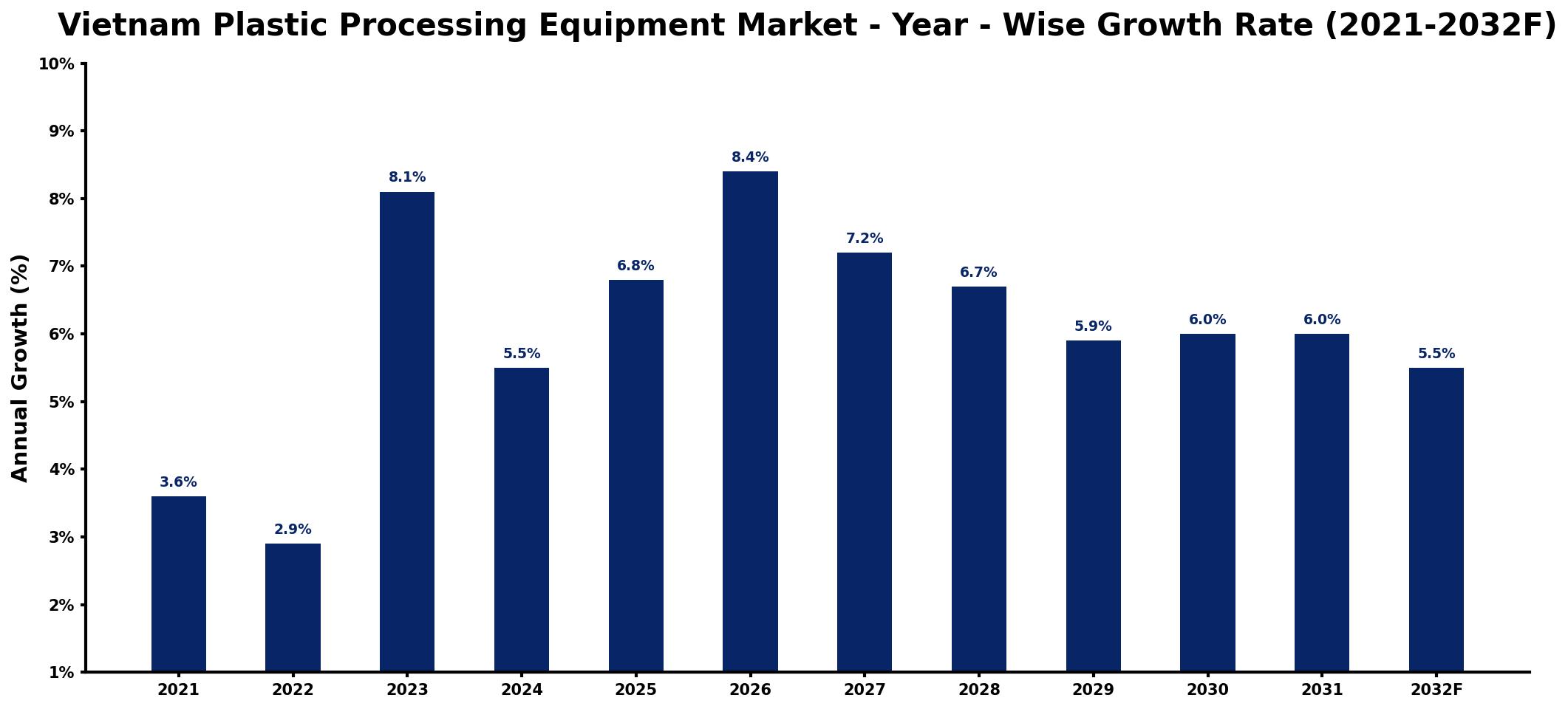
The table below presents the year‑wise growth rates along with the key drivers influencing the market
| Year | Growth Rate | Major Drivers |
| 2021 | 3.6% | Rising demand in packaging sector |
| 2022 | 2.9% | Increased investment in manufacturing |
| 2023 | 8.1% | Growth in consumer goods industry |
| 2024 | 5.5% | Expansion of construction activities |
| 2025 | 6.8% | Surge in automotive production rates |
| 2026 | 8.4% | Boost in electronics manufacturing sector |
| 2027 | 7.2% | Increase in export opportunities |
| 2028 | 6.7% | rising infrastructure development spending |
| 2029 | 5.9% | strengthening underlying market demand |
| 2030 | 6.0% | increased production capacity utilization |
| 2031 | 6.0% | enhanced product quality standards |
| 2032 | 5.5% | increased capital investment inflows |
Note: Market size estimations and growth projections presented in this report are based on 6Wresearch's proprietary forecasting methodology, utilizing the latest available industry data, government publications, and primary research inputs.
Vietnam Plastic Processing Equipment Market Synopsis
The Vietnam Plastic Processing Equipment Market is a dynamic segment that is integral to the nation's broader manufacturing landscape. With a surge in demand for diverse plastic products, the need for advanced processing machinery has become imperative for manufacturers looking to enhance output and quality.
Technological innovation is at the forefront of this market's evolution. As players seek to improve efficiency and reduce costs, the integration of automation and smart technologies into plastic processing equipment is increasingly prevalent. This shift not only boosts productivity but also aligns with global trends toward sustainable manufacturing practices.
Vietnam Plastic Processing Equipment Market Key Takeaways
- The market is expected to grow steadily, reflecting the increasing adoption of plastic in various industries.
- Technological advancements, particularly in automation and processing efficiency, are key drivers of market growth.
- Government initiatives to bolster the manufacturing sector support demand for processing equipment.
- Investment in innovative and reliable equipment is essential to meet evolving industry standards.
- Emerging sectors such as electric vehicles and green packaging create new opportunities for plastic processing equipment.
Evaluation of Restraints in Vietnam Plastic Processing Equipment Market
While the Vietnam Plastic Processing Equipment Market presents significant opportunities, certain restraints hinder its full potential. Manufacturers face challenges in keeping pace with rapid technological advancements, which necessitate substantial investments in both equipment and training. Additionally, quality control remains a critical focus, as the demand for higher precision in manufacturing processes grows. These factors can strain resources and complicate the operational landscape, emphasizing the need for continuous adaptation and investment in technological upgrades.
Vietnam Plastic Processing Equipment Market Trends
One of the prominent trends shaping the Vietnam Plastic Processing Equipment Market is the increasing incorporation of Industry 4.0 concepts, which emphasize automation, data exchange, and smart manufacturing. This shift not only enhances efficiency but also allows for real-time monitoring and predictive maintenance, significantly reducing downtime. Additionally, sustainability trends are prompting manufacturers to seek eco-friendly alternatives in both materials and production processes, steering the market towards greener technologies and practices.
Vietnam Plastic Processing Equipment Market Opportunities
The market is ripe with growth opportunities, particularly as Vietnam positions itself as a manufacturing hub in Southeast Asia. The ongoing expansion of the electric vehicle sector presents a unique demand for specialized plastic components, creating a lucrative avenue for processing equipment manufacturers. Furthermore, the rise of e-commerce and packaged goods enhances the need for innovative packaging solutions, driving further investments in advanced processing technologies. These trends indicate a vibrant landscape for stakeholders looking to capitalize on the growing plastic processing sector.
Government Initiatives in the Vietnam Plastic Processing Equipment Market
The Vietnamese government has implemented various policies aimed at fostering industrial growth and modernization, particularly in manufacturing. Initiatives include investment incentives for high-tech industries, support for sustainable manufacturing practices, and the promotion of research and development. By providing a conducive environment for innovation, the government actively encourages the adoption of advanced plastic processing technologies, aiming to enhance the overall competitiveness of the manufacturing sector.
Future Insights of the Vietnam Plastic Processing Equipment Market
Looking ahead to 2026-2032, the Vietnam Plastic Processing Equipment Market is poised for robust growth, driven by ongoing industrialization and technological advancements. As manufacturers increasingly prioritize efficiency and sustainability, the adoption of cutting-edge processing solutions will be pivotal. The market is likely to witness further investments in automation and digitalization, enhancing operational capabilities. Additionally, as consumer preferences shift towards eco-friendly products, the industry will need to adapt, potentially leading to innovative developments in processing technologies.
Vietnam Plastic Processing Equipment Market Latest Developments (2025 - 2026)
Recent developments in the Vietnam Plastic Processing Equipment Market indicate a strategic shift towards smart manufacturing solutions. Manufacturers are increasingly exploring partnerships for technology transfer and collaborative projects focused on sustainability. Additionally, trade exhibitions and seminars have gained momentum, fostering discussions on technological trends and best practices among industry players. This engagement is expected to spark innovation and drive the industry forward.
Vietnam Plastic Processing Equipment Market - Key Attractiveness of the Report
- 10 Years of Market Numbers
- Historical Data Starting from 2022 to 2025
- Base Year: 2025
- Forecast Data until 2032
- Key Performance Indicators Impacting the Market
- Major Upcoming Developments and Projects
Key Highlights of the Report:
- Vietnam Plastic Processing Equipment Market Outlook
- Market Size of Vietnam Plastic Processing Equipment Market, 2025
- Forecast of Vietnam Plastic Processing Equipment Market, 2032
- Historical Data and Forecast of Vietnam Plastic Processing Equipment Revenues & Volume for the Period 2022-2032F
- Vietnam Plastic Processing Equipment Market Trend Evolution
- Vietnam Plastic Processing Equipment Market Drivers and Challenges
- Vietnam Plastic Processing Equipment Price Trends
- Vietnam Plastic Processing Equipment Porter's Five Forces
- Vietnam Plastic Processing Equipment Industry Life Cycle
- Historical Data and Forecast of Vietnam Plastic Processing Equipment Market Revenues & Volume By Product for the Period 2022-2032F
- Historical Data and Forecast of Vietnam Plastic Processing Equipment Market Revenues & Volume By Screw for the Period 2022-2032F
- Historical Data and Forecast of Vietnam Plastic Processing Equipment Market Revenues & Volume By Twin Screw for the Period 2022-2032F
- Historical Data and Forecast of Vietnam Plastic Processing Equipment Market Revenues & Volume By Barrel for the Period 2022-2032F
- Historical Data and Forecast of Vietnam Plastic Processing Equipment Market Revenues & Volume By Nozzle System for the Period 2022-2032F
- Historical Data and Forecast of Vietnam Plastic Processing Equipment Market Revenues & Volume By End Caps for the Period 2022-2032F
- Historical Data and Forecast of Vietnam Plastic Processing Equipment Market Revenues & Volume By Others for the Period 2022-2032F
- Historical Data and Forecast of Vietnam Plastic Processing Equipment Market Revenues & Volume By Material for the Period 2022-2032F
- Historical Data and Forecast of Vietnam Plastic Processing Equipment Market Revenues & Volume By Bimetallic for the Period 2022-2032F
- Historical Data and Forecast of Vietnam Plastic Processing Equipment Market Revenues & Volume By Nitride for the Period 2022-2032F
- Historical Data and Forecast of Vietnam Plastic Processing Equipment Market Revenues & Volume By Carbide for the Period 2022-2032F
- Historical Data and Forecast of Vietnam Plastic Processing Equipment Market Revenues & Volume By Steel for the Period 2022-2032F
- Historical Data and Forecast of Vietnam Plastic Processing Equipment Market Revenues & Volume By Chrome for the Period 2022-2032F
- Historical Data and Forecast of Vietnam Plastic Processing Equipment Market Revenues & Volume By Others for the Period 2022-2032F
- Historical Data and Forecast of Vietnam Plastic Processing Equipment Market Revenues & Volume By Industry for the Period 2022-2032F
- Historical Data and Forecast of Vietnam Plastic Processing Equipment Market Revenues & Volume By Automotive for the Period 2022-2032F
- Historical Data and Forecast of Vietnam Plastic Processing Equipment Market Revenues & Volume By Packaging for the Period 2022-2032F
- Historical Data and Forecast of Vietnam Plastic Processing Equipment Market Revenues & Volume By Electronics for the Period 2022-2032F
- Historical Data and Forecast of Vietnam Plastic Processing Equipment Market Revenues & Volume By Healthcare for the Period 2022-2032F
- Historical Data and Forecast of Vietnam Plastic Processing Equipment Market Revenues & Volume By Consumer Goods for the Period 2022-2032F
- Historical Data and Forecast of Vietnam Plastic Processing Equipment Market Revenues & Volume By Others for the Period 2022-2032F
- Historical Data and Forecast of Vietnam Plastic Processing Equipment Market Revenues & Volume By Application for the Period 2022-2032F
- Historical Data and Forecast of Vietnam Plastic Processing Equipment Market Revenues & Volume By Extrusion for the Period 2022-2032F
- Historical Data and Forecast of Vietnam Plastic Processing Equipment Market Revenues & Volume By Injection Molding for the Period 2022-2032F
- Historical Data and Forecast of Vietnam Plastic Processing Equipment Market Revenues & Volume By Sales Channel for the Period 2022-2032F
- Historical Data and Forecast of Vietnam Plastic Processing Equipment Market Revenues & Volume By OEM for the Period 2022-2032F
- Historical Data and Forecast of Vietnam Plastic Processing Equipment Market Revenues & Volume By After Market for the Period 2022-2032F
- Vietnam Plastic Processing Equipment Import Export Trade Statistics
- Market Opportunity Assessment By Product
- Market Opportunity Assessment By Material
- Market Opportunity Assessment By Industry
- Market Opportunity Assessment By Application
- Market Opportunity Assessment By Sales Channel
- Vietnam Plastic Processing Equipment Top Companies Market Share
- Vietnam Plastic Processing Equipment Competitive Benchmarking By Technical and Operational Parameters
- Vietnam Plastic Processing Equipment Company Profiles
- Vietnam Plastic Processing Equipment Key Strategic Recommendations






































