Vietnam Plastics Products Market Summary
The vietnam plastics products market was estimated at USD 946 Million in 2025 and is projected to reach USD 1346 Million by 2032, growing at a CAGR of 8.4% from 2026 to 2032.
Vietnam Plastics Products Market Year-wise Growth Rate and Key Drivers
This graph highlights how the Vietnam Plastics Products Market has steadily grown over the past five years, supported by major growth factors.
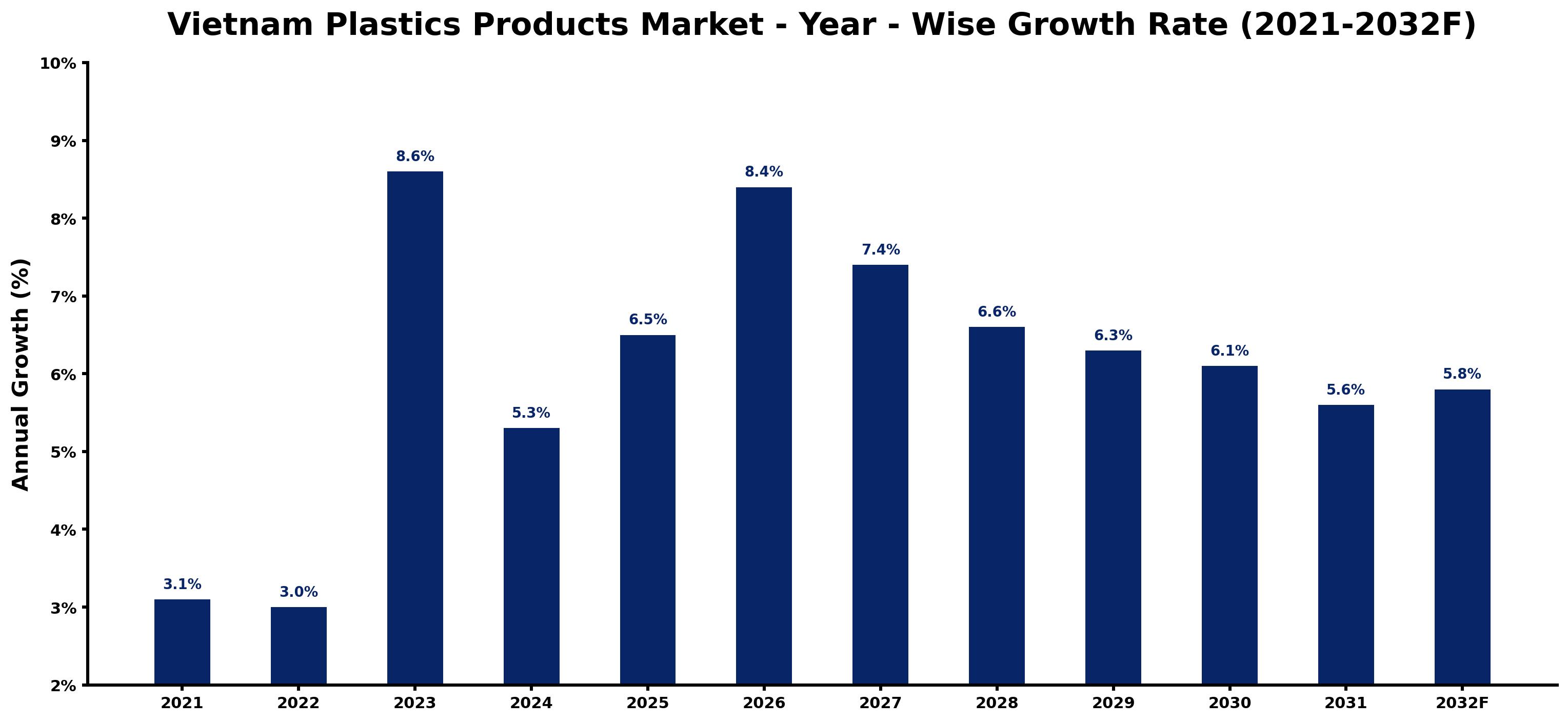
The table below presents the year wise growth rates along with the key drivers influencing the market
| Year | Growth Rate | Major Drivers |
| 2021 | 3.1% | Post-lockdown retail projects in Vietnam spurred demand for sustainable plastic alternatives. |
| 2022 | 3.0% | Major manufacturers began relocating operations to Vietnam, enhancing local production capabilities. |
| 2023 | 8.6% | Investments in eco-friendly packaging technologies transformed the competitive landscape significantly. |
| 2024 | 5.3% | Urbanization trends intensified, increasing the need for durable plastic products in construction. |
| 2025 | 6.5% | Rising consumer awareness about recycling boosted the demand for biodegradable plastics. |
| 2026 | 8.4% | Local firms prioritized innovation, launching new products tailored to diverse market needs. |
| 2027 | 7.4% | Supply chain efficiencies improved as Vietnam became a manufacturing hub for Asia. |
| 2028 | 6.6% | Export opportunities expanded, with demand for Vietnamese plastic products growing in global markets. |
| 2029 | 6.3% | Technological integration in production processes enhanced quality and reduced waste significantly. |
| 2030 | 6.1% | Collaboration with international brands increased, promoting best practices in sustainability efforts. |
| 2031 | 5.6% | Emerging startups specialized in circular economy models, reshaping the industry's approach to waste. |
| 2032 | 5.8% | Consumer preferences shifted towards novel plastic applications, further stimulating market growth. |
Note - Market size estimations and growth projections presented in this report are based on 6Wresearch's advanced forecasting approach, validated with industry datasets as of June 2026.
Vietnam Plastics Products Market Synopsis
The Vietnam Plastics Products Market is projected to reach 8.4% and witness significant growth during the forecast period (2026-2032). The robust expansion of this market is primarily attributed to the country's dynamic manufacturing sector and the increasing demand for plastic products across various industries. The versatility of plastics makes them indispensable in sectors such as packaging, automotive, electronics, construction, and consumer goods, thereby solidifying their status as essential components of contemporary life. Vietnam's accelerating economic growth and industrial advancement have spurred a notable rise in the consumption of plastic products, further bolstering market expansion.
Vietnam Plastics Products Market Growth Drivers
Several key drivers are propelling the growth of the Vietnam plastics products market. Firstly, the rapid urbanization occurring in Vietnam is transforming consumer lifestyles, leading to an escalating demand for lightweight and convenient plastic packaging solutions suitable for food, beverages, and various consumer goods. Secondly, the remarkable growth within the automotive and electronics industries has created a significant requirement for plastic components, essential for enhancing performance and reducing weight. Additionally, government initiatives aimed at promoting manufacturing and infrastructure investments are facilitating increased plastic usage in construction and various industrial applications. Other notable drivers include:
- Rising disposable incomes among consumers, prompting higher spending on packaged goods and electronics.
- Growing concerns around product safety, driving demand for hygienic plastic packaging.
- Widespread adoption of plastics in agriculture, particularly in irrigation systems and greenhouse covers.
- Innovations in plastic manufacturing processes that are enhancing efficiency and reducing costs.
- Increased availability of recycled plastics, bolstering sustainability efforts across industries.
Vietnam Plastics Products Market Challenges and Restraints
Despite the flourishing trajectory of the Vietnam plastics products market, several challenges persist that could hinder growth. Environmental concerns surrounding plastic waste and pollution are becoming increasingly pressing, necessitating a pivot towards sustainable and eco-friendly plastic alternatives. The market must tackle these challenges by exploring biodegradable and recyclable options to mitigate the ecological impact of plastic products. Furthermore, the volatility of raw material prices, particularly crude oil and natural gas, has a direct bearing on production costs, consequently affecting the profitability of manufacturers. Other challenges include:
- The need for investment in technology and processes to improve recycling rates and reduce waste.
- Regulatory pressures necessitating compliance with environmental standards and practices.
- Shifting consumer preferences towards more sustainable packaging solutions.
- Intense competition from alternative materials, such as glass and metal, which are perceived as more environmentally friendly.
- Economic fluctuations that can impact manufacturing operations and consumer demand.
Vietnam Plastics Products Market Government Investment and Initiatives
The Vietnamese government has introduced numerous initiatives aimed at fostering growth within the plastics products sector. In recent years, policies have focused on attracting foreign investments into the manufacturing space while also promoting sustainable practices. Initiatives include tax incentives for companies investing in eco-friendly technologies and public spending directed towards enhancing environmental infrastructure. Additionally, the government is actively supporting research and development projects that focus on biodegradable plastics and recycling technologies, which are critical in addressing environmental concerns. Other notable initiatives comprise:
- Establishment of funding programs for startups focused on innovative plastics solutions.
- Collaboration with international organizations to implement best practices in waste management.
- Investment in training programs to upskill the workforce in sustainable manufacturing processes.
- Promotion of public awareness campaigns highlighting the importance of recycling and responsible plastic use.
- Development of a comprehensive regulatory framework to ensure compliance with environmental standards.
Vietnam Plastics Products Market Latest Developments (May 2025 - June 2026)
Recent developments in the Vietnam plastics products market from May 2025 to June 2026 indicate a shift towards sustainability and innovation. Companies within the sector are increasingly adopting advanced production technologies to enhance efficiency and reduce waste. Furthermore, there is a growing emphasis on the production of biodegradable plastics in response to rising environmental concerns. Various partnerships have emerged between public and private sectors to facilitate research and development efforts aimed at creating sustainable plastic alternatives. Additionally, the government has accelerated its efforts to promote the recycling of plastic waste, with several initiatives launched to improve collection and processing capabilities. Overall, the market is witnessing a positive trend towards integrating sustainability into its core practices.
Vietnam Plastics Products Market - Key Attractiveness of the Report
- 10 Years of Market Numbers
- Historical Data Starting from 2022 to 2025
- Base Year: 2025
- Forecast Data until 2032
- Key Performance Indicators Impacting the Market
- Major Upcoming Developments and Projects
Key Highlights of the Report:
- Vietnam Plastics Products Market Outlook
- Market Size of Vietnam Plastics Products Market, 2025
- Forecast of Vietnam Plastics Products Market, 2032
- Historical Data and Forecast of Vietnam Plastics Products Revenues & Volume for the Period 2022-2032F
- Vietnam Plastics Products Market Trend Evolution
- Vietnam Plastics Products Market Drivers and Challenges
- Vietnam Plastics Products Price Trends
- Vietnam Plastics Products Porter's Five Forces
- Vietnam Plastics Products Industry Life Cycle
- Historical Data and Forecast of Vietnam Plastics Products Market Revenues & Volume By Types for the Period 2022-2032F
- Historical Data and Forecast of Vietnam Plastics Products Market Revenues & Volume By Plastics Packaging Materials And Unlaminated Film And Sheet for the Period 2022-2032F
- Historical Data and Forecast of Vietnam Plastics Products Market Revenues & Volume By Plastic Pipes And Shapes for the Period 2022-2032F
- Historical Data and Forecast of Vietnam Plastics Products Market Revenues & Volume By Laminated Plastics Plate, Sheet, And Shape for the Period 2022-2032F
- Historical Data and Forecast of Vietnam Plastics Products Market Revenues & Volume By Plastics Bottle for the Period 2022-2032F
- Historical Data and Forecast of Vietnam Plastics Products Market Revenues & Volume By Urethane And Other Foam Product for the Period 2022-2032F
- Historical Data and Forecast of Vietnam Plastics Products Market Revenues & Volume By Polystyrene Foam Product for the Period 2022-2032F
- Historical Data and Forecast of Vietnam Plastics Products Market Revenues & Volume By Other Plastics Product ? ? for the Period 2022-2032F
- Historical Data and Forecast of Vietnam Plastics Products Market Revenues & Volume By End-users for the Period 2022-2032F
- Historical Data and Forecast of Vietnam Plastics Products Market Revenues & Volume By Automotive & Transportation for the Period 2022-2032F
- Historical Data and Forecast of Vietnam Plastics Products Market Revenues & Volume By Electrical & Electronics for the Period 2022-2032F
- Historical Data and Forecast of Vietnam Plastics Products Market Revenues & Volume By Medical for the Period 2022-2032F
- Historical Data and Forecast of Vietnam Plastics Products Market Revenues & Volume By Construction for the Period 2022-2032F
- Historical Data and Forecast of Vietnam Plastics Products Market Revenues & Volume By Others for the Period 2022-2032F
- Vietnam Plastics Products Import Export Trade Statistics
- Market Opportunity Assessment By Types
- Market Opportunity Assessment By End-users
- Vietnam Plastics Products Top Companies Market Share
- Vietnam Plastics Products Competitive Benchmarking By Technical and Operational Parameters
- Vietnam Plastics Products Company Profiles
- Vietnam Plastics Products Key Strategic Recommendations






































