Vietnam Platform as a Service (PaaS) Market Size & Growth Rate (2026-2032)
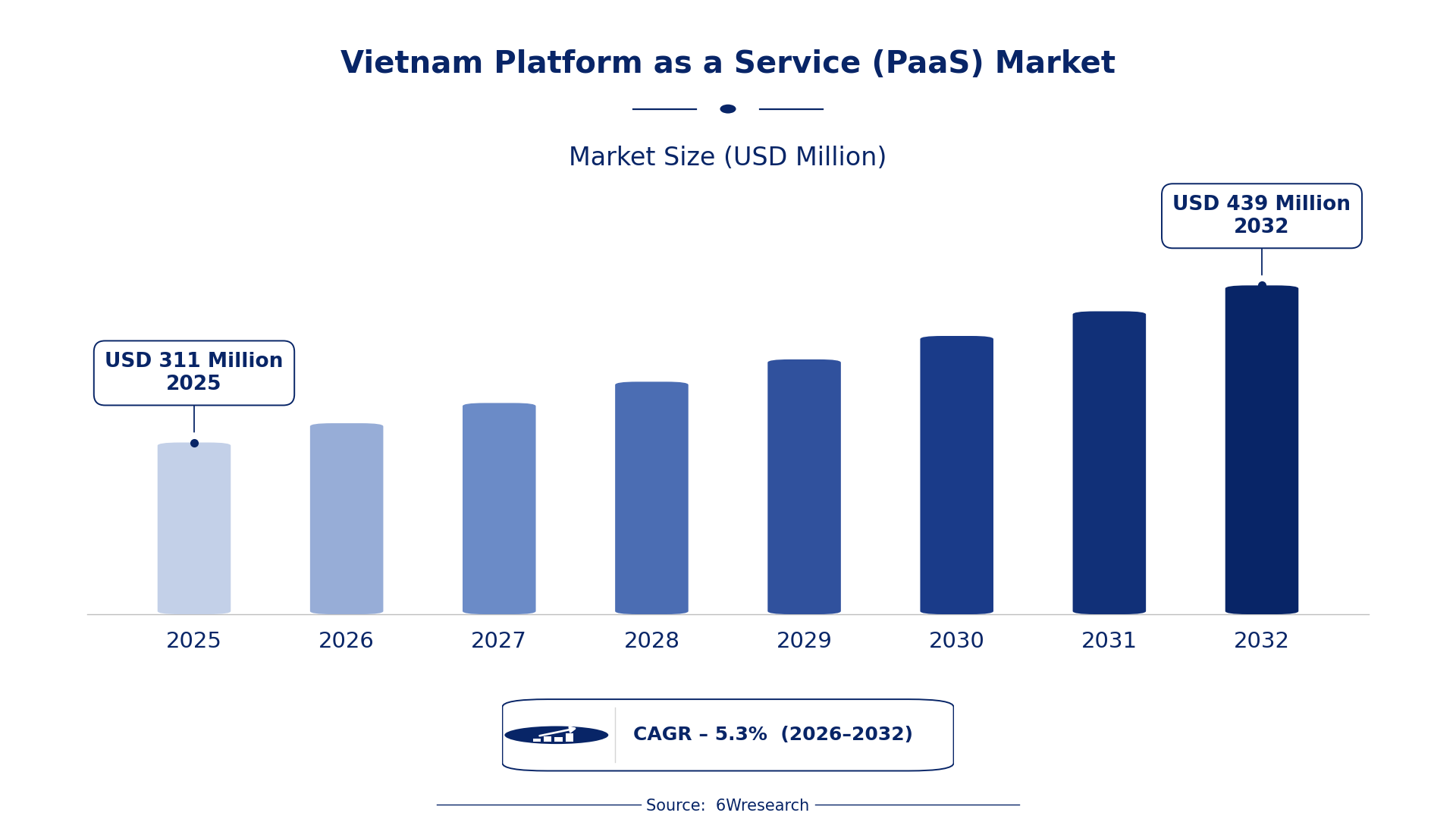
The Vietnam Platform as a Service (PaaS) Market was estimated at USD 311 Million in 2025 and is projected to reach USD 439 Million by 2032, growing at a CAGR of 5.3% from 2026 to 2032.
Vietnam Platform as a Service (PaaS) Market Synopsis
In Vietnam, the demand for agile application development is pushing businesses to adopt PaaS solutions. As organizations look to enhance their development capabilities, PaaS provides an essential framework for building, testing, and deploying applications efficiently, which is increasingly critical in the current digital-first environment.
The local developer community is growing rapidly, fostering an environment ripe for innovation. This trend underscores the potential of PaaS in Vietnam, where companies are striving to shorten time-to-market and improve collaboration among teams, leading to a more dynamic development ecosystem.
Vietnam Platform as a Service (PaaS) Market Year-wise Growth Rate and Key Drivers
This graph illustrates the annual growth rates of the Vietnam Platform as a Service (PaaS) Market from 2021 to 2032, highlighting a steady upward trajectory and projected expansion over the forecast period.
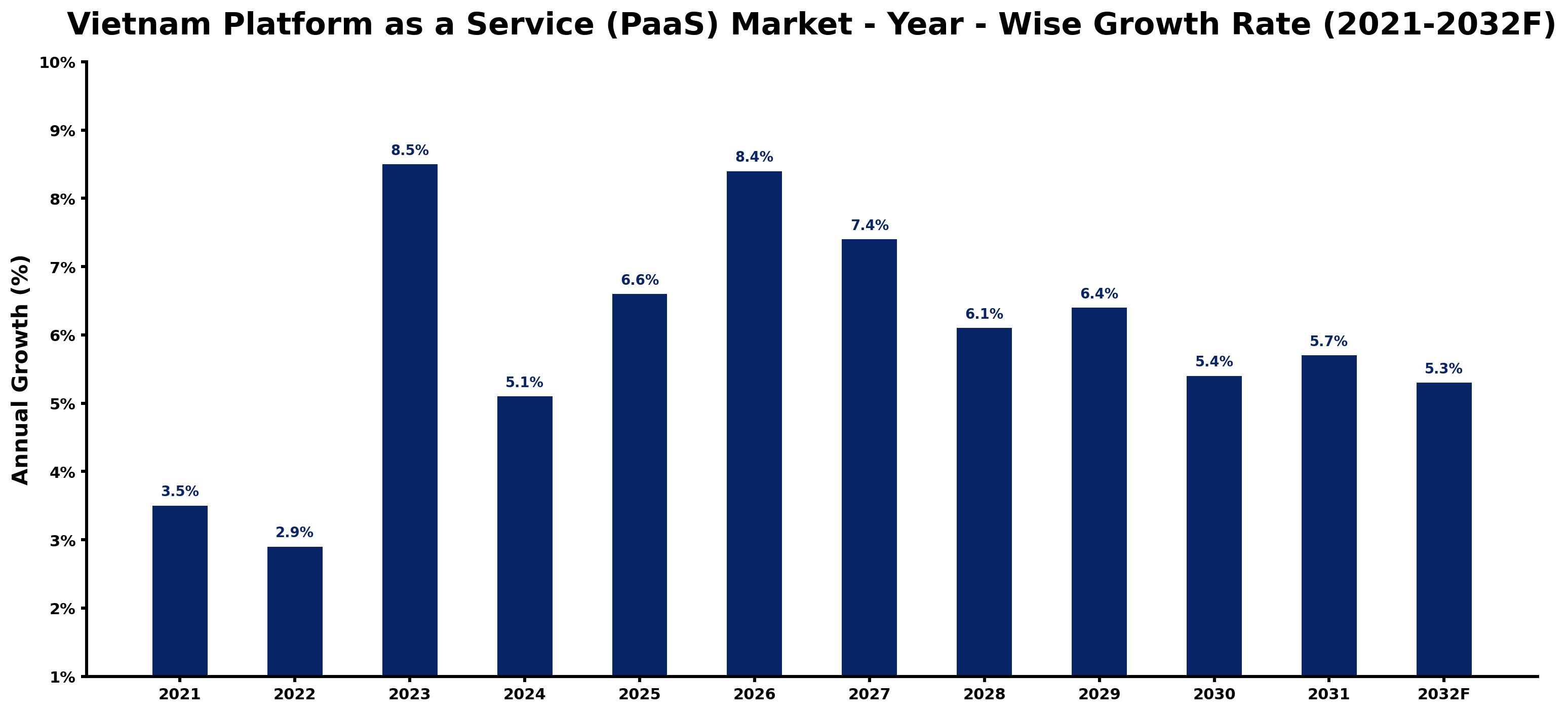
The table below presents the year‑wise growth rates along with the key drivers influencing the market
| Year | Growth Rate | Major Drivers |
| 2021 | 3.5% | Vietnam's digital economy growth plan boosting cloud adoption. |
| 2022 | 2.9% | Government support for startups leveraging PaaS platforms. |
| 2023 | 8.5% | Increased demand for remote work solutions in Vietnam. |
| 2024 | 5.1% | Local tech innovation centers enhancing PaaS ecosystem. |
| 2025 | 6.6% | Rising local enterprises migrating to cloud services. |
| 2026 | 8.4% | Adoption of Industry 4.0 accelerating PaaS market growth. |
| 2027 | 7.4% | Growing e-commerce driving demand for scalable platforms. |
| 2028 | 6.1% | Educational institutions embracing cloud-based learning solutions. |
| 2029 | 6.4% | Vietnamese SMEs increasingly utilizing PaaS for digital transformation. |
| 2030 | 5.4% | Cybersecurity regulations enhancing trust in cloud platforms. |
| 2031 | 5.7% | Increased foreign investment in Vietnam’s tech sector. |
| 2032 | 5.3% | Rising mobile application development accelerating PaaS utilization. |
Note: Market size estimations and growth projections presented in this report are based on 6Wresearch's proprietary forecasting methodology, utilizing the latest available industry data, government publications, and primary research inputs.
Vietnam Platform as a Service (PaaS) Market Key Takeaways
Below are some of the specific key takeaways from the market, including:
- The market is witnessing a surge in demand for cloud-based applications, enhancing the appeal of PaaS solutions.
- Scalability is a major draw for businesses, enabling them to efficiently manage resources based on project requirements.
- Continuous integration and deployment capabilities are key features that help organizations reduce time-to-market.
- The need for agility and innovation continues to drive adoption rates among Vietnamese businesses.
- Challenges in developer adoption are being addressed as the ecosystem matures and options expand.
Evaluation of Restraints in Vietnam Platform as a Service (PaaS) Market
Despite the promising growth trajectory, the Vietnam PaaS market faces notable challenges. A major hurdle is the resistance from developers who are comfortable with existing tools and frameworks. This hesitation can slow down the transition to PaaS solutions, stifling potential growth. on top of that, the current ecosystem's limited options and support for niche technologies make it hard for organizations to fully embrace PaaS. Addressing these concerns will be vital for market expansion.
Vietnam Platform as a Service (PaaS) Market Trends
Several trends are emerging in the Vietnam PaaS market that are reshaping its future. One such trend is the increasing integration of artificial intelligence and machine learning capabilities into PaaS offerings, enabling developers to build smarter applications. Additionally, there is a growing emphasis on collaboration tools within PaaS environments, which facilitates teamwork among distributed teams. This shift is critical as more organizations adopt hybrid work models.
Vietnam Platform as a Service (PaaS) Market Opportunities
The Vietnam PaaS market presents ample opportunities for growth, particularly in sectors such as fintech and e-commerce. As these industries strive for digital transformation, they require scalable and efficient development platforms. Companies that offer specialized PaaS solutions tailored to these sectors can capture significant market share. on top of that, partnerships with local educational institutions can foster talent development, ensuring a steady pipeline of skilled developers for future projects.
Government Initiatives in the Vietnam Platform as a Service (PaaS) Market
The Vietnamese government is actively promoting digital transformation initiatives that directly impact the PaaS market. With a focus on enhancing the country's technological infrastructure, public policy is increasingly supportive of cloud adoption and PaaS solutions. As Vietnam positions itself as a regional tech hub, these initiatives are critical for fostering innovation and attracting investment in the PaaS sector.
- A national digital infrastructure upgrade programme is currently underway, aimed at enhancing cloud service capabilities across the country.
- The Ministry of Information and Communications launched a policy in late 2025 to encourage cloud adoption among small and medium-sized enterprises.
- Planned public-private partnerships expected to roll out by 2028 will focus on expanding access to PaaS solutions in underserved areas.
- A recent initiative introduced in 2024 mandates educational institutions to integrate cloud computing into their curricula.
- Ongoing workshops and training sessions are being conducted to educate developers about the benefits of PaaS solutions.
Future Insights of the Vietnam Platform as a Service (PaaS) Market
Looking ahead to 2026-2032, the Vietnam PaaS market is set to expand significantly. With businesses increasingly recognizing the value of agile development processes, the demand for PaaS solutions will likely grow. As the ecosystem matures, enhanced service offerings and specialized platforms will emerge, catering to diverse industries. on top of that, government backing and a burgeoning developer community will create a favorable environment for sustained growth in the years to come.
Vietnam Platform as a Service (PaaS) Market Latest Developments
In recent months, the Vietnam PaaS market has experienced a flurry of activity, reflecting a strong commitment to digital innovation. Companies are ramping up their efforts to enhance their PaaS offerings, catering to the evolving needs of developers and businesses alike. This momentum suggests that the market is not only growing but also becoming increasingly competitive.
- A major technology vendor launched a new PaaS solution in early 2025, focusing on providing advanced analytics tools for developers.
- A partnership between leading cloud providers was formed in mid-2025 to enhance interoperability among various PaaS platforms.
- Ongoing development of a regional PaaS hub aims to facilitate knowledge sharing and collaboration among local startups.
- A planned upgrade to existing PaaS offerings is expected to introduce additional features by late 2026, improving user experience.
- Several companies are currently piloting AI-enhanced development tools within their PaaS environments, with results expected by early 2026.
Vietnam Platform as a Service (PaaS) Market - Key Attractiveness of the Report
- 10 Years of Market Numbers
- Historical Data Starting from 2022 to 2025
- Base Year: 2025
- Forecast Data until 2032
- Key Performance Indicators Impacting the Market
- Major Upcoming Developments and Projects
Key Highlights of the Report:
- Vietnam Platform as a Service (PaaS) Market Outlook
- Market Size of Vietnam Platform as a Service (PaaS) Market, 2025
- Forecast of Vietnam Platform as a Service (PaaS) Market, 2032
- Historical Data and Forecast of Vietnam Platform as a Service (PaaS) Revenues & Volume for the Period 2022-2032F
- Vietnam Platform as a Service (PaaS) Market Trend Evolution
- Vietnam Platform as a Service (PaaS) Market Drivers and Challenges
- Vietnam Platform as a Service (PaaS) Price Trends
- Vietnam Platform as a Service (PaaS) Porter's Five Forces
- Vietnam Platform as a Service (PaaS) Industry Life Cycle
- Historical Data and Forecast of Vietnam Platform as a Service (PaaS) Market Revenues & Volume By Type for the Period 2022-2032F
- Historical Data and Forecast of Vietnam Platform as a Service (PaaS) Market Revenues & Volume By Application PaaS (aPaaS) for the Period 2022-2032F
- Historical Data and Forecast of Vietnam Platform as a Service (PaaS) Market Revenues & Volume By Integration PaaS (iPaaS) for the Period 2022-2032F
- Historical Data and Forecast of Vietnam Platform as a Service (PaaS) Market Revenues & Volume By Database PaaS (dbPaaS) for the Period 2022-2032F
- Historical Data and Forecast of Vietnam Platform as a Service (PaaS) Market Revenues & Volume By Others for the Period 2022-2032F
- Historical Data and Forecast of Vietnam Platform as a Service (PaaS) Market Revenues & Volume By Deployment for the Period 2022-2032F
- Historical Data and Forecast of Vietnam Platform as a Service (PaaS) Market Revenues & Volume By Public for the Period 2022-2032F
- Historical Data and Forecast of Vietnam Platform as a Service (PaaS) Market Revenues & Volume By Private for the Period 2022-2032F
- Historical Data and Forecast of Vietnam Platform as a Service (PaaS) Market Revenues & Volume By Market Type for the Period 2022-2032F
- Historical Data and Forecast of Vietnam Platform as a Service (PaaS) Market Revenues & Volume By APaaS for the Period 2022-2032F
- Historical Data and Forecast of Vietnam Platform as a Service (PaaS) Market Revenues & Volume By IPaaS for the Period 2022-2032F
- Historical Data and Forecast of Vietnam Platform as a Service (PaaS) Market Revenues & Volume By DBPaaS for the Period 2022-2032F
- Historical Data and Forecast of Vietnam Platform as a Service (PaaS) Market Revenues & Volume By Organization Size for the Period 2022-2032F
- Historical Data and Forecast of Vietnam Platform as a Service (PaaS) Market Revenues & Volume By Large Enterprises for the Period 2022-2032F
- Historical Data and Forecast of Vietnam Platform as a Service (PaaS) Market Revenues & Volume By SMEs for the Period 2022-2032F
- Historical Data and Forecast of Vietnam Platform as a Service (PaaS) Market Revenues & Volume By Vertical for the Period 2022-2032F
- Historical Data and Forecast of Vietnam Platform as a Service (PaaS) Market Revenues & Volume By BFSI for the Period 2022-2032F
- Historical Data and Forecast of Vietnam Platform as a Service (PaaS) Market Revenues & Volume By Consumer goods and retail for the Period 2022-2032F
- Historical Data and Forecast of Vietnam Platform as a Service (PaaS) Market Revenues & Volume By Telecommunication for the Period 2022-2032F
- Historical Data and Forecast of Vietnam Platform as a Service (PaaS) Market Revenues & Volume By IT and ITeS for the Period 2022-2032F
- Historical Data and Forecast of Vietnam Platform as a Service (PaaS) Market Revenues & Volume By Manufacturing for the Period 2022-2032F
- Historical Data and Forecast of Vietnam Platform as a Service (PaaS) Market Revenues & Volume By Healthcare and life sciences for the Period 2022-2032F
- Historical Data and Forecast of Vietnam Platform as a Service (PaaS) Market Revenues & Volume By Energy and utility for the Period 2022-2032F
- Historical Data and Forecast of Vietnam Platform as a Service (PaaS) Market Revenues & Volume By Others for the Period 2022-2032F
- Vietnam Platform as a Service (PaaS) Import Export Trade Statistics
- Market Opportunity Assessment By Type
- Market Opportunity Assessment By Deployment
- Market Opportunity Assessment By Market Type
- Market Opportunity Assessment By Organization Size
- Market Opportunity Assessment By Vertical
- Vietnam Platform as a Service (PaaS) Top Companies Market Share
- Vietnam Platform as a Service (PaaS) Competitive Benchmarking By Technical and Operational Parameters
- Vietnam Platform as a Service (PaaS) Company Profiles
- Vietnam Platform as a Service (PaaS) Key Strategic Recommendations






































