Vietnam Playground Equipment Market Size, Share & Growth Rate
The Vietnam Playground Equipment Market was estimated at USD 762 Million in 2025 and is projected to reach USD 1081 Million by 2032, growing at a CAGR of 5.1% from 2026 to 2032. This upward trajectory is fueled by the increasing recognition among parents and policymakers of the critical role that play has in fostering children's development. Furthermore, urbanization trends and the expanding residential communities drive an escalating demand for safe and innovative playground installations.
Vietnam Playground Equipment Market Year-wise Growth Rate and Key Drivers
This graph highlights how the Vietnam Playground Equipment Market has steadily grown over the years, supported by major growth factors.
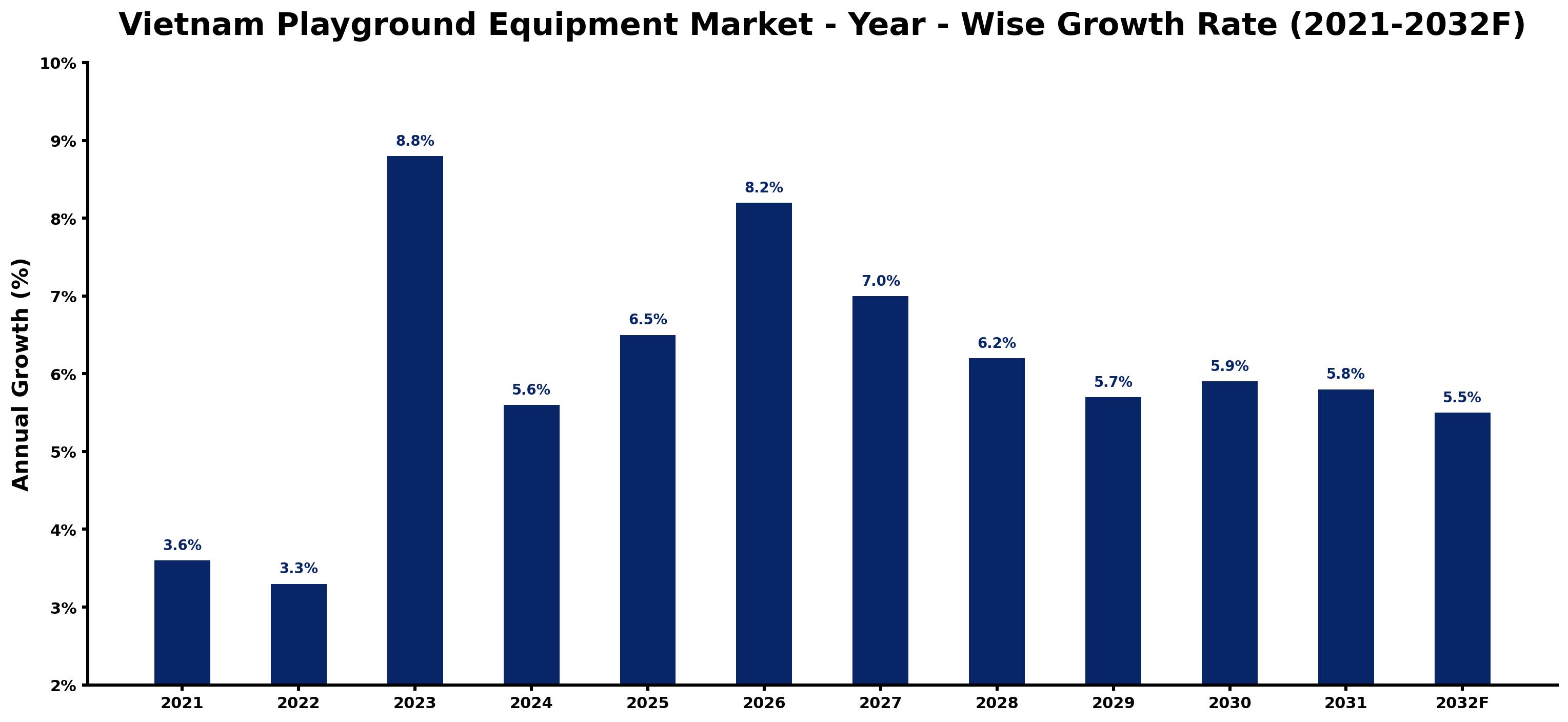
The table below presents the year‑wise growth rates along with the key drivers influencing the market
| Year | Growth Rate | Major Drivers |
| 2021 | 3.6% | Government infrastructure modernization initiatives |
| 2022 | 3.3% | Increasing industrial infrastructure investments |
| 2023 | 8.8% | Expansion of commercial construction activities |
| 2024 | 5.6% | Increasing industrial automation investments |
| 2025 | 6.5% | Growing urbanization and commercial development |
| 2026 | 8.2% | Expansion of transportation and logistics networks |
| 2027 | 7.0% | Increasing industrial automation investments |
| 2028 | 6.2% | Increasing adoption of advanced technologies |
| 2029 | 5.7% | Increasing industrial automation investments |
| 2030 | 5.9% | Growing renewable energy integration projects |
| 2031 | 5.8% | Rising electricity demand across industries |
| 2032 | 5.5% | Expansion of manufacturing activities |
Note - Market size estimations and growth projections presented in this report are based on 6Wresearch's advanced forecasting approach, validated with industry datasets as of June 2026.
Vietnam Playground Equipment Market Synopsis
The landscape of the Vietnam Playground Equipment market is shaped by a diverse array of offerings ranging from traditional swings to state-of-the-art interactive playsets. The increasing focus on developing child-friendly urban spaces reflects a growing societal commitment to enhancing children's recreational opportunities.
With an influx of both domestic and international manufacturers, the market is seeing a surge in competition that prioritizes safety and compliance with international standards. This emphasis is particularly relevant as parents seek assurance that their children are engaging in play environments that prioritize safety, thus stimulating further investment in quality playground equipment.
Vietnam Playground Equipment Market Key Takeaways
- The market is projected to grow significantly, driven by urbanization and rising residential developments.
- Innovative designs and safety features are increasingly prioritized by manufacturers to attract customers.
- Government initiatives aimed at creating child-friendly environments are crucial to market expansion.
- Eco-friendly materials are becoming more prevalent in playground equipment manufacturing, aligning with global sustainability trends.
- Safety and compliance with international standards are fundamental to maintaining market integrity and consumer trust.
Evaluation of Restraints in Vietnam Playground Equipment Market
Despite the positive growth outlook, the Vietnam Playground Equipment market faces significant challenges. The limited availability of open spaces, particularly in urban centers, restricts the establishment of new playgrounds and can hinder outdoor activity options for children. Additionally, manufacturers grapple with safety compliance requirements, which can lead to increased operational costs. Budget constraints in public funding for recreational spaces also pose a hurdle, often delaying necessary projects and limiting overall market growth.
Vietnam Playground Equipment Market Trends
Several key trends are emerging within the Vietnam Playground Equipment market. A notable shift towards eco-friendly materials not only enhances product appeal but also aligns with the growing environmental consciousness among consumers. Additionally, manufacturers are increasingly incorporating innovative technology in playground equipment, such as interactive play features that engage children in new ways. Furthermore, customization is becoming a significant trend, with modular playground designs allowing for flexibility in space utilization and adherence to safety guidelines.
Vietnam Playground Equipment Market Opportunities
The market presents substantial opportunities for growth and investment, particularly in urban development projects. As Vietnam continues to urbanize, the demand for public parks and recreational spaces is set to rise, creating openings for new playground installations. Moreover, as educational institutions increasingly recognize the importance of outdoor play, opportunities for collaboration in designing and implementing school playgrounds are expanding. The push for innovative and safe solutions creates a fertile ground for manufacturers to introduce new products that cater to evolving consumer needs.
Government Initiatives in the Vietnam Playground Equipment Market
Government initiatives play a crucial role in shaping the Vietnam Playground Equipment market. Policies aimed at creating child-friendly urban environments include the establishment of guidelines for safe playground construction and public investment in recreational areas. Programs designed to enhance community play spaces are increasingly being prioritized, reflecting the government's commitment to improving child welfare and development through active outdoor engagement.
Future Insights of the Vietnam Playground Equipment Market
Looking ahead to 2026-2032, the Vietnam Playground Equipment market is expected to experience robust growth. Urbanization will continue to drive demand, with increasing investments in residential and commercial developments emphasizing the importance of outdoor play. As the market matures, innovations in design and safety will likely become even more integral to manufacturers' strategies, ensuring that playgrounds remain attractive and safe for children. The growing importance of sustainable practices will also shape future product offerings, aligning with broader environmental goals.
Vietnam Playground Equipment Market Latest Developments (May 2025 - June 2026)
Recent developments in the Vietnam Playground Equipment market showcase a trend towards enhanced safety and sanitation in playground designs. Companies have begun incorporating more hygienic materials and customizable features to meet the evolving demands for safe play environments. There has been a noticeable increase in collaborative projects between manufacturers and local governments aimed at revitalizing public parks and recreational facilities, reflecting a shared commitment to promoting outdoor activities for children.
Vietnam Playground Equipment Market - Key Attractiveness of the Report
- 10 Years of Market Numbers
- Historical Data Starting from 2022 to 2025
- Base Year: 2025
- Forecast Data until 2032
- Key Performance Indicators Impacting the Market
- Major Upcoming Developments and Projects
Key Highlights of the Report:
- Vietnam Playground Equipment Market Outlook
- Market Size of Vietnam Playground Equipment Market, 2025
- Forecast of Vietnam Playground Equipment Market, 2032
- Historical Data and Forecast of Vietnam Playground Equipment Revenues & Volume for the Period 2022-2032F
- Vietnam Playground Equipment Market Trend Evolution
- Vietnam Playground Equipment Market Drivers and Challenges
- Vietnam Playground Equipment Price Trends
- Vietnam Playground Equipment Porter's Five Forces
- Vietnam Playground Equipment Industry Life Cycle
- Historical Data and Forecast of Vietnam Playground Equipment Market Revenues & Volume By Product for the Period 2022-2032F
- Historical Data and Forecast of Vietnam Playground Equipment Market Revenues & Volume By Monkey Bars for the Period 2022-2032F
- Historical Data and Forecast of Vietnam Playground Equipment Market Revenues & Volume By Sandbox for the Period 2022-2032F
- Historical Data and Forecast of Vietnam Playground Equipment Market Revenues & Volume By Climbing Equipment for the Period 2022-2032F
- Historical Data and Forecast of Vietnam Playground Equipment Market Revenues & Volume By Swings and Slides for the Period 2022-2032F
- Historical Data and Forecast of Vietnam Playground Equipment Market Revenues & Volume By Balance Equipment for the Period 2022-2032F
- Historical Data and Forecast of Vietnam Playground Equipment Market Revenues & Volume By Motion and Spinning for the Period 2022-2032F
- Historical Data and Forecast of Vietnam Playground Equipment Market Revenues & Volume By Others for the Period 2022-2032F
- Historical Data and Forecast of Vietnam Playground Equipment Market Revenues & Volume By Application for the Period 2022-2032F
- Historical Data and Forecast of Vietnam Playground Equipment Market Revenues & Volume By Commercial Playgrounds for the Period 2022-2032F
- Historical Data and Forecast of Vietnam Playground Equipment Market Revenues & Volume By Adult Outdoor Fitness Equipment for the Period 2022-2032F
- Historical Data and Forecast of Vietnam Playground Equipment Market Revenues & Volume By Theme Play Systems for the Period 2022-2032F
- Historical Data and Forecast of Vietnam Playground Equipment Market Revenues & Volume By Others for the Period 2022-2032F
- Vietnam Playground Equipment Import Export Trade Statistics
- Market Opportunity Assessment By Product
- Market Opportunity Assessment By Application
- Vietnam Playground Equipment Top Companies Market Share
- Vietnam Playground Equipment Competitive Benchmarking By Technical and Operational Parameters
- Vietnam Playground Equipment Company Profiles
- Vietnam Playground Equipment Key Strategic Recommendations






































