Vietnam Ploughing and Cultivating Machinery Market Size, Share & Growth Rate
The Vietnam Ploughing and Cultivating Machinery Market was estimated at USD 306 Million in 2025 and is projected to reach USD 434 Million by 2032, growing at a CAGR of 5.1% from 2026 to 2032. This promising trajectory is fueled by the ongoing modernization efforts within Vietnam's agriculture sector, where an increasing number of farmers are embracing mechanization to boost productivity and efficiency. Government initiatives supporting agricultural innovation further enhance investment in advanced machinery, indicating a robust future for the market.
Vietnam Ploughing and Cultivating Machinery Market Year-wise Growth Rate and Key Drivers
This graph highlights how the Vietnam Ploughing and Cultivating Machinery Market has steadily grown over the years, supported by major growth factors.
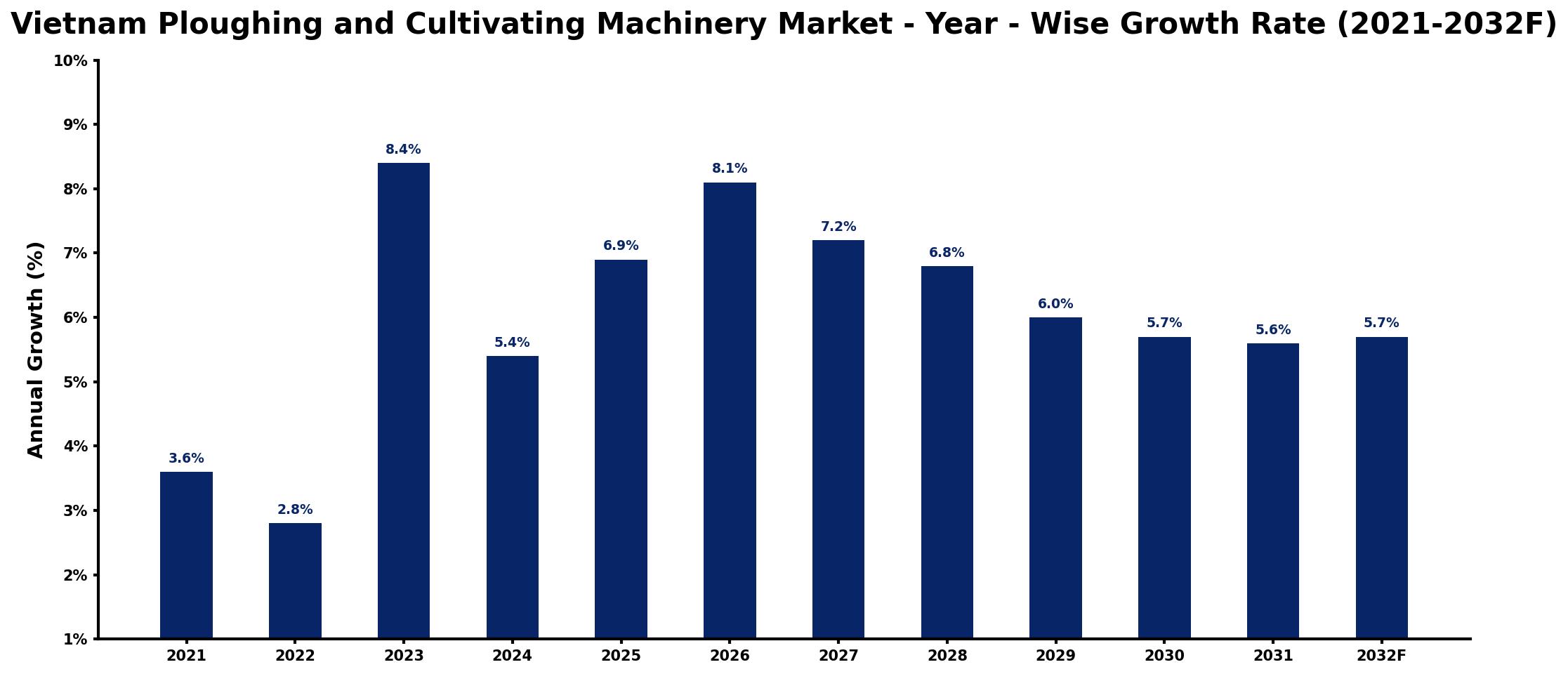
The table below presents the year‑wise growth rates along with the key drivers influencing the market
| Year | Growth Rate | Major Drivers |
| 2021 | 3.6% | Rising agricultural technology adoption |
| 2022 | 2.8% | Increase in mechanized farming practices |
| 2023 | 8.4% | Growing demand for efficient farming |
| 2024 | 5.4% | Expansion of rural infrastructure projects |
| 2025 | 6.9% | Boost in agricultural investment funding |
| 2026 | 8.1% | Surge in export-oriented agriculture |
| 2027 | 7.2% | Enhanced government support initiatives |
| 2028 | 6.8% | Rising global food demand pressures |
| 2029 | 6.0% | Development of smart farming solutions |
| 2030 | 5.7% | Increased focus on sustainability practices |
| 2031 | 5.6% | Growth in agro-tourism sectors |
| 2032 | 5.7% | Advancements in precision agriculture technologies |
Note: Market size estimations and growth projections presented in this report are based on 6Wresearch's proprietary forecasting methodology, utilizing the latest available industry data, government publications, and primary research inputs.
Vietnam Ploughing and Cultivating Machinery Market Synopsis
The strongest force shaping the Vietnam ploughing and cultivating machinery market is the government's unwavering commitment to modernizing agriculture. This focus is essential, given that agriculture remains a significant pillar of the Vietnamese economy, directly influencing food security and rural livelihoods.
As farmers increasingly turn to mechanized solutions to address labor shortages and enhance cultivation efficiency, demand for ploughing and cultivating machinery is on the rise. The integration of advanced technology not only promises improved yields but also plays a crucial role in establishing sustainable agricultural practices across the country.
Vietnam Ploughing and Cultivating Machinery Market Key Takeaways
- Government initiatives are pivotal in driving the modernization of agriculture in Vietnam.
- Mechanization is crucial for enhancing productivity and achieving food security goals.
- Investment in advanced machinery is expected to rise significantly in the coming years.
- Adoption of mechanized farming practices faces challenges, particularly among small-scale farmers.
- Domestic manufacturers are under pressure to innovate due to competition from imported machinery.
Evaluation of Restraints in Vietnam Ploughing and Cultivating Machinery Market
Despite the momentum in the market, several restraints impede progress. A considerable portion of the farming population still clings to traditional methods, which stifles the transition to advanced machinery. The high initial investment required for ploughing and cultivating equipment acts as a significant barrier, particularly for small-scale farmers with limited financial resources. Additionally, inadequate infrastructure can hinder the effective deployment of these machines. Ensuring that farmers receive proper training and ongoing technical support is another vital concern, as is the increasing competition from advanced imported machinery, which can create challenges for local manufacturers striving to maintain relevance.
Vietnam Ploughing and Cultivating Machinery Market Trends
In recent years, trends towards precision agriculture have emerged, driving demand for technologically advanced ploughing and cultivating solutions. These innovations include equipment that leverages data analytics to optimize field preparation and cultivation processes. Additionally, sustainable farming practices are becoming increasingly popular, prompting a rise in machinery designed for eco-friendly operations. As farmers seek to balance productivity with environmental impact, the market is likely to see further innovations tailored to these dual objectives.
Vietnam Ploughing and Cultivating Machinery Market Opportunities
There are significant opportunities for growth and investment within the Vietnam ploughing and cultivating machinery market. The government's commitment to agritech development presents avenues for partnerships between technology firms and traditional agricultural stakeholders. The rise in urbanization and population growth in Vietnam creates a compelling case for enhanced agricultural productivity, further encouraging investment in mechanization. Furthermore, as farmers increasingly adopt smart farming techniques, there is a considerable market for advanced machinery equipped with automation and data-driven capabilities.
Government Initiatives in the Vietnam Ploughing and Cultivating Machinery Market
The Vietnamese government has undertaken various initiatives aimed at enhancing agricultural productivity through mechanization. Supportive policies include financial assistance programs for farmers looking to acquire modern machinery. Additionally, the government emphasizes research and development in agricultural technology, encouraging innovation and competitiveness in the ploughing and cultivating machinery sector. Public spending aimed at improving infrastructure, such as rural road networks and storage facilities, further complements these efforts to modernize agriculture.
Future Insights of the Vietnam Ploughing and Cultivating Machinery Market
Looking ahead to 2026-2032, the Vietnam ploughing and cultivating machinery market is poised for significant transformation. Continued government support and investment in agricultural modernization are expected to propel growth. As Vietnam aims to strengthen its food security and adapt to climatic changes, the demand for sophisticated agricultural machinery will likely increase. Moreover, advancements in smart technology will shape new product offerings, enhancing efficiency and sustainability within the sector.
Vietnam Ploughing and Cultivating Machinery Market Latest Developments (2025 - 2026)
Recent developments in the Vietnam ploughing and cultivating machinery market include increased collaboration between local manufacturers and technology firms to integrate advanced features into existing machinery. Moreover, the sector has seen an uptick in training programs aimed at equipping farmers with the skills necessary to utilize modern equipment effectively. Ongoing government initiatives to improve rural infrastructure are also expected to facilitate smoother logistics and distribution for agricultural machinery.
Vietnam Ploughing and Cultivating Machinery Market - Key Attractiveness of the Report
- 10 Years of Market Numbers
- Historical Data Starting from 2022 to 2025
- Base Year: 2025
- Forecast Data until 2032
- Key Performance Indicators Impacting the Market
- Major Upcoming Developments and Projects
Key Highlights of the Report:
- Vietnam Ploughing and Cultivating Machinery Market Outlook
- Market Size of Vietnam Ploughing and Cultivating Machinery Market, 2025
- Forecast of Vietnam Ploughing and Cultivating Machinery Market, 2032
- Historical Data and Forecast of Vietnam Ploughing and Cultivating Machinery Revenues & Volume for the Period 2022-2032F
- Vietnam Ploughing and Cultivating Machinery Market Trend Evolution
- Vietnam Ploughing and Cultivating Machinery Market Drivers and Challenges
- Vietnam Ploughing and Cultivating Machinery Price Trends
- Vietnam Ploughing and Cultivating Machinery Porter's Five Forces
- Vietnam Ploughing and Cultivating Machinery Industry Life Cycle
- Historical Data and Forecast of Vietnam Ploughing and Cultivating Machinery Market Revenues & Volume By Type for the Period 2022-2032F
- Historical Data and Forecast of Vietnam Ploughing and Cultivating Machinery Market Revenues & Volume By Ploughs for the Period 2022-2032F
- Historical Data and Forecast of Vietnam Ploughing and Cultivating Machinery Market Revenues & Volume By Harrows for the Period 2022-2032F
- Historical Data and Forecast of Vietnam Ploughing and Cultivating Machinery Market Revenues & Volume By Others for the Period 2022-2032F
- Historical Data and Forecast of Vietnam Ploughing and Cultivating Machinery Market Revenues & Volume By Application for the Period 2022-2032F
- Historical Data and Forecast of Vietnam Ploughing and Cultivating Machinery Market Revenues & Volume By Soil Loosening for the Period 2022-2032F
- Historical Data and Forecast of Vietnam Ploughing and Cultivating Machinery Market Revenues & Volume By Clod Size Reduction for the Period 2022-2032F
- Historical Data and Forecast of Vietnam Ploughing and Cultivating Machinery Market Revenues & Volume By Clod Sorting for the Period 2022-2032F
- Historical Data and Forecast of Vietnam Ploughing and Cultivating Machinery Market Revenues & Volume By Others for the Period 2022-2032F
- Vietnam Ploughing and Cultivating Machinery Import Export Trade Statistics
- Market Opportunity Assessment By Type
- Market Opportunity Assessment By Application
- Vietnam Ploughing and Cultivating Machinery Top Companies Market Share
- Vietnam Ploughing and Cultivating Machinery Competitive Benchmarking By Technical and Operational Parameters
- Vietnam Ploughing and Cultivating Machinery Company Profiles
- Vietnam Ploughing and Cultivating Machinery Key Strategic Recommendations






































