Vietnam Plumbing Components Market Size, Share & Growth Rate
The Vietnam Plumbing Components Market was estimated at USD 334 Million in 2025 and is projected to reach USD 469 Million by 2032, growing at a CAGR of 5.0% from 2026 to 2032. This growth trajectory is driven primarily by the robust expansion of the construction and infrastructure sectors, which demand high-quality plumbing materials and fixtures. Moreover, innovations in plumbing technology and a growing focus on water conservation are further propelling the need for reliable plumbing systems in both residential and commercial applications.
Vietnam Plumbing Components Market Year-wise Growth Rate and Key Drivers
This graph highlights how the Vietnam Plumbing Components Market has steadily grown over the years, supported by major growth factors.
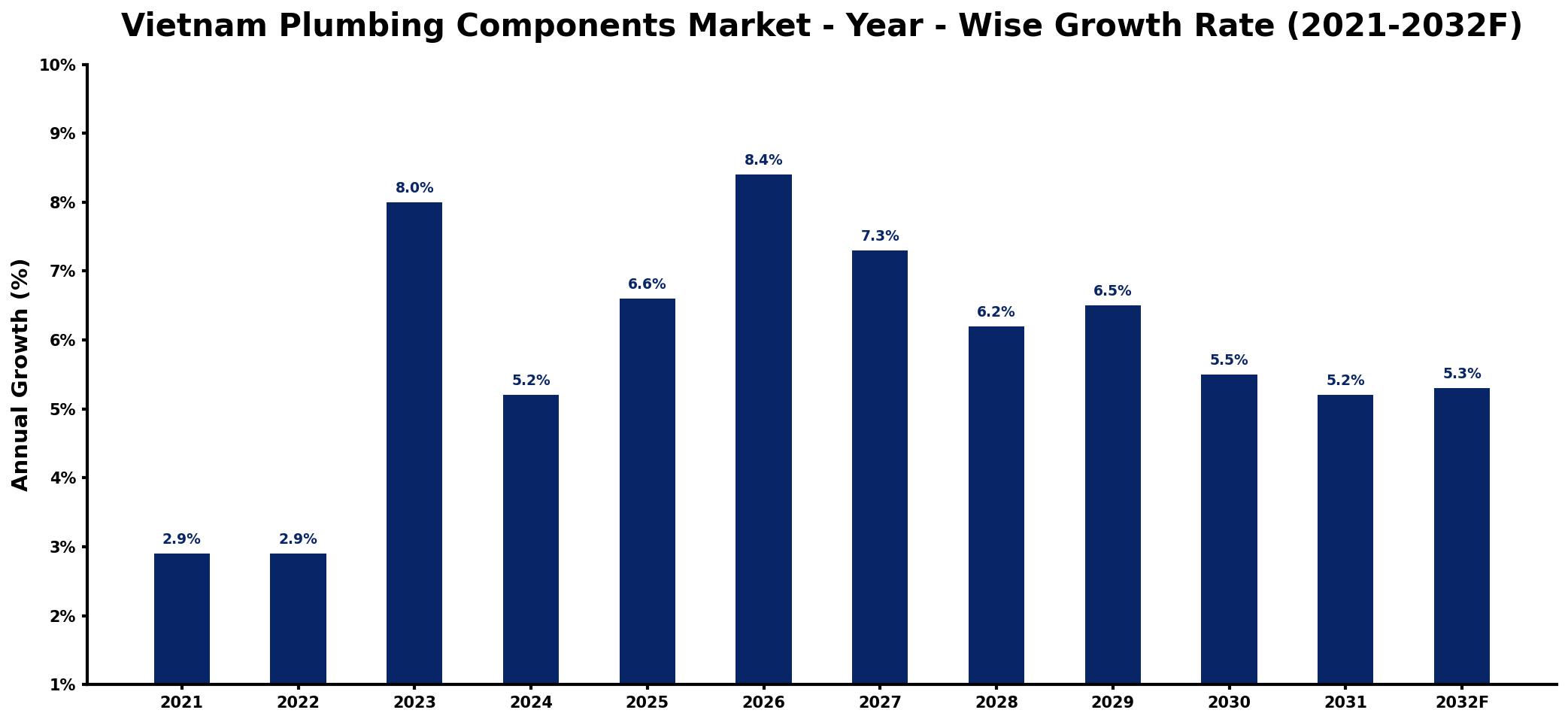
The table below presents the year‑wise growth rates along with the key drivers influencing the market
| Year | Growth Rate | Major Drivers |
| 2021 | 2.9% | Rising construction industry activities |
| 2022 | 2.9% | Increased infrastructure development projects |
| 2023 | 8.0% | Growing urban population demands |
| 2024 | 5.2% | Enhanced government spending initiatives |
| 2025 | 6.6% | Expansion of residential housing market |
| 2026 | 8.4% | Surge in industrial facility construction |
| 2027 | 7.3% | Increased foreign direct investments |
| 2028 | 6.2% | Technological advancements in construction |
| 2029 | 6.5% | Growing demand for sustainable solutions |
| 2030 | 5.5% | Rising renovation and remodeling activities |
| 2031 | 5.2% | Strengthened regulatory frameworks established |
| 2032 | 5.3% | Emergence of smart building technologies |
Note: Market size estimations and growth projections presented in this report are based on 6Wresearch's proprietary forecasting methodology, utilizing the latest available industry data, government publications, and primary research inputs.
Vietnam Plumbing Components Market Synopsis
The Vietnam plumbing components market has recently experienced notable momentum, largely fueled by increasing construction activities and an expanding urban population. However, as the market matures, ongoing innovation and adherence to water management practices will play pivotal roles in shaping its future trajectory.
Looking ahead, the market is poised for steady growth, driven by heightened consumer awareness regarding water efficiency and the integration of advanced plumbing technologies. The ongoing transition towards sustainable solutions presents an opportunity for market players to enhance their offerings and capture a larger share of this evolving market landscape.
Vietnam Plumbing Components Market Key Takeaways
- Steady growth forecasted at a CAGR of 5.0% from 2026 to 2032, driven by construction and infrastructure demands.
- Increased emphasis on water conservation technologies is reshaping product offerings.
- Urbanization and rising disposable incomes are enhancing demand for high-quality plumbing components.
- Innovations in plumbing technologies are pivotal in maintaining competitive advantages.
- COVID-19 has prompted shifts towards home improvement projects, boosting demand in the plumbing sector.
Evaluation of Restraints in Vietnam Plumbing Components Market
While the Vietnam plumbing components market is on a positive growth trajectory, it faces certain restraints that could limit its full potential. Competition from alternative piping materials poses a significant challenge, as more economical options become available. Additionally, the need for reliable, water-efficient plumbing solutions continues to grow, which necessitates ongoing innovation and adherence to stringent plumbing standards. Managing production costs while ensuring high quality remains a critical hurdle for many players in this market. Staying abreast of technological advancements and evolving consumer expectations is essential for sustained success.
Vietnam Plumbing Components Market Trends
Current trends indicate a strong inclination towards the adoption of smart plumbing technologies, including sensors and automation for leak detection and management. These advancements not only enhance efficiency but also support water conservation efforts. Furthermore, sustainability trends are leading to increased interest in eco-friendly materials and designs, which cater to a growing demographic of environmentally-conscious consumers. The focus on energy-efficient and durable plumbing solutions is expected to shape market offerings significantly.
Vietnam Plumbing Components Market Opportunities
The market is rich with growth and investment opportunities, particularly in the realm of sustainable plumbing solutions. Companies that invest in research and development can capitalize on the increasing consumer demand for innovative water-efficient technologies. Moreover, opportunities exist in expanding distribution networks and enhancing product accessibility in both urban and rural areas. The rise in infrastructure projects backed by government initiatives further represents a significant avenue for market players to explore.
Government Initiatives in the Vietnam Plumbing Components Market
The Vietnamese government has made substantial investments in infrastructure and housing projects aimed at improving the quality of life for its citizens. Public spending is increasingly directed towards modernizing water management systems and promoting sustainable practices within the plumbing sector. Various programs and incentives are being introduced to encourage the use of high-quality and water-efficient plumbing components, creating a conducive environment for market growth and innovation.
Future Insights of the Vietnam Plumbing Components Market
From 2026 to 2032, the Vietnam plumbing components market is expected to witness dynamic evolution. As urbanization continues to accelerate, there will be an increasing demand for advanced plumbing solutions that prioritize sustainability and efficiency. The integration of smart technologies will likely become a standard, pushing companies to innovate relentlessly. Furthermore, with government backing and a focus on infrastructure development, the plumbing sector is positioned for robust growth, ultimately enhancing the countrys plumbing infrastructure and contributing to improved public health and sanitation.
Vietnam Plumbing Components Market Latest Developments (2025 - 2026)
Recent developments indicate that manufacturers are increasingly adopting safety protocols and adopting advanced manufacturing techniques to meet rising demand. Additionally, emerging trends around sustainability are leading companies to explore innovative materials and technologies. The market landscape is becoming increasingly competitive, with businesses focusing on enhancing product efficiency while maintaining affordability, reflecting broader consumer preferences for value-driven purchases.
Vietnam Plumbing Components Market - Key Attractiveness of the Report
- 10 Years of Market Numbers
- Historical Data Starting from 2022 to 2025
- Base Year: 2025
- Forecast Data until 2032
- Key Performance Indicators Impacting the Market
- Major Upcoming Developments and Projects
Key Highlights of the Report:
- Vietnam Plumbing Components Market Outlook
- Market Size of Vietnam Plumbing Components Market, 2025
- Forecast of Vietnam Plumbing Components Market, 2032
- Historical Data and Forecast of Vietnam Plumbing Components Revenues & Volume for the Period 2022-2032F
- Vietnam Plumbing Components Market Trend Evolution
- Vietnam Plumbing Components Market Drivers and Challenges
- Vietnam Plumbing Components Price Trends
- Vietnam Plumbing Components Porter's Five Forces
- Vietnam Plumbing Components Industry Life Cycle
- Historical Data and Forecast of Vietnam Plumbing Components Market Revenues & Volume By Product for the Period 2022-2032F
- Historical Data and Forecast of Vietnam Plumbing Components Market Revenues & Volume By Fittings for the Period 2022-2032F
- Historical Data and Forecast of Vietnam Plumbing Components Market Revenues & Volume By Manifolds for the Period 2022-2032F
- Historical Data and Forecast of Vietnam Plumbing Components Market Revenues & Volume By Pipes for the Period 2022-2032F
- Historical Data and Forecast of Vietnam Plumbing Components Market Revenues & Volume By Valves for the Period 2022-2032F
- Historical Data and Forecast of Vietnam Plumbing Components Market Revenues & Volume By End User for the Period 2022-2032F
- Historical Data and Forecast of Vietnam Plumbing Components Market Revenues & Volume By Residential for the Period 2022-2032F
- Historical Data and Forecast of Vietnam Plumbing Components Market Revenues & Volume By Non-residential for the Period 2022-2032F
- Historical Data and Forecast of Vietnam Plumbing Components Market Revenues & Volume By Application for the Period 2022-2032F
- Historical Data and Forecast of Vietnam Plumbing Components Market Revenues & Volume By Bathtubs for the Period 2022-2032F
- Historical Data and Forecast of Vietnam Plumbing Components Market Revenues & Volume By Showerheads for the Period 2022-2032F
- Historical Data and Forecast of Vietnam Plumbing Components Market Revenues & Volume By Faucets for the Period 2022-2032F
- Historical Data and Forecast of Vietnam Plumbing Components Market Revenues & Volume By Others for the Period 2022-2032F
- Vietnam Plumbing Components Import Export Trade Statistics
- Market Opportunity Assessment By Product
- Market Opportunity Assessment By End User
- Market Opportunity Assessment By Application
- Vietnam Plumbing Components Top Companies Market Share
- Vietnam Plumbing Components Competitive Benchmarking By Technical and Operational Parameters
- Vietnam Plumbing Components Company Profiles
- Vietnam Plumbing Components Key Strategic Recommendations






































