Vietnam Pneumatic Equipment Market Size, Share & Growth Rate
The Vietnam Pneumatic Equipment Market was estimated at USD 313 Million in 2025 and is projected to reach USD 442 Million by 2032, growing at a CAGR of 5.1% from 2026 to 2032. This growth trajectory is underpinned by the rapid expansion of Vietnams manufacturing sector, bolstered by foreign investments and a burgeoning automotive industry. As companies increasingly prioritize automation for efficiency and cost-effectiveness, the demand for pneumatic solutions is set to rise significantly.
Vietnam Pneumatic Equipment Market Year-wise Growth Rate and Key Drivers
This graph highlights how the Vietnam Pneumatic Equipment Market has steadily grown over the years, supported by major growth factors.
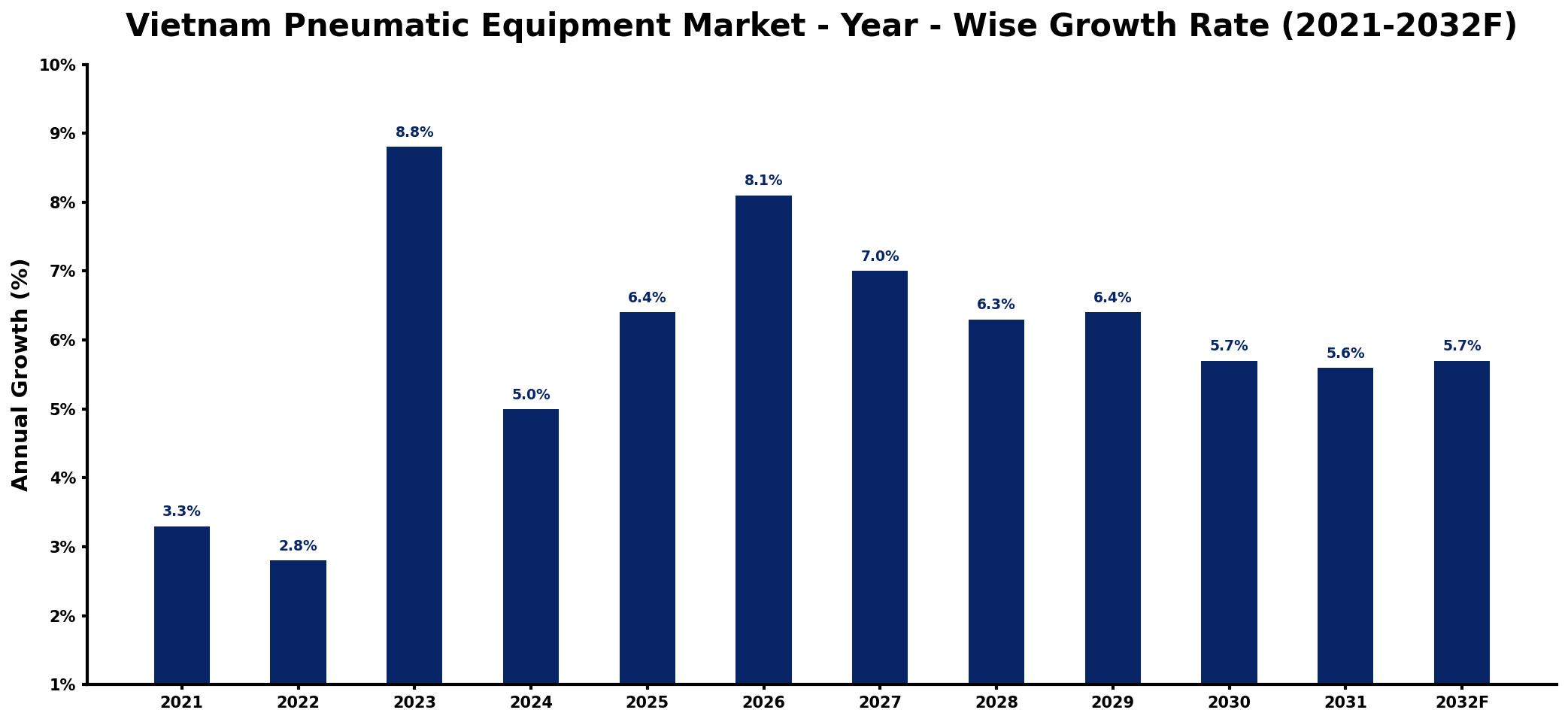
The table below presents the year‑wise growth rates along with the key drivers influencing the market
| Year | Growth Rate | Major Drivers |
| 2021 | 3.3% | Rising industrial automation demand |
| 2022 | 2.8% | Growing construction sector investments |
| 2023 | 8.8% | Increased manufacturing output growth |
| 2024 | 5.0% | Expansion of renewable energy projects |
| 2025 | 6.4% | Boost in logistics and transportation |
| 2026 | 8.1% | Surge in automotive production rates |
| 2027 | 7.0% | Enhanced agricultural mechanization trends |
| 2028 | 6.3% | Growth in smart factory initiatives |
| 2029 | 6.4% | Increased focus on energy efficiency |
| 2030 | 5.7% | Development of urban infrastructure projects |
| 2031 | 5.6% | Rising demand for process optimization |
| 2032 | 5.7% | increased domestic production output |
Note: Market size estimations and growth projections presented in this report are based on 6Wresearch's proprietary forecasting methodology, utilizing the latest available industry data, government publications, and primary research inputs.
Vietnam Pneumatic Equipment Market Synopsis
In recent years, the Vietnam pneumatic equipment market has gained momentum, driven primarily by an increasing focus on automation across various industries. Manufacturing, construction, and automotive sectors are among the key contributors to this growth. As the market evolves, the demand for sophisticated, efficient pneumatic solutions is expected to intensify, signaling a promising horizon.
The post-pandemic recovery has introduced new opportunities for growth, particularly in infrastructure projects and advancements in manufacturing technologies. With a robust framework for investment and a commitment to sustainability, the Vietnam pneumatic equipment market is poised for further advancements and expansion in the coming years.
Vietnam Pneumatic Equipment Market Key Takeaways
- The market is projected to grow at a CAGR of 5.1%, indicating a strong recovery post-pandemic.
- Expansion of the manufacturing sector, driven by foreign investments, is a major growth catalyst.
- Pneumatic equipments reliability and low maintenance requirements enhance its appeal across industries.
- Compliance with energy efficiency and sustainability regulations poses challenges that need addressing.
- The automotive sector is emerging as a significant user of pneumatic solutions in Vietnam.
Evaluation of Restraints in Vietnam Pneumatic Equipment Market
While the Vietnam pneumatic equipment market is on a growth trajectory, several restraints impact its full potential. Key among these is the urgent need for manufacturers and end-users to transition to energy-efficient and environmentally friendly solutions. The high energy consumption and emissions associated with traditional pneumatic systems pose operational and regulatory challenges. Additionally, ensuring access to quality components and reliable maintenance services remains critical for sustained market performance, as any disruption in supply chains or service availability can lead to inefficiencies across the industries dependent on these systems.
Vietnam Pneumatic Equipment Market Trends
Current trends highlight a shift towards smart pneumatic systems, integrating IoT technology for real-time monitoring and enhanced efficiency. These advancements facilitate predictive maintenance and optimize energy usage, addressing environmental concerns. Furthermore, an increase in automation across manufacturing processes is prompting greater adoption of advanced pneumatic solutions, which are seen as essential for enhancing productivity and competitiveness.
Vietnam Pneumatic Equipment Market Opportunities
The ongoing industrial transformation in Vietnam opens up substantial opportunities in the pneumatic equipment sector. As manufacturers pursue automation, investments in innovative pneumatic technologies are likely to surge. Additionally, the growing emphasis on sustainable practices presents a unique opportunity for companies to develop eco-friendly pneumatic solutions that comply with regulations and meet market demands. Infrastructure development projects funded by both public and private investments further promise to fuel growth in the market.
Government Initiatives in the Vietnam Pneumatic Equipment Market
The Vietnamese government is increasingly recognizing the importance of advanced manufacturing technologies, including pneumatic systems, in driving economic growth. Initiatives aimed at enhancing industrial capabilities and attracting foreign investment are being prioritized. Public spending in infrastructure and industrial upgrades, along with supportive policies for automation and technology adoption, are set to foster an environment conducive to growth within the pneumatic equipment market.
Future Insights of the Vietnam Pneumatic Equipment Market
Looking ahead to 2026-2032, the Vietnam pneumatic equipment market is expected to continue its upward trajectory, propelled by the ongoing development of the manufacturing and construction sectors. The focus on automation will likely deepen, prompting increased investment in pneumatic technologies. Furthermore, the push towards sustainability will shape product offerings and operational practices, making energy-efficient pneumatic solutions not only desirable but necessary. As such, the market will likely see heightened competition among providers, spurring innovation and efficiency gains across the board.
Vietnam Pneumatic Equipment Market Latest Developments (2025 - 2026)
Recent developments indicate a shift towards the adoption of smart and connected pneumatic systems, enhancing automation capabilities within the industry. Furthermore, collaborations among key players are emerging to develop innovative solutions that cater to the evolving needs of the manufacturing sector. Investment in training and maintenance services is also being prioritized to ensure the effective deployment of these advanced pneumatic technologies.
Vietnam Pneumatic Equipment Market - Key Attractiveness of the Report
- 10 Years of Market Numbers
- Historical Data Starting from 2022 to 2025
- Base Year: 2025
- Forecast Data until 2032
- Key Performance Indicators Impacting the Market
- Major Upcoming Developments and Projects
Key Highlights of the Report:
- Vietnam Pneumatic Equipment Market Outlook
- Market Size of Vietnam Pneumatic Equipment Market, 2025
- Forecast of Vietnam Pneumatic Equipment Market, 2032
- Historical Data and Forecast of Vietnam Pneumatic Equipment Revenues & Volume for the Period 2022-2032F
- Vietnam Pneumatic Equipment Market Trend Evolution
- Vietnam Pneumatic Equipment Market Drivers and Challenges
- Vietnam Pneumatic Equipment Price Trends
- Vietnam Pneumatic Equipment Porter's Five Forces
- Vietnam Pneumatic Equipment Industry Life Cycle
- Historical Data and Forecast of Vietnam Pneumatic Equipment Market Revenues & Volume By Product Type for the Period 2022-2032F
- Historical Data and Forecast of Vietnam Pneumatic Equipment Market Revenues & Volume By Camera for the Period 2022-2032F
- Historical Data and Forecast of Vietnam Pneumatic Equipment Market Revenues & Volume By Lens for the Period 2022-2032F
- Historical Data and Forecast of Vietnam Pneumatic Equipment Market Revenues & Volume By Others for the Period 2022-2032F
- Historical Data and Forecast of Vietnam Pneumatic Equipment Market Revenues & Volume By Distribution Channel for the Period 2022-2032F
- Historical Data and Forecast of Vietnam Pneumatic Equipment Market Revenues & Volume By Online Retail for the Period 2022-2032F
- Historical Data and Forecast of Vietnam Pneumatic Equipment Market Revenues & Volume By Offline Retail for the Period 2022-2032F
- Vietnam Pneumatic Equipment Import Export Trade Statistics
- Market Opportunity Assessment By Product Type
- Market Opportunity Assessment By Distribution Channel
- Vietnam Pneumatic Equipment Top Companies Market Share
- Vietnam Pneumatic Equipment Competitive Benchmarking By Technical and Operational Parameters
- Vietnam Pneumatic Equipment Company Profiles
- Vietnam Pneumatic Equipment Key Strategic Recommendations






































